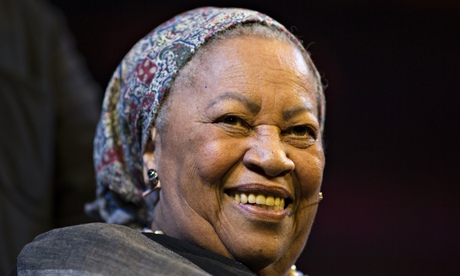
I did not encounter the work of Toni Morrison at school, which I count as lucky: she didn’t come to me with the label of “Nobel prize-winning novelist”. Instead, I read The Bluest Eye in my late teens: the story of Pecola Breedlove, a dark-skinned black girl who dreams of having blue eyes, the pinnacle of what is considered beautiful in the 1940s Midwest. “Here is the house. It is green and white” is the innocuous opening line: rarely has a book sucker-punched me so completely.
At 84, Morrison’s career has spanned decades. The Bluest Eye was published in 1970, when she was 39 and a publishing industry veteran (at Random House, where she edited the work of Angela Davis, among others). She has just published a slim novel, God Bless The Child, that tells the story of another black woman, and the terrible things humans do in the absence of love. And her work ethic remains strong: she’s at least 50 pages into her next book, set just after the second world war.
At the heart of each of her novels (Beloved, Jazz, Sula, and so on) is unapologetic blackness: the worlds, the characters, the situations. “What I’m interested in is writing… without the white gaze,” she said in a recent New York Times profile. To the Paris Review, she said: “It’s very important that my work be African American.” And it is thrilling to read: the lives of slaves, alcoholics, bad women and terrible men at different points in history, all black, all valid. You cannot read Toni Morrison and avoid the deliberateness of her work: we are human – our stories deserve to be told. It is, for me, permission to simply be.