- Jeremy Corbyn is widely expected to become Labour leader on Saturday after voting closed at noon in the most extraordinary party leadership election in modern times. The contest has seen three mainstream figures apparently swept aside by a self-effacing maverick from the party’s far left who’s has been catapulted into frontrunner status by an anti-Westminster insurgency convulsing Britain’s main opposition party.
- Corbyn has insisted that there will be a “coming together” of the party if he wins. Asked about the difficulties caused by the fact that most MPs did not support his leadership bid, he told ITV: “MPs are important but they are not the entirety of the Labour Party”.
- David Lammy, a Labour London mayoral candidate, has called for an inquiry into the party’s electoral system, claiming almost 20% of people in London did not get a ballot paper. But a party spokesman dismissed this. Everyone entitled to a ballot was sent one, he said. (See 1.57pm.)
- David Cameron has ordered three ministers to repay outstanding expenses debts after they were exposed a parliamentary watchdog. As Rajeev Syal reports, the Independent Parliamentary Standards Authoritynamed Tobias Ellwood, Edward Timpson and Caroline Dinenage among 26 current and former MPs who failed to settle sums of up to £500 last year, forcing them to be written off. Ipsa said it asked the individuals for the money several times, and warned them that their names would be published.
- Downing Street has said Cameron does not favour any move to legalise assisted dying. As Rowena Mason reports, MPs are due to debate the ethically fraught issue in the House of Commons for the first time in around 20 years on Friday, after Labour’s Rob Marris laid a private members bill that would give terminally ill patients the right to die. It is not clear whether Cameron will vote on the second reading of the bill but his official spokeswoman said: “The PM’s views are clear on this issue. He is not convinced further steps need to be taken and he is not in favour of an approach that would take us closer to euthanasia.”
That’s all from me for today.
Thanks for the comments.

Jeremy Corbyn has been tweeting.
Thank you to everyone who has supported our campaign. Regardless of result on Saturday it's been an inspiring summer https://t.co/Bvp1BLVAOJ
— Jeremy Corbyn MP (@jeremycorbyn) September 10, 2015
Here are two Labour leadership blogs worth reading.
Corbyn will run 'collegiate and collectivist leadership', says Burgon
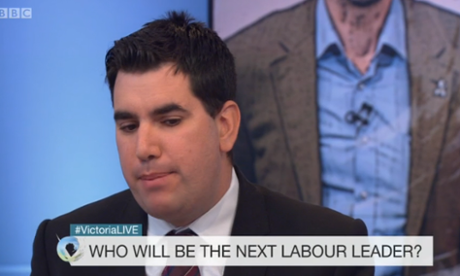
Richard Burgon, the Labour MP and Jeremy Corbyn supporter, was also on the World at One. Here are the main points from his interview.
-
Burgon said that Corbyn would run a “more collegiate and more collectivist leadership than Labour was used to. Opponents would have their views taken into account, he said.
I think if and when Jeremy Corbyn is elected some people will be pleasantly surprised at the new type of leadership Jeremy will offer. It will be a more collegiate and a more collectivist leadership which will include MPs who don’t agree with some of Jeremy’s politics ... I actually think there will be MPs who disagree with Jeremy on various things who find that they get heard more and get listened to more more than was the case under previous leaders that they did agree with.
- Burgon criticised MPs like Liz Kendall who have said they would not serve on the frontbench under Corbyn, accusing them of not “putting the party first”.
-
He downplayed the significance of the problems with people not receiving ballot papers.
I think that the party has done a good job under difficult circumstances dealing with 500,000 people, three different types of voter – the members, the registered supporters and the affiliated supporters – and I know that there was an appeal process and there will be some people who are unhappy but I don’t think it’s going to make a difference to the outcome of the election.
-
And he dismissed David Lammy’s call for an inquiry into the electoral system. (See 1.57pm.) Burgon said:
I’m not particularly interested in Labour party inquiries and constitutional navel-gazing. I think that turns people off. We need to be speaking to the country, not navel-gazing within the Labour party.
I’ve taken the quotes from PoliticsHome.
Here is Jeremy Corbyn talking about why his campaign has attracted so much support.
The voting is over, but the campaigning isn’t, Sky News’s Faisal Islam reports.
... Jeremy Corbyn will continue to hold rallies even after voting has closed, because he wants to hit 100 public meetings, I was told
— Faisal Islam (@faisalislam) September 10, 2015
Corbyn is holding a rally in Islington tonight.
Updated
Lammy calls for inquiry into electoral system amid concerns over missing ballot papers
David Lammy, a candidate in the London mayoral candidate election, told the World at One that the party needed to hold an inquiry into problems with the electoral system after the contest. He said that his team had been calling members and supporters in London, and that almost 20% of them had not had a ballot paper.
If you are ringing say 150, 200 people in the course of an evening, or attempting to do that, what they say to me is one in five people were saying in London – and this is obviously London that I am focussed on - that they have not received a ballot. And that was up to last night.
So I suspect now that this is closed there will be a clamour of people very, very upset that, despite being a member - or indeed someone who has signed up and paid their £3 and haven’t been excluded because they do not share the values of the Labour party - for a few of those people they have not been able to vote.
Now the extent of this across the country needs proper inquiry and proper understanding. Whether it has affected the ultimate vote I do not know.

Corbyn says he remains 'unclear' as to why Cameron ordered RAF drone attack on British jihadi
Jeremy Corbyn has said he is “unclear” as to why David Cameron felt it necessary to order the RAF drone attack that killed two British Islamic State (Isis) jihadis in Syria. This is what he told ITV News.
I’m unclear as to the point of killing the individual by this drone attack.
He also questioned the legality of Cameron’s decision, saying “the [prime minister] has some very difficult questions to answer about the legality of what he did.”
In the Commons on Monday Cameron said he order the attack because the main target, Reyaad Khan, was involved in planning and directing attacks against the UK, and that this meant was justified on the grounds of self-defence. But Cameron refused to give further details of what attacks were being planned, or what Khan’s exact involvement was.
The Lord Ashcroft polling report looking at the views of Labour supporters, Project Red Dawn (pdf), broadly supports the analysis Liz Kendall made in her speech.
Ashcroft’s findings are based on polls and focus groups involving Labour loyalists (defined as those who voted for the party in 2010 and 2015) and Labour defectors (defined as those who voted for Labour in 2010, but another party in 2015). According to his findings, concern about Labour spending and borrowing too much (a point highlighted by Kendall) was a big factor in explaining why people defected. But Ed Miliband was an even more important factor, the report says. Here’s an excerpt.
Defectors, not surprisingly, were less likely than Loyalists to have been lifelong Labour voters before 2015. However, their reasons for switching varied depending on where they ended up. While a majority of all Defectors said Ed Miliband had helped push them to another party, the second biggest factor for those who had switched to the Conservatives was the fear that a Labour government would spend and borrow too much. Next was the belief that the country was going in the right direction, so it was not a good time to change the government: they did not want to “rock the boat”.
Switchers to the Tories were more likely than Defectors as a whole to say they had been put off by the impression that Labour were not ready to form a competent government. They were also more likely to say they had been attracted by the Conservatives’ record in office, especially on the economy, than by any shift in Tory Party values (though some did detect a welcome change) ...
Predictably, switchers to Ukip very often mentioned immigration as one of the reasons they no longer felt Labour stood up for their views. Notably, however, we found in the groups that this included a number of public sector workers whose worries about the effect of large-scale immigration on the services they worked in outweighed any concerns they had about continued Tory austerity.
Updated
Liz Kendall's speech - Summary
Here are the key points from Liz Kendall’s speech.
- Kendall said that for too long Labour had avoided debating difficult issues.
The debate that’s exploded during this contest has been simmering for many years ...
When Gordon Brown took over from Tony Blair, we didn’t have a proper debate about our Party’s future, in part because there wasn’t a serious contest.
We didn’t have it after the financial crash - even though the global economic crisis raised huge challenges for centre-left parties across Europe - opening the door further to those who believe market economics was always bound to fail.
And we didn’t have a genuine debate in the 2010 leadership contest, which ended up being dominated by the story of the rivalry between the Miliband brothers, and because after Ed won, we wanted to keep the Party united.
A shared purpose is vital for political parties to succeed. But that only comes after genuine discussion and debate, not by papering over the cracks, and by dealing with the difficult challenges facing your party, not by ignoring them or hoping they’ll go away.
Over the past five to eight years we have failed to take on hard arguments about a range of issues – from the public finances, to reforming welfare and our public services, and Britain’s role in the world.
Every day we neglected to make the argument for modern social democracy left more space to those promoting the comforting politics of yesteryear.
Politics is like a muscle. If you don’t use it, it weakens. And when you finally start to exercise again, it cries out in pain.
-
She insisted that Labour had to be credible on the economy.
During this leadership campaign I’ve argued Labour must be the party of responsibility and reform on the economy. Unless we are credible on the public finances, and regain people’s trust with their taxes, we won’t get a hearing on anything else.
But reform is also required because the global economy is leaving too many people behind, and the world of work now is very different to the one from which our Party was formed.
- She said, if Jeremy Corbyn won, the party should accept the result as legitimate.
If Jeremy Corbyn wins, it would be a huge mistake not to accept that result as legitimate. The voters will have made their decision and the rest of us must accept it as such.
-
She said she would not serve on the frontbench if Corbyn were leader.
Saying people who believe Labour must face difficult questions head on if we want to win again are “Tory-lite” – or have swallowed the Tory manifesto whole – may seem like a quick win during a leadership campaign.

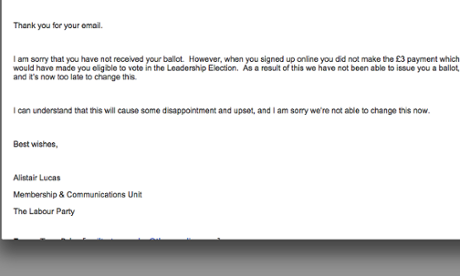
Many people are complaining about not being able to vote in the Labour leadership contest. As an example, here’s a screengrab from an email I’ve just been sent from someone who paid £3 to become a registered supporter. In August he got an email from Labour’s general secretary, Iain McNicol, confirming he had paid the £3 fee. When he failed to get a ballot email, he called Labour in early September and was told he would get one by email. Today, six minutes before the 12pm deadline, he received this email saying he would not get a vote.
This is from the Sun’s Steve Hawkes.
Sources claim there are likely to be around 340,000 votes cast in Labour leadership election - low turnout among union members
— steve hawkes (@steve_hawkes) September 10, 2015
Some 554,000 people are entitled to vote in the contest, so that would imply a turnout of 61%.
Charlie Mansell, a Labour campaigner, thinks Jeremy Corbyn will win with 54% of the vote.
@steve_hawkes @stephenkb I had it at 332,000 so a 61% t/o Thus @Corbyn4Leader likely to get 180,000 votes and around 54% on my estimate
— charliemansell (@charliemansell) September 10, 2015
Here are some post-deadline tweets.
From Tom Watson, a candidate for the deputy leadership (and the favourite)
These good people deserve a drink! See you soon team. https://t.co/hn7JgsM8LK
— tom_watson (@tom_watson) September 10, 2015
From Caroline Flint, a candidate for the deputy leadership
Thanks to all who voted for @CarolineFlintMP! Let's hope this poll from @MetroUK is right... http://t.co/NXtrz4G3OA pic.twitter.com/8xK8hmFLfC
— Caroline 4 Deputy (@Caroline4Deputy) September 10, 2015
From Ben Bradshaw, another candidate for the deputy leadership
I am really grateful for all the support and goodwill I have received on this campaign! Thank you. pic.twitter.com/NjDm551J1V
— Ben Bradshaw (@Ben4Deputy) September 10, 2015
From Christian Wolmar, one of the candidates seeking the London mayoralty nomination
The voting deadline for Labour's London Mayor candidate has now passed. So relieved I can FINALLY stop pretending I know how to ride a bike
— Wolmar for London (@wolmarforlondon) September 10, 2015
From Tessa Jowell, another mayoral candidate
Voting is over! Thanks to everyone on #TeamTessa for their brilliant support for building #OneLondon over the last few months... (1/2)
— Tessa Jowell (@TessaJowell) September 10, 2015
and my thanks also to @HackneyAbbott @SadiqKhan @DavidLammy @GarethThomasMP @christianwolmar for a positive @LondonLabour contest (2/2)
— Tessa Jowell (@TessaJowell) September 10, 2015
Voting closes in the Labour leadership contest
That’s it. Voting has finally closed in one the most extraordinary party leadership election contests in modern times.
(Or ever? Can anyone think of a more remarkable one?)
And Jeremy Corbyn, a backbencher and serial rebel who has spent his 32-year parliamentary career on the far left of the Labour party, is widely expected to win, having run a distinctive anti-austerity campaign that has energised an army of supporters disillusioned with conventional politics.
Two more minutes to go.
Jeremy Corbyn has not even won yet, but there is already speculation about how long he could survive as Labour leader.
What are odds on #Corbyn being shortest ever lasting Labour leader? George Barnes 10-11 1 year, Arthur Henderson 31-32: 1 year I month.
— Gerry Hassan (@GerryHassan) September 10, 2015
Only about 10 minutes to go.
Some people received ballot papers by post, but many people are voting electronically, and if you still can’t find your online ballot paper, Owen Jones has some last-minute advice.
If you're trying to vote in the Labour leadership contest, search emails for 'labourelections@electoralreform.co.uk' https://t.co/sg17HY5n9d
— Owen Jones (@OwenJones84) September 10, 2015
There are lots of hugs at the Kendall event, the Telegraph’s Michael Deacon says.
If you've ever wanted a hug from Liz Kendall, come to her "concession speech" in London now because she's giving them out like no tomorrow
— Michael Deacon (@MichaelPDeacon) September 10, 2015
Liz Kendall has summed up her “concession” message in posts on Twitter.
Our Leader will change on Saturday, but the challenges facing Labour will not. #labourleadership pic.twitter.com/KiIM4qO58J
— Liz Kendall (@LizforLeader) September 10, 2015
Those who want to lead our party can no longer tack-left to get the nomination, and tack-centre to win the country.
— Liz Kendall (@LizforLeader) September 10, 2015
But my view is that in politics as in life, you cannot deal w problems by ignoring or avoiding them #labourleadership
— Liz Kendall (@LizforLeader) September 10, 2015
Twenty minutes to go.
HuffingtonPost’s Emily Ashton describes Liz Kendall’s speech as a concession speech.
This is a classy concession speech from Kendall. She was almost teary at times. Standing ovation.
— Emily Ashton (@elashton) September 10, 2015
And this is from the Daily Mirror’s Jack Blanchard.
Liz Kendall close to tears as she all but concedes defeat in the Labour leadership contest. "I will continue to serve this party," she vows.
— Jack Blanchard (@Jack_Blanchard_) September 10, 2015
Some Labour members and supporters are still complaining online about failing to receive ballot papers right up until the deadline for voting, although some received email links with just hours to go. David Lammy, one of the six Labour London mayoral candidates, claims in the New Statesman that almost one in five Labour members in the capital have not received a ballot paper.
Just under 20 minutes to go, but it sounds as if Liz Kendall, the most “Blairite candidate” who is now tipped to come last in the Labour leadership contest, is running up the white flag. My colleague Patrick Wintour has been at her speech.
Everyone loves a good funeral. In concession speech Liz Kendall delivers last rites to Blairism, a body frequently buried.
— Patrick Wintour (@patrickwintour) September 10, 2015
George Osborne told the New Statesman in an interview published yesterday that having Liz Kendall as Labour leader would cause the Tories the most problems. But the Spectator’s James Forsyth says David Cameron worries most about having Yvette Cooper as his opponent.
Tories still can’t quite believe it’ll be Corbyn. But think Burnham damaged goods. Told ‘PM worries about Yvette more than any of the others
— James Forsyth (@JGForsyth) September 10, 2015
The difference (assuming Forsyth is right - he normally is) may be explained by Osborne thinking more about the 2020 election, when he hopes to be leading the Conservative party, and Cameron thinking more about PMQs. In policy terms, Kendall would take Labour more into Tory territory, but in the chamber Cooper would undoubtedly present more of a challenge to Cameron.
Ian Murray, Labour’s shadow Scottish secretary and a potential Jeremy Corbyn refusenik, has confirmed he would serve under Corbyn’s leadership and remain as the party’s “Scottish voice” in Labour’s shadow cabinet
Now Scotland’s sole Labour MP after the Scottish National party rout in May, Murray had indicated he was deeply sceptical about Corbyn even as the left-wingers popular support surged over the summer, saying he “can’t commit” to Corbyn until he had a far clearer idea of the Islington North MP’s policy agenda and his willingness to work with his critics.
Murray, a shadow Business minister under Ed Miliband and a moderate who has publicly backed Yvette Cooper’s leadership bid, feared Corbyn would be unable to unite the party, leading to a deep split. One of the few policy agreements between the two men is over cancelling Trident’s replacement.
But only a few hours before voting closes, the MP for Edinburgh South has told BBC Radio Scotland’s Good Morning Scotland programme he was now keen to remain in post. Murray confirmed he had originally said he needed to consider his options if Corbyn won but added:
I would serve under a Jeremy Corbyn, leader of the Labour party, if I’m asked to do so. I think we need a strong Scottish voice in the shadow cabinet. I think people would expect Scotland to be properly represented in that shadow cabinet and we’ve got a good job to do.
Kezia Dugdale [Scottish Labour’s new leader] was elected less than a month ago, she’s doing a tremendous job in Scotland turning the Labour party around, talking about our values again, getting stuck into the big issues that people care about. And we want to make sure that that’s represented in the shadow cabinet so they can work in partnership for the benefit of Labour values and Labour voters.
Liz Kendall is giving her speech now.
Liz Kendall, 'A Fresh Start', now giving her final campaign speech before Labour makes 'An Old Finish'.... pic.twitter.com/5lH0IOXwOY
— Carl Dinnen (@carldinnen) September 10, 2015
Liz Kendall: After 2010 Ed Miliband "papered over the cracks" of a split in Labour that had been growing since 1997
— Jack Blanchard (@Jack_Blanchard_) September 10, 2015
Kendall: “The programme Corbyn offers is not new. His politics & policies are the same as in the '80s, and will end up with the same result”
— Jack Blanchard (@Jack_Blanchard_) September 10, 2015
I will post a full summary when I’ve seen the text.
This is from PoliticsHome’s Kevin Schofield.
EXCL Labour leadership hotline was closed down because it was receiving too many calls. http://t.co/xsOrLkhbpX pic.twitter.com/0Z9XCbOES4
— Kevin Schofield (@PolhomeEditor) September 10, 2015
David Lammy, one of the six Labour London mayoral candidates, is claiming that almost one in five Labour members in the capital have not received a ballot paper, Stephen Bush at the Staggers reports.
He also quotes a very good line on the possible impact of Green supporters voting in the contest.
The mood in Labour party headquarters remains bleak. Although under 4,000 people have had their applications denied as a result of membership of Labour’s rivals, many within One Brewers’ Green believe that thousands more members of other parties remain on the rolls. “This is going to be the first and only time the Green party wins an election,” quipped one.
Here are three Labour leadership stories from today’s papers.
-
Kate McCann in the Daily Telegraph says Alan Johnson, the Labour former home secretary, says Corbyn himself is not fully committed to being Labour leader. “The last person who expected to get this job and wants it is Jeremy himself,” Johnson said.
Here are the latest Labour leadership odds.
Latest #Labour odds as voting about to close: 1/7 Corbyn 7 Cooper 10 Burnham 100 Kendall http://t.co/I2esGvPPDP pic.twitter.com/rpCdcyMIo2
— Ladbrokes Politics (@LadPolitics) September 10, 2015
Last night Newsnight ran a report saying that, even if some Tory MPs refused to back the government in a vote to authorise air strikes against Islamic State (Isis) in Syria, David Cameron would win because enough Labour MPs would defy the whip and support him. (This is based on the assumption that Jeremy Corbyn becomes leader, and that Labour MPs would be told to vote against military action.) Newsnight said it had spoken to 14 Labour MPs who would defy the whip in these circumstances.
The New Statesman’s George Eaton has come to the same conclusion. He says up to 30 Labour MPs would defy Corbyn on this issue.
Although many MPs are waiting until a specific proposal is tabled before breaking cover, Labour sources estimate that as many as 30 would vote for military action. One told me: “Absolutely I’ll support it and many others will, too. They feel completely ashamed by what we did two years ago.” Some were uncomfortable with how Miliband’s unintended victory was subsequently spun as a landmark decision to halt a “rush to war”.
Jon Cruddas's Today interview - Summary
Jon Cruddas came out with one fairly harsh line about Jeremy Corbyn, but his whole interview was much more nuanced. Here is a summary of the main points. I’ve taken the quotes from PoliticsHome.
- Cruddas said he was worried that Labour under Jeremy Corbyn could turn into a “Trotskyist tribute act” that would “collapse” in front of the electorate. (See 9.08am.)
- He said he disagreed with Corbyn’s analysis about Labour’s problem being that it was too pro-austerity at the election. “Jeremy’s diagnosis is that Labour is austerity-lite,” he said. “Now, that seems to me to be at odds with where the country is.” Cruddas carried out his own review of the reasons for Labour’s defeat which said one of the key problems for the party was that voters accepted the Tory case for cutting the deficit.
-
He praised Corbyn’s campaign for energising supporters.
[Corbyn is] cutting through in ways that I didn’t think were imaginable barely weeks away ... I didn’t think he’d have as much success as he obviously has and it has changed the whole character of the conversation and it needed to ... He has had an analysis of what happened in the election – we were austerity lite – and he’s come up with a policy-heavy, very disciplined campaign which has enthused people.
To give an example, my son rings me up at the beginning of the campaign and he says ‘look, I’m rejoining the party’. A couple of days later, my mum rings up, says she’s joining the party – something she’s equivocated over for nearly a decade. They are enthused by something that’s going on in and around Labour, which they have not been for a very long time.
-
Cruddas explained why he had not yet voted. (The interview was recorded yesterday.)
What I decided to do was wait until the very last minute to sort of consume everything that everyone’s trying to say and then try and make sense of it and make my mind up, because I still haven’t made up my mind, really.
-
He said there was a growing gap between the Labour membership and the public at large.
All the evidence shows that the nature of the Labour membership is increasingly different to the nature of the society that we want to govern. And that is difficult in terms of future prospects for the party, and that means that at some stage we’re going to have to pivot out of this leadership election and confront the realities in the country, which could be quite a salutary experience for us.
- He suggested Ed Miliband should not have resigned so early. It would have been better to have allowed time for the party to “diagnose the nature of the defeat” before having the leadership election, he said.
-
He said Labour had to “rehabilitate” Tony Blair. (Cruddas worked for Blair in Number 10 before becoming an MP.)
At some stage, the Labour party’s going to have to rehabilitate Blair and his legacy. And it goes beyond this simple caricature of what it was. I mean, it was a rich, textured political project that had real grip in the country and that’s part of the crisis that is consuming us now because now he’s become some sort of figure to be demonised.

Jon Cruddas, the Labour MP who was head of policy under Ed Miliband, gave a revealing insight into his party’s plight in an interview on the Today programme this morning. Cruddas is one of the parliamentary party’s leading thinkers. Yet, with voting in the leadership contest closing at midday today, Cruddas told Sarah Montague, in an interview recorded yesterday, that he still had not decided how to vote. Maybe that just says something about the hopelessness of intellectuals, but it is more likely that Cruddas was articulating the torn emotions that many in the party have about the Jeremy Corbyn anti-Westminster insurgency.
Cruddas, who nominated Corbyn without fully backing his policies, conceded that the leftwing backbencher, who has become the surprise favourite, had energised the contest in a remarkable way. But he also admitted that he was worried that a Corbyn leadership could turn out to be a disaster.
I’m worried that it might turn into quite a sort of early 80s tribute act, Trotskyist tribute act which has the culture around it which is very hostile to anyone who just disagrees and it could just collapse in front of the electorate. But I don’t think there’s any safe ground for Labour anyway, so this is one strategy, it might not work, we’ll see.
I’ll post more from the interview shortly.
In another development Lord Ashcroft has published a major polling study looking at Labour supporters. Ashcroft has summarised it here, Patrick Wintour has written it up for the Guardian here, and the full report is here (pdf). Here’s the start of Patrick’s story.
More than half of Labour’s loyalist voters think it is more important to stick to the party’s principles than to temper those views to try to win an election, according to an opinion poll for the former Conservative party deputy chairman Lord Ashcroft.
The poll also reveal a yawning gap between the views of Labour loyalists and voters who defected to another party at the last election, especially on the issues of welfare, the economy and immigration.
Ashcroft’s polling, conducted in the last fortnight and revealed to the Guardian exclusively, confirms that Ed Miliband was one of the single biggest reasons why people who voted Labour in 2010 decided not to vote for the party in 2015.
I will be looking at the research myself in more detail.
Here is the diary for the day.
9.15am: David Cameron meets Binyamin Netanyahu, the Israeli prime minister, at Downing Street.
10am: The Independent Parliamentary Standards Authority publishes annual data about MPs’ expenses. According to Sky News, Ipsa will name and shame MPs who have not repaid money owed.
11am: Liz Kendall, the Labour leadership candidate, gives a speech.
12pm: Voting closes in the Labour leadership contest.
As usual, I will also be covering breaking political news as it happens, as well as bringing you the best reaction, comment and analysis from the web. I will post a summary at lunchtime.
If you want to follow me or contact me on Twitter, I’m on @AndrewSparrow