
Twenty-five years ago, or so, I found the magic.
I was paging through a cookbook, the seminal "La Methode," Jacques Pepin's sequel to his even more seminal "La Technique." As I was grazing through the pages, I came upon a recipe for croquembouche.
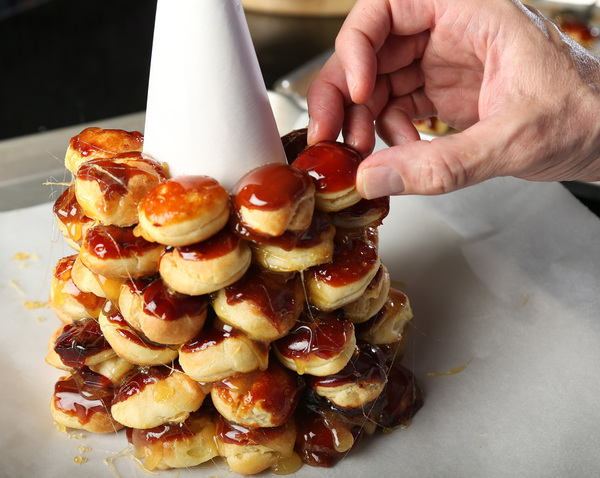
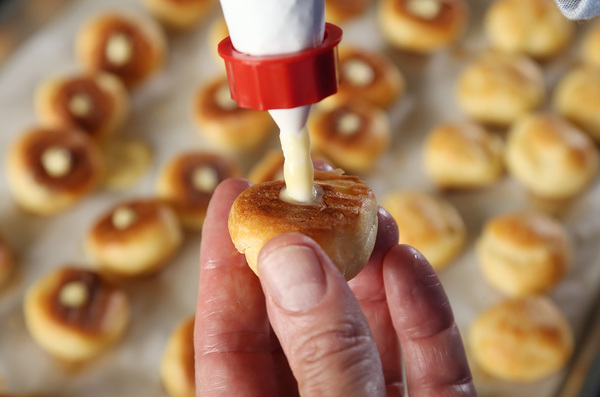
It was the most astonishing recipe I had ever seen: little baked puffs filled with pastry cream and then stuck together with caramel to form a beautifully shaped mound.
It wasn't just astonishing, it was also the hardest recipe I had ever encountered. It covered most of five large pages _ though photos and white space also took up a large part _ and required 11 difficult steps.
They were difficult, but they were not impossible. And that was what was magical. I realized as I read it that I could make this thing.
At the time, I had never attempted pate a choux, the dough that puffs up and becomes hollow as it bakes _ it is the same dough that is used in eclairs. Neither, at the time, had I made pastry cream. I hadn't even made caramel. But I was certain I could do them all.
Since then, of course, I have made pate a choux numerous times, pastry cream and also caramel. But I still had never made a croquembouche.
So I decided to try. How hard can it be?
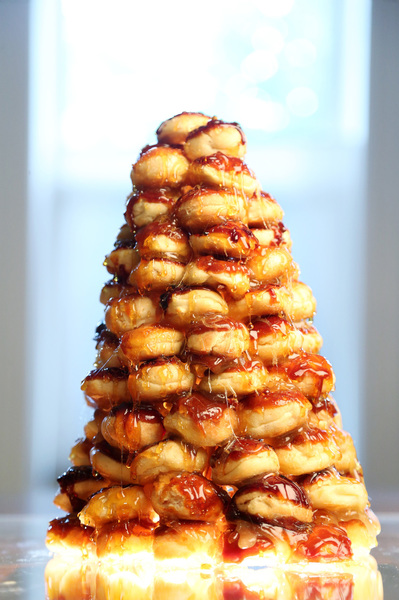
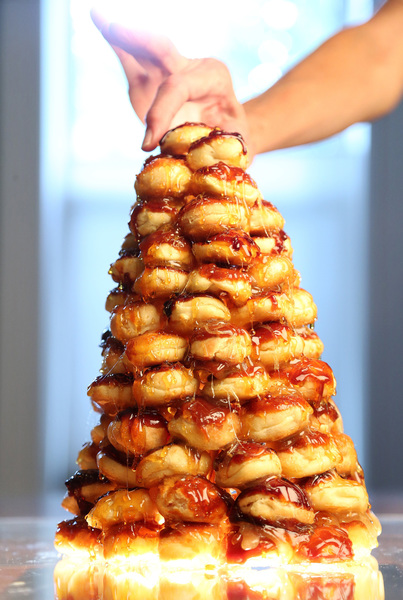
As it turns out, it is pretty hard. But it is also spectacular, both in appearance and taste. I ended up with a beautiful croquembouche that tasted even better than I thought it would.
Pepin writes in the introduction to the recipe that the dish is typically served at weddings in France. It is certainly the sort of thing you would want to bring out only for a special occasion, both because of the effort and time that it takes to make and also because something this extraordinary should never become commonplace.
In the introduction, Pepin also writes "avoid making it on a humid summer day because the caramel may stick and melt and the cake may collapse."
Naturally, I made it just after a monsoon. And although I did what I could to dry them out, the choux puffs lost their crispness and some of them deflated a bit.
There was one other major problem, which I can blame only on myself. The way Pepin makes his croquembouche, he dips the top of each puff in caramel (others leave out this step). It is much easier to do this with your hands than with tongs, but you have to remember that caramel is extremely hot and the puffs are rather small.
I don't think of it as four of my fingers are burned and blistered, I prefer to think that six of my fingers are fine.
And to be honest, two of the burns came when I decided the caramel was so enticing that I would wipe it from the back of a spoon with my finger _ two fingers _ and lick it off of them. So, really, that one's all on me.
While croquembouche as a whole is daunting, when broken down into its individual parts it actually goes easily, though it does take time.
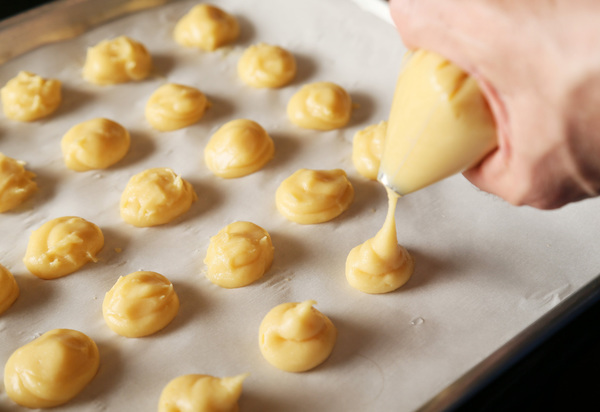
First up is the pate a choux, which develops its miraculous ability to become hollow through a couple of intriguing techniques: You dump the flour all at once into a mixture of boiling milk (or water) and melted butter, and you add several eggs one at a time, making sure each one is thoroughly incorporated before adding the next.
If you do these two simple tricks, you have pate a choux.
While the choux are baking and puffing up beautifully, you make the pastry cream, which is also called creme patissiere. This is basically a super-rich custard; this version requires eight egg yolks, plus milk, cream, sugar, vanilla and half a stick of butter. A little more than a teaspoon of unflavored gelatin holds it all together and keeps it from becoming runny.
Unlike other recipes I have seen, Pepin uses two caramel glazes on his croquembouche. One adds a layer of sweetness to each puff (this is the step that is ignored by other cooks) and the other is used to glue the thing together so that it holds its shape.
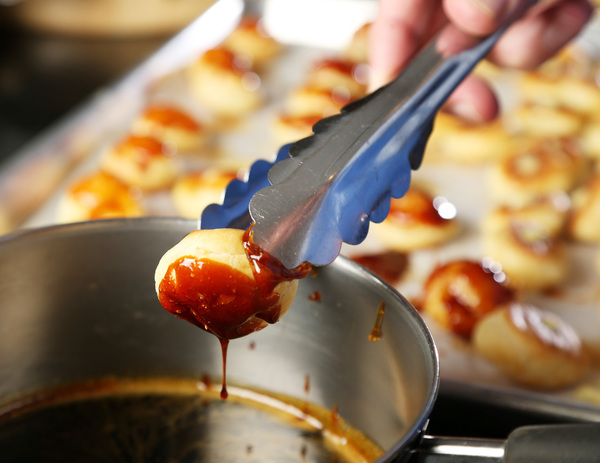
Pepin uses the same caramel recipe for each. He just cooks the sweetness glaze longer than he cooks the glue one. But don't worry. You can take my word for it that both are hot.
And other chefs add a step that Pepin does not. After they have assembled the croquembouche around a mold, they weave a gossamer web of spun sugar around it.
I decided to do that part, too. What the heck? At that point, it didn't really matter.
One word about the mold. Pepin recommends greasing the inside of a mixing bowl and building the croquembouche up against that wall.
Most other chefs use a traditional cone shape. I went with the cone, because the mechanically inclined photographer created one out of cardboard, which we then covered with parchment paper to keep the puffs from sticking to the mold. It also looks better than the mound-shaped result you get from Pepin's method.
Pepin's idea is easier. But if you're going to go to all the trouble to make croquembouche, you may as well go all the way.