
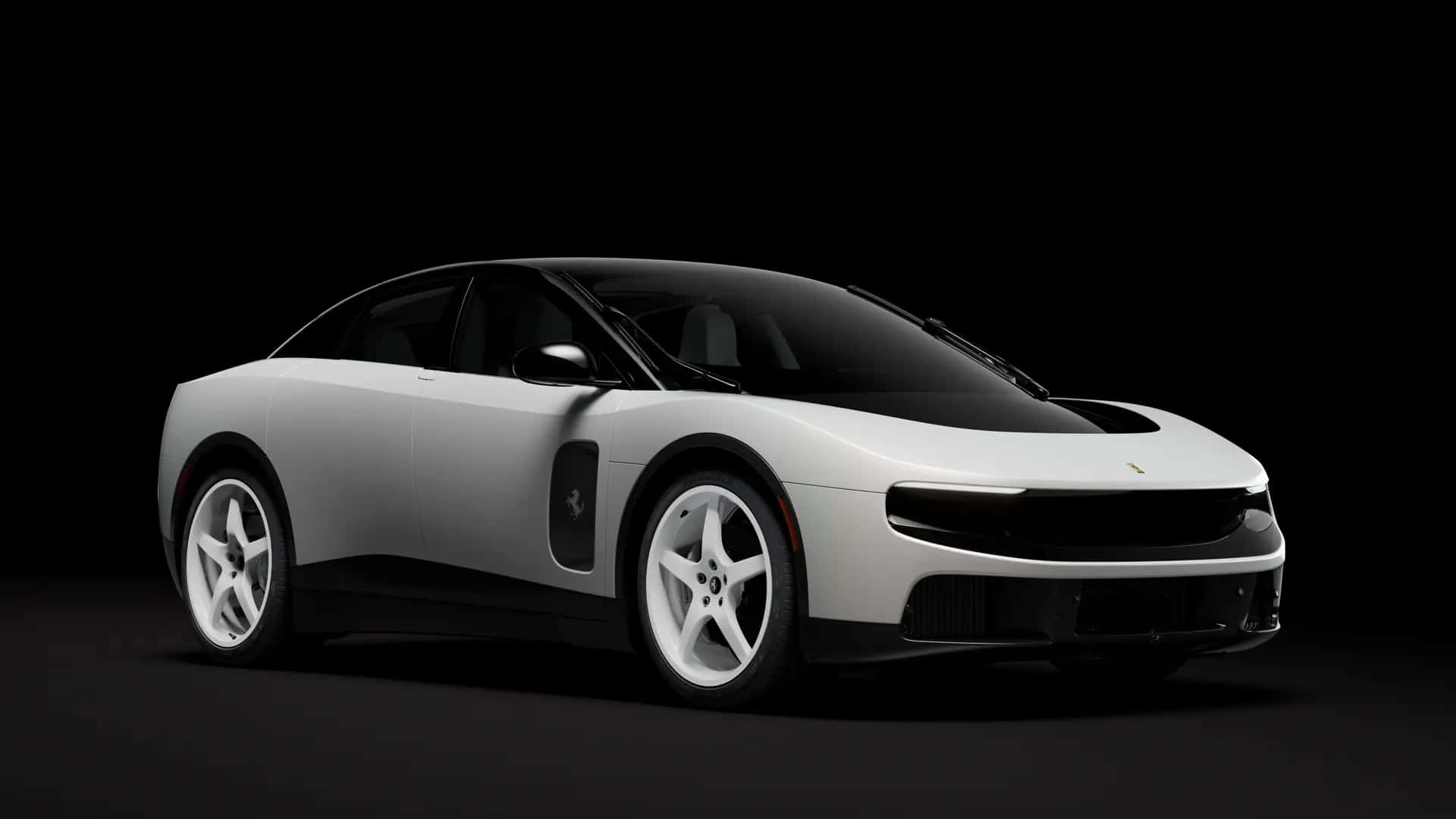
- The first production Ferrari Luce EV just set a new record for the most expensive new car ever sold at an auction.
- Someone paid nearly 40 times the estimate for a bespoke version of Ferrari’s first electric car.
- To make things even more interesting, the car doesn’t exist yet, and Ferrari is not keeping the money.
Ferrari got a lot of flak for its first electric car, the Luce, but the Italian automaker is proving critics wrong. Despite the criticism, reviewers found that the Luce performs better than expected, and now the controversial EV has just smashed the record for the most expensive new car sold at auction.
The first production Luce, known as “Chassis 0,” fetched a whopping $40 million this past weekend at RM Sotheby’s Monterey Car Week auction. That’s nearly 40 times more than the $1.1 million pre-auction estimate, and $14 million more than the one-off Daytona SP3 that sold last year at the same auction.
The record-setting Luce, VIN ZFF21BUA8T0338000, was uniquely configured through the Ferrari Tailor Made program and features an exterior finished in an exclusive livery of Madraperla Semi-Gloss, which was developed specifically for it.
Ferrari says the pigment can produce iridescent reflections that go from green to violet, depending on the intensity and angle of the light. Exclusive finishing details, including dedicated wheels, bespoke brake calipers, and the Ferrari logo on an optical white background, complete the picture.
The interior gets Le Mans metallic leather finished in Perla, an exclusive material that was developed specifically for the automaker’s Tailor Made program. For the first time, a medium gray called Grigio Corvara was used for the secondary interior elements instead of traditional black, making for a much more airy cabin. And because this is a special one-off, there’s a dedicated plaque that lets everyone know what the car is all about.
Even though someone paid an extreme amount of money for Ferrari’s first production EV, they won’t get it just yet. (And it’s anyone’s guess if they’ll actually drive it or keep it locked up, hoping its value will increase over time.) The car, which was made to adhere to U.S. standards, will be returned to Maranello and is scheduled to be delivered in the first quarter of 2027. In other words, if the buyer is from outside the U.S., they’ll have to shell out even more money to get it homologated and road-legal.
About that money, though—Ferrari is not keeping a dime, as all of the proceeds will be donated to charity through the Ferrari Foundation, which will use them for future educational initiatives.