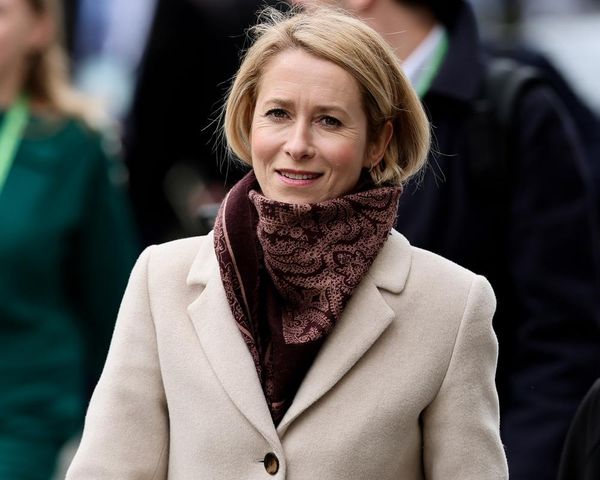
Self-deconstructing Harry ... Woody Allen (out of focus) with Scarlett Johansson, Jonathan Rhys Meyers and Emily Mortimer in Cannes earlier this year. Photo: AFP
Is it all over for Woody Allen? The sad and - this quarter at least - desperate truth is that the Woodman has conclusively run out of steam, ideas, and any semblance of self-perception.
His recent decamp to London has only made matters worse: his toiling, flailing efforts to keep his film-making conveyor belt going have resulted in one film, Match Point, which just about struggled into cinemas, and another, Scoop, which even more embarrassingly is unlikely to make it into theatres at all. This isn't, it has to be said, the first time one of Allen's films is deemed unreleasable in the UK: Hollywood Ending similarly missed the cut a few years ago. But Scoop is a more serious case: you would think that - set in London, as it is - someone would think it would be worth a punt. Apparently not.
The reasons behind Allen's decline are well rehearsed: his inability to understand any milieu outside the lower half of Manhattan; the queasiness induced by the dramatic eruption of his personal life into his film-making; and the realisation that far too often he has cast himself opposite unfeasibly nubile young women.
I personally don't have any problem with Allen's intellectual pretensions; he knows what he likes, and at least he's clear and articulate about it. But what concerns me most is the sense of mental and physical exhaustion in Allen's work.
Ever since "the trouble" in 1992, and his appallingly public split with Mia Farrow, the cottage-industry feeling of his film-making was destroyed forever, and Allen was forced to sing for his supper. He ended up dancing with the devil, in the form of big-studio multi-picture deals; it was clear he was under no illusions that "serious" films like Crimes and Misdemeanors and Another Woman were no longer on the menu.
His work in the latter 1990s became erratic; for me, his last authentic masterpiece was Deconstructing Harry in 1997, the homage to Philip Roth. Celebrity and Sweet and Lowdown were the work of a director still in the game, able to produce work of top quality. But nothing since then has passed any kind of muster (only Melinda and Melinda could be described as "adequate").
It can't be a coincidence that this 21st-century nosedive also coincided with a less publicized problem for Allen; his break with Sweetland Films, the company that has produced his films since Bullets Over Broadway. (He launched legal action in 2001 accusing them of cheating him out of profits; the case was settled out of court.) Since then, Allen has found himself ever more at the mercy of the big bad world; his defiant unfashionability doing him no favours.
Like everyone else who remembers his glorious, every-one-a-masterwork run between Manhattan (which is getting a UK rerelease next week) in 1979 to Husbands and Wives in 1992, I'm hoping that somehow he'll come up with another Radio Days or Stardust Memories or Crimes and Misdemeanors. But, in truth, I doubt it.