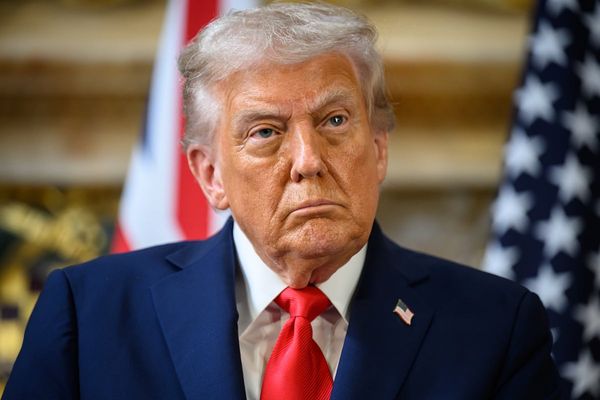
WASHINGTON _ As Richard Rosenfeld listened to Donald Trump accept the Republican presidential nomination Thursday, a couple of recent crime trends the candidate cited were immediately familiar.
Trump told convention delegates and millions of Americans watching on TV that homicides in the nation's 50 largest cites are up 17 percent and that assaults on police have increased.
Rosenfeld, a University of Missouri criminology professor who briefed 120 congressional aides and executive branch employees this month on Capitol Hill, recognized those statistics because they came from a paper he'd written last month for the U.S. Justice Department, whose findings had been widely cited in news reports.
"He didn't misquote my report," Rosenfeld said Friday. "In those two instances, he was correct."
That doesn't mean Rosenfeld agrees with Trump's overall speech and the dark vision it painted of a fearful nation. The general claim that the nation is beset by violence is "way off base," said Rosenfeld, one of the nation's foremost experts on crime statistics. "Even with the homicide increase in large cities last year, the country is still experiencing violent-crime rates that are far lower than they were 20 years ago."
On Friday, President Barack Obama made a similar point in countering Trump.
"When it comes to crime, the violent crime rate in America has been lower during my presidency than anytime in the last three, four decades," Obama said. "And although it's true that we've seen an uptick in murders and violent crime this year, the fact of the matter is that the murder rate today ... is far lower than it was when Ronald Reagan was president, and lower than when I took office."
Yet while experts denounced Trump's portrayal of a country beset by violence and fear as exaggerated, Rosenfeld and others acknowledged that many people respond emotionally to high-profile police shootings, Islamic jihadist attacks or killings by police of unarmed men _ especially when they receive a lot of attention not just on television, but also in social media.
"You can turn on cable TV and get scared any minute of the day or night," said Barry Glassner, a sociologist at Lewis & Clark College in Portland, Ore. "And now you have all these social media sites, and they all have a certain kind of authority _ not the kind that any scholar or serious journalist would respect, but the authority of immediacy and directness."
Statistics show decreased crime rates over the last quarter century: 1.17 million violent crimes in 2014, down from 1.93 million in 1992, according to the FBI.
But those dry numbers hardly are as compelling as the 10-minute video that Philando Castile's girlfriend shot as he lay dying in their car after being shot by a police officer during a minor traffic stop in Minnesota. Live-streamed on Facebook, it went viral, with more than 1.8 million YouTube views as of Friday.
A military veteran's ambush of five police officers in Dallas July 7 also was captured on video, streamed online and commented about by millions of Twitter users.
Other recent horrific acts have had wide exposure, like the killing of 49 people at an Orlando nightclub last month _ the shooter reportedly checked Facebook to see whether it was trending _ and the repeated shooting by police of a black man July 5 in Baton Rouge, La., and the killing last Sunday of three police officers in that city.
Videos have shown a dozen or so violent encounters between police and mainly African-American men that began with the killing of Michael Brown on Aug. 9, 2014, in Ferguson, Mo.
"The streaming video really gets people's attention and scares them," said James Lynch, president-elect of the American Society of Criminology and a criminal justice professor at the University of Maryland. "Statistics are kind of bloodless because they're designed to be systematic and factual. There's not a lot of sensation in statistics."
Statistics show a very different story from the one told by Trump, and by three speakers earlier in the Republican convention, who told of their family members having been murdered by immigrants who were in the country illegally.
The number of violent crimes �� including homicide, rape, robbery and aggravated assault ��rose virtually every year from 1960 through 1993. Since then, the number has fallen just as steadily, although Rosenfeld notes an apparent increase in the past year or so.
Analysts don't blame Trump for noting the high-profile acts of violence, but they criticize him as exploiting the crimes for political gain.
Glassner said that while Trump is not the first presidential candidate to foster fear, he has taken it to an extreme.
"This candidate is much more dramatic than most we've had," Glassner said. "Nixon engaged in fear-mongering, as did Bill Clinton and George W. Bush. But compared to Donald Trump, they were very low-key."
Gary Cordner was a police officer for six years in Maryland before teaching criminal justice at Kutztown University in Pennsylvania. Since retiring from that post, he's a research fellow at the Police Foundation in Washington and consults law-enforcement agencies in other countries.
"I don't think either the public's confidence in the police or the public's fear of crime is at some kind of crisis proportions, but because of the events that have occurred, there's bound to have been some change in how people feel," Cordner said. "And with the shootings of just the last couple weeks especially, there is bound to be some change in how police feel about their own safety."
Rosenfeld, however, said opinion polls consistently found that Americans were less fearful than they were during a 1990s crime wave that led Clinton and a Republican-controlled Congress to put 100,000 more police officers on the street and pass "three strikes" laws toughening criminal sentences.
"When Americans are asked by pollsters to rank the top problems in the country, crime in the streets ranks quite low, especially compared with the early 1990s, when it was viewed as one of the top problems," he said. "If you go back 20 years ago, fear of crime was much greater then than it is now."