Best player
Mike Selvey Brendon McCullum. It would be easy to pick a batsman such as Kumar Sangakkara or AB de Villiers; or a bowler like Mitchell Starc or Trent Boult. But McCullum has inspired not just his team but a nation to a level that had to be experienced to be appreciated. He is a captain of tactical genius, sets an inspirational example in the field, and in the semi final his assault on the finest fast bowler of his generation reduced a difficult target to a manageable one.
Vic Marks There were two contenders: McCullum and Starc and the outcome was decided in the final by McCullum b Starc 0.
Ali Martin In a tournament where bat dominated ball – 300 was passed a record 28 times – Mitchell Starc’s 22 wickets at 10 runs apiece, with an economy rate of at 3.5 runs an over, shone through. The left-armer picked up at least two per game and set the tone when he cleaned up Brendon McCullum with the fifth ball of the final.
Russell Jackson Sangakkara. It was a fitting way for the champion to go out, reminding everyone that he’s perfected the art of one-day international batting. How do the Sri Lankans cover such a loss in batting productivity, leadership and temperament? He was nothing less than magnificent in his final tournament.
John Ashdown It’s difficult to look past Starc. The joint leading wicket-taker with an average and an economy rate at a different level to anyone else – 22 wickets at 10.18 with an economy rate of 3.50 was remarkable in what has been a batsman’s tournament. Sangakkara had an astonishing time with the bat – it might have been his World Cup had his team-mates offered any support.
Simon Burnton Sangakkara’s four successive centuries in an unexceptional Sri Lanka side make him the sentimentalist’s choice, but Glenn Maxwell’s exhilarating batting for Australia, coupled with his handy bowling and some eye-catching moments in the field probably made him the most influential.
Dileep Premachandran Starc. He took at least two wickets in each of the eight matches he played. Both his average (10.18) and economy rate (3.50) would suggest that he was playing against Minor Counties batsmen rather than the world’s best. In the final, it took him just three balls to dent New Zealand’s hopes of an upset.
Best match
Mike Selvey What, in modern parlance, is called a no-brainer. The semi-final in Auckland was one of the most extraordinary, intoxicating sporting events I have ever attended. If mistakes were made on both sides, then the level of commitment was astonishing, the result nail-biting to the end, the eventual hero one of genuine humility, and the spirit in which it was played exemplary. Half an hour after the finish the teams were sharing a beer.
Vic Marks NZ v SA semi-final was unswitchoffable. Thanks goodness I wasn’t there since it would have been impossible to deliver decipherable early copy. Had no idea who was going to win until the last ball. The tension of that match may have ruined New Zealand’s chances in the final.
Ali Martin New Zealand’s finger nail-reducing semi-final win over South Africa. And the chase of 299 in 43 overs looked on the second Brendon McCullum started treating Dale Steyn like a bowling machine. Grant Elliott then proved South Africans are no chokers with his ice-cool unbeaten 84, albeit against the country of his birth.
Russell Jackson New Zealand vs Australia at Eden Park, if only for the sheer bloody novelty of it. In only their third ODI meeting in the past five years, they showed again that the best ODIs are low-scoring ODIs. Boult and Starc were magnificent, the batting so brittle you felt it could be over in 2 hours. And what about that finish? Kane Williamson will never crack a sweeter six than that.
John Ashdown The New Zealand v South Africa semi-final was obviously one of the great ODI matches, but there was something equally magical about Afghanistan’s win over Scotland. Seven years ago they were below Fiji and Italy in the world rankings and here they were winning a match at the World Cup, and in the final over too.
Simon Burnton For drama, importance and atmosphere it’s impossible to overlook the New Zealand v South Africa semi-final, though the co-hosts’ only other match at Auckland’s Eden Park, when Australia came so close to defending their miserably low total of 151 with Mitchell Starc outstanding, was brief but brilliant.
Dileep Premachandran Though I wasn’t at Eden Park, the atmosphere for the semi-final seemed electric. The game, perhaps the best the World Cup has seen since the epic Edgbaston semi-final of 1999, was worthy of that setting. South
Africa batted splendidly, but McCullum’s blink-and-you’ll-miss-it 59 was the inspiration behind one of the great run chases. Grant Elliott’s Cool-Hand-Luke 84 applied the finishing touches as South Africa lost their nerve.
Best moment
Mike Selvey Elliott, in his moment of triumph, understanding the despair of the vanquished and the thin line he had trodden, and offering a hand to a disconsolate Dale Steyn. It encapsulated everything of how the New Zealand v South Africa semi-final game was played, how it should be played in general, and of the character of those who contributed to a memorable occasion.

Vic Marks Daniel Vettori’s catch at third man to dismiss Marlon Samuels in the Wellington quarter-final. He had just been whacked for 21 in his first over; his body is supposed to be creaking. Yet he produced a career best leap, stuck up his hand and even retained a touch of quiet nonchalance when he realised that somehow the ball had lodged there.
Ali Martin The 36-year-old Daniel Vettori was rightly tossed one of those orange catch-a-million T-shirts after leaping to pouch a breathtaking one-handed effort to remove Marlon Samuels on the boundary rope in New Zealand’s quarter-final disposal of West Indies in Wellington. We’ll miss him.
Russell Jackson Shapoor Zadran’s winning runs for Afghanistan against Scotland. There is a risk of ascribing slightly patronising qualities to sides like Afghanistan; exotic, plucky, ever-smiling. Shapoor and his fast-bowling colleagues bowled with steam coming out of their ears and in this instance, batted like their lives depended on it. Why would we want to lose that from the World Cup?
John Ashdown That six. The knockout rounds were a disappointment in the main after a hugely entertaining group stage, but Elliott’s thunk into the stands at cow corner off Steyn’s final over against South Africa (and his subsequent handshake for the bowler) provided a brilliant snapshot of simultaneous joy and despair.
Simon Burnton The conclusion toDe Villiers’ ludicrously, thrillingly brutal turn against West Indies at the SCG. Jason Holder’s first eight overs went for five apiece but his last two, with the South African rampant, cost 64, De Villers scoring them all, including four sixes and a four from the last five deliveries of the innings.
Dileep Premachandran The Johannesburg-born Elliott reaching out a hand to console a stricken Steyn at the end of that semi-final. New Zealand played tigerishly till a muted showing in the final, but they also showed that it was possible to win with class.
Best fans

Mike Selvey A special mention to those who willed Ireland along, as well as those from the subcontinent who managed to turn matches into home games for their team. But it has to be the Stadium of Four Million that has been New Zealand. No further embellishment needed.
Vic Marks The Kiwis with the sponsored orange shirts who would career through hell and high water – and a few fellow spectators - in order to try and catch those six hits in one hand.
Ali Martin New Zealand’s side of the Tasman Sea was the beating heart of this World Cup, with the co-hosts demonstrating how fervent support can feed both off and into a team playing dynamic, aggressive cricket to the greater sum of its parts. Honourable mentions to those of Afghanistan and Bangladesh.
Russell Jackson Bangladesh. Their schedule suggested they might only pull a handful of fans at some far-flung destinations but a hardy crew of loyalists followed the side everywhere and supported them in song and dance, even during warm-ups. ‘Nilon’ the human Tiger was undoubtedly the fan of the tournament, too. Honourable mention: the Sri Lankan Papare Band were never less than magnificent.
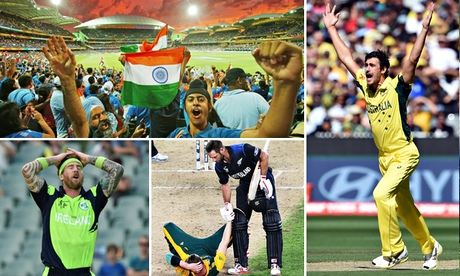
John Ashdown In general supporters from all nations added to the tournament, whether they were the 92,000 of host nation followers who crammed into the MCG for the final or the merry bands of Scotland and Ireland fans that made the long trip. For atmosphere, though, no one could quite touch the India support.
Simon Burnton For numbers, noise, colour and slightly scary cricket-related contact lenses, India’s supporters had all the other non-hosts beat.
Dileep Premachandran The Manuka Oval was one of the World Cup’s remote outposts, but for one night when Bangladesh took on Afghanistan, it could have been any throbbing Asian venue. The Bangladesh Tigers were in the majority and let that be known at every opportunity, but the Afghan drums and chants never stopped, even as the team slipped to a heavy defeat.
Best thing about the Associates …
Mike Selvey That they were there, gave tangible evidence of the massive improvement in their standards, and contributed some of the best contested games of the tournament. As Andy Moles, the Afghan coach, said after their last game, the Champions Trophy is for the elite; the World Cup should be a shop window for the game as well.
Vic Marks The Irish, of course. However the most exciting game involving the Associates, albeit of dubious quality, was between Scotland and Afghanistan in Dunedin.
Ali Martin Ireland, and for the third World Cup in a row. William Porterfield’s men claimed the pelts of two more Test nations in West Indies and Zimbabwe, only missed out on progression due to net run rate and gloriously chuntered about their future marginalisation every time a microphone came near them.
Russell Jackson That they not only talked up their own cricket in the kind of stirring, confrontational manner that made the world listen, but at times showed the full member/Associate divide up for what it is: outdated and elitist. The performance gap has shrunk, the tournament should not.
John Ashdown Quite possibly Afghanistan’s Hamid Hassan, who charged in to bowl looking like one of Arnie’s buddies in Predator, had a nice line in unusual celebrations and fizzing yorkers. The Associate Members’ determination to prove that they deserve their seat at the table and the relish with which they faced the challenge was also hugely refreshing.
Simon Burnton They have provided some of the outstanding moments in the pool stages of this World Cup (and the last, for that matter). While group-stage clashes between Test-playing nations sometimes underwhelmed, Ireland v UAE, Ireland v Zimbabwe and Scotland v Afghanistan were among the most dramatic games of the tournament.
Dileep Premachandran Ireland’s batting, and Afghanistan’s fast bowling. A combined team would have been a formidable force. As it was, Ed Joyce, Gary Wilson, Andy Balbirnie and William Porterfield won plenty of admirers with their composed, aggressive batting. Shapoor, with his flowing mane and steep bounce, became a cult hero, as did ‘Rambo’ Hassan.
One thing I’d change …
Mike Selvey The decision to cut the next World Cup to 10 teams. I understand that the intention is to make the qualification process much more competitive, but the associates have done nothing but enhance this tournament. The game needs to be obvious in its evangelism.
Vic Marks The use of two balls, which perversely makes life more difficult for the bowlers – at the end of the innings. They need a bit of respite.
Ali Martin The length of the tournament. The economic reality that sees Indian television demand their team is locked into a set number of group games is scant excuse for not getting on with it - 44 days? Ridiculous. The proposed 10-team World Cup does not actually fix this either.
Russell Jackson The meandering schedule, which on week days tended to conspire against both local crowds and TV viewership. The Kiwis embraced it a little more enthusiastically than Australians, I think. The thought that the next tournament is scheduled to be three days longer with four fewer teams involved is beginning to rankle even more.
John Ashdown Six weeks is just too long for a tournament. TV priorities mean it will never happen, but playing two games a day through the group stages would have made for a more compact event. And the obvious other change is to reverse the ICC’s decision on the Associate nations for 2019. Take them out of this tournament and it would have been a pretty flat affair.
Simon Burnton The pool stage is undeniably overlong. This year there were generally two games a day at weekends and one during the week; playing two every day would have shortened the tournament by over a week, and seems a good place to start, rather than exclude teams that should instead be encouraged.
Dileep Premachandran The tournament is still far too long. Even without reducing the number of associate teams – and they really do need this exposure – you could easily make the event more compact by having two group games a day. The only thing stopping that happening is avarice.
In 2019 England will …

Mike Selvey … almost certainly be starting to play ODI cricket appropriate to the previous tournament or the one before that. It was ever thus. But there are some extremely talented young players who must be given their head. Bowling is a real worry.
Vic Marks … do better. Well, they can’t do any worse can they?
Ali Martin … blaze their way to the semi-finals under the captaincy of Joe Root, playing an unshackled style (not brand, never brand) of attacking cricket hewn from four years of meticulous preparation. A cruel, last-over defeat to Steve Smith’s Australia and the positives taken thereafter will be their only reward.
Russell Jackson … probably disappoint in some respect no matter what they do. How such a safe, staid and outdated side can catch up in the meantime is hard to tell. Ian Chappell’s theory that you look at what England are doing and do the opposite still rings unfortunately true in ODI cricket. Selecting the right combination of players would be a start, as would giving them greater freedom and support to play attacking, 21st century limited overs cricket.
John Ashdown … most likely be striving to play the style of cricket that helped Australia and New Zealand to this year’s final. Unfortunately, though, everyone else will have moved on again and England will still be four years behind the rest of the world.
Simon Burnton … have remodelled and recalibrated their approach to the game and, buoyed by home support, surge to 2012 Olympics-style glory. Hey, I’m an optimist, and the last two tournaments have been won by the hosts. Besides, a lot can change in four years (and needs to).
Dileep Premachandran … again be also-rans unless they have a Darren Lehmann-like figure as coach. England have the talent, but unless they let go of the reins, the likes of Alex Hales and Jos Buttler will never reach their full potential. Every other team bats their most explosive players in the top four. England had Buttler at No.7. Enough said.