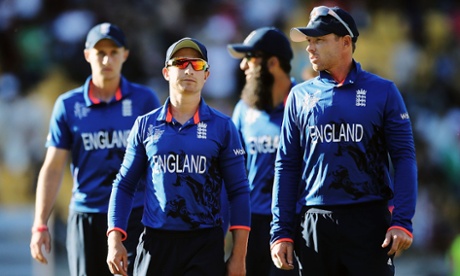
The match in Wellington was just the sort of encounter the organisers dreaded once the tournament was expanded to include 14 teams. It was all over in 45.4 overs – that’s about two dollars per over for those who turned up on time.
There was no need to turn the lights on. The game was an almighty embarrassment to the losing side and a dire disappointment for the spectators, even the most partisan. Only the New Zealand team could be quietly jubilant – calmness is their current mantra. Such an outcome was always on the cards in this World Cup with all those associate sides around to be bullied by the big boys. Except that there were no associates in Wellington. Just England.
It was probably England’s worst performance in the World Cup, certainly their most humiliating. Surely it cannot get any worse? Er … well, it could on Monday when they play Scotland in Christchurch.
On this evidence England could lose to Scotland, which would be the ultimate humiliation. Even if they were beaten they could still qualify for the quarter-finals, such are the quirks of the format of this tournament. They would have to win their last three games against Sri Lanka, Afghanistan and Bangladesh, which should be well within their capabilities in this part of the world in normal times.
But England have not been delivering normal defeats. Any associate side would have been dismayed by the standard of England’s cricket against Australia and New Zealand. Thus the team tiptoed towards Christchurch with tails between their legs and, whatever they may say, full of trepidation about the match against the Scots.
Scotland have never won a World Cup game, yet anyone who has watched England in their last two matches could not discount the possibility of that duck being broken. There is a precedent for a team playing dreadfully at the start and recovering in time to win the cup. This is what Pakistan conjured up in 1992, when Imran Khan famously implored his men to play like “cornered tigers”. England resemble cornered kittens. They also resemble the associates of old – it would perhaps be libellous to compare them with the current crop of non-Test playing nations.
In Wellington, Tim Southee bowled beautifully – in a very English way. The pitch was true and firm, but the ball swung more than anticipated from his end. He bowls at a brisk pace and swings the ball away from right-handed batsmen – a phenomenon not unknown in England though you would not have guessed this on Friday.
It was as if all these English professionals – with the exception of Joe Root – had never encountered swing bowling before. They were so tentative in defence and so reluctant to move their feet beyond the popping crease. Again, this was reminiscent of old associates unaccustomed to the extra pace of the pros.
Moeen Ali, Gary Ballance, James Taylor and Chris Woakes were permanently stuck behind the crease, as if disconcerted by the pace, of the Kiwi bowlers and became prime lbw candidates if their stumps had not already been splattered. The accepted wisdom against swing bowling demands batsmen should play late, and therefore move late, but that does not mean they should not move at all.
Most of England’s top order can claim that they were dismissed by fine deliveries from Southee but these are commonplace at the highest level. If a batsman is always dismissed by the first good ball that comes his way, he will not last long as an international. Combating those good balls is rather an important element of becoming a successful professional batsman. England should not feel betrayed because the ball swung.
As for Stuart Broad, he has forfeited his all-rounder status. This is the man who hit a polished 169 in a Test against Pakistan in 2010 and who seemed destined to be a genuine all-rounder. On Friday his feet did move, but in the wrong direction. Something has happened to Broad’s batting and the obvious assumption is that this something has to do with Mitchell Johnson. It seems his nerves have gone when taking guard against pace bowlers and he is now batting two places too high so his value to the team must be reassessed.
Watching England bat at least helped us to understand their original strategy for this tournament before the late swerve. The virtues of an established orthodox opener, accustomed to facing the new ball, were plain to see at Wellington – someone like … let’s think … Alastair Cook perhaps? … provided he was in good form, which was obviously not the case in the build-up to the World Cup.
Theoretically, England have had the best possible preparation for any World Cup in the past two decades – with the possible exception of the last one in England, in 1999. This time around Ashes series had been shifted specifically to enhance their chances of winning. They had more than six months to ponder nothing but one-day cricket. Cunning plans may have been laid but few have come to fruition.
Two matches into the tournament and they cannot be confident of what constitutes their best team. In Christchurch there may be a case for a tactical change by introducing James Tredwell for either Steve Finn or Broad, since the spinners were quite effective in the first game here. But establishing the best batting line-up is dependent on little more than hunches among those in charge. Ravi Bopara was dropped for Ballance in Melbourne, but Ballance now looks in dreadful touch. Alex Hales is hovering earnestly on the sidelines, where one or two others beyond the inner circle must have difficulty stifling guffaws.
It looks a mess. After all that preparation England have been unceremoniously thrashed by both hosts. In the first match the bowlers gave the batsmen no chance and in Wellington the batsmen retaliated. England may be grateful to be playing Scotland since they do not possess the firepower of Australia and New Zealand. But I suspect the feeling is mutual.