Who in their right mind would pursue a career as a professional cricketer? Even in this day and age, only a select few will ever get to wrap themselves in the comfort blankets of central contracts, endorsements and insanely lucrative Twenty20 stints – the majority of cricketers are forced to eke out a seasonal crust as jobbing county pros, travelling up and down the country to put their bodies through the wringer on a daily basis. Small wonder, then, that collectively, cricketers have pursued a distinctly motley array of careers after hanging up their pads.
Many, of course, take a predictably 21st century path by morphing seamlessly into television personalities – Darren Gough and Mark Ramprakash (now often in the Ashes spotlight, due to his status as England’s batting coach) won Strictly Come Dancing in successive years, and Andrew “Freddie” Flintoff appears to be on a one-man crusade to dominate the field of reality TV. Front-of-camera work must offer an acceptable substitute for the adrenaline induced by dodging hand-grenades hurled by the likes of Brett Lee, and Flintoff’s post-cricket career would seem to bear that out: he even had a stint as a professional boxer. Former England colleague Adam Hollioake took that urge even further – in 2012, after losing money in a property deal that went south, he announced that he was taking up MMA cage fighting.
Delving further back into the annals, some striking – and far less predictable – post-cricket careers can be found. Some cricketers clearly had a greater calling, and none more so than CB Fry. His crowning glory on the employment front occurred in the 1920s, at the nascent League of Nations, where he was forging a reputation as assistant to erstwhile batting partner Ranjitsinhji. Fry was approached as a candidate to become king of Albania. Unfortunately for Fry, the Albanian royal recruiters were looking for an English gentleman with an annual income of over £10,000, and Fry fell short. Instead, he contented himself with copious sports journalism, running the training ship Mercury, writing and publishing Boy’s Own-style magazines and standing as the Liberal candidate for Brighton – unsuccessfully, despite polling over 20,000 votes.
Abe Waddington performed public service of a more prosaic stripe. Having run the family fat-rendering firm, he was appointed chairman of the North Eastern Division Advisory Committee for the Control of Oils and Fats in the second world war. Sadly, he was accused of financial irregularities after the ending of hostilities, but blamed his brother and was acquitted.
Sir C Aubrey Smith, after one Test in which he took seven wickets, also made a considerable mark on the wider world – as a Hollywood actor. He featured in The Prisoner of Zenda, Dr Jekyll and Mr Hyde, and in Little Women, alongside the likes of Elizabeth Taylor and Janet Leigh. He has a star on Tinseltown’s Walk Of Fame, and founded the Hollywood Cricket Club, which featured such luminaries as David Niven, Laurence Olivier and Boris Karloff.
The alluring glitz of showbiz has persuaded countless cricketers to pursue musical careers. Most notably, in recent times, Mark Butcher, whose Mark Butcher Band remains much in demand. The great Don Bradman, an accomplished pianist, recorded several albums; 1950s wicketkeeper Frank Parr played trombone in George Melly’s band for many years; Zimbabwean fast bowler Henry Olonga has enjoyed considerable success as an opera singer and Curtly Ambrose and Richie Richardson play together in a band called Dread and the Baldhead.
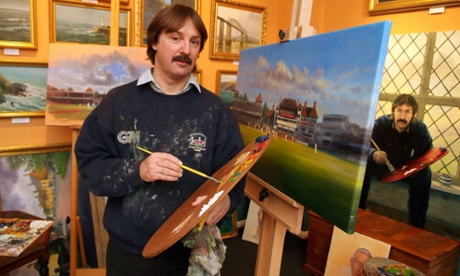
In a more cerebral vein, Mike Brearley – always, controversially, picked for England due to his preternatural captaincy skills rather than any aptitude as an opening batsman – became one of the world’s leading psychoanalysts, acting as president of the British Psychoanalytical Society from 2008 to 2010. Eccentric wicketkeeper Jack Russell, meanwhile, turned his hobby into a successful career, becoming a painter whose works fetch considerable sums.
Sadly, there are cricketers whose failure to cope with sporting retirement led to nefarious careers. Former England all-rounder Chris Lewis, for instance, was convicted of smuggling liquid cocaine into Britain from St Lucia in 2008. Happily, a contrite and embarrassed Lewis has just been freed. Former Lancashire, Derbyshire and Somerset player Andy Hayhurst was recently jailed for two years after admitting swindling £100,000 from the Lancashire Cricket Board. That really wasn’t cricket.
In truth, most cricketers end up settling into comfortable and unspectacular careers. England and Yorkshire bowler Chris Old ran a fish and chip restaurant on Praa Sands in Cornwall for decades. After a career in journalism, Australian spinner Arthur Mailey ended up running a butcher’s shop in Sydney, adorned with the sign: “Mailey: used to bowl tripe; used to write tripe; now he sells tripe.” In pre-central contract days, England bowler Ed Giddins and county colleague Nadeem Shahid ran a successful Christmas-tree business in the off-season. And Somerset player Seymour Clark, having discovered unexpected prowess as a wicketkeeper aged 25, declined a second season with the county in 1931, preferring to return to his job driving trains for the Great Western Railway.
Among today’s identikit professional sportsmen, cricket still manages to stand out as a sport for all sorts. Long may it continue.