Picture the scene. It’s Cardiff, the first day of the opening Ashes Test of the summer. David Warner strides out to bat. There is a crescendo of boos from a boisterous, and well-oiled, crowd. James Anderson bowls the Australian a devil of a delivery first up that beats the outside edge. Words are exchanged. Now ask yourself this question: is what you have just witnessed an electric, gladiatorial sporting collision that makes the hairs on the back of your neck stand up or a boorish exhibition of loutishness that sullies the reputation and contravenes the spirit of the game?
Cricket’s self-appointed moral arbiters would have you believe the latter. Chief among them is Jonathan Agnew, the BBC cricket correspondent, whose well-intentioned but clumsy attempts to link the death of Phillip Hughes with on-field behaviour sparked the sport’s latest bout of navel gazing.
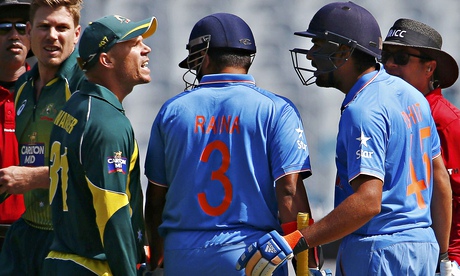
Others have piled in since to bemoan the conduct of the modern cricketer, before Warner’s run-in with Rohit Sharma during the Tri-Series match in Melbourne on Sunday, when the opener demanded his Indian opponent “speak English”. That clash prompted fears from the former New Zealand captain Martin Crowe, writing a column for Cricinfo, that overt on-field aggression could break out into violence during the forthcoming World Cup.
Darren Lehmann, Australia’s coach, made it quite clear this week that he would not curb Warner’s confrontational attitude or that of other members of his team. “David is an aggressive character and we support that,” he said. “If the ICC decides it’s not in the spirit of the game or we cross the line, [it’ll] come down on us. We’re always going to teeter pretty close to it, that’s just the way we play, but we’ve got to make sure we don’t cross it.”
Agnew, among many others, clearly believes that line has been crossed too often in the recent past. But is on-field behaviour really worse now than it was 20, 30 or even 100 years ago? The answer is no. WG Grace certainly didn’t adhere to the “spirit of cricket” and it was the last thing on the minds of Dennis Lillee and Javed Miandad when they squared up to each other during Australia’s Test against Pakistan at Perth in 1981.
Put simply, cricket is currently in the grip of a moral panic that feeds the illusion the sport is descending into barbarity. Condescending, pompous treatises about the state of the game add fuel to this imaginary fire. Russell Jackson, writing here last week, made the point that it is unfair to drag players still mourning their friend and team-mate into the debate about sledging.
To use the tragic death of Hughes, and the eloquent eulogy of his captain Michael Clarke, to ram home your point, as Agnew did, is perverse. This is exactly what he did in his interview with the Radio Times, when he said:
“I have that Michael Clarke speech tucked away ready to throw at the Australians. Michael Clarke said very clearly that Hughes’ memory would run through the team, and would be in the way they would play their cricket. Well, I haven’t seen evidence of that. I really hoped that out of this tragedy might have come some good, but the players haven’t behaved any better, and I think that’s a real disappointment.”
There has been some backtracking from the broadcaster since the understandably hostile reaction in Australia to his comments. “These were picked up and presented out of context from an interview I gave to a non-sports magazine,” he said. For context we can go to Agnew’s own website, where shortly after Hughes’ funeral in Macksville he wrote:
“It simply does not seem possible that cricket can be played in the same way again. The juvenile posturing, swearing and swaggering attempts by fast bowlers to appear macho has become a blight. We will never forget Phillip Hughes, not merely for his charm and sparkling batting but hopefully for making his fellow players take a long hard look at what cricket has become – and not liking all of what they see.”
The problem with this view is it misses the point. Cricket should not change, precisely because of the Hughes tragedy. That’s how people cope with grief. After mourning their loss they seek refuge in everyday life and take comfort that some things are just as they were. Hughes, were he still here, certainly wouldn’t want his team-mates to change the way they approach the game.
There is a more pertinent point to all this too. Cricket has far bigger problems right now than the on-field behaviour of players – match-fixing, as well as the shameless power grab at the top of the International Cricket Council by Australia, India and England to name but two.
Agnew, Crowe and the rest would be better served directing their moral outrage towards those issues. However, rather than take on a serious problem, they choose to take pot shots at an easy target – the players.
Gideon Haigh, the eminent Australian cricket writer, got to the truth of the matter when he said: “Administrators and the media have an ambivalent relationship with on-field aggression. They affect to deplore it but in truth they know it sells.” And the reason it sells is because it is entertaining. To admit it, though, is verboten.
When it comes to on-field behaviour, cricket could do worse than look at other sports. In football, spite and abuse between players and between rival fans is endemic, while in boxing unseemly pre-fight trash talk – and even brawls – are woven into the fabric of the sport. It is time for cricket to count its blessings and start addressing far more important issues. Only then will we truly be custodians of the game’s spirit.
• This is an extract taken from the Spin, the Guardian’s weekly cricket email. To subscribe, just visit this page, find ‘The Spin’ and follow the instructions.