1) Australia after Hughes’s death
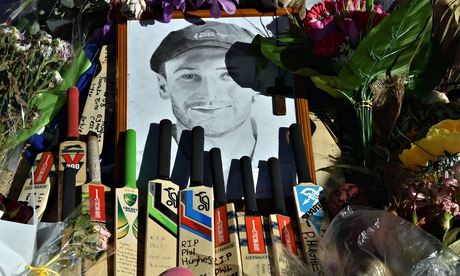
The tragedy of Phillip Hughes’s death brought out the best in cricket. The whole of Australia mourned, it seemed, but so did the rest of the cricket world, not in a manner suggesting intrusion on to private grief, but as part of a wider family. Social media came into its own, and cricketers young and old set out bats, topped with a cap, in a collaborative worldwide tribute. It was incredibly moving. Throughout it all Michael Clarke graduated from being Australia’s cricket captain and became a national leader. His career may be in jeopardy through injury, but his reputation as a great Australian is intact.
2) Buttler’s innings at Lord’s
Matt Prior was struggling physically, that much was clear, and it was impacting on his game. But for some years he had been a vertibra in the backbone of the England team. In the aftermath of the Ashes debacle Alastair Cook wanted his lieutenant. Then, against Sri Lanka at Lord’s, Jos Buttler hit a century from 61 balls, arguably the most astounding and certainly the quickest one-day hundred ever made by an England player and suddenly, over that weekend, the landscape changed. England though missed a trick, unable to recognise the moment, seize it and tap into the zeitgeist. Prior played on, until the inevitable happened midway through the India Test series. If only they had been brave.
3) Shantry’s remarkable performance at New Road
At New Road, in September, Worcestershire gained their championship promotion by beating Surrey and did so on one of the most remarkable individual performances that cricket has witnessed. Jack Shantry is the journeyman’s journeyman, but here he produced the perfect storm. In their first innings Worcestershire, 133 for six at one time , had reached 228 for seven, before Shantry, at nine, scored 21 of 44 for the eighth wicket, helping his side to 272. Surrey reached 373 for four in reply before Shantry took 5 for 15 (6 for 87 in the innings) to keep the lead to 134. By the time Shantry batted again, Worcestershire were seven down and only 37 runs on, whereupon he made 101 not out from 89 balls. Chasing 217 to win, and 131 for two, Surrey fell again to Shantry, 4-22 in an inspired spell.
Worcester won by 27 runs: no one had ever taken ten wickets in a match and made a century at nine or below. They have now.
4) ICC clamps down on throwing
It took a while but finally the International Cricket Council realised that it needed to address the increasing problem of illegal bowling actions. Brave decisions were taken by umpires but they were able to do so in the knowledge that now they had the backing of the international governing body. As a result there were some high profile casualties, most glaringly the Pakistan spinner Saeed Ajmal, whose action after testing was found to be illegal to a ridiculous degree. He has undergone work to remodel and will be back, as has, already, the Sri Lankan spinner Sachithra Senanayake. The question remains as to how they were allowed to get away with it for so long. It is inconceivable that they themselves did not realise what they were doing.
5) Rise of the young guns Root, Ballance and Buttler
From the ruins of the Ashes drubbing emerged the next generation. Joe Root had been around for a little while, and had an Ashes hundred to his name already but struggled in Australia, while Gary Ballance, the spellcheck nightmare, made his debut at the end and was said to have trouble with the short ball. Instead, Ballance has shown himself to be Jonathan Trott’s natural unflustered successor, and Root the calculating mainstay of the middle order. Together with Jos Buttler they should form the backbone of the England team for the next decade.
6) Moeen Ali being Moeen Ali
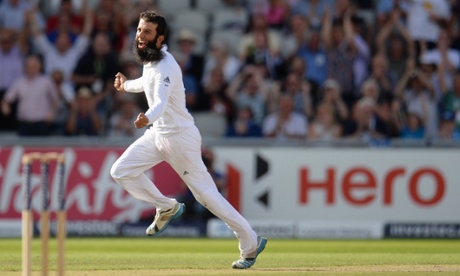
Who can say they do not love Moeen Ali? He has remained true to himself. Dismissed erroneously by many as a part-time offspinner, he has become an integral part of the England attack now Graeme Swann has gone, and bowled England to a win against India at the Ageas Bowl with 6 for 67. He enchants with the bat (and frustrates at times too), with the sweetest timing since David Gower. Against Sri Lanka at Headingley, in adversity, he batted majestically and unflustered all day for a maiden Test hundred that came within two balls of saving a game that had seemed long lost. Then in Colombo, as counterpoint, he struck 119 from 87 balls. His Gaza wrist-band demonstration was heartfelt, a humanitarian rather than political act.
7) Strauss on air over Pietersen
Of all the thousands of column inches written, and millions of words spoken, in the months since Kevin Pietersen was told that he would no longer be selected as part of the England cricket team, nothing was more succinct than the handful of sharp words uttered by Andrew Strauss, and heard by television viewers, all the more poignant for his brief comment being inadvertent. Strauss was an England captain of the utmost integrity, in no small part driven into the ground and ultimately out of the game, by an unmanageable individual. He more than anyone can be listened to. There never was a smoking gun: ultimately it was just Kevin being Kevin and enough was enough.
8) Watching Tim Murtagh bowling
Cricket can produce pleasures that are strictly personal. I spent many years bowling from the Nursery end at Lord’s, and often wondered what, at the top of my game anyway, it might have looked like. Few people understand fully the nuances of bowling from that particular end, with prevailing wind and the slope down from right to left and most pacemen prefer to bowl from the Pavilion end. But then I saw Tim Murtagh, Middlesex’s ersatz Irishman, on song, bowl Lancashire out with a masterful display of fast-medium swing, and use of the slope, and I think I got some idea. It gave me a glow anyway.
9) Professional contracts for women
Charlotte Edwards is a cricketing phenomenon, Dame Lottie in waiting: no England batsman, male or female, has scored more one-day runs than her; she is arguably the most successful captain this country has had in any sport and a deserved Wisden cricketer of the year. In 1996, when she first played for England, it was in divided skirts and few cared. This May, 18 women cricketers were awarded England central contracts. During Edwards’s time she has watched the women’s game expand into the fastest growing female sport in the country and perhaps the world. In Hobart in late January she and Sarah Taylor added 114 runs in 13 overs to secure a Twenty20 win over Australia and with it seal the Ashes, Edwards hitting 92 from 59 balls. A word of caution though: the world, particularly Australia, has caught up, indeed overtaken. Edwards’s task now is to take England to the next level .
10) Cook’s difficult year
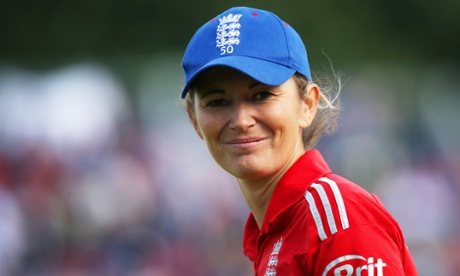
What was it the Queen called 1992? Annus horribilis? Alastair Cook will not forget 2014 in a hurry much as he would like. It has been painful watching a great England batsman degenerate into a floundering novice. He has had his detractors, increasingly so in the past few months, and his enemies post-Pietersen have been vociferous and relentless. There are supporters too though, and the reception he received in the Test against India at the Ageas Bowl was moving. The majority of cricket followers want him back to what he was.
However, Cook is falling between the two stools of being a limited limited-overs batsman and, contingent on that, a declining Test match batsman. His stubbornness is part of what has made him the batsman he has been, but it is also a millstone. Whatever happens between now and April, he will not carry on ODIs beyond the World Cup, and we may see his Test match hundreds once more. It is not the end.