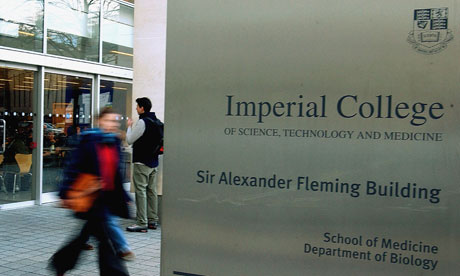
As Imperial College becomes the latest university to declare that it will charge the full £9k in 2012, Jeevan Vasagar tells Cribsheet how Tim Leunig, an economist at the LSE, sees the fees issue.
Leunig reckons most Russell Group universities would still fill their places if they were allowed to charge 20k. "Certainly the top five or seven," he says.
So from a market perspective, students are still getting a bargain.
But Aaron Porter, president of the National Union of Students, says:
"It comes as little surprise to us that Imperial College has decided to charge at least £27,000 for a degree.
"This urgently raises the issue of when the government will apply the brake on fees in order to deliver on their promise that fees above £6,000 will only be charged in exceptional circumstances.
My instinct is that many universities outside the Russell Group will also charge £9,000 to send a price signal of quality and the government has put in place no incentive to stop it."
"To maintain the excellence of the education we provide to students it is our intention, subject to agreement by the Office for Fair Access, to set fees at £9,000 for home and EU students for 2012 entry.
We still have a way to go in our considerations about what forms of financial aid would attract and support the most able, but needy, students. Our message to the outside world though must be that for those who can manage Imperial's courses, the college will work to ensure they can manage its costs."
If only students could pay for their degrees with Tesco clubcard points… oh, wait a minute, they can. An online education provider called RDI has teamed up with the supermarket to ensure the student-consumer gets those cash tills ringing.
More education news from the Guardian
• More than 50 poorly performing secondary schools in England are nearly half empty after being deserted by parents, according to a new analysis that reveals intense competition to secure children the best state education. Official figures show there are over 300,000 surplus places at schools in England, and half of these are at the worst-performing 25% of schools. The Guardian has learned that free schools will be encouraged to open up in buildings currently occupied by poorly performing schools with falling rolls.
On the data blog we have full details of where those 303,751 surplus places are.
• The "Russian business week forum" at the London School of Economics had to cope without one of its star delegates, Alexander Lebedev, owner of The Independent and the London Evening Standard, yesterday. He told them he's afraid that if he leaves Russia, he won't be allowed back in.
• Our Guardian Postgraduate Guide 2011 launched yesterday with full details of master's courses, MBAs and PGCEs at all universities in the UK. These are exclusive tables, based on Hesa figures and other sources, interpreted by Intelligent Metrix.
Education stories from around the web
• British students are increasingly looking at options abroad, and the BBC has been talking to some studying in Maastricht, where most courses are in English, 43% of students are not from the Netherlands, and fees are just £1,500 a year. The Independent reports that a record 22,000 UK youngsters have opted for full-time study overseas, according to official figures.
Meanwhile universities remain concerned about curbs on foreign students coming to the UK. @million_plus tells us: "There were oral questions in the Lords yesterday on the proposed changes to the student immigration system."
• David Cameron will seek to recruit school-leavers to his Big Society today with a call for them to sign up to a volunteering scheme this summer, the Mail reports. The prime minister is using a Facebook page to urge youngsters to register for one of 12 pilots of the government's new National Citizen Service programme. On it he says:
"I want National Citizen Service to inspire you to realise what you can achieve. This summer you will be able to spend two months mixing with other young people, learning new skills, and putting something back into your community.
"NCS will be available to 11,000 people in 2011 and 30,000 in 2012. Over time I want all 16-year-olds to be able to take part.
Blog of the day
Education by Numbers looks at "two papers published this week by respected science education organisations" that call for "fundamental changes to England's exams system".
While the Campaign for Science and Engineering says competition between exam boards can force down standards, the Royal Society complains that the current system discourages students from choosing science subjects post-16. The blog analyses the cases they make and the alternatives they propose.
Insight into journalism seminars for teachers
A unique opportunity for teachers to spend a day at the Guardian, find out how a national news media organisation works and get ideas and resources that can be used in the classroom.
News 11 March Learn about the 24 news cycle; meet news reporters, feature writers, picture and sub editors; understand the role newspaper advertising; go on a tour of the editorial floors and take part in a workshop creating you own news front page which will be evaluated by an editor.
Multimedia 31 March Writing for a news website, web editing, blogging, the use of social media, video production; podcasting.
Places are limited and likely to fill up quickly, so book soon.
Find us on the Guardian website
All today's EducationGuardian stories
Follow us on Twitter and Facebook
EducationGuardian resources
The Guardian University Guide 2011
The Guardian Postgraduate Guide 2011
The world's top 100 universities
More education links on the Guardian
Free online classroom resources from the Teacher Network
More about Cribsheet
Sign up to get Cribsheet as a daily email
To advertise in the Cribsheet email, contact Sunita Gordon on 0203 353 2447 or email sunita.gordon@guardian.co.uk