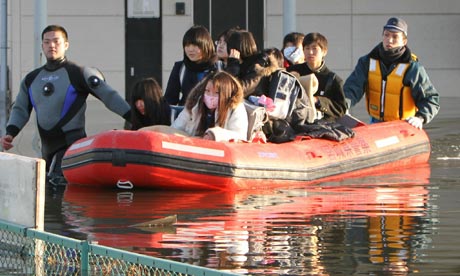
It's a one-story news day, isn't it? The kind of day you think about your counterpart in another part of the world and try to imagine what it's like to be them. Kumiko Makihara is a writer living in Tokyo and throws a little light on family life for the New York Times:
"As I pedalled my way in the dark, I thought about how my son and I would bond on the way home over our first big earthquake. But that fantasy was short-lived. When the teacher brought him out, he was fuming.
'Why did you come? I really wanted to stay the night at school,' he said. The children had been lounging around in brand new blankets, watching DVDs and eating emergency ration cookies.
We spent the rest of the evening watching TV footage. We saw tsunamis sweeping over towns; ceilings collapsing and bright orange fires in the black night. My son grudgingly said: 'I guess it's best to be home.'"
If you work in a Japanese school or university, you might like to let us know what's happening by commenting below.
Education news from the Guardian and Observer
• Headteachers warn that a fifth of teachers could be made redundant. The Association of School and College Leaders (ASCL), which represents 15,000 heads and deputies, said some of its members planned to make 15 or 20 redundancies out of a workforce of about 100. A third of calls to a 24-hour helpline for senior teachers set up by the association are now related to redundancies.
• History textbooks tailored to fit A-level exam requirements have "stultified" teachers' thinking and left children ill-equipped for the type of independent study needed at university, according to an Ofsted report on history teaching.
• Headteachers are angry that Connexions, the youth careers advice service, is being closed down and will not be replaced until September. They say ministers are depriving up to two million teenagers of careers advice at a time of rising youth unemployment and record competition for university places.
• Half of all teenagers in England and Wales are being failed by secondary schools that focus on brighter children destined to go on to higher education, according to a damning new report from the thinktank Demos.
One of its authors, Jonathan Birdwell, says they are not meeting the vocational aspirations of many students:
"The education system needs to be less focused on pushing young people through the hoops of assessment that lead on to higher education, and more on equipping them with the skills to enter and progress through the labour market."
• Simon Hughes is pushing for a multimillion-pound package to support 16- to 19-year-olds staying on at school and college. The Lib Dem deputy leader is lobbying for a compromise solution after the coalition set out plans to abolish the education and maintenance allowance (EMA).
Education news from around the web
• Traditional children's games such as tag are thriving in 21st century school playgrounds - alongside reenactments of the Jeremy Kyle show and Britain's Got Talent. Rather than being killed off by computer games as some fear, children's play is in robust health, according to academic research, a ground-breaking website from the British Library, and a documentary film.
Launched by the former children's laureate, Michael Rosen, the findings of a two-year project, Children's Playground Games and Songs in the New Media Age, will be unveiled at the British Library tomorrow.
One child describes a favourite game:
"Some people play Dr Who by choosing characters from the show and then improvising. They travel to different places in the police box, fight villains and save the world."
Andrew Burn of the IOE, leader of the project, says:
"Pretend play is still flourishing. Children have always enjoyed enacting scenarios from their home or school lives, as well as fantasy stories involving witches, zombies, princesses, martial arts warriors and other figures."
• The Telegraph reports that "a string of universities" have pulled out of a deal with Tripoli to train hundreds of health workers. The disclosure came as official statistics showed virtually every university in Britain is being paid by the Libyan government to educate students.
An anonymous "senior source" at the LSE told the Independent that leading figures at the LSE openly joked about getting a donation from Saif Gaddafi before he had even been examined for his PhD.
"At really top levels of the school people were joking and very aware he was going to be examined for his PhD and thinking ahead to what that could mean."
• @MarcusduSautoy tells us it's Pi Day (3.14) and suggests we celebrate with this pi podcast from the University of Oxford.
Pi, as you know, is the symbol for the ratio of the circumference of a circle to its diameter. Pi Day is celebrated by maths enthusiasts around the world on March 14, because Pi=3.1415926535…
• Aaron Porter, the outgoing president of the National Union of Students, is preparing to launch a bid to become Labour MP for Leicester South, says the Independent. It reports that he is expected to put his name forward to become the party's candidate in the forthcoming by-election, triggered by Sir Peter Soulsby, who has a 8,800 majority, standing down.
• The University of Leeds has been accused of breaching its own equality policies by agreeing to hold a men-only alumni event in Saudi Arabia, the THE reports.
• The BBC reports that heads at the ASCL conference were sporting badges that said: "I failed the English Bac!"
• Oscar the dog helps improve behaviour at a Southampton school.
Caricature masterclass by a Guardian cartoonist
Sharpen your pencils - the Prince's Drawing School is running a weekend masterclass for adults, led by Nicola Jennings, on Saturday 19 and Sunday 20 March from 10am to 4pm.
The weekend will begin with a brief history of caricature, followed by a look at the proportions of the face. Students will learn to observe and analyse facial expressions and movements, highlighting appropriate characteristics to describe personality. Here's the booking form.
Insight into journalism seminar for teachers
A unique opportunity for teachers to spend a day at the Guardian, find out how a national news media organisation works and get ideas and resources that can be used in the classroom.
Multimedia 31 March Writing for a news website, web editing, blogging, the use of social media, video production; podcasting.
Find us on the Guardian website
All today's EducationGuardian stories
Follow us on Twitter and Facebook
EducationGuardian resources
The Guardian University Guide 2011
The Guardian Postgraduate Guide 2011
The world's top 100 universities
More education links on the Guardian
Free online classroom resources from the Teacher Network
More about Cribsheet
Sign up to get Cribsheet as a daily email
To advertise in the Cribsheet email, contact Sunita Gordon on 0203 353 2447 or email sunita.gordon@guardian.co.uk
Subscribe to get Cribsheet as an RSS feed
Interested in social policy too? Sign up for Society Daily