
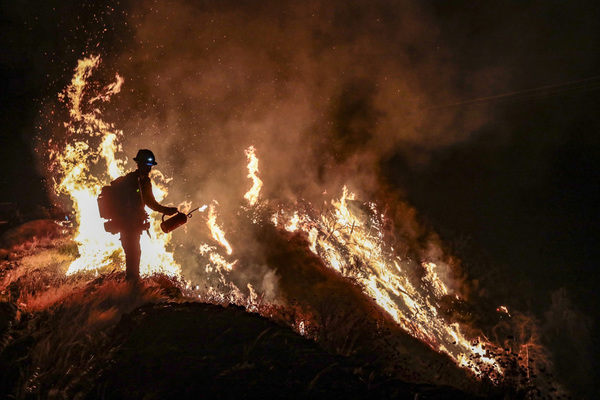
LOS ANGELES _ Beleaguered fire crews made significant progress overnight on the Bobcat fire burning in northeastern Los Angeles County.
After weeks of struggling to keep up with the fire's erratic, multidirectional growth, crews had achieved 38% containment of the blaze as of Wednesday morning _ more than doubling the fire's containment from the previous day.
"Today we had a pretty successful day," Kerri Gilliland of the California Interagency Management said in a Tuesday evening update.
Crews successfully placed several direct containment lines _ barriers created with bulldozers and mechanical equipment to hinder the spread of flames _ along the fire's edge, Gilliland said.
The fire's growth is also slowing. After ballooning to twice its size in the course of one week, it is now increasing in slower increments, growing by a little more than 1,000 acres overnight. The total acreage burned Wednesday was 113,307, according to the U.S. Forest Service.
Progress was so significant that the estimated containment date for the fire has been moved up by one month, to Sept. 30.
"We finally got the resources, we got favorable weather, and the fuel transition was big," Forest Service spokesman Larry Smith said Wednesday. "Once it came out of the really steep timber (of the Angeles National Forest), we were able to get more mechanized."
The northern portion of the fire, which seared through Juniper Hills and portions of the Antelope Valley, has been marked as contained, Smith said.
But the fight is not over. Mount Wilson, home to an observatory and a reported $1 billion worth of communications towers, remains threatened by the fire, which is considered one of the largest in L.A. County history.
Fire crews will continue strategic operations to protect the hilltop throughout the day Wednesday, the Forest Service said.
"I'm exhausted," said Thomas Meneghini, executive director of the Mount Wilson Observatory.
Meneghini said observatory staff have been "pretty well wiped out" from seeing flames lap at Mount Wilson for more than a week. At one point, the fire reached less than 500 feet from the storied structure.
"Our stuff is priceless, it's irreplaceable," he said of the observatory's equipment, which includes a 100-year-old telescope that played an important role in the history of astronomy, and the 2004-built CHARA array for digitized space study.
"There's no monetary value you could put on these items," he said.
On the northern perimeter of the fire, at least 29 structures have been burned, including the nature center at the Devil's Punchbowl, a 1,310-acre rock canyon that receives a reported 130,000 visitors each year.
Evacuation orders remain in place for several communities in the Angeles National Forest and the foothills north of the blaze. Evacuation warnings also remain for Pasadena, Altadena and other areas threatened by the fire.
The Bobcat fire, which ignited Sept. 6, is one of more than two dozen fires burning across California, and resources are spread thin. In response, the Forest Service has mobilized 100 firefighters from across Mexico to assist with wildfire suppression throughout the state.
The firefighters are expected to arrive Wednesday and will receive orientation and training before traveling to the Castle fire within the Sequoia Complex of fires in Sequoia National Forest.
Firefighters from Canada and the U.S. military are also deployed to fires around the state, the Forest Service said. More than 3 million acres have burned in California this year.
But after what felt like weeks of playing whack-a-mole with the unpredictable Bobcat fire, officials said Wednesday's substantial gains could be the start of a new chapter.
"We're really starting to turn a corner on this fire and getting the upper hand," Forest Service spokesman Andrew Mitchell said Wednesday.
But, Mitchell said, officials are not celebrating just yet, as the forecast calls for hot, dry weather that could help reignite the blaze.
"We are expecting elevated to critical fire weather," he said. "It all depends on this weekend."
.jpg?w=600)











