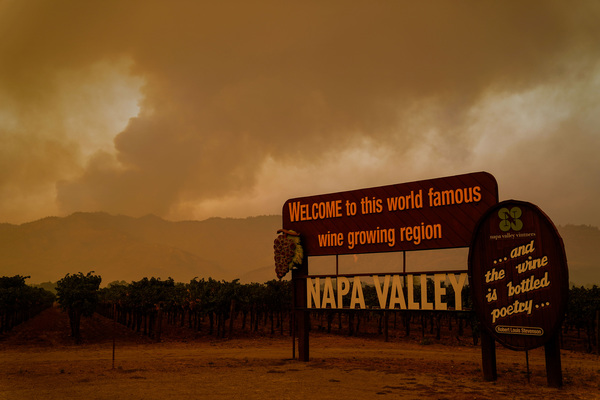
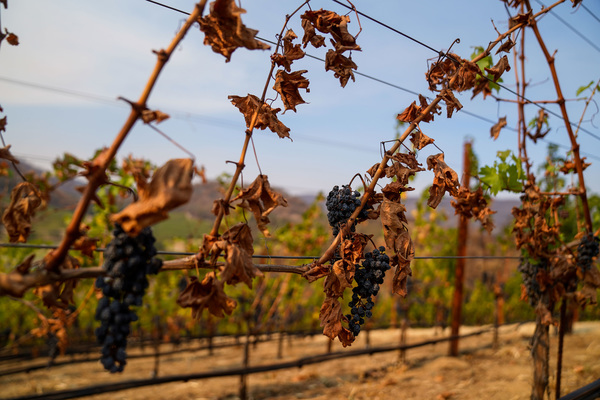
Dangerously dry and windy conditions will challenge crews battling the Glass fire in California's wine country over the coming days, as officials warn that gusts could potentially push the blaze toward communities in Napa County.
The ominous forecast comes as the nearly 57,000-acre blaze remains largely uncontrolled. Officials on Thursday reported that the fire, burning in Napa and Sonoma counties, was 5% contained _ up a bit overnight, but still too low for comfort.
"Our concerns are coming up here in the next 48 hours as that wind starts to shift around from the south and west, coming around to the northwest, and starts to push this fire back in toward the community of Angwin and over toward Pope Valley," fire behavior analyst Brian Newman said Wednesday night. "So we're trying to look at what it's going to do and what kind of heads-up we need to give our operations folks."
Angwin, in the northern Napa Valley, is home to a number of wineries, the liberal arts Pacific Union College and a small airfield. The town is currently under a mandatory evacuation order.
After a midweek reprieve, the National Weather Service issued red flag warnings starting Thursday afternoon for the San Francisco Bay Area's hills, as well as portions of Lake, Mendocino and Monterey counties. They are expected to last through Saturday morning.
Red flag warnings are issued when meteorologists say there's high confidence of dangerous fire weather.
"What that means is the fire now has more energy behind it with the weather to actually get more active and become more difficult to control," said Tom Bird, incident meteorologist for the Glass fire.
Winds could gust up to 30 mph Thursday afternoon, and the air is expected to remain considerably dry through Friday morning.
Even worse, temperatures were expected to again spike across Northern California, climbing as much as 25 degrees above average for this time of year.
Santa Rosa is expected to see a high of 104 degrees Thursday.
Billy See, an incident commander with the California Department of Forestry and Fire Protection, or Cal Fire, said, "We're looking at a very similar wind event" as when "this fire first started moving out" after igniting early Sunday.
"Mother Nature is something that we don't try to guess, so we're preparing for the worst-case scenario and we're hoping for the best," he said during a briefing Wednesday.
The adverse weather comes as crews continue their arduous work to hem in the blaze, which has already destroyed numerous structures _ including 107 homes in Napa County and 36 in Sonoma County.
The fire is still threatening more than 26,000 other structures, officials said Thursday. Its cause remains under investigation.
"It's a scene that's all so very familiar with people in the Napa and Sonoma regions that have been torn asunder by wildfires seemingly every single year _ this drumbeat where people are exhausted, concerned, anxious about their fate and their future, not just their safety," Gov. Gavin Newsom said Thursday as he surveyed fire damage.
One major concern when winds whip up is that gusts can carry embers outside an existing burn area and spark new spot fires.
"In these conditions, these hot, dry conditions with these winds, the vast majority of those embers actually will ignite fires," Newsom said. "It's not the exception, it's almost the rule. And that's why it's absolutely incumbent upon people to take these mandatory and recommended evacuations very, very seriously."
Newsom said the approach to addressing wildfires has to be multipronged and address both near-term needs _ such as proactive forest and vegetation management and earmarking resources and assets for suppression efforts _ as well as the long-term impacts and challenges of climate change.
"We're seeing hots getting much hotter, the dries getting much drier," he said. "We're seeing what traditionally have been smaller, containable fires become unprecedented megafires."
The Glass fire is one of two dozen such major wildfires burning throughout California.
Another is the Zogg fire, which has scorched more than 55,000 acres in Shasta County, southwest of Redding.
Officials made substantial progress on that fire overnight, increasing containment to 26% as of Thursday morning.
However, the blaze has still taken a severe toll. It's been blamed for four deaths and destroyed 147 structures.
Given the recent progress, Incident Commander Sean Kavanaugh said he hopes it will soon be safe enough to allow residents who have been evacuated to return home.
"What I do not want to do is to have an evacuation ... put people back in, and then have to re-evacuate," he said during a briefing Thursday.
More than 96,000 Californians are still away from their homes because of fire, according to state figures.
That's just one of the sobering statistics that's emerged from this year's historic firestorm. Statewide, more than 8,100 wildfires have ignited this year and, together, they've burned close to 4 million acres, according to Cal Fire.
Thirty people have perished in wildfires, and flames have consumed more than 7,500 structures.
"This is a very extreme fire year for all of us," said Jeremy Rahn, a public information officer for the Zogg fire.
Given the enormity and extent of this year's fire season, "clearly, we have our work cut out for us to deal with not only suppression, but prevention strategies," Newsom said.
Weather conditions like those forecast for the coming days raise concerns even for older blazes.
The 6-week-old Dolan fire burning in the Big Sur area of Monterey County is 87% contained, but, like with the Glass fire, there's worry that wind gusts of up to 30 mph could worsen it.
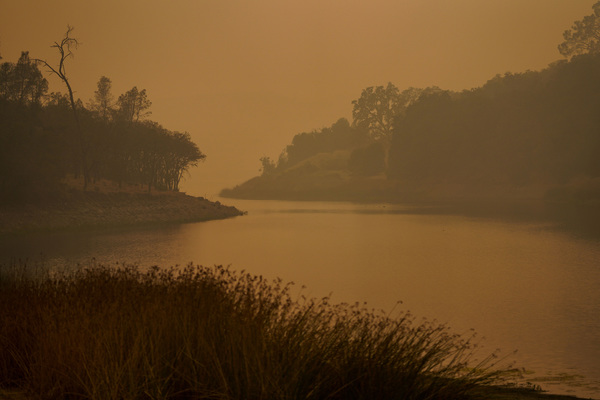
And as always, where there's smoke, there's worsening air quality. The air reached unhealthy levels in some parts of the San Francisco Bay Area on Thursday, as well as across swaths of the Central Valley and Northern California.