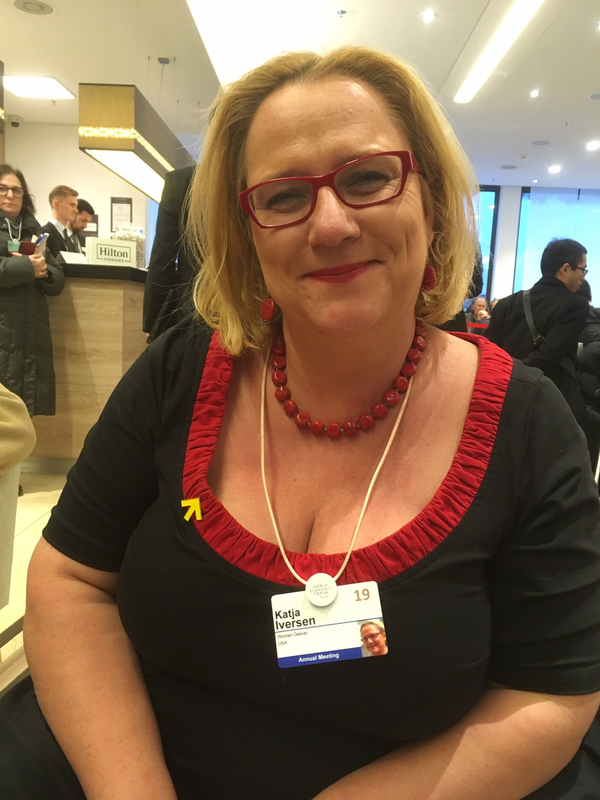
There are precious few chances for face-to-face discussions with global leaders and representatives from politics, business and society -- all at a single venue. The annual meeting of the World Economic Forum (WEF) in Davos, Switzerland, provides these opportunities every year in late January. The Japan News attended the 2019 WEF, interviewing two distinguished figures, Katja Iversen, president and chief executive officer of Women Deliver, during the event, and Kumi Naidoo, secretary general of Amnesty International, after the event through the internet.
Quotas can help Japan reach gender parity, aid economy
The Japan News: How do you evaluate the current progress on gender equality?
Iversen: I'm an impatient optimist. I challenge Klaus [Schwab, founder and executive chairman of the WEF]. Twenty-four percent of participants here [at Davos] are women. Fifteen years ago it was 6 percent. It's gone up by about 1 percent a year. Now I'm teasing him and saying: "You've got to be a little more ambitious. Start taking at least 2 percent jumps."
If we look at the world of leadership, the numbers move a little bit back and forth.
Government leaders say we need gender parity in the cabinets. In 2015, [Canadian Prime Minister Justin] Trudeau did it first, but now we have Spain, [a few] months ago it was Colombia, then it was Ethiopia, then Rwanda, now it's Costa Rica. I met with the presidents of Costa Rica and Colombia [at Davos], and they said, "It's because it's the right thing to do, economically, socially and politically." They are young men. [It's great to] hear them say it's not enough to just have parity in the cabinet, and see how they really challenge gender norms on so many frontiers.
Q: How about women in the workforce?
A: [Leaders] look at the data and say, if we had more women participants in the workforce, our GNP [Gross National Product] could go up 8 percent. That's a lot of money. How do we do that? They look at it not only from a rights and social cohesion perspective, but also from an economic perspective. I am hopeful. We're also actually seeing businesses do the same. You have big global companies going for gender parity now on boards and in leadership. That's also why a place like this becomes an inspiration tank.
Q: You're not pessimistic?
A: I'm pessimistic on one front. Politically, we see a rollback of women's rights in some countries. That also refers to women's right to their own body. In those countries we also see -- and that's kind of cause and effect -- the #MeToo movement. Women won't have it anymore. There's a power in the collective voice. We have all the evidence that shows [gender equality] is not only the right thing to do, it's also the smart thing to do.
We also see how sexual harassment is not just bad for the individual but for the family and society, and for companies. There's starting to be consequences when it's being called out. It's a reputational risk for companies not to do anything. So I am hopeful, but I also know we can never stop watching. We always have to be vigilant and keep showing the evidence, and as women keep lifting our voices up and lifting each other up.
Q: In Japan, we have one woman in the Cabinet. You can criticize these countries where women's rights are abused, but there's little to criticize institutionally in Japan. We've got paternity and maternity leaves, but it's not quite effective. What should we do?
A: One of the biggest questions being discussed here is the question of quotas. The head of the IMF [International Monetary Fund] is talking about quotas and being supportive of it, and heads of state have started supporting it, too, because they see what it does. You can't be what you can't see. A woman or a young girl won't achieve if she doesn't have role models she can look up to and say, that could be me -- and that goes for both the private and public sectors.
Quotas make for good role modeling, but they also show -- for example, when you see it used in the Scandinavian countries -- how women come in and prove their worth, and that the company didn't go bankrupt but actually improved.
One of the issues in Japan is unpaid care work -- the work in the home -- because if you are a mother and you have to do everything at home, there might just be time for a contract job. [There is] a report on the benefits you would see in Japan if you had gender parity in the workforce. You have to work on the norms, the role modeling. You have some beautiful qualities. Those temporary quotas have been successful both for business and for government in other countries.
Discussions profound
Q: Do you think a forum like this helps achieve gender equality and diversity?
A: I truly think so. The discussions now are so much more profound than they were three or four years ago. For example, four years ago when I first started coming, all the gender discussions happened out here in the side rooms. Now they happen in [the main rooms]. They're part of the official forum. It's a positive development.
Q: How could you describe Women Deliver?
A: It's a movement. Or kind of a convener or collaborator. We get different sectors together, whether it's private sector, civil society or government, and people trust us enough to come together and sit at the same table because they know we don't blame and shame. We always have an open discussion that's evidence-based.
We do gender equality broadly, so we can invite to the same table the water people, the education people, the economic people, the health people, and people trust us to facilitate so that they don't just go into their own silos. We say, let's take the girl and the woman and put them in the middle, and let's take our egos and our logos and put them away. There's an educational element, but it's also linked to health because they're integrated and interdependent.
-- Katja Iversen / President and chief executive officer of Women Deliver
Iversen is an internationally recognized expert on development, advocacy and communications, with more than 25 years of experience working in NGOs and U.N. agencies. Her previous positions include chief of strategic communication and public advocacy at UNICEF. She holds a master's degree in communications.
WEF talks useful, but more action needed
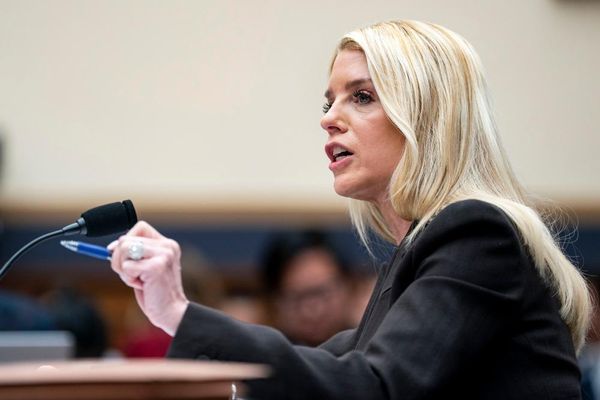
The Japan News: My impression of Davos around 15 years ago was it was more like a so-called rich man's club, a club for the privileged. Now, on the surface at least, it seems there have been many changes to the WEF.
Naidoo: For more than two decades, there has been the participation of NGOs, trade unions, business leaders, as well as cultural actors who are engaged in social issues. In the past, I sat in sessions where a CEO said: "You know, I don't come here for this. I come here to advance my business. This is an economic forum."
That view has been heavily challenged as the business community has run into several legitimacy challenges [such as the banking crisis and the global financial crisis in 2008] where many powerful leaders in the banking industry let us down. The big powerful leaders in business have been forced to show they are engaging in social issues, that they're concerned about climate change, inequality and so on.
But here's the problem: The more things change, the more they stay the same. The more things appear to change, the more they're actually staying the same. And that's what I'd argue.
What the WEF has done is it has absorbed the language and the issues. But what it has not done is address the issues with either the depth of seriousness, urgency or purposefulness that is needed. After the financial crisis in 2008 followed the Asian Financial Crisis from a decade earlier, it was clear that the world economy was not working for the majority of people. What was needed was, if you want a redesign of our economic system, it should have been system redesign, system innovation and system transformation.
However, the response of the Davos community was largely system recovery, system preservation and system maintenance. So just because they're talking about the topics that the world should be talking about, that doesn't mean they're addressing it with the depth of seriousness.
Q: Do you think it will have any kind of positive impact to make a commitment and discuss openly with people like you?
A: There's a small number of us [organizations such as Amnesty and Greenpeace]. Altogether, if you combine them, probably less than 5 percent of people [at the WEF].
Another question you could ask me is, "If you think it is so bad, why do you go?" I would say that firstly politics is too important to be left to politicians alone, economics is far too important in terms of the impact it has on ordinary people's lives to be left to the system alone. If you're calling yourself the WEF and you're discussing the state of the world economy, then it is critically important that those of us who have quite a fundamentally different perspective on the direction the world is headed need to be at those spaces to present the counter-narrative, a different view of the world, a different vision of possibility.
Someone like me, even 10 years ago, was really dismissed as a romantic, an idealist when we were saying we need to move to 100 percent renewable energy as soon as possible. People were like, "Oh my god, 100 percent renewable energy is a vision!" Now, people in large numbers all accept that if we're going to save humanity. So our first role of being there was to present an alternative narrative.
Perpetual deflection
Q: Do you think there's still a use for Davos or this type of forum to continue to engage leaders of the business community or politicians?
A: This is an ongoing perpetual debate, right? I'm sure it'll happen again this year at Amnesty. We'll look at what happened, how the conversations went, what we achieved and then revisit.
Amnesty International is a movement that is committed to dialogue with government and business because we feel that dialogue is important to try to influence them to change because they are the ones that need to change to address climate change and all the issues that we are facing. This is a moment where dialogue is important.
On the other hand, the conversation is not at a level where it needs to be in terms of urgent change. Therefore, every year it's like a bit of a debate. I don't say that this is the same for every civil society organization, but certainly for the movements that I have represented there over the years, first Greenpeace and now Amnesty, it's a perpetual deflection.
So right now, not withstanding all the criticisms, organizations like Amnesty find it still useful.
Q: You said the business community at Davos felt the need to listen to the social issues or civil society because of the economic situation and business environment. Do you think there is a possibility that when business picks up again, they will once again disregard what you want them to hear and what you want from them as commitments in social or human rights or other issues that you feel are very important?
A: With some of the major economic directions that some of the powerful countries like the United States and its administration have pursued, especially advantaging the rich over the poor with massive tax cuts that put the strain on the poor and help the rich, I can't see a path where the economy is going to recover to anything like the heyday of overconsumption, where high-flying CEOs were celebrated as the creme de la creme of society. I think that's never going to come back.
Therefore, I think that we are in a very serious moment right now, so I don't see the WEF having the possibility of ignoring these issues [such as the climate crisis] because those issues are burning more strongly. So I don't think they really have the option, [other than] at least symbolically trying to show that they [care about] the real issues of the day.
-- Kumi Naidoo / Secretary general of Amnesty International
Born in 1965 in Durban, South Africa, Naidoo has been a social justice campaigner throughout his life. At the age of 15, Naidoo organized and joined in an anti-apartheid protest, his first taste of activism. Before assuming his current position, he held multiple leadership roles, including at Greenpeace International.
These interviews were conducted by Yuki Hasegawa.
Japan should make use of changes at Davos
By Yuki Hasegawa / The Japan News Managing Editor
"Huh? Has the ambience changed?"
In late January I participated in the annual meeting of the World Economic Forum in Davos, Switzerland. The last time I covered the event was about 15 years ago, so my memory may be a bit foggy, but compared to that time the atmosphere seemed different.
Following my interests, I attended sessions such as "Discovering Happiness," "More than GDP," "A 'Fourth Social Revolution'?" and "Female Leadership at a Tipping Point," and repeatedly heard the terms "human-centric" and "inclusive."
The topics discussed varied: How should we tackle environmental issues? Can the correcting of disparities coexist with economic growth? What should the relationship be between the development of information technology and human rights?
A head of a global company proposed a target of achieving 100 percent recycling, while an executive of a giant IT company praised measures to prevent the spread of false information.
There were also sessions where the moderator and all the panelists were women.
It's true: The previous one I attended had given me the strong impression of a male-dominated hardcore meeting where heavyweight politicians and major company presidents gathered. Have the hurdles become lower?
"Not good enough," said Katja Iversen, president and chief executive officer of Women Deliver, but the WEF has changed bit by bit. For instance, she said, while female participation is only at 24 percent, more sessions related to gender issues, which used to be held on the outskirts of the forum, have been held in the main venue.
In these times when consumers' personal wishes are hard to ignore with the development of an information-driven society and globalization, it's inevitable that there has been an increase in speech and behavior as well as projects that are conscious of social responsibility and branding. It's easy to criticize such nice words and deeds. For participants, however, reasonable preparation is needed because their remarks and the questions during the sessions have no restrictions. The sessions are webcast live over the internet and media outlets in the United States and Europe put them together to create special reports on Davos.
In fact, one of the remarks reported widely was when someone pointedly asked why people came by private jet in order to attend a session where the current state of environmental destruction was being discussed.
Without regard to intention, people transcend their normal position or background to exchange opinions and to network. With the widening disparity gap becoming a global issue, such opportunities are precious.
While the WEF has been making "small improvements rather than fundamental changes," said Kumi Naidoo, secretary general of Amnesty International, there are few chances where you can talk with important persons in one place and deliver messages to the world.
It was a shame I couldn't really feel Japan's presence at Davos. Since many discussions this time centered on the way society ought to be, Japan should have had many good opportunities to positively convey its views and initiatives. They had the chance to introduce its concept for a future society, dubbed Society 5.0, but I had the impression that the message was lost amid the animated delivery that mixed enthusiasm and humor. People were feeling, "Who was the message for and what did it want to say?"
Shouldn't we take more advantage of the changes at Davos to raise Japan's presence?
Read more from The Japan News at https://japannews.yomiuri.co.jp/