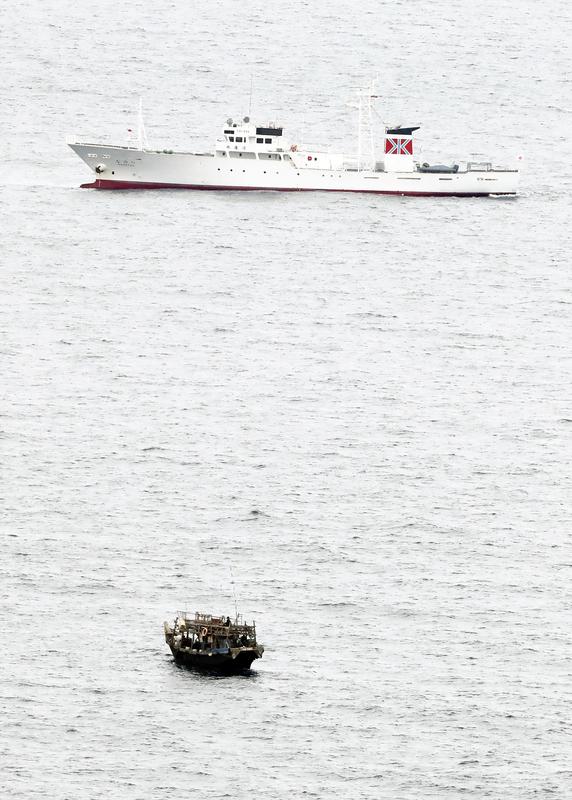
The government intends to develop a new system that will enable officials to instantly determine whether foreign fishing vessels are operating illegally in Japan's exclusive economic zone and whether authorities can crack down on such ships, The Yomiuri Shimbun has learned.
Development of the system will start next fiscal year and is aimed at strengthening the nation's response to illegal fishing in Japanese waters.
North Korean fishing boats have frequently operated illegally in the prime Yamatotai fishing ground off the Noto Peninsula in Ishikawa Prefecture. This fishing ground is inside Japan's EEZ, but government confirmation of vessel locations in these waters and application of the law have previously taken considerable time. In some cases, this situation has allowed vessels to flee and hindered attempts to clamp down on their operations.
The Foreign Ministry will launch development of the system, which features the introduction of electronic charts for the first time by the ministry. Inputting the location, actions and other details of fishing vessels into the system will enable instant decisions on whether a crackdown can be launched.
If a Japanese fishing boat is seized in waters near another nation's EEZ, the new system is expected to help emphasize the vessel was operating lawfully.
The complex nature of EEZs has prompted development of the new system. Every coastal nation may establish such a zone extending 200 nautical miles (about 370 kilometers) from shore. However, the zones of geographically close nations such as China, South Korea and North Korea can overlap with Japanese waters. In these cases, based on Japanese domestic law, a median line is established and the waters on the Japanese side are considered to be its EEZ.
Even within Japan's zone, bilateral fishing agreements concluded with nations including China and South Korea allow their vessels to operate in some areas.
Crews on these ships are foreign nationals, so when the Japan Coast Guard has contacted the ministry during previous crackdowns, its officials have asked questions such as, "Can this ship be seized for operating in violation of EEZ fishing laws?" and "The captain has been defiant, so can we arrest him on suspicion of interfering with the duties of government officials?"
Each time, the ministry would check its charts to determine whether the site in question was "provisional waters" in which the vessel could operate under a fisheries agreement. Considerable manual work was needed to check whether such a vessel was violating fisheries-related laws and regulations.
Read more from The Japan News at https://japannews.yomiuri.co.jp/