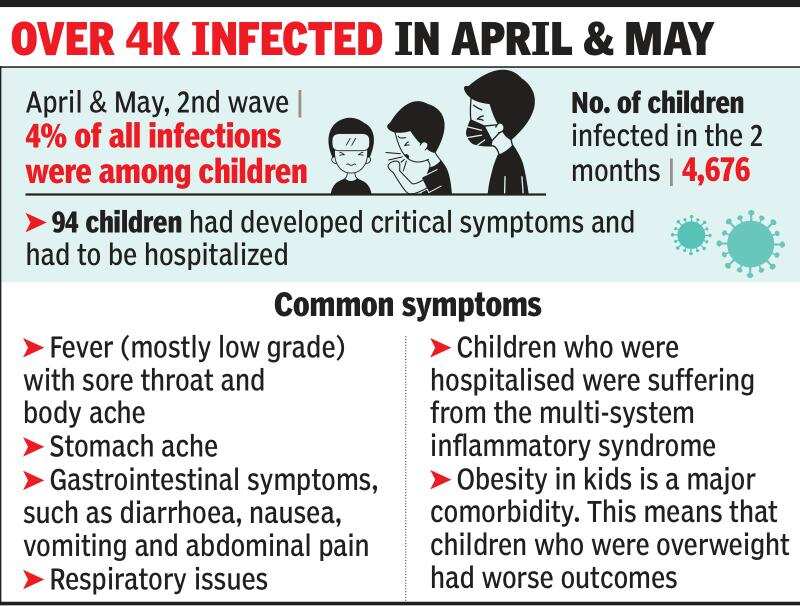
GURUGRAM: Children aged up to 15 years accounted for 4% of Covid cases in the city during the height of the second wave between April 1 and May 31. Of the 4,676 children who were infected during this period, 94 (2%) had to be hospitalised, according to data sourced from the health department.
In contrast, 1,154 children were found to have Covid during the first wave and none of them needed hospitalisation.
Amid apprehension that a fresh wave of Covid infections may affect children more, several doctors TOI spoke to said children were among the healthiest lot and it was wrong to assume that they would be hit the hardest if there is a third wave. However, the health department has started strengthening infrastructure for treatment of children, should there be a surge in cases among kids.
“It’s not true that only children would be affected if there is a third wave. The virus will hit anybody who is susceptible to the infection. However, we have prepared ourselves to manage any kind of situation. We have already strengthened the paediatric intensive care units (PICU) and neonatal intensive care units (NICU),” said Dr Virender Yadav, the chief medical officer of Gurugram.
He added, “We have set up 20 beds in paediatric units and made arrangements for BiPAP machines for children. In Medanta hospital, around 100 ventilators are being installed in paediatric wards. At M3M Group’s facility, 100 oxygen paediatric beds have been set up. We are also keeping aside 100 observation beds for children at Bharat Vikas Parishad in Palam Vihar.”
According to doctors, children infected with Covid mostly have low-grade fever with sore throat and body ache. Some children feel a pain in the stomach and develop gastrointestinal symptoms, such as diarrhoea, nausea, vomiting and abdominal pain. Others also experience breathing distress and high fever.
Doctors said there were very few fatalities among children due to Covid. “During the second wave, saw 30-40 children getting infected with Covid every week. But there were very few deaths among children. Deaths were noticed only in cases where the child was already suffering from cancer or any other life-threatening disease. Compared to adults, children were less infected. Healthy children recovered faster without hospitalisation,” said Dr Kishore Kumar, founder chairperson and neonatologist at Cloudnine Group of Hospitals.
According to official data, however, there have been no deaths among children at city hospitals due to Covid.
Dr Manish Mannan, head of paediatrics and neonatology at Paras Hospitals, said, “Here, we had to admit only two children, both of whom were 15 years old. The symptoms in one of them were high grade non-responsive fever with increased rate of breathing. He had to be administered oxygen. The second child also had high-grade fever beyond seven days with deranged blood reports. They had a CT score of 12/25 and 15/25. They were treated according to prescribed protocols. Both of them were discharged after a week. They are doing well now.”
Doctors linked Covid-19 in children with comorbidities. Dr Sudip Chowdhury, consultant paediatrician at Columbia Asia Hospital, said, “Children were affected more during the second Covid wave primarily because more adults were infected. Like adults, obesity in children is a significant comorbidity. This means that the children who were obese had worse outcomes. The ones below the age of one and those with comorbidities like asthma, renal issues, heart disease, genetic conditions or ailments where immunity is low, were at higher risk.”