The Tokyo Olympics had been billed as the "recovery and reconstruction Games," but the novel coronavirus pandemic has disrupted plans to showcase how areas hit hard by the Great East Japan Earthquake and tsunami are getting back on their feet.
Ahead of Friday's opening ceremony, Olympic softball and soccer matches were played Wednesday in Miyagi and Fukushima prefectures -- two areas severely impacted by the March 2011 disaster. However, most competition venues will be without spectators due to the pandemic, eliminating opportunities for people to see the disaster-affected region with their own eyes. Games and local officials are now trying to devise ways to widely share information about the Tohoku region's recovery.
Fukushima Gov. Masao Uchibori observed a softball game played in Fukushima City on Wednesday. "I'm really moved to see that the matches have started in Fukushima, a key pillar of the recovery Games," Uchibori said to reporters after the game.
The Japanese Olympic Committee pitched the "recovery Games" when it decided in July 2011 -- four months after the disaster -- to select Tokyo as the bidding city for the 2020 Games and Paralympics. Under a basic plan the Cabinet approved in 2015, the government said it would promote efforts that support reconstruction and recovery of the disaster-hit areas.
As part of that initiative, the J-Village sports complex, which became a frontline base for cleanup efforts at the wrecked Fukushima No. 1 nuclear power plant, was selected as the starting point for the Olympic torch relay. Fukushima and Miyagi prefectures were picked as venues for matches played before the Games officially started. Other plans drawn up included visits to Fukushima Prefecture by ambassadors from various countries, and events explaining the state of reconstruction efforts in the region.
However, the spread of coronavirus infections pulled the rug from under many of these plans. In March, the Tokyo Games organizing committee and other bodies barred overseas spectators from coming to Japan to watch the Olympics and Paralympics. In July, they decided Olympic sporting events held in Tokyo and three neighboring prefectures would be held without spectators. At one stage, Fukushima Prefecture was preparing to allow a limited number of fans to watch Olympic events at its venues, but it reversed this plan out of concern about infections in the prefecture. Reconstruction-related events have been canceled.
These developments disappointed Kimiko Sato, who was due to be a volunteer guide for spectators. "Given that these were touted as the recovery Games, I wanted many people to see the current situation in Fukushima," said Sato, 72.
-- PR efforts turn to Tokyo
Venues in Miyagi Prefecture are among the few where spectators are still allowed in. A group of about 30 volunteer "storytellers" will welcome spectators arriving at the airport and train stations. On Wednesday, volunteer Hiromi Kyono used display panels as a backdrop near Sendai Station while detailing her firsthand accounts of the 2011 disaster.
"I spoke with a desire to repay the kindness the whole world showed us [after the disaster]," said Kyono, 42.
Aside from Miyagi Prefecture, opportunities to directly convey the reconstruction and recovery efforts are few and far between. Consequently, the Reconstruction Agency and the organizing committee will ramp up a campaign to raise awareness in Tokyo, where the bulk of overseas media will be based during the Games.
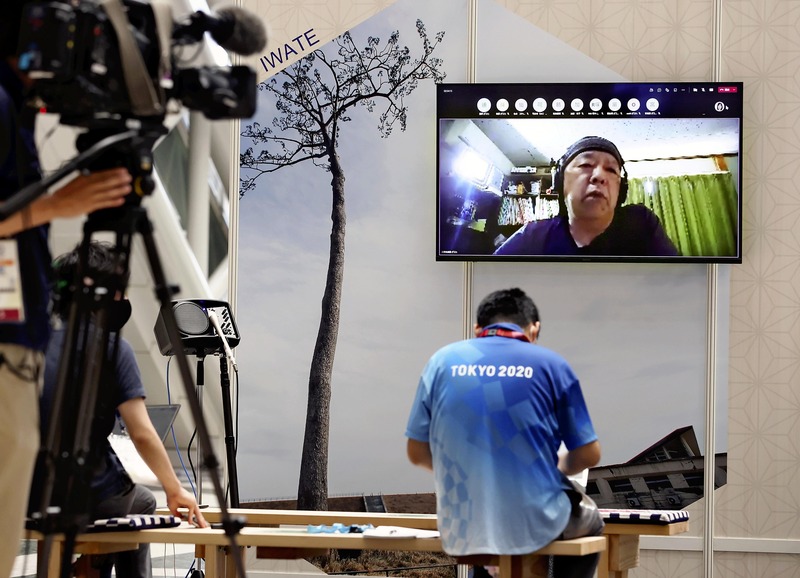
A booth featuring photos and videos highlighting the current state of reconstruction in the disaster-hit region has been set up inside the Main Press Center. After the Games have finished, the agency is considering asking foreign residents living in Japan to visit Olympic venues in Fukushima and Miyagi prefectures, and then use social media to share the legacy of the "recovery Games."
-- Food safety
Considerable resources are being poured into emphasizing the safety of food grown in the disaster-affected areas. Only in extremely rare cases have radioactive substances above set safe levels been detected in food products. Extensive checks and tests are in place, and any food that exceeds specific safety levels does not get shipped. Despite these steps, 14 nations and territories still restrict imports of agricultural, fishery and forestry products from Japan.
Meals featuring vegetables and fish from the disaster-hit areas will be served daily in the athletes village in Tokyo. However, South Korea has called for its athletes to avoid eating food from Fukushima and other places.
In contrast, David Hughes, chief medical officer of the Australian Olympic team, had no qualms about the ingredients being used. At a press conference Sunday, Hughes said it was safe to eat such food, given the results of surveys conducted by experts.
On Monday, a farmer from Nihonmatsu, Fukushima Prefecture, gave a speech online to Games officials and overseas media at the Main Press Center. "The safety of the food we grow hasn't been fully conveyed," said Noboru Saito, 62. "I want more people to understand the efforts made to reduce radioactive substances in our produce, and the results of these efforts."
Read more from The Japan News at https://japannews.yomiuri.co.jp/