Health authorities have downgraded the risk assessments of a series of close contact COVID-19 exposure sites, in an apparent concession the territory cannot contain the virus or cope with its ballooning impact on testing and tracing resources.
The monitor for symptoms exposure location definition was reintroduced on Tuesday and sites downgraded to that status included crowded locations where significant transmission of the coronavirus has been identified.
Under the new approach, such sites will have no formal isolation or testing requirements for attendees.
The move that will release people early from quarantine and ease pressure on overwhelmed testing clinics by requiring fewer people who have come into contact with the virus to be tested.
ACT Health said the new risk assessments would focus on identifying sites where COVID-19 was at risk of being transmitted into high-risk settings, such as healthcare facilities, and at-risk population groups.
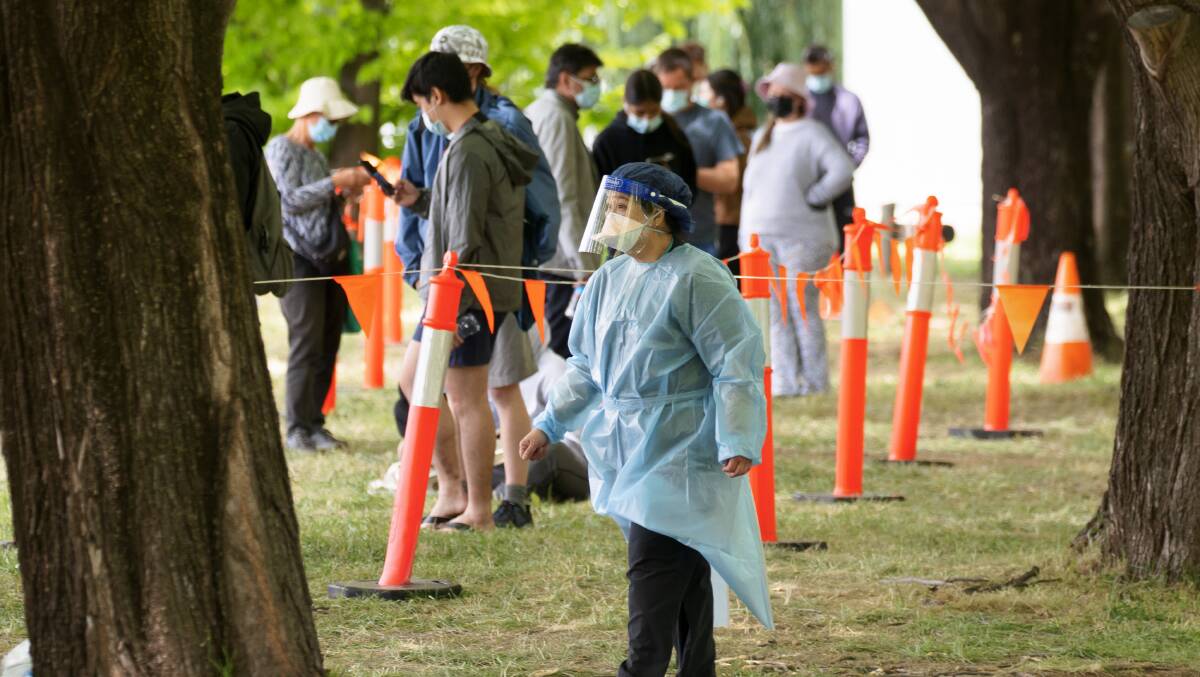
The ACT broke its daily case number record again on Tuesday with 252 fresh infections of COVID-19, as significant demand for PCR tests continued at government-run clinics. There were 908 active COVID-19 cases at 8pm on Monday night.
The Basement in Belconnen, which had been identified as a close contact exposure site on the night of Friday, December 17, was reclassified as a monitor-for-symptoms site on Tuesday, despite extensive virus transmission.
The ACT's chief health officer, Dr Kerryn Coleman, last Thursday said exposure times at The Basement and the Mooseheads nightclub would stay classed as close contact sites. "I would consider them high-risk impact sites. Absolutely," Dr Coleman said at the time.
ACT Health says monitor exposure locations "have a lower risk of onward transmission" to people present.
ACT Health said the changes to exposure sites would not change the requirement for people to be tested for COVID-19 if they were classed as contacts based on interactions with a confirmed case.
"Symptom-free individuals who have been to a 'monitor-for-symptoms' location at the specified time no longer need to quarantine and do not require a COVID-19 test," ACT Health said in a statement.
"However, people who have attended these locations should be particularly vigilant for any symptoms, and if they develop, they should get tested with a COVID-19 PCR test and isolate until a negative result is received."
The ACT's check-in phone app, Check In CBR, will issue push notifications for exposure sites and ACT Health will no longer send text messages to inform people they have been to an exposure site.
People who were isolating because they had been at a casual exposure site that was downgraded to a monitor-for-symptoms site could leave quarantine immediately if they were symptom free, without needing to hear from ACT Health.
The rapid increase in ACT COVID-19 infections prompted one hospital insider to warn a large number of cases would significantly reduce the capacity of the broader health system as staff were forced into isolation.
Senior lecturer in medicine at the Australian National University Dr David Caldicott said the healthcare workforce "breathed a collective sigh of relief" as the Delta COVID wave waned, but now assumed the situation would get "far worse before it gets better".
"We're bandaging our wounds and getting ready to go back on the battlefield again. There's no one within healthcare itself that feels this is over, this is cool, this is mild," he said.
Dr Caldicott said easing the strain on intensive care was a matter of repeating tried and tested measures over New Years, including reintroducing density limits and mask wearing to limit the number of COVID cases in the community.
But he accepted there was a "political imperative" for leaders afraid of electoral repercussions after reintroducing tough measures.
"Encouraging people to go to New Year's Eve festivities does not represent the pinnacle of healthcare advice," he said.
with Hannah Neale