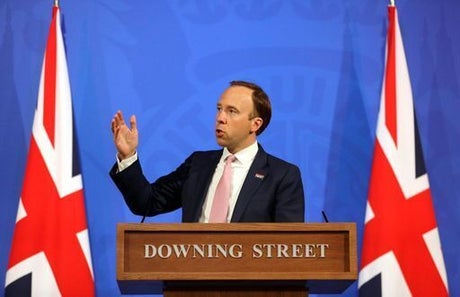
Matt Hancock will lead a Downing Street press conference at around 5pm on Wednesday to give an update on England's progress in tackling Covid-19.
The health secretary will address the public as concerns mount over a new strain of the virus, first detected in India, which has thrown into doubt plans for a lifting of all restrictions on 21 June.
Mr Hancock is to be joined by top government scientists and will take questions from journalists once a full update on the latest data and statistics has been given.
Concerns are growing that England may have to delay the end of lockdown restrictions due to the more transmissible B.1.617.2 strain of the infection.
Prime minister Boris Johnson said on Tuesday that he would end speculation about delays in the coming days, adding that there is no "no conclusive evidence" to suggest that a change to the roadmap is needed.
Mr Hancock and other ministers have previously refused to rule out local lockdowns, saying that "everything is on the table" when it comes to protecting the most vulnerable.
The Indian variant is dominant in some areas of northern England but spreading to other parts of the UK.
Mr Hancock said earlier this week there have been more than 2,000 confirmed cases of the variant of concern in the UK – with cases doubling in some parts of the country over the last week.
Data from the Wellcome Sanger Institute – based on recent surge testing – showed how rapidly the Indian variant has spread across England.
There had been a 44 per cent increase in the number of areas in England detecting the Indian variant over the past week. The variant of concern was found in 127 areas in the week ending 8 May, compared with 71 in the week before.
However, most areas have under five cases – and health authorities in 40 of the 127 areas have only identified one case of the variant so far.
Earlier today, the Conservative leader of Bolton Council, where the variant is high highly prevalent, said there could be civil unrest if a lockdown is enforced.
David Greenhalgh told BBC Radio 4's Today programme: "We've been there before and they don't work - not in a dense conurbation like Greater Manchester.
"This happened before, the spread increased because people travelled 50 yards across the county boundary to access hospitality that they can't in their own area."
Asked if he had told Mr Hancock there would be civil unrest, he said: "I do think there is a danger of unrest."