Since the outbreak of COVID-19, the world has essentially hit the pause button in order to deal with the pandemic.
So complete is the global slowdown, the results can be seen from space — and in the air we breathe.
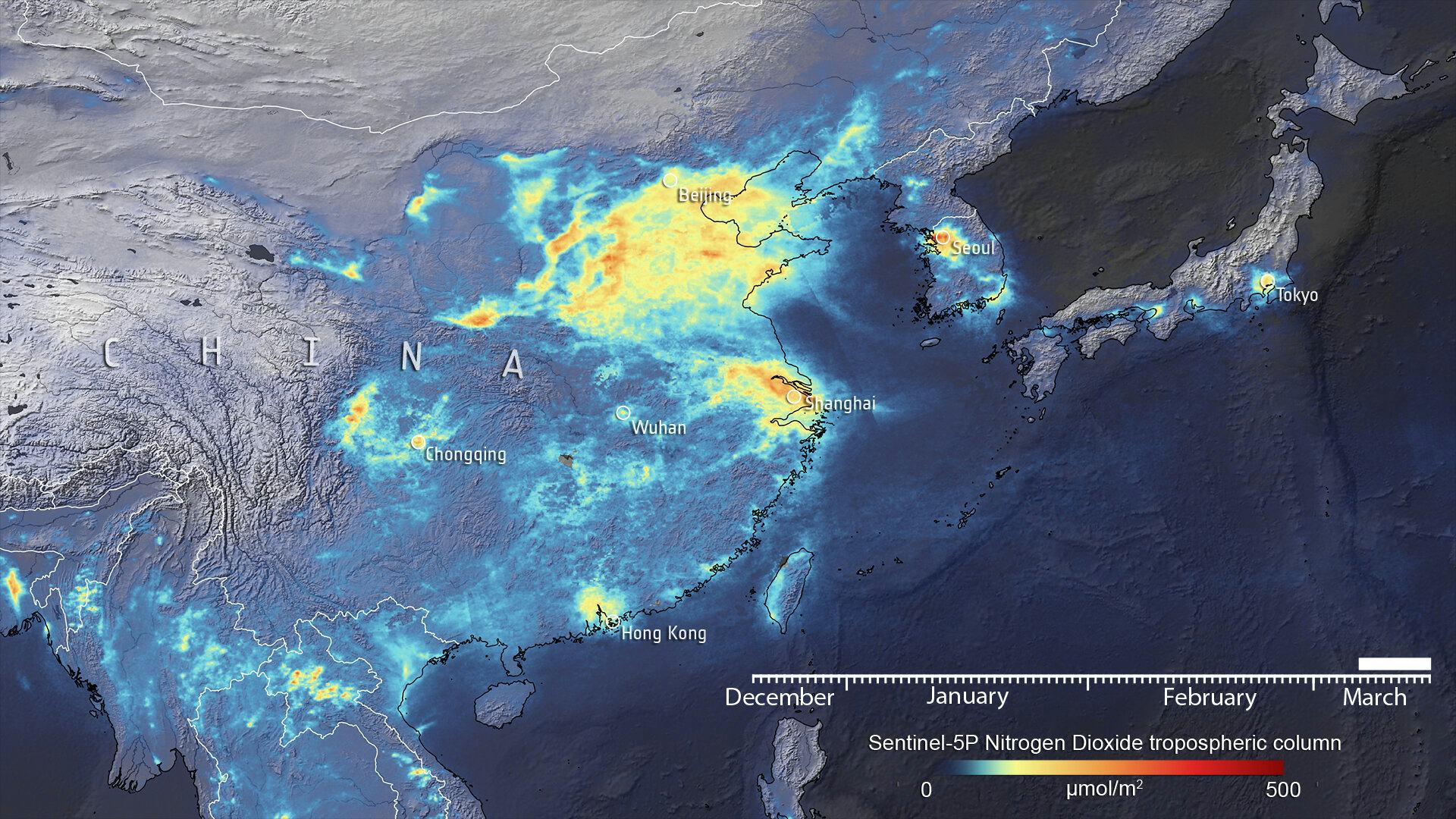
In a new video, the European Space Agency (ESA) reveals how satellite observations show a significant decline in nitrogen dioxide levels over China since the outbreak began in December, 2019. Nitrogen dioxide is one of the most abundant greenhouse gas pollutants.
The animated video uses data collected by ESA’s Copernicus Sentinel-5P satellite, which measures air pollution from space, from December to March over large parts of China.
The data revealed a 20-30 percent reduction in fine particle matter compared with the previous three years.
As the video reveals, nitrogen dioxide emissions begin to decline in late January, which coincided with a government-imposed lockdown of certain regions of the country. On January 23, the Chinese government imposed a lockdown in Wuhan and other surrounding cities in order to help stop the spread of the novel coronavirus.
The lockdown shut down factories, closed off roads and restricted people to their homes.
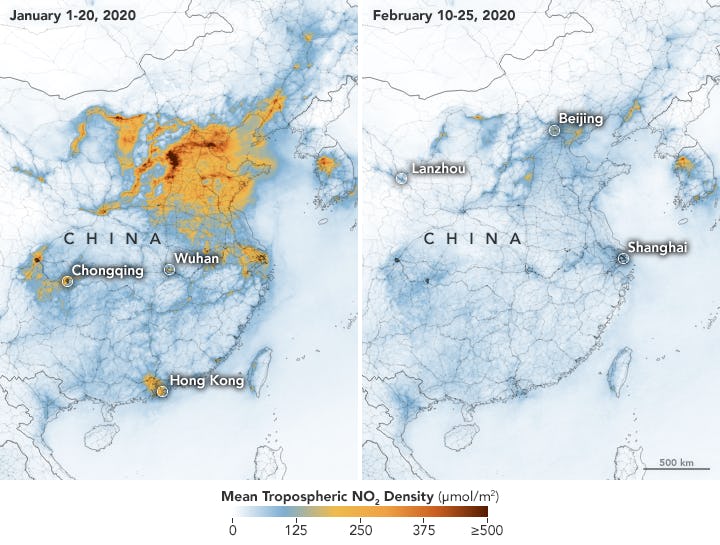
"As nitrogen dioxide is primarily produced by traffic and factories, it is a first-level indicator of industrial activity worldwide," Josef Aschbacher, ESA’s Director of Earth Observation Programmes, said in a statement.
But worryingly, the video shows nitrogen dioxide levels are beginning to rise again in early March, as restrictions eased across some Chinese cities as the number of new cases decreases over time. Only time will tell if they will reach pre-coronavirus levels, or surpass them, as industry ramps back up.
Global effect
The video echoes a similar trend in the data observed over Italy, where there is also a significant outbreak of COVID-19 and a country-wide shutdown in force.
As in China, nitrogen dioxide emissions started to decline in late January as the state started to lockdown industry-heavy areas of the country.
In order to help stop the spread of the virus, Italy’s Prime Minister Giuseppe Conte recently extended the lockdown from northern Italy to the entire country. Italy has the most cases out of all European countries, with more than 9,000 diagnosed cases at the time of writing.
This video was also captured by ESA's Copernicus Sentinel-5P satellite, from January 1 to March 11, showing a view of all of Europe. The drop in air pollution is most precipitous over northern Italy.
The World Health Organization (WHO) recently declared COVID-19 as a global pandemic. So far, it has claimed the lives of almost 10,000 people worldwide.
Aside from the disease's devastating effects on our lives, it has also highlighted how a slight decrease in human activity may have dramatic influence another looming threat to people's health. Air pollution kills around 7 million people per year, according to the WHO.
The two animations provide some indication of how ongoing social distancing and working-from-home habits currently being implemented in some cities in the United States may have on the levels of air pollution, for example in normally bustling cities like New York or San Fransisco.
Perhaps by the time things return to semi-normality, we will all be going out to clearer skies, and fresher air than before.