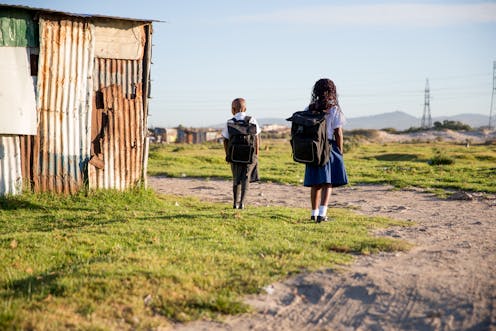
The COVID-19 pandemic could be the catalyst for action to address the consequences of inequalities in South Africa’s education system. This is because measures taken to prevent the spread of the coronavirus are unearthing a wide range of systemic problems right across the education landscape – from water shortages to bad sanitation and overcrowding.
Over the past two and a half decades the legacies of apartheid have slowly emerged. But never at the scale – or with the impact – inflicted by COVID-19.
One example is basic water and sanitary infrastructure. The schools built under apartheid for black children in both urban and rural settings still have chronic infrastructure shortages.
These gross inadequacies have hit the headlines from time to time. One example was the death of six-year-old Michael Komape in 2014 after he fell into a pit latrine at a school in the Limpopo province. The tragedy led to an outcry, but that didn’t last. Many people were disturbed and saddened, but nothing changed substantially.
By October 2019, over 26 years after apartheid and more than five years after Michael Komape’s passing, projects to refurbish pit latrines were still under way.
But COVID-19 could be the shock that changes this. The country closed all schools in March as part of lockdown measures designed to curb the pandemic. This week the government announced a plan for the gradual opening of schools.
The announcement has brought home the fact that many schools are not in a condition to welcome pupils back in a way that ensures their health and safety. For many this will mean that they can’t return to their classrooms, with long term consequences for the country. These would include having to shift the school-going age for children and losing an entire cohort of university entrants.
The impact of the changes being forced by COVID-19 were best summed up by the minister of basic education, Angie Motshekga, when she said:
The virus has forced us to re-engineer the basic education system.
The gaps
This week Motshekga announced that grade 7 and 12 learners would be going back to school on 1 June 2020.
The announcement followed weeks of uncertainty during which the minister set various dates for opening, pointing to the government’s decision to take a staggered approach.
The country’s trade unions were clear from the beginning that they opposed goverment’s plans. For example, the country’s biggest teacher union, South African Democratic Teachers Union, issued a media statement which ended with the words:
We stand firm that no schools shall open until our concerns are met.
The union’s concerns were laid out in 14 points. These included:
proper school infrastructure in the form of proper toilet facilities and classrooms,
observance of social distancing inside the classroom and in courtyards,
reduction of class sizes,
the provision of soap, sanitisers and masks,
the screening of learners, teachers and support personnel.
Another union, the National Professional Teachers’ Organisation of South Africa, asserted that the proposed dates were incomprehensible.
The government’s most recent statement was met with a more muted response from the unions. This suggests that government had begun to address many of the concerns raised initially.
The events of the past six weeks have systematically exposed the scale of the problems facing South African schools. Many are so severe that they stand in the way of the country being able to send its pupils safely back into the classroom.
They also point to the fact that there was never a full overhaul of the education system after apartheid.
Inadequate sanitation and water infrastructure, overcrowded classrooms and a shortage of teachers in specific phases and subjects are some of the challenges the education system is battling with.
All militate against schools reopening.
The consequence is that the Department of Basic Education is being forced to prioritise the basics. This was made clear by Motshekga when she pointed out that:
We have had to focus on water sanitation. The question of water and sanitation is part of the plans.
It’s quite likely that at no point in the post-apartheid era has there been more urgent and decisive action taken to address inequalities related to basic water and sanitary infrastructure than at present in the education system.

Zahraa McDonald has received funding from the NRF and Zenex Foundation. The views expressed in this article are however her own.
This article was originally published on The Conversation. Read the original article.