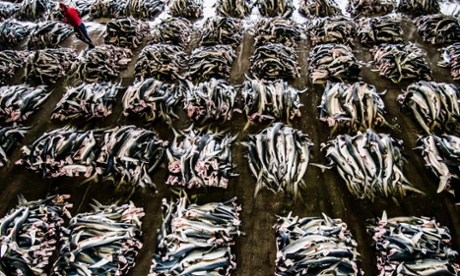
In early 2014, a story made headlines around the world. At a factory in Wenxhou, southeast China owned by a Mr Li, whale sharks were being slaughtered in their hundreds, their various constituent parts distributed for food, medicine and cosmetics not just in China, but in the west too.
Footage of an undercover sting in the factory is among the most viscerally shocking sequences in Racing Extinction, which airs tonight on the Discovery Channel in the UK. The new documentary by Louis Psihoyos, director of The Cove, is based on the premise that we humans are driving earth’s sixth great extinction event – the first time that such a happening has been caused by a species.
Ocean advocate and Emmy winning photographer and cinematographer Shawn Heinrichs has been reporting from the frontline of the trade in sharks and rays for many years now and was a core member of the Racing Extinction crew. He and his colleague, photojournalist Paul Hilton were key to gaining access to Hong Kong and Mainland China’s notorious trade in endangered and protected species.
“Louis realized he had to go to the heart of the trade and that meant going to China,” Heinrich explains. “At the Li facility, we posed as western buyers opening up new markets in the USA.”
Li is captured on camera admitting to smuggling whale sharks out of China, in contravention of a CITES ban. “Those whale sharks were coming from the South China Sea around the disputed islands, others from Indonesia and the Philippines,” he says. In other words a significant proportion were and probably still are, being caught in the Coral Triangle.
Racing Extinction makes for sobering viewing. We are currently losing species at 1000 times the background rate – that is, the natural rate of extinction. And vital marine ecosystems like reefs, sea grass and mangroves could be among the first truly catastrophic losses of the Anthropocene era.
“Certain forecasts are saying we could lose most of the world’s reefs by 2050. We just can’t afford to increase CO2 emissions further. 40% of the world’s fish come from coastal resources, two billion people depend on the ocean – we’re literally threatening the world’s fisheries.”
Extrapolate on scenarios like this one and you begin to understand just how ubiquitous a crisis climate change presents. “What are hungry, frustrated people going to do? Climate change could be the single most important factor threatening [US] national security,” Heinrichs suggests.
The same point was made by Bernie Sanders during October’s Democratic debate on CNN, though his assertion failed to make headlines. Nevertheless, It’s a major concern for policy makers – leading think tank the International Institute for Strategic Studies (IISS) states that “climate change could have a serious effect on regional and global stability.”
As Heinrichs puts it, “the poor custodial decisions we are making today are breeding the issues of tomorrow.”
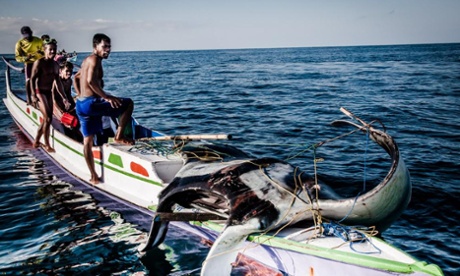
There are examples of positive change in the film and many of these come from the Coral Triangle. There is the story of the Indonesian village of Lamakera, whose residents have been traditional hunters of manta rays for generations. According to Heinrichs, they were conscripted into commercial fishing and quickly obliterated the regional manta population. That trade has now largely stopped and a programme is underway to help the community convert to hand line fisheries as well as getting locals involved in research and a fledgling eco tourism enterprise.
“If you can change a place as remote as Lamakera to the sustainable utilization of resources while embracing cultural traditions, there’s hope,” says Heinrichs.
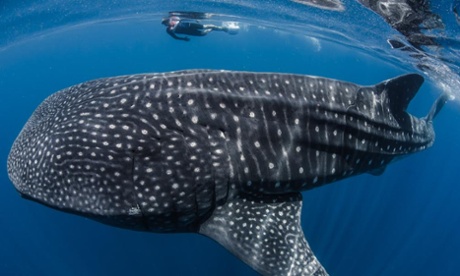
Then there’s the province of Raja Ampat in West Papua, Indonesia, the global epicentre of marine biodiversity. It is also one of the world’s foremost conservation success stories, where communities, N.G.Os and local government have worked together to turn it into the world’s first conservation province. Both sharks and rays are protected throughout Raja Ampat – legislation that has impacted on policy at the national level, with a blanket ban on manta ray fisheries across Indonesia – the first of its kind anywhere in the world.
“Big iconic species are a way to bring people into conservation – you start with whales, move onto sharks and their tourism value and then bring in turtles, dugongs…from there you can begin protecting entire ecosystems,” says Heinrichs.
Progress of a kind. But if negotiators are unable to agree a binding agreement at the climate talks in Paris over the next two weeks to keep global warming below 2C, these efforts may prove too little too late for the the Coral Triangle, the world’s reefs and quite possibly the planet’s storehouse of marine life. This is a race we can’t afford to lose.
Racing Extinction airs on the Discovery Channel tonight at 9pm.