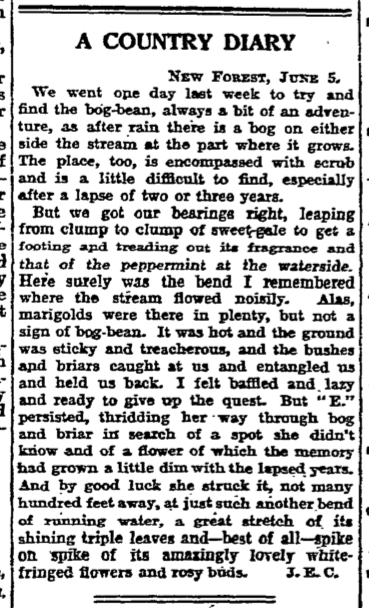
Fascinated by JEC’s account of her search for the bog bean (Menyanthes trifoliata) in a Country diary dated 5 June 1933 (I’d come across it in the slim grey selection of her diaries published posthumously in 1939), we tried last year to relive the adventure.
When Janet Elizabeth Case (1863–1937), a classics scholar who had taught Virginia Woolf, was writing eight decades ago, the forest retained a sense of wilderness that it is hard to find now. Cars were around but did not infest it as they do in this century, and car parks were virtually unknown.
JEC describes leaping from clump to clump of sweet-gale (bog-myrtle) to get a footing as she and a friend named only as “E” crossed ground that was sticky and treacherous, even on a hot day, their path impeded as briars snagged and entangled them. Persistence was rewarded when they came across “a great stretch of its shining triple leaves and – best of all – spike on spike of its amazingly lovely white-fringed flowers and rosy buds”.
Today there are several bog bean sites that can be reached easily from nearby car parks. Last year we visited some we thought fitted her description but there was no trace of the plants.

It’s said that the bog bean gets its name from the triple cluster of leaves that are reminiscent of the broad bean, but its enchanting flowers are unlike anything else. This spring the plants are coming into flower somewhat later than in recent years – we have seen them here in late April – but, because of the drenching we have had over past weeks the forest is very wet, the ground indeed sticky and treacherous. As we found out, keeping a sure footing requires good balance.
Perhaps, though, the real adventure belongs to the modern age. Even without briars to snag and entangle, getting into position to frame a good picture from a low perspective is a challenge. The forest’s boggy areas often conceal sink holes, just where bog beans thrive, often in shallow water with a glutinous muddy bottom. A chance, maybe, to get stuck in!