
WASHINGTON / JERUSALEM -- More and more countries are introducing "vaccination certificates" proving that the holder has been inoculated against COVID-19. This measure is drawing attention as a way to help normalize social and economic activities, but numerous issues remain, including discrimination against people who do not have such a certificate and how long vaccines remain effective.
-- Official go-ahead
Vaccinations are underway at a rapid pace in many countries. What effect will that have on the social and economic activities brought to a near halt by the pandemic? One measure drawing attention as a possible image of the future is Israel's Green Pass vaccination certificate, which is becoming more and more common among its people.
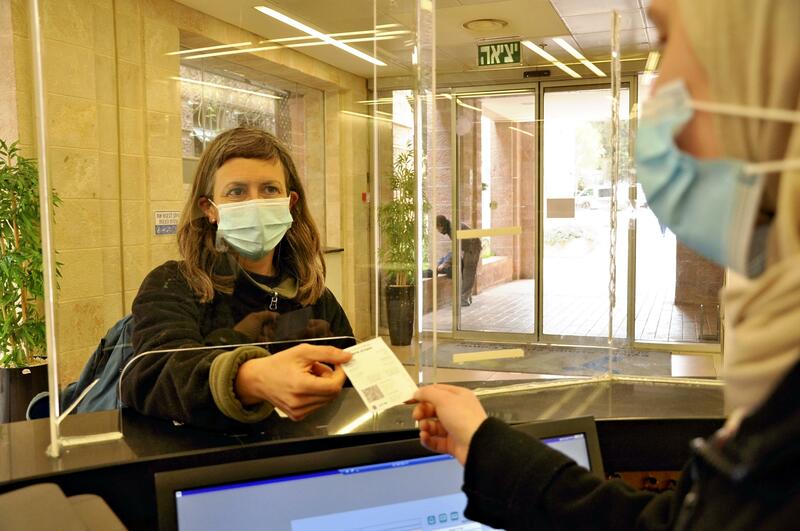
At the YMCA Sports Center in central Jerusalem on March 4, users showed their Green Pass certificates at the reception and entered the gym one after another. The certificate is issued by the central government and is valid for six months. People without a Green Pass cannot patronize theaters or restaurants, or attend music events, among other activities.
While infection prevention measures are still in place, special equipment is increasingly being deployed to approve holders of the certificate by scanning a QR code printed on its surface.
More than 50% of the people in Israel had received their first dose of vaccine as of March 8, and about 40% had gotten the second. Nearly 10,000 new cases of infection were reported daily in January, but the number has since declined to one-third that level.
"People here have already been vaccinated, which gives me a sense of security," said a 62-year-old man who visited the gym. He clearly felt that vaccinations were bringing society back to normal.
-- Global standards
Some countries are striving to use such certificates as a border control measure against the coronavirus.
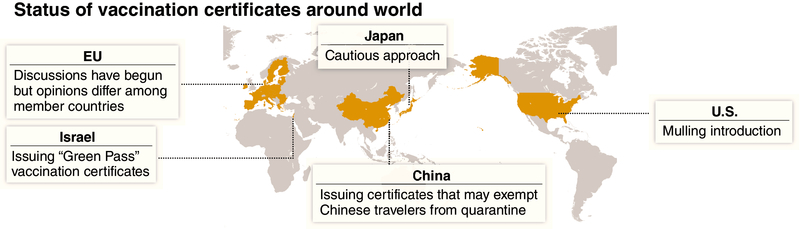
On March 8, China launched a health certificate for international travel for its people, both in electronic and printed form. The certificate contains the holder's COVID-19 vaccination history, PCR test results and other information.
China proposes to create an international system to mutually approve such certificates. It appears to be considering measures such as exempting travelers from countries that have reached an agreement with China from quarantine on arrival.
The European Union is expected to present bills to issue "vaccination passports" to member countries before the end of this month. Vaccination passports will be issued in the form of a digital certificate, and information such as the type of vaccine the holder received and their test results will be shared among member countries. The EU envisions that individuals traveling between EU countries will be able to present the vaccination passport and thereby be exempt from quarantine. It will consider applying similar measures to travelers from outside the EU in the future.
The International Air Transport Association, comprised of airlines worldwide, will start operating an app for smartphones and other devices at the end of this month to manage information on passengers' COVID-19 health status, such as their test results and vaccination records, in an integrated manner. The app will automatically determine whether passengers meet the entry requirements set by their destination countries and simplify boarding and immigration procedures.
U.S.-based IBM is also developing a similar app. There likely will be competition over creating global standards for vaccination certificates.
-- Different opinions
As some people cannot receive vaccines or do not want to be inoculated, there are concerns that a certificate system that exempts vaccinated people from behavioral restrictions will encourage discrimination.
French President Emmanuel Macron is cautious about the introduction of such a system, saying it poses ethical issues. In contrast, Greece, Spain and other tourism-oriented countries are supportive of the idea, revealing a gap among EU nations.
Another issue is how to prevent leaks and misuse of personal information, as vaccination certificates handle a large amount of personal data.
On March 8, the U.S. Centers for Disease Control and Prevention (CDC) issued new guidelines on COVID-19 vaccines. For example, the guidelines allow fully vaccinated people to hold meetings of small groups without wearing masks if they meet certain conditions. CDC Director Rochelle P. Walensky emphasized that this is an important step toward resuming daily activities.
However, how long the vaccines will be effective is still unknown. The CDC is carefully considering the introduction of vaccination certificates. It will continue to compile the latest knowledge and information, saying facts are still limited concerning the efficacy of vaccines.
-- Japan negative about certificates
By Tsuyoshi Oyabu / Yomiuri Shimbun Staff Writer
Japan is not enthusiastic about introducing vaccination certificates. At a recent press conference, Health, Labor and Welfare Minister Norihisa Tamura said, "We have no plans to do that."
In Japan, people are required only to strive to get vaccinated against COVID-19, based on the immunization law. Some might be unable to get inoculated due to allergies, while others could opt out due to concerns about adverse effects. If the movements of such people are restricted because they do not have vaccination certificates, this could lead to discrimination against them.
COVID-19 vaccines have been shown to be effective in mitigating symptoms, but their efficacy in preventing infection has not been fully proved. This has prompted concern that if infected but symptom-free people with vaccination certificates move around, it will worsen the situation, according to a senior official at the Cabinet Secretariat.
If Japanese people traveling abroad are required by their destination countries to present a vaccination certificate, respective municipalities are supposed to issue them.
The central government aims to introduce a vaccination record system to allow municipalities to ascertain the inoculation status of each individual in tandem with the start of vaccinations for elderly people on April 12. Notices for municipalities say they should use the system when they need to issue international vaccination certificates. The government is considering a system that displays the certificate on the screen of smartphone or other devices, to make it easy to use for international travelers.
Read more from The Japan News at https://japannews.yomiuri.co.jp/













