It seems bizarre when Europe’s leaders have finally started to acknowledge that the EU faces its greatest existential crisis since its foundation in 1957. But, at this fateful moment, those who supported British membership of the eurozone are also goaded by the Greek crisis into peeking over the parapet. About time too.
The irrepressible Sir Richard Branson popped up on Andrew Marr’s Sunday morning sofa. In his capacity as a pro-European business leader, he was one of the signatories to a recent round robin warning against the perils of a British exit after the promised referendum – though, with help from Brussels, the Greeks may beat us to it.
In his brief but perky exchanges Branson made some useful points about tariff barriers and the (often forgotten) need to avoid war. But when Marr asked if he was glad sterling hadn’t joined the euro, he replied:
“Not particularly. I think if we were part of the euro right now, our currency would be a lot cheaper. Great Britain would be doing that much better at trading in Europe. Because the pound is a lot stronger than the euro, it makes it more difficult for us. I mean, Greece has got problems because it overspent, it hasn’t run into difficulties because it’s part of Europe.”
Even for a businessman of Branson’s alleged distinction (the Marr interview revived questions about his chequered career), this was a pretty incoherent answer, one which had circling eurosceptics rubbing their tummies in glee and reaching for their iPads. Here’s the Branson transcript.
This month, the Observer’s Will Hutton crossed swords with the Guardian’s Heather Stewart on the subject. Stewart argued that the single currency was a “fundamentally misconceived project” and Hutton insisted that the alternatives would have been even worse while he accused Stewart, a touch ungraciously, of mouthing “straight Ukip” arguments.
On Thursday morning Martin Sandbu, the clever FT economics pundit, boldly offered a more subtle case (paywall) for UK euro membership – one which is closer to that routinely offered by Ken Clarke, as the ex-chancellor did when I interviewed him for a Guardian Membership audience last winter.
Basically it says everything would have been different if we too had joined the new eurozone group (initially 11 countries phased it in in 1999-2002 with Greece admitted at the last minute). It would have been different for them, different for us.
If sterling had gone in and helped everyone keep to the 1992 Maastricht Treaty criteria for disciplined government borrowing (a maximum of 3% of GDP a year, with only a 60% debt-to-GDP ceiling, would you believe) the Greek crisis could have been avoided, so this kind of argument runs.
Why so? Because the Bank of England has the intellectual heft, the result of centuries of experience at the heart of Europe’s money markets, to have offered a major counter-weight to the caution showed by the European Central Bank (ECB) after the financial crash of 2008, so the argument also runs.
Instead of easing monetary policy by rapidly cutting interest rates as the BoE did, the ECB raised them and did so again (twice) in 2011. It only embraced the unorthodox Anglo-Saxon remedy of quantitative easing (QE) to sustain liquidity in the money markets in 2014 – and then only timidly and against German opposition.
As for fiscal policy, inside the eurozone group George Osborne – whose own tax and spend policies have been pretty tight – could have helped persuade Germany to relax its obsession with trade and financial surpluses to the benefit of deficit trading partners like Britain. Instead its austerity policies pushed Europe back into recession – and didn’t do our exports much good either.
I don’t find this very convincing as a narrative. Nor did some FT readers. For example, eurozone membership in 2002 would have would have required Britain to lower its exchange rate and its interest rates, which might have led to an even bigger UK borrowing boom and subsequent crash than actually happened, the Eurosceptic Open Europe lobby’s director wrote to the paper.
As for QE, Britain would have only got a small share of the ECB’s funds, insufficient to do the job properly. And what would the Bank of England’s influence have been as one of then 13 members? Honest folk can disagree, but if Britain’s 2007-9 “hot money “ banking crisis had been even deeper than it was, Frankfurt might have been even less inclined to take our advice.
We can argue about this sort of counter-factual narrative for ever and probably will as long as the lights stay on. It’s not just navel gazing either because it goes to the heart of the Greek crisis now under way, the nature of which is misrepresented by both sides.
It will also affect the British referendum debate which, we are now told, David Cameron would like to use to secure Britain’s place in a reformed Europe. I favour that outcome too, but I was also pleased when Gordon Brown and Ed Balls (who devised the Treasury’s impossible “five tests”) kept us out of the euro in 2002 and beyond. History suggested the euro that was on offer wouldn’t last.
“You can’t have a currency without a state” was my snappy slogan (it never caught on). There would be the short-term problems of one-size-fits-all adjustment, cheap credit and excessive borrowing leading to painful correction and (in sterling’s case) a sharp devaluation of 25% after 2008.
But the new currency design had also fudged long-term governance issues.
By that, sceptical analysts meant the imperative need for a central bank and broad central control – from Brussels and (in reality) Berlin – over tax and spending policies. In return, the centre would bail out “regions” ( ie countries) in temporary economic difficulty, Thus Texas and Massachusetts grudgingly support each other when the oil price is up (good for Houston) or down (good for Boston). Outside the euro, London and Edinburgh retain the capacity to do the same while the Union lasts.
That’s not how it is in Europe of 2015.
In a heady moment Greece was allowed to fiddle its entry tests and join the euro, a badge of modernity which did not bring promised reform of a backward Balkan state. Its political and economic elite behaved badly, the Syriza government is right about that, and the EU elite in Brussels turned a blind eye.
Worse than that, most of the major eurozone states breached the Maastricht 3% borrowing rule, Germany and France included, and for good reasons too: to see them through a rough patch. See C4’s briefing here. Here’s der Spiegel’s.
But it was only when tiny Ireland did it too that Brussels got heavy: bully the small one, it’s an iron law of life.
Yet today, the European troika of creditors – the ECB, the European commission and the International Monetary Fund (IMF) – present themselves as stern upholders of the rule book.
They are the “grownups” withholding the family credit card from spendthrift Greek teenagers who took advantage of eurozone creditworthiness to borrow recklessly. Now that the financial chickens have come home to roost, they have imposed a self-defeating German austerity on the zone, still without copying the wicked Anglo-Saxons and seriously stress-testing their own suspect banks (some German regional banks are suspect).
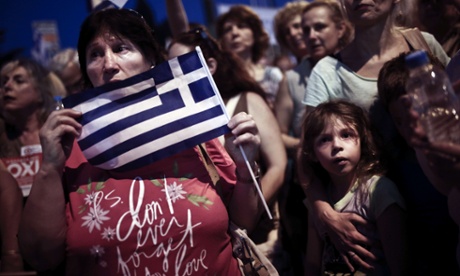
The Greeks can’t pay and something will have to give. But the troika’s myopic hypocrisy allows the Syriza government in Athens to play the “democracy v Europe’s cruel capitalists” card, as Aditya Chakrabortty put it in a spirited column on Monday. Pundit Paul Mason, for whom it is finally “all kicking off” at last, provides a vivid, heady account of how it feels to be young in Athens at the moment. Reading it, I wondered “was Barcelona briefly like this in 1936 before Franco arrived?”
But it’s not that simple or heady. Syriza’s ministers have not yet have behaved as badly as the rogues they threw out, but they have squandered sympathy in EU capitals at a rate that would impress a crooked banker and avoided hard reformist choices in the finest Greek tradition. Greek voters want it both ways: an end to austerity and continued eurozone membership. They may end up with neither.
And that’s the point about the failure of British supporters of the eurozone project – mostly well-meaning men and women of the solid centre ground – to put their hands up and admit their error. It pushes frustrated and bewildered voters – who have immigration and terrorism in their Eurovision sights too – towards extreme options.
Which is the point too easily glossed over when urging solidarity with Syriza. This is an insurgent government full of high sounding theory and little experience, produced by desperation – a government of panacea merchants not solely of the Marxoid left, but also of the anti-establishment right. Some of its members would make both Jeremy Corbyn and Nigel Farage look like Tony Blair.
Lovely though it is, Greece is a country which can’t collect its taxes or find a use for its 2004 Olympic stadium, which suffered a bloody civil war within living memory, but whose current government thinks it can stage a referendum in a week.
It will invite voters to endorse an option which is no longer on the table. In doing so it puts a pistol to the Greek people’s left temple. What does the troika of grownups do in response? It calls a press conference to put another pistol to Greece’s right temple.
This is bad politics on top of bad economics. Barring a miracle of last-minute statesmanship, it will end badly and the left will lose (again).