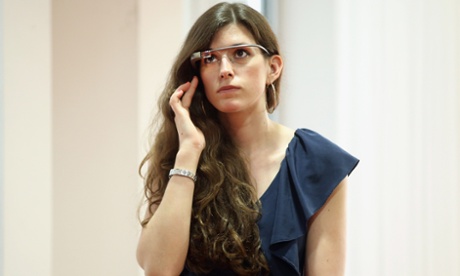
Augmented reality is not new, but the mainstream use of the technology is. Augmented reality (AR) is a live direct or indirect view of a real-world environment whose elements are supplemented by computer-generated inputs such as sound, video, graphics or GPS data. Walking down the street, anyone can easily download one of the many apps available that layer information over visuals to help you find a restaurant or famous landmark.
AR creates the opportunity to extend our own sensory experiences almost like having a sixth sense. Everyone has heard of smartglasses , but AR can also be bionic. For example, you can now have contact lenses that act much like the virtual glasses laid directly over the human eye. Now imagine a doctor using this to receive information during surgery in an emergency situation. This is where AR can become more than just a convenient way to obtain information; it can help save lives.
AR can also bring inanimate objects to “life” – where we can learn in a more interactive and entertaining fashion. Take for example, a new augmented reality tool that can seamlessly animate the world, as seen through a smartphone called Aurasma. It can do everything from making a painting talk to overlaying live news onto a printed newspaper. Think of how education could be enhanced in rural countries and areas with a richness that was not there before.
But beyond the already well-covered discussions in the consumer landscape, AR presents a huge opportunity in the enterprise. The enterprise seems an unlikely place for the domain of augmented and virtual reality. How could these supposed toys of Rift and others be of any value where “real” work happens? But just as the onslaught of consumer mobile devices has forever changed the face and value of business, the coming innovations in augmented reality will have a powerful role as a serious tool in the enterprise arsenal.
While consumer augmented reality and virtual reality products don’t have to be as concerned with obstruction of the visual plane, augmented reality tools for the enterprise need to be discreet. For many obvious safety reasons, enterprise employees need to be fully alert of their immediate settings, while making sure they actually get tasks completed rather than being distracted by a “cool” technology.
Products such as Google Glass and Epson’s Moverio BT-200 have been designed to be omnipresent but not invasive. They allow employees to have full visual access but require little effort to bring up relative visual information. These wearables serve as more elegant tools that don’t ever need to be put away, therefore greatly increasing efficiencies not just convenience.
Similar to personal use cases, the real value of augmented reality in the work environment stems from its ability to layer information, be it text, graphics, video, or audio on top of our surroundings. Objects cease to be information-less lumps but instead become part of a larger process chain. Augmented reality allows workers to see objects contextual meaning and business justification as part of their tasks. This is extended even further when this layered information is something that employees can interact with directly through verbal or visual responses.
Take for example, warehouse operations where workers have to navigate through a vast space to fulfill an order. Imagine the efficiency gain in the operation where employees no longer have to carry around a paper or digital pick-list. This interactive experience would be further enhanced because the augmented experience would able to give directions to each part for shipment, visual cues, and audio cues upon search and arrival. Augmented reality allows workers to work in parallel on multiple complex shipments at a time, rather than in a single serial fashion.
Safety could be another real boon of augmented reality in the enterprise. Industrial mining operations could benefit greatly by providing machine operators real time display of distances from each other. Size and weight of object could be shown to alert workers when additional help or equipment is needed. Employees who work in low lighting could have a basic type of night vision added. There are many aspects where sensors could extend our natural senses.
Augmented reality could also be introduced into the territory of 3D printing. Imagine instead of having the time and cost of printing a physical prototype it could be envisioned right before everyone’s eyes as though it actually existed. Don’t like a particular design element? Just quickly change the underlying file and instantaneously see the results in front of you.
AR could greatly enhance the enterprise and improve our personal lives as well. Businesses would benefit from additional immediate information supplied to the workforce without the need to pull out a separate device. People would benefit from more information and have richer experiences and it could also help save lives.
As tech advances, the power of AR increases and the size of the equipment shrinks, ask how it could benefit your business.
Benjamin Robbins is a co-founder at Palador, a mobile consultancy located in Seattle, WA. He can be found on Twitter @PaladorBenjamin.
Amisha Gandhi is Director, Global Product Marketing, Mobile at SAP. She can be found on Twitter @amishagandhi.
This advertisement feature is brought to you by SAP, sponsors of the Guardian Media Network’s Next-gen tech hub