Shares of Tesla Inc (NASDAQ: TSLA) are trading around $410 this week, holding on to most of the gains they’ve logged since hitting a multi-month low in late April. The broader bull case has been well documented, from full self-driving and robotaxis to Optimus and the longer-term robotics ambition.
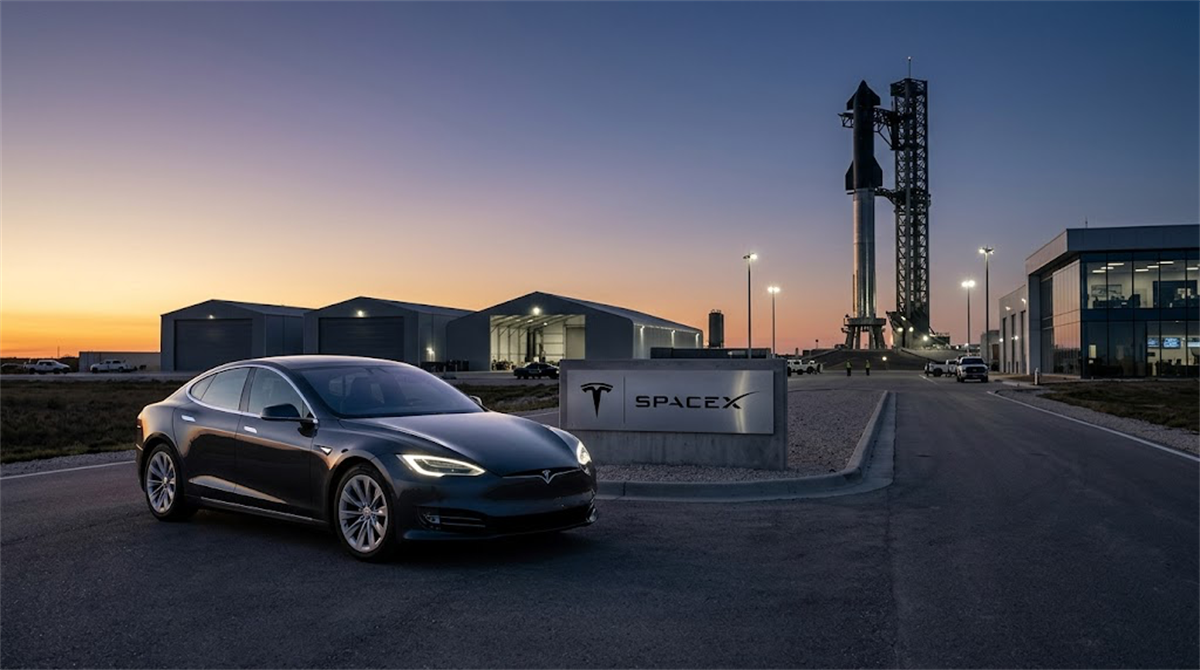
But in recent weeks, a new and potentially more significant narrative has been quietly building in the background. That narrative is the growing consensus that Tesla and SpaceX are heading toward a merger, and the latter’s blockbuster IPO last week has brought it into even sharper focus. SpaceX has gone officially public, and the timing has triggered a fresh round of commentary from Wall Street's most vocal Tesla bulls.
While Tesla’s retail investors have been busy debating robotaxi rollouts, the conversation among serious institutional voices has shifted.
The SpaceX IPO Changes Everything
Last Friday, SpaceX listed on the Nasdaq in what's considered the biggest IPO in history. It was oversubscribed fourfold; retail investor demand alone topped $100 billion, and firms like BlackRock were looking to invest at least $5 billion themselves.
But beyond the headlines, the IPO has fundamentally changed the conversation around Tesla in a way that hasn't quite sunk in yet. Up until last week, the prospect of a Tesla-SpaceX merger was a fascinating theoretical exercise built on speculation and Musk's track record.
However, now there's a publicly traded counterparty with a real market valuation, a real share structure, and a real set of public shareholders. The merger thesis has gone from being hypothetically interesting to a tangible scenario that the market can actually start pricing in.
Why Ives Thinks It's Coming
That brings us to the comments from Wedbush's Dan Ives, one of Wall Street's most consistently bullish voices on Tesla. Speaking to Bloomberg ahead of the SpaceX listing last week, Ives put the odds of a Tesla-SpaceX merger within the next year at 80% and framed it as the logical next step in a broader strategy that Elon Musk, the founder and CEO of both companies, has been quietly executing for years.
His reasoning is worth exploring properly. Ives sees the merger not as a corporate vanity project, but as part of a deeper play around AI and data. In his words, the eventual combination is about consolidating "the broader plan, specifically when it comes to AI data and all under that Musk ecosystem associated from a control perspective."
He went further, arguing that SpaceX itself should be viewed less as a traditional space company and more as a "data AI play" with the potential to host data centers in space within three or four years.
That reframing matters because it directly challenges the way many investors currently think about both companies. If Ives is right, then everything from full self-driving to robotaxis to Starlink will eventually form part of a single, integrated AI and data empire that's far more valuable as one entity than as two.
Musk Has Done This Before
What gives the merger thesis genuine credibility isn't just Ives's commentary; it's the pattern that comes before it. Earlier this year, Tesla invested in Musk's xAI, which had acquired X (formerly Twitter). SpaceX has since acquired xAI, meaning Tesla shareholders already have a substantial indirect link to SpaceX sitting on their balance sheet, without a formal merger having even taken place.
That's not a coincidence; it's an intentional and methodical chain of transactions. Each step has brought Tesla and SpaceX closer together operationally and financially, quietly laying the foundations for something much larger.
Add in the joint Terafab semiconductor fabrication facility currently under development, which will manufacture chips for both companies, and the picture of two organizations being deliberately stitched together becomes hard to ignore. Now that SpaceX is publicly listed, the final structural barrier to a formal combination has effectively been removed.
A Long Shot Worth Watching
All that being said, the risks are real, and there are still plenty of reasons to be cautious. Both companies are trading at stretched multiples in their own right, and merging them introduces meaningful execution risk.
Prediction markets, which have become increasingly recognized for their forecasting accuracy, are still placing the odds of a merger before May 2027 at around 50%, well below Ives's call. There's also the not-so-small matter of the legal scrutiny and shareholder battles that any deal of this scale would inevitably attract.
Still, the direction of travel feels clearer than it did even a month ago. Musk has a long track record of eventually delivering on ideas that initially seemed implausible, and the SpaceX IPO might have just handed him the final piece of the puzzle.
The article "Could a Tesla-SpaceX Merger Be Closer Than Investors Think?" first appeared on MarketBeat.