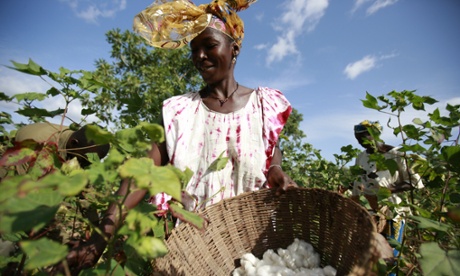
Cotton is big business, with 25.8m tonnes of the raw material being supplied to the $294bn (£197bn) global textile trade and the $412bn (£276bn) clothing industry every year. The crop is grown by huge agri-businesses in the US as well as by close to 100m rural households in developing countries, a number that more than doubles when workers in transportation, ginning, bailing and storage are taken into account. As well as providing rural employment, cotton plays a major role in the economic and social development of low-income countries, accounting for around 63% of Benin’s export and 72% of Burkina Faso’s.
Yet high street competition in developed countries has fuelled consumer expectations of ever cheaper, disposable clothing, pushing manufacturers to reduce their cotton purchases and increase sourcing of cheaper man-made fibres such as polyester, which now has a dominant 68% share of the global fibre market. Government subsidies – worth $6.5bn (£4.3bn) in 2013/14 and led by China and the US – have also contributed to global cotton price deflation that costs African farmers in the region of $250m (£168m) a year. Together, these factors have put downward pressure on cotton prices, which have plummeted by 45% in real terms since the 1960s, drastically squeezing the incomes of already struggling cotton farmers.
Rather than joining farmers’ organisations, small-scale cotton farmers often work independently, which means they have little power in the supply chain. They sell their cotton to ginners, the first in a long line of operators who benefit from various manufacturing processes that add value to the farmer’s raw crop. In India, cotton farmers are economically dependent on the local ginners or traders who buy their cotton, often at below the cost of production. Many are seriously indebted by exorbitant loans from the very same traders, to buy essential fertilisers and pesticides. Rising costs of production, decreasing yields, the impacts of climate change, and rising household costs add pressure to already unstable and inadequate incomes, which prevent cotton farmers from investing in the infrastructure, training and modern farming practices they need to improve their incomes.
But it wouldn’t cause retailers and brands much hardship to turn this situation around. Depending on the amount of cotton used and the processing needed, the cost of raw cotton usually makes up a small share of the final retail price of a finished textile product, which also includes the cost of various processing and manufacturing activities. So a 10% increase, for example, in the price that a brand pays for raw cotton, might only result in a 1% increase in the retail price of a finished garment, or perhaps even less – a negligible amount when you consider that retailers often receive more than half the final retail price of finished cotton products (pdf).
Apart from farmer livelihoods, a number of serious challenges threaten the sustainability of the cotton industry. Cotton production uses $2bn (£1.34bn) of chemical pesticides a year – nearly half of them classified as hazardous by the World Health Organization – to control the pests which destroy around 15% of world production. These chemicals contribute to deterioration in soil quality, contaminate water sources and present a serious health risk to farmers and workers, who often lack the appropriate training and protective equipment to handle them safely. Cotton production and processing is also highly dependent on water – it takes about 2,720 litres of water to make just one T-shirt and 10,850 litres to make a pair of jeans. Inefficient irrigation systems can deplete local water sources, making water a scarce commodity for many cotton growing communities. Flood irrigation can be wasteful and cause the runoff of fertilisers and pesticides that pollute rivers, lakes and water tables.
Farmers are planting more GM cotton in the hope of increasing yields and incomes. In reality, they are becoming tied into buying expensive seeds and pesticides each year from multinational companies, and there is a concern that yields may actually decline after initial gains. In India, an epidemic of farmer suicides has been blamed on high levels of indebtedness controversially linked to the rising costs of GM cotton seeds, fertilisers and insecticides alongside declining yields, while question marks remain over the long-term effect of GMOs on the environment, biodiversity and human health.
Forced and child labour has also been documented in several cotton producing countries including Uzbekistan, Turkmenistan and Tajikistan, where tens of thousands of children, students and adults are forced out of school, college or workplaces for several weeks a year and mobilised to pick cotton, in order to meet government-imposed production quotas. Hundreds of thousands of children work illegally in the cotton industry in India, often working alongside their parents to supplement miserable wages or as bonded labour, paying off loans taken out by their parents.
This all sounds incredibly bleak, but a number of certification schemes are available to businesses that want to build sustainability into their cotton supply chains. Many focus on environmental protection or product traceability, but Fairtrade certification is unique in being the only scheme whose primary aim is to tackle poverty through better terms of trade, as well as giving farmers greater power within their trading relationships.
Fairtrade Standards provide a framework for cotton farmers to form democratic organisations, or strengthen such organisations where they already exist. This enables farmers to come together to increase their negotiating power in the marketplace, improve their business systems, access new markets, develop long-term trading partnerships, implement sustainable farming practices and manage the environmental and health risks from cotton production. Fairtrade Minimum Prices contribute to financial stability, by acting as a safety net when market prices drop, while Fairtrade Premiums - the extra amount that producers earn on top of the price they receive for their crop - can be invested in improving cotton quality and productivity, climate change adaptation and improving community welfare.
By offering Fairtrade cotton products, businesses are contributing to a more sustainable future for cotton farmers, their families, their communities and the environment. And by purchasing Fairtrade cotton products, consumers are choosing products that change lives.
Visit the Fairtrade Foundation’s website to read its new Cotton Commodity Briefing (pdf).
Fashion Revolution Day takes place on 24 April. For more information click here.
Content on this page is paid for and provided by Fairtrade Foundation