This is the fourth installment of a series examining the issues the Japan-U.S. alliance will face in the years ahead.
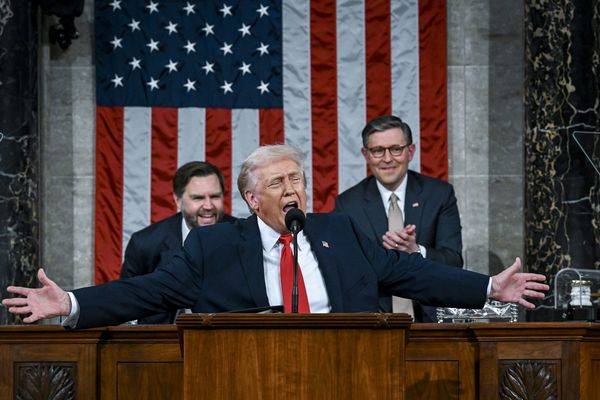
U.S. President Donald Trump has introduced the idea of tying dollar figures to security issues, shaking the relationships between the United States and its allies.
On Oct. 12, a parliamentary audit session was carried out at the South Korean National Assembly's Foreign Affairs Committee. Lee Soo-hyuck, the South Korean ambassador to the United States, attended the session remotely and made controversial remarks.
Asked about his view of the U.S.-South Korea alliance, Lee said that just because the two countries formed the alliance 70 years ago, this does not mean that South Korea should maintain the alliance. He went on to say that choosing the United States would be because it serves South Korea's national interests.
The remarks drew criticism in the United States and South Korea, with some people asking whether such a view suggests that an alliance with China is a possible option. In the wake of this, the South Korean government was forced to quell the criticism. Foreign Minister Kang Kyung-wha said some expressions by Lee were problematic and expressed an apology at the National Assembly.
The U.S. military fought alongside South Korea against North Korea and China during the 1950-1953 Korean War. Since then, the United States has stationed its troops in South Korea and kept watch over these countries.
However, the administration of South Korean President Moon Jae-in has been inclined to take a neutral position between the United States and China in the pursuit of Korean reunification. In addition to this, it is widely believed that the accumulation of strained emotions toward the Trump administration, which has urged South Korea to shoulder significantly more costs for U.S. forces in the country, has led Lee to make such remarks, according to The Dong-a Ilbo newspaper.
-- Increasing the bill
South Korea's share of the cost for U.S. forces for 2019 was 1.0389 trillion won (about 93.5 billion yen). During negotiations on the cost sharing for 2020, then U.S. national security adviser John Bolton, who resigned from the post in September 2019, called on Seoul to pay 5 billion dollars (about 520 billion yen) to cover the full cost for hosting U.S. troops and an additional 50% premium. As South Korea rejected such a demand amounting to a fivefold increase from the previous year, the bilateral agreement in which each side's share of the cost is set expired at the end of last year.
On Oct. 14, then U.S. Defense Secretary Mark Esper met with South Korean Defense Minister Suh Wook at the Pentagon. During the meeting, Esper said the two countries need to reach an agreement as soon as possible to ensure the "stable stationing" of U.S. troops in South Korea, while hinting at cutting the number of U.S. troops in the country.
The bargaining over the cost sharing has also had an impact on the ground.
The U.S. military did not participate in a joint U.S.-South Korean maritime firing drill, which had been scheduled for May. As a result, in June the South Korean military conducted the exercise on its own off Uljin in the eastern South Korean province of Gyeongsangbuk-do.
Initially, there had been speculation that the U.S. military did not participate in the joint drill out of consideration for North Korea. However, a source related to the South Korean government said: "It seems that the move was intended to pressure South Korea to bear more defense costs. It's an alarming situation."
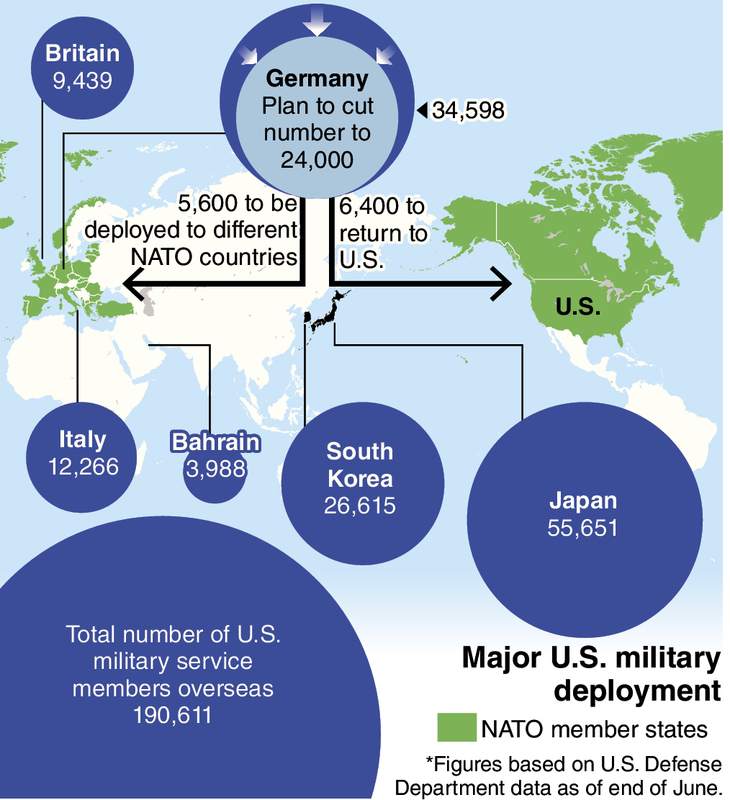
On June 15, Trump abruptly announced his intention to reduce the number of U.S. troops in Germany. He took such action as he became frustrated with Germany's refusal to comply with the U.S. demand for Berlin to pay more defense expenses. Washington plans to cut the number of U.S. troops in Germany from 36,000 to 24,000.
Expressing her displeasure with Trump's tactic of using the U.S. military as a bargaining chip, German Defense Minister Annegret Kramp-Karrenbauer said at a meeting in Berlin on June 16, "NATO (North Atlantic Treaty Organization) is not a trade organization, and security is not a commodity."
-- Trend could continue
Since World War II, the United States has stationed its troops around the world under a forward deployment strategy of staving off threats away from the U.S. mainland. Although the nature of the threats has changed over time, about 190,000 U.S. troops are currently stationed around the world to deter North Korea, which threatens the neighboring countries with nuclear weapons, and China, among others, as well as to counter terrorist organizations.
Furthermore, if the presence of the U.S. military helps stabilize a region, that could boost trade there and result in benefiting the United States. In light of this, a succession of U.S. administrations have continued to station troops overseas while asking host countries to shoulder a certain share of the burden.
Trump's thinking, however, is fundamentally different.
Guy Snodgrass, who was a speechwriter for former U.S. Defense Secretary James Mattis, closely watched and listened to interactions between Trump and Mattis. Snodgrass said Trump believes that the stationing of U.S. troops is only to protect host countries, so these countries should pay the full cost.
Trump's stance of having host countries bear the financial burden in return for U.S. military power underlines his thinking in which U.S. troops are like mercenaries, according to a diplomatic source in Washington.
U.S. President-elect Joe Biden, who ran against Trump in the U.S. presidential election on Nov. 3, contributed a message to the Yonhap News Agency on Oct. 29 that read, in part, "I'll stand with South Korea, strengthening our alliance to safeguard peace in East Asia and beyond, rather than extorting Seoul with reckless threats to remove our troops."
However, the administration of former U.S. President Barack Obama under whom Biden served as vice president also had a negative view about the large-scale overseas deployment of U.S. troops.
An administration led by Biden, who favors big government with measures such as an increase in welfare spending, will mean the United States will face a greater fiscal burden from domestic costs. Although a Biden administration is likely to have different ideas from those of the Trump administration, the current trend of demanding allies to share more of the financial burden that Washington cannot shoulder will possibly continue.
Read more from The Japan News at https://japannews.yomiuri.co.jp/