
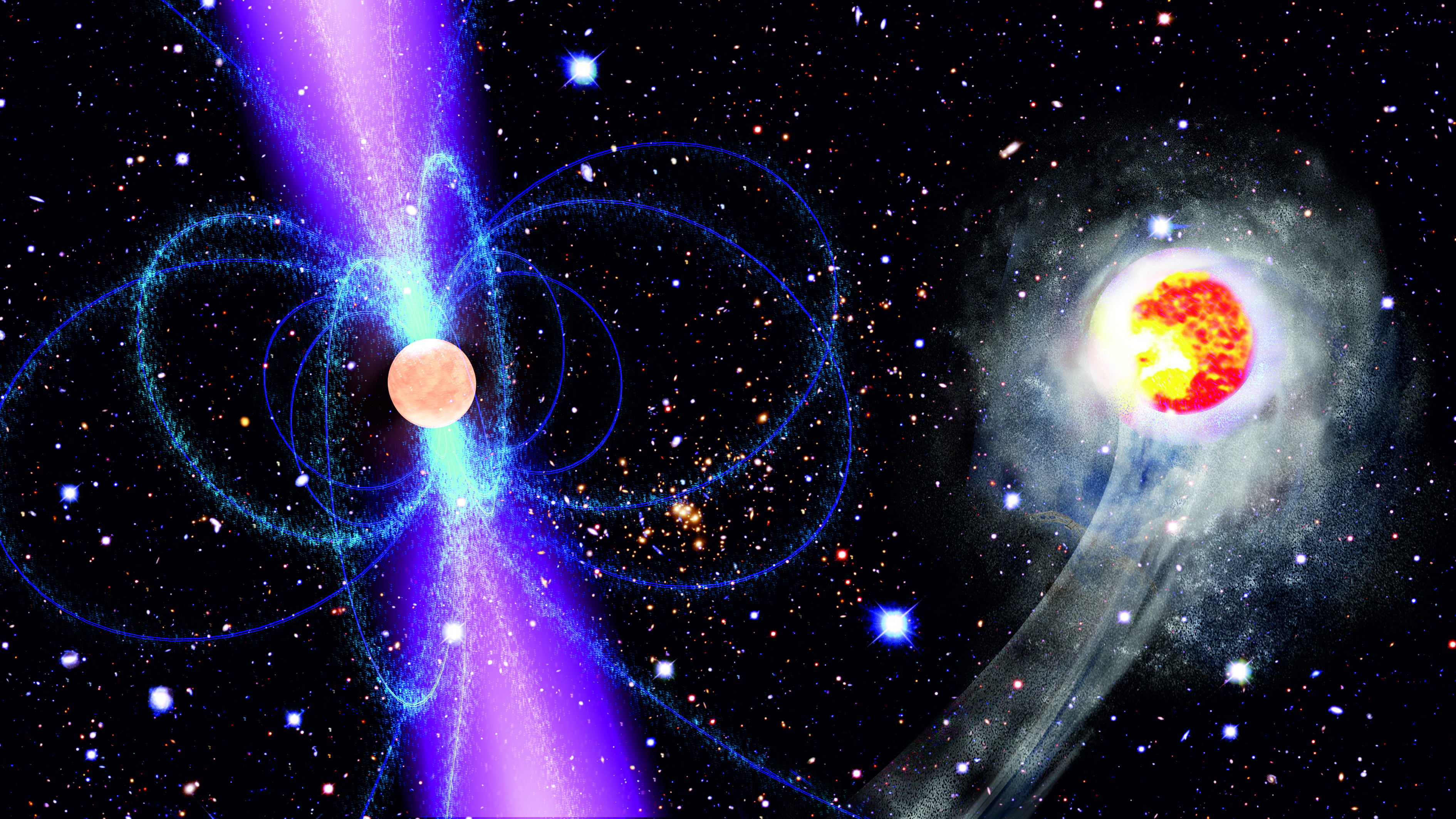
Astronomers have solved the decade-long mystery of how a bizarre cosmic object toggles rapidly between "high" and "low" energy states: by launching plasma cannonballs from its orbit.
The object in question is a pulsar — a type of extremely magnetic neutron star. Like other neutron stars — the remnants of massive stars that have collapsed — pulsars are extremely dense and tend to spin quickly around their axes. But unlike other neutron stars, a pulsar emits bright beams of electromagnetic radiation from its poles. This gives it the appearance of "pulsing" in space, like a lighthouse beacon viewed from a distance.
A pulsar known as J1023 has been an enigma for the past decade. It forms part of a binary star system some 4,500 light-years away and orbits very closely to its companion star. When scientists first began observing J1023 in 2009, it behaved much like any other pulsar, flashing regularly and at a consistent electromagnetic frequency.
Related: Bizarre new cosmic object is the most magnetic star in the universe
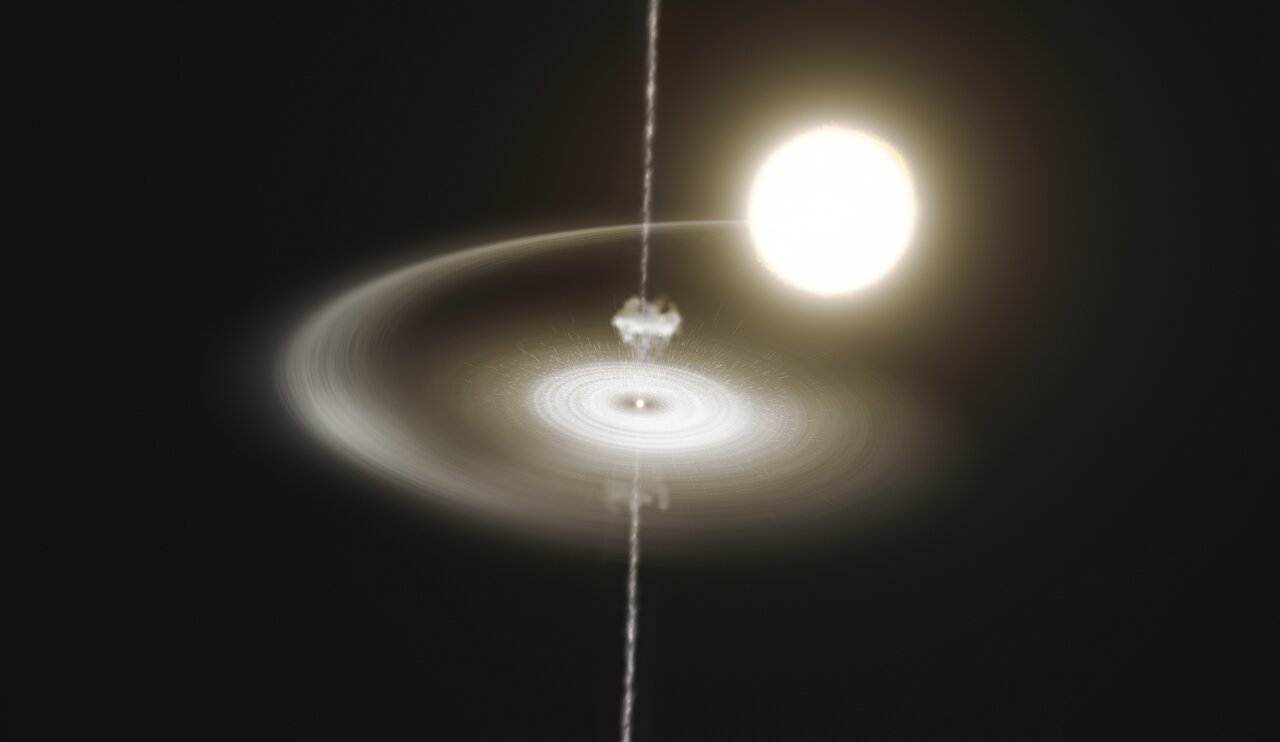
But in 2013, something changed: Rather than displaying regular electromagnetic pulses, the pulsar suddenly began flip-flopping between two states: a high-energy mode, in which it emitted X-rays and bright visible and ultraviolet light, and a low-energy mode characterized by longer, dimmer radio waves. Even more strangely, it switched between these modes every few seconds.
Scientists had never seen a pulsar act this way before, so J1023 quickly became an object of fascination for astronomers. Now, after a decade of observations, researchers think they've gotten to the bottom of its weird behavior.
Because J1023 orbits so close to its companion, its intense gravity has begun stripping plasma from this other star. This matter collects in a disk around the pulsar, where it is quickly superheated by the object's solar wind, sending the system into high-energy mode. Then, as J1023 spins, the blobs of hot plasma are flung suddenly and dramatically into space like a "cosmic cannonballs," the researchers said. This sends the pulsar back into low-energy mode in seconds. The team reported the results Aug. 30 in the journal Astronomy & Astrophysics.
In a statement, lead study author Maria Cristina Baglio, an astronomer at New York University Abu Dhabi, called the cycle a series of "extraordinary cosmic events." For now, the researchers will continue to study this unusual pulsar, but they'll be on the lookout for other celestial cannonballs to determine whether J1023 is a unique system, or perhaps one of many trigger-happy star corpses.