Poor posture should be corrected at any age, but it becomes especially important once you reach your senior years.
Slouching shoulders, weak back muscles, and lack of upper-body mobility can affect your overall balance, result in chronic aches and pains, and make you more susceptible to injury.
Many of my senior personal training clients struggle with poor posture, so it’s usually one of the first things we address in our sessions together.
I often recommend doing four simple exercises every day to help improve posture. They are: wall angels, cat-cow stretch, doorway stretch and resistance band rows.
“Some of the most effective posture exercises are also the simplest,” says Dr Stephanie Duffey, PT, DPT, after I tell her about the exercises I use.
The physical therapist and owner of Empower Physio and Wellness goes on to add: “The great thing about these four exercises is that they are easy and safe to perform. You need minimal equipment, just a resistance band, and they can be done right at home.”
How to do the four exercises
You’ll need a light resistance band (like this one), a yoga mat (like this one), a section of bare wall, and a doorway for these exercises.
Start by doing the wall angels, cat-cow stretch, and resistance band rows for one set of eight to 10 reps, and hold the doorway stretch for 15-30 seconds.
Once you’ve built some strength and mobility, gradually increase to 15-20 reps and 45-60 second holds, adding one rep or 5 seconds every time you repeat the workout.
Try these exercises three to five times a week at first, slowly working your way up to five to seven times a week as your comfort level allows.
“When starting any new mobility or exercise program, meet your body where it’s at,” Duffey recommends.
“Don't push into pain, but know that moving your body in a new way can bring some productive soreness. Be gentle with yourself and integrate these movements slowly into your weekly routine.”
Clear any new activity with your doctor before proceeding. These exercises are beginner-friendly, but if you’ve just recently started to work out regularly, meet with a certified personal trainer for guidance on correct form.Duffey also recommends caution depending on your health history and background. “If you have a spinal fracture or had spine or shoulder surgery within the past three months, these exercises may not be appropriate for you,” she says. “If you have a hypermobility condition like Ehlers-Danlos syndrome, you would benefit from doing these under the supervision of a physical therapist to ensure proper form and joint protection.”
Here’s how to do the moves:
1. Wall angels
Sets: 1 Reps: 8-20
- Stand about six inches in front of a wall, with the wall behind you.
- Lean your back against the wall.
- Raise your arms, bringing your elbows to shoulder height, resting your forearms against the wall.
- Lift both of your arms overhead, maintaining contact with the wall.
- Lower your arms, bringing your elbows back to shoulder height.
Trainer tips: Be sure that your shoulders, forearms, and wrists stay in contact with the wall throughout the movement. Avoid arching your back away from the wall as you lift your arms. If you’re unable to lift your arms without arching your back, or you’re unable to keep your wrists against the wall, reduce your range of motion and focus on keeping good form. Don’t let your shoulders shrug towards your ears. Keep your core muscles engaged as you lift the arms.
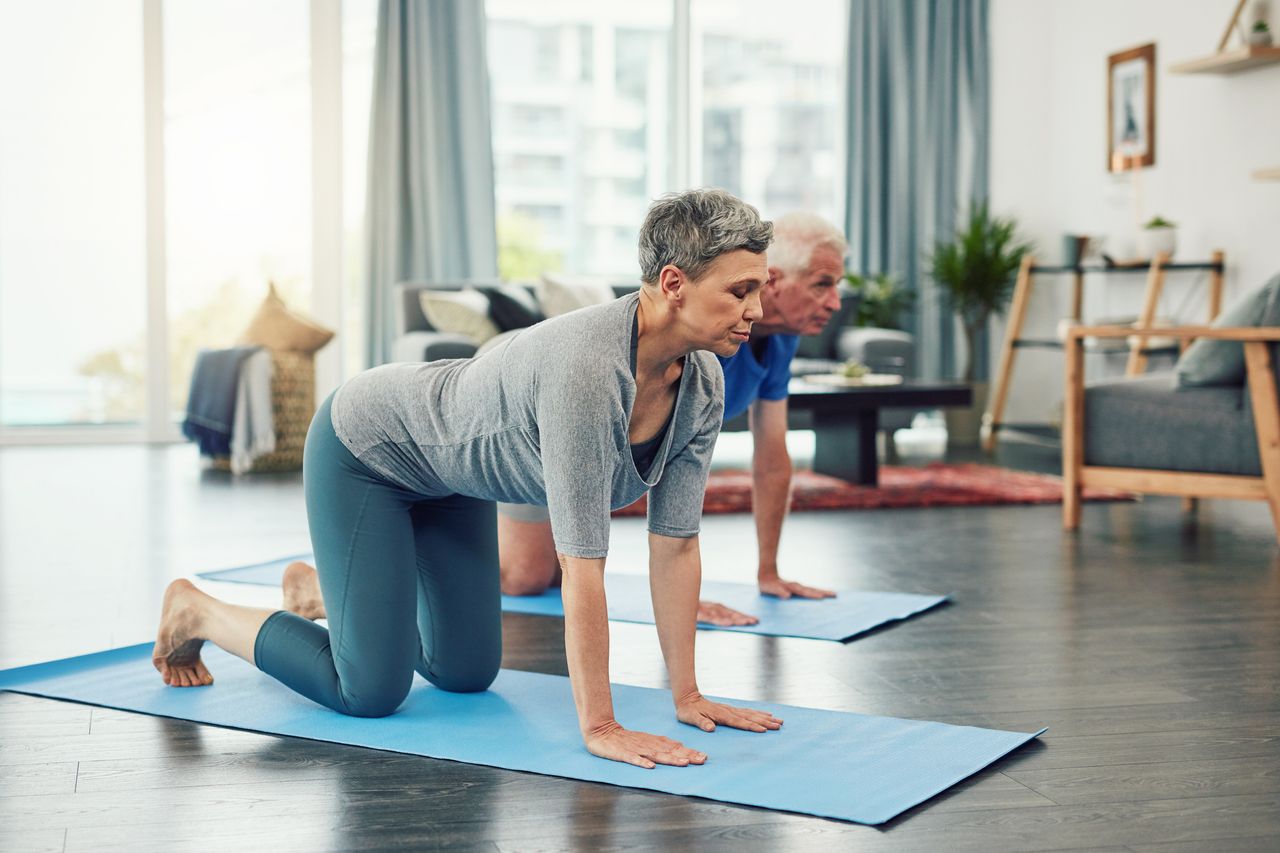
2. Cat-cow stretch
Sets: 1 Reps: 8-20
- Come to all fours on the mat.
- Round your back, moving the crown of your head and your tailbone to point towards the floor.
- Pause briefly.
- Arch your back, aiming the crown of your head and your tailbone towards the ceiling.
- Pause briefly.
- Continue alternating between the two positions.
Trainer tips: Move slowly through each position and focus on reaching the endsof your range of motion. If you’re unable to get onto the floor, try the stretch on your bed or couch. Place a pillow or rolled-up towel underneath your knees for additional cushioning, if needed.
3. Doorway stretch
Sets: 1 Time: 15-60sec
- Stand in front of an open doorway.
- Place your forearms against the doorframe, with your elbows at shoulder height.
- Step one foot through the doorway, keeping your forearms braced against the doorway, and carefully move your hips and torso forward.
- Once you feel a stretch through your chest, hold.
Trainer tips: Don’t allow your shoulders to shrug towards your ears. Keep your neck relaxed throughout the stretch. Maintain a tall posture, and avoid excessive arching in your lower back.
4. Resistance band row
Sets: 1 Reps: 8-20
- Loop a resistance band around a strong anchor point, like a stair railing, at chest height.
- Extend your arms and hold the ends of the band in each hand.
- Step away from the anchor point until the band is taut.
- Squeeze your shoulder blades together and pull the ends of the band towards you, keeping your elbows close to your body.
- Pause briefly.
- Extend your arms with back to the start with control.
Trainer tips: Don’t allow your lower back to arch. Keep your shoulders and neck relaxed throughout the movement. If you notice tension in your shoulders and neck, step closer to the anchor point or use a lighter resistance band. Move slowly and with a controlled tempo.
The benefits of these four exercises
“These movements are accessible for all fitness levels, especially beginners and seniors, and have a big impact on protecting and improving posture throughout your life,” says Duffey.
“There are two aspects to improving and maintaining posture. The first is mobility. You need to get your joints moving through a bigger range of motion to maintain your mobility and hold yourself upright. This is where the cat-cow and doorway stretch come into play. These mobility drills keep the spine and chest open and moving well.
“The second step is to build strength around those joints so you can hold yourself upright all day,” she continues.
“This is where the wall angels and resistance band row come in. These drills target the upper back and core, the primary muscle groups that hold you upright every single day.”