One change brought on by the coronavirus pandemic has been that some women have been having an easier time in the corporate world. The proliferation of teleworking has made it easier for women to hold full-time jobs while raising children.
In contrast, in lines of business like retail sales and real estate in which working from home is not an option, women in management positions have decreased.
The government is urgently trying to come up with new measures to increase the opportunities.
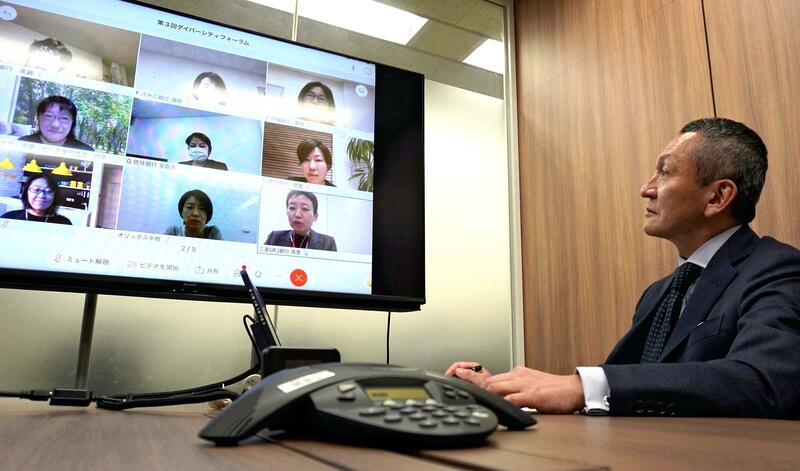
In early February, female executives from 28 companies, including regional banks and life insurance firms, met in an online conference to discuss how to promote diversity. "Men are not used to having women as superiors or equals," commented one participant. "Unconscious biases remain, such as refraining from asking women who are raising children to do difficult tasks."
The conference was organized by MUFG Bank Ltd. with the aim of encouraging women to play active roles and pursue promotions in the financial industry. "We want to continue to create opportunities for dialogue [across companies] in the future," said Shuichi Yokoyama, managing executive officer at MUFG Bank.
The ratio of females in administrative positions at the bank has risen to 20%, already surpassing the immediate goal of 17%. However, just four of the 101 executive officers female, and none of the 29 directors, making the next issue the promotion of women to executive level.
The pandemic is having both positive and negative effects on the balance between work and childcare.
At Kao Corp., more and more employees who had opted for shorter working hours to allow for childcare have returned to full-time status by working from home. The company believes that "using teleworking is effective for forming a women's career" because it eliminates the need for commuting time.
At Tokyu Railways Co., where the conductors used to be all male, the ratio of women performing that job is now 14%, and a female has even been appointed as a station manager.
The company is making efforts to create an environment amenable to working women, such as giving them an option of work shifts that allows them to secure time for childcare.
Tokyu Corp., the railways' parent company, has set a goal of increasing the percentage of female managers to 10% or more by the end of the 2023 fiscal year.
In a July 2020 survey conducted by Nomura Research Institute Ltd., about 3,000 male managers were asked about female employees currently raising children. Given the assumption that working from home becomes a permanent fixture, more than 60% agreed with the statements "it makes it easier to expect business results and contributions to the organization" and "it makes it easier to consider appointments to jobs and positions with greater responsibility."
Conversely, jobs and industries in which it is difficult to work from home are facing strong headwinds.
According to Teikoku Databank Ltd., the percentage of women in corporate management positions in 2020 increased 0.1 percentage points to a record high of 7.8%, but the growth rate slowed from 0.5 percentage points in the previous year. This was due to a decrease of 1.1 percentage points to 12.8% in the retail industry and a decrease of 0.7 percentage points to 12.2% in the real estate industry.
In the Global Gender Gap Index, which measures the disparity between men and women in each country, Japan ranks a lowly 121st out of the 153 countries surveyed. The government had set a goal of increasing the percentage of women in leadership positions to around 30% by 2020, but last year decided to push back the target to "as early as possible in the 2020s."
"With the spread of working from home, there have been positive developments in gaining active participation by women, but it is not enough," said Yasuko Oshima, a senior researcher at Recruit Works Institute. "It is important to create a system for fair evaluation and to flexibly look again at work styles."
Read more from The Japan News at https://japannews.yomiuri.co.jp/