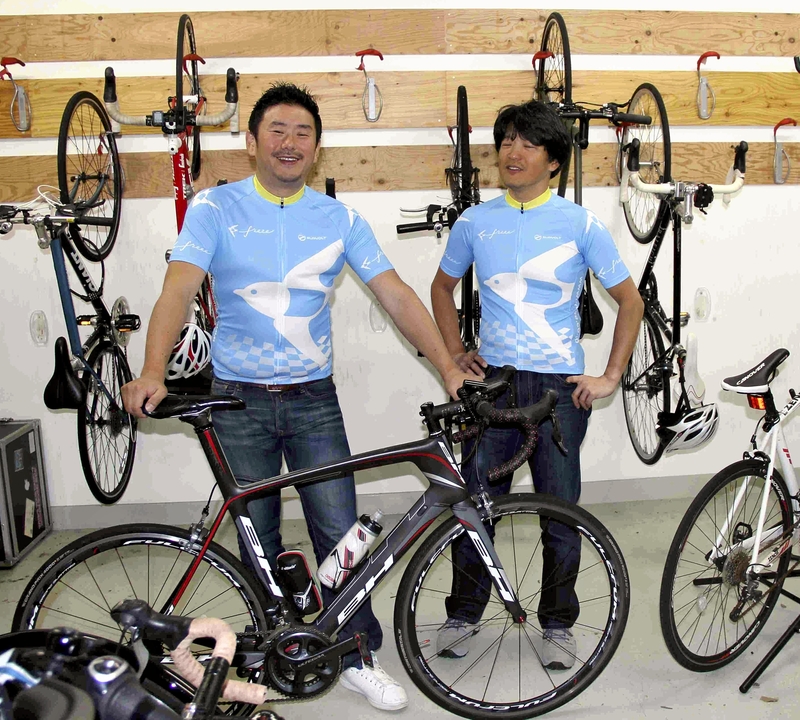
Company-organized cycling programs for purposes such as promoting employees' health are becoming more common. At some firms, employees are banding together to form cycling clubs on their own.
An accounting software company called freee K.K., based in the Gotanda district of Tokyo, has an employees' cycling club. In March, club members gathered in a meeting room to discuss a logo for the club uniform.
"How about an image of a swallow flying through the sky?" one of the members suggested.
"A blue color for the sky would be nice," another said.
The creation of the club was suggested by Sosuke Sekiguchi, 43, who is now its head. "I wanted to feel closer to colleagues who also enjoy cycling," he said.
The company was founded in 2012. The average age of employees is 31. To promote communication between employees, the firm started a club system for extracurricular activities. The cycling club, formed in 2014, is one of them.
The 28 men and women of the club, in their 20s to 40s, gather several times a month to bike past wharves and along lakesides, among other areas.
Club members -- wearing their new uniforms -- took part in an eight-hour endurance race on May 3 in Shimotsuma, Ibaraki Prefecture. The team from freee finished 97th out of 285 teams. This was an even better result than they had aimed for.
"We know more about our other colleagues now, beyond just their age and job title," said Junji Nakayama, the club's oldest member at 47. "This makes things go more smoothly at work and enables us to generate various kinds of ideas."
Japan Airlines Co. founded a corporate cycling club in February 2015. It now has 60 members, including pilots and flight attendants. They have taken paid holidays to places like Hawaii to participate in cycling races. Members say they can come back feeling refreshed.
IDC Frontier Inc., a Tokyo-based information technology company, has given official sanction to a cycling club for employees and funds some of its costs. Club members have taken part in events such as the Tour de Tohoku, which is held in Miyagi Prefecture to support people stricken by the 2011 Great East Japan Earthquake.
Bikes for commuting
Some companies are encouraging employees to commute by bicycle.
Cookpad Inc., a Tokyo-based company that runs a recipe website, built a bicycle parking lot for employees and installed shower rooms at its office. Employees who commute by bicycle from within 15 kilometers of the office receive an allowance of 10,000 yen per month. Employees must insure their bikes and the company holds traffic safety lectures on revisions to the Road Traffic Law and other topics.
The program is popular with employees, who say it relieves them of the stress of traveling on crowded trains and helps them get regular exercise.
The bathing area and shower booths at Shimano Inc., a bicycle parts maker based in Sakai, Osaka Prefecture, are busy before work starts at 8 a.m. each morning. About one-third of employees commute by bicycle and wash up before work begins. The company has a parking lot that can hold 1,100 bikes, and subsidizes bicycle and helmet purchases.
The central government also supports cycling programs. The Law on Promotion of the Use of Bicycles went into effect in May 2017. Since bicycle use has benefits such as reducing greenhouse gas emissions, easing traffic jams and improving public health, the law is designed to encourage city planning to facilitate bicycle use.
Takashi Masuda, chief economist at Toray Corporate Business Research Inc., said, "There has been a rising tide of corporate support for cycling activities. It can help resolve environmental, health and other problems."
The economic and social effects of bicycles are being reexamined.
Whether it is in one's private life or at work, cycling can help people look at life differently and enrich people's lives.
Delivery bike use expanding
The use of bicycles at work is also expanding. Japan Post Co. has introduced about 1,200 pedal-assist bicycles for making deliveries. Yamato Transport Co. uses about 5,200 pedal-assist bicycles that have attached trailers.
"Bicycles have better freedom of movement than trucks in urban office blocks and built-up residential areas. It makes work more efficient," the Yamato official in charge of the matter said.
Another benefit is that people who do not have driver licenses can also ride.
"Cycling programs are good PR, because it gives us an image of being concerned with the environment and our workers' health. It is also helpful in recruiting workers," a spokesperson at an IT company that promotes bicycle commuting said.
Read more from The Japan News at https://japannews.yomiuri.co.jp/


.png?w=600)