With an uncertain economic future in 2019, business leaders must prepare to face disruption. A general election, a trade war between the world's largest economic powers, and the spectre of a new global recession could greatly affect several industries.
Telecoms must begin laying the infrastructure for 5G wireless broadband, the financial sector must digitise and embrace big data to keep up with the global trends, and hoteliers must brace for the possibility of a continuing decline in Chinese tourist numbers.
But while the short-term future poses many challenges, the long-term potential is for a more technology-driven economy, the government's Thailand 4.0 initiative.
How can companies not only adapt to the future, but also thrive in it? Will the economy continue to grow, or find itself falling behind?
The Business section spoke with some of the country's top business leaders -- a food tycoon, a banking guru, an industrial heavyweight and a telecom kingpin -- to get an expert's guide to the economic future in 2019.
Suphachai Chearavanont
Chief executive of Charoen Pokphand (CP) Group
The 2019 outlook for the Thai economy looks positive with the upcoming elections a contributing factor, says Suphachai Chearavanont, chief executive of Charoen Pokphand (CP) Group.
Despite possible disruption from the US-China trade war, Mr Suphachai predicts economic growth in Thailand and worldwide, and even thinks the trade tensions could work in Thailand's favour.
"China will focus more on the Belt and Road to build economic ties and security through trade and infrastructure development," he said. "Japan has agreed and joined hands with China, and the Eastern Economic Corridor (EEC) investment in Thailand is a good example of China-Japan cooperation."
According to Mr Suphachai, who also serves as chairman of True Corporation, the election will spur the government to act out economic reforms, increase foreign investment and further development of industry 4.0.
"Post-election, what we want to see next year is the continuity of economic policies which address infrastructure and agriculture at the grassroots level," he said.
"The country's agriculture sector is at a turning point, becoming more modern and at the same time facing an ageing society, with a majority of farmers approaching 60. This requires support from younger generations for technology management and research or capacity building for value creation, which will help for the advancement into Agriculture 4.0 along with Industry 4.0."
But Thailand still has a few key areas to improve, he said, most notably education and training, as well as "modernising the legal and tax implications for investors".
"If we are not a hub or leader in the field of education in the region, we cannot build investor confidence from global investors," Mr Suphachai said. "Nonetheless, in the meantime, we can attract people from other parts of the world by our tax structure and by making it easier for them to work in Thailand."
To prepare for these challenges, and a possibly tumultuous future global economy, he said CP Group must invest locally, but also in both China and the US. The group will focus on retail and distribution of livestock in China and prioritise food and shrimp farms in America.
Mr Suphachai cited exponential disruptive changes that continue to drive digitisation of all CP affiliates and spur the group to be a data-driven organisation and to have online processes for transactions with partners and customers.
"CP Group will transform its organisation into a leader in food technology and have a digital platform to support the digital economy, as well as automation and use of artificial intelligence (AI) and data in the development of logistics," he said.
The company will also promote development of sustainability and waste management in Thailand.
"Beyond education and development in rural areas, we will also pursue policies and guidelines on waste management," Mr Suphachai said. "We have adopted a sustainable packaging policy to reduce the use of plastic and include traceability alongside promotion of good governance."
Predee Daochai
President of Kasikornbank and chairman of the Thai Bankers Association
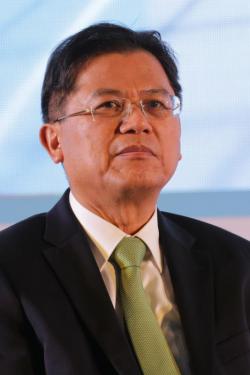
Preedee Daochai. WICHAN CHAROENKIATPAKUL
Amid the increasing external headwinds, stronger domestic demand is expected to provide a cushion and help the country deliver economic growth in a range of 4-4.3% in 2019.
Moreover, the imminent general election and a raft of economic stimulus measures, including additional welfare and subsidies for low-income earners and the elderly who are welfare smartcard holders, will also come as a boon to domestic consumption, says KBank president Predee Daochai.
The country's mainstay exports are expected to face speed bumps this year, given the trade spat between the US and China.
Mr Predee forecasts Thai outbound shipments to expand at a slower pace of 5-7% in 2019 than the 8% predicted for last year.
Apart from trade protectionism, the Brexit development and its impact on the global economy, as well as fund mobility, are expected to result in wild swings amid the tightening monetary policy of the US Federal Reserve.
"The external uncertainties will affect foreign capital movement across the world, including the Thai market," Mr Predee said. "The Bank of Thailand could raise its policy rate next year, and this would lead to higher funding costs for business operators."
To brace for the darkening economic prospects this year, banks will focus on funding cost management and urging customers to concentrate on risk management.
Mr Predee said digital disruption is another key challenge for the banking industry and its fee-based income.
Banks need to search for new sources of income from digital business to maintain profitability, he said.
KBank, the country's third-largest lender by assets, has set the upper end of its gross non-performing loan (NPL) ratio target range for 2019 at 3.7%, up from 3.4% last year, though the lower end is kept unchanged at 3.3%.
The bank, however, set a target for credit cost, the percentage of loan-loss provisions to total loans, of up to 165 basis points for this year, down from up to 185 basis points targeted for 2018.
It aims for a non-interest income contraction in the range of 5-7% for 2019, compared with 6-8% shrinkage last year.
The bank also set targets for net interest margin at 3.3-3.5% and cost-to-income ratio in the low to mid-40s in 2019. Its targeted interest margin was 3.2-3.4% in 2018, and its cost-to-income ratio was in the mid-40s.
KBank looks forward to achieving loan growth of 5-7% this year, breaking down to corporate loan growth of 3-5%, SME loan growth of 2-4% and retail loan growth of 9-12%.
Roongrote Rangsiyopash
President and chief executive of Siam Cement Group
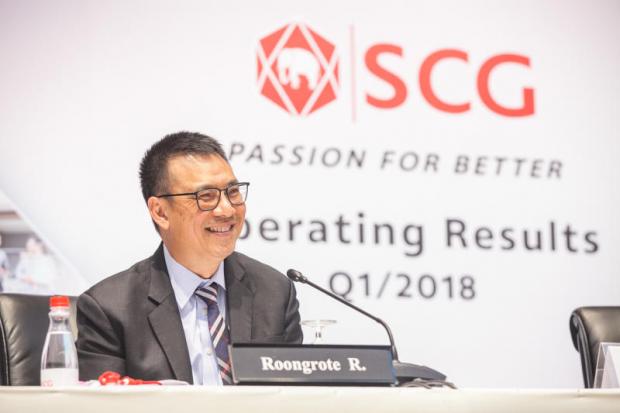
Roongrote Rangsiyopash, president and CEO of Thailand's largest cement maker and industrial conglomerate, says the global economic outlook in 2019 is coming with many risks attached because of the US-China trade war.
Because of their spat, the US and China are facing slower growth in their GDP and other macroeconomic indicators, while economic sentiment in Europe is also expected to dim.
Moreover, the global economy will get more negative impacts from the trade wars, so Thailand itself will suffer. Exports contribute 60-70% of Thai GDP.
"The world economy in 2019 will fluctuate highly in Asia and Europe, threatening to adversely affect the US economy and challenge Thailand's economy," Mr Roongrote said.
"But SCG believes the local economy in 2019 will have many positive factors to boost and offset external risks: people's purchasing power, new investment flows from business operators and the government's megaprojects."
For the megaprojects, Mr Roongrote said they will come to fruition with auction results and budget disbursement in 2019.
He said both local and overseas investors will have positive confidence to expand their operations in 2019.
Meanwhile, the key driver of Thailand this year is the general election scheduled for February.
"Investors are monitoring the election to plan for their future strategies, so the election can build up their confidence," Mr Roongrote said.
In addition, the flagship EEC scheme is attracting new investment flows to implement higher technology and innovation in the country's industrial sector.
The EEC will create more skilled jobs to serve demand in the labour market, and the government has high expectations of receiving technology transfer from abroad to increase efficiency in the industrial sector.
Mr Roongrote said the negative risks for Thailand in 2019 are fluctuating movements of the baht and the upcycle trend of policy interest rates and inflation.
Moreover, the country's tourism sector is unpredictable because of a reliance on huge volumes of Chinese tourists.
"I am optimistic that Chinese tourists will return to the country in 2019," Mr Roongrote said.
Thailand also faces technology disruption hitting all business sectors.
"Each company has to prepare and handle any disruption and cannot avoid this huge wave; otherwise, it will not survive in the future," he said.
SCG itself has been bolstering its business strategy in line with the global changes; for example, seeking new markets, supporting a renewable energy to save power costs at plants and improving production efficiency.
Somchai Lertsutiwong
Chief executive of Advanced Info Service

The economic and investment mood in the country overall will benefit from the upcoming election, especially in the eyes of international observers, says AIS CEO Somchai Lertsutiwong.
But internal politics is just one dimension that may affect the overall economic system in the country, he said, not the sole factor.
"All sectors have to monitor related factors, especially international politics, that could inevitably create a huge impact to other countries."