Summary
- Fauci confirms New York Times report Trump rebuffed social distancing advice. Health adviser says on CNN: “You could logically say if you started mitigation earlier, you could have saved lives.”
- Trump advisers doubt swift reopening as WHO official says virus will “stalk human race”. Senior US public health officials have pushed back on Donald Trump’s eagerness to reopen the country quickly.
- The first wave of stimulus checks were sent out to Americans on Saturday, the IRS has confirmed. “We know many people are anxious to get their payments; we’ll continue issuing them as fast as we can,” the tax service said.
- The White House did not conduct press briefing for today. Sunday marked the first time since the president started his Covid-19 updates that Trump has missed two days in a row.
- Andrew Cuomo and Bill de Blasio continue their debate on whether NYC schools will close for the year. Neither he New York governor nor NYC mayor appear ready to back down over who has the authority to close the schools in America’s biggest city.
Updated
Brick-and-mortar retailers continue to take a major hit amid the coronavirus pandemic, forcing many to come up with creative ways to reach customers. The Associated Press reports:
Long before there was a global coronavirus pandemic, brick-and-mortar retailers struggled to get people to walk through their doors instead of shopping online.
Now those retailers are faced with an even more Herculean task: how to stay on people’s minds and more importantly their pocketbooks when many of their store doors are closed.
More than 250,000 stores like Macy’s, Nordstrom and Nike that sell non-essential merchandise have temporarily shuttered since mid-March in response to the pandemic. Thats 60% of overall U.S. retail square footage, according to Neil Saunders, managing director of GlobalData Retail.
“Retail has hung a closed sign on the door literally and metaphorically,” Saunders said. “This is the most catastrophic crisis that retail has faced worse than the financial crisis in 2008, worse than 9/11. Almost overnight, the retail economy shifted from being about things people want to things that they need.”
Some retailers have responded to the challenge by coming up with creative ways to stay relevant. Nike, for instance, introduced workout apps in China when the coronavirus first surfaced there, resulting in an 80% increase in users within the quarter and a 30% increase in online sales. It’s now pushing a similar campaign in the U.S. and Europe.
Yoga pants maker Lululemon is holding online classes in North America and Europe after gaining thousands of new followers in China on WeChat. Lululemon CEO Calvin McDonald told analysts during a recent call that during its first week of closures in the U.S., it saw nearly 170,000 customers join Lululemon for its live classes.
Small businesses are also pivoting in order to hold onto customers. Camp, a new toy chain that set itself apart from online retailers by doubling down on the physical experience, is hosting virtual birthday parties and creating curated gift boxes now that its five stores have gone dark. Politics & Prose, a popular Washington D.C. bookstore, was also forced to temporarily close and is now starting to stream author talks online and offering a curbside pickup service.
Joe Biden, the presumptive Democratic nominee for president, has outlined his plan to safely reopen the United States in an op-ed published in today’s New York Times.
His three steps include: 1) getting the number of new cases down significantly through continued social distancing and improved supply lines to our hospitals with a more thorough deployment of the Defense Production Act; 2) the establishment of widespread, easily available and prompt testing with contact tracing strategy that protects privacy; and 3) increasing the capacity of our healthcare system to protect against the potential flare-up of cases when economic activity reopens.
“For more Americans to go back to their jobs, the president needs to do better at his job,” Biden wrote.
As if Trump, the great counterpuncher, was going to take that lying down. Moments ago, he fired off a tweet that appeared to take aim at Times and, more broadly, the “Lamestream Media”, a wordplay popularized by former Alaska governor and 2008 vice presidential candidate.
The Opposition Party (Lamestream Media) and their partner, the Radical Left, Do Nothing Democrats, have put their political game plan in full swing. “Whether he is right or wrong, it doesn’t matter. Criticize ’Trump’ for everything, and don’t let the public see Biden. Hide him.”
— Donald J. Trump (@realDonaldTrump) April 12, 2020
Updated
Illinois’ governor, JB Pritzker, expressed hope that his state’s coronavirus figures are leveling off during Sunday’s daily press briefing in Chicago, despite the largest one-day increase of infections to date.
Pritzker said the increase of 1,672 cases in the last 24 hours can be attributed in part to increased testing statewide, saying: “I’ve spoken before about a stabilizing or bending of the curve and today is one more piece of evidence that it may indeed be happening.”
The governor reported 43 additional lives lost to the virus in the last day, bringing the overall total to 720, but noted it is the lowest death count since last weekend. He lauded Illinoisans adherence to social distancing and other preventative measures, also expressing thanks for a shipment of 100,000 N95 masks courtesy of Apple and company founder Tim Cook.
Updated
A New York Times report on Saturday, which appeared to be backed up by Dr Anthony Fauci today, that said Donald Trump ignored warnings as early as February that he needed to take action against Covid-19 has clearly riled the president. Trump had already complained about the Times’ reporting on Saturday but renewed his attacks on Twitter on Sunday.
If the Fake News Opposition Party is pushing, with all their might, the fact that President Trump “ignored early warnings about the threat,” then why did Media & Dems viciously criticize me when I instituted a Travel Ban on China? They said “early & not necessary.” Corrupt Media!
— Donald J. Trump (@realDonaldTrump) April 12, 2020
“If the Fake News Opposition Party is pushing, with all their might, the fact that President Trump ‘ignored early warnings about the threat,’ then why did Media & Dems viciously criticize me when I instituted a Travel Ban on China,” wrote the president this afternoon. “They said ‘early & not necessary.’ Corrupt Media!”
Fauci, a prominent government health adviser, appeared to confirm the Times report earlier on Sunday. Asked on CNN’s State of the Union why the administration did not act when he and other officials advised, Fauci said: “You know … as I have said many times, we look at it from a pure health standpoint. We make a recommendation. Often, the recommendation is taken. Sometimes, it’s not ... It is what it is. We are where we are right now.”
Updated
Storms and tornadoes have hit the south today with 20 states, including Texas, Mississippi, Alabama and Louisiana, affected. That raises two dangers for residents -– Covid-19 and the elements. However, the Mississippi Emergency Management Agency said that people should prioritize shelter over social distancing in the case of emergency.
Director Michel and our team are monitoring the weather and standby ready to assist. Have a safe place to go. If you go to a public shelter please wear a mask, bandana, or scarf around your nose and mouth. Practice social distancing. We will get through this! pic.twitter.com/owoDLwL3rI
— msema (@MSEMA) April 12, 2020
“Have a safe place to go. If you go to a public shelter please wear a mask, bandana, or scarf around your nose and mouth. Practice social distancing. We will get through this,” wrote the agency in a tweet.
Updated
Louisiana, which has the fourth-highest number of deaths of any state despite ranking only 25th in population, has reported a drop in deaths. The 34 deaths from Covid-19 reported on Sunday was the lowest total in Louisiana since 1 April. Fears the state will run out of ventilators and intensive care beds have also eased. 840 people have now reported to have died from the virus in Louisiana since the start of the outbreak.
The New Orleans Times-Picayune also reports that the number of most serious crimes, such as homicide and robberies, have fallen since Mayor LaToya Cantrell ordered the closing of most businesses in the city last month. However, other crimes such as some categories of domestic violence and shoplifting have risen.
A friend who Donald Trump alluded to when detailing his experiences with Covid-19 has died from the virus. The Real Deal, which covers the New York real estate industry, identified the man as Stanley I Chera when it reported his death on Saturday. Chera’s identity was then confirmed to the Associated Press by a White House official. Chera was in his late 70s and involved in the real estate business and had donated money to the Trump campaign.
The president mentioned Chera, but did not identify him, when he spoke about the effects of Covid-19 on 29 March. “I had a friend who went to a hospital the other day. He’s a little older, and he’s heavy, but he’s [a] tough person,” Trump said. “And he went to the hospital, and a day later, he’s in a coma ... he’s not doing well ... The speed and the viciousness, especially if it gets the right person, it’s horrible. It’s really horrible.”
Trump mentioned Chera at a 2019 rally when he described him as “one of the biggest builders and real estate people in the world.” The president added: “He’s a great guy, and he’s been with me from the beginning.”
The Associated Press spoke to a New York cab driver as part of a project to gauge the effect of the pandemic on the nation’s workers. Nicolae Hent has been a cab driver in the city since 1988 and said he no longer bothers heading to JFK airport for lucrative fares as there are almost no passengers. He said on a good day he used to be able to earn $300 but the figure is more like $100 since the start of the lockdown.
He said the best places to look for a fare are hospitals. “That’s where the customers are now,” Hent told AP last week. “Hospital workers, nurses, doctors, and where there are stores for food.”
He said once the day shift at hospitals ends around 7pm he heads home too. “Then there’s no reason to stay on the street, because there’s nobody,” he said.
The first wave of stimulus checks were sent out to Americans on Saturday, the IRS has confirmed.
“We know many people are anxious to get their payments; we’ll continue issuing them as fast as we can,” the tax service said in a Twitter post.
The first to receive direct deposits are tax payers who have filed tax returns for 2018 or 2019 and authorized direct deposit. Others may have to wait weeks or months to receive disbursement authorized under a $2.2tn stimulus package passed by Congress last month.
Individuals are due up to $1,200 and couples will receive up to $2,400 – plus $500 a child. Tax payers with adjusted gross incomes of more than $75,000 will receive less according to sliding scale, with eligibility capped at $99,000. Qualification thresholds are double for couples.
According to a memo issued by democrats, the IRS anticipates issuing paper checks starting in the first week of May. The checks will be issued at a rate of about five million per week, the memo says. The service has until the end of 2020 to make the transfers.
Updated
One day after Donald Trump declared Wyoming a disaster area due to the coronavirus outbreak, the US president framed it in the broader context of national victory – namely, winning – on Sunday afternoon.
For the first time in history there is a fully signed Presidential Disaster Declaration for all 50 States. We are winning, and will win, the war on the Invisible Enemy!
— Donald J. Trump (@realDonaldTrump) April 12, 2020
According to White House deputy press secretary Judd Deere, it is the first time a disaster declaration has been in effect in all 50 states at once. As of Sunday afternoon, the overall US toll from the pandemic has surpassed 21,300 deaths and more than half a million confirmed cases.
Richard Luscombe has news on Joe Biden’s movements over the weekend...
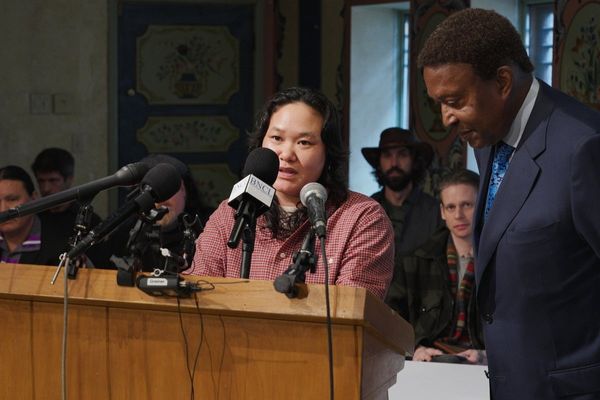
From a basement in deepest Wilmington, Delaware, comes a special Easter Sunday edition of the popular podcast Here’s the Deal. Its host is none other than Joe Biden, the presumptive Democratic presidential nominee, chewing the fat with Reverend William J Barber II, the prominent activist, Protestant minister and board member of the National Association for the Advancement of Colored People (NAACP).
In lockdown and unable to command national attention in the way he would like, Biden has turned to the internet to spread his message. Today’s podcast, the third of a series launched just over a week ago, deals with the coronavirus, a return to civility in the US, and “this guy in the White House.”
“I’ve preached about the soul of America and how we had to restore it,” Biden says, referring to a central tenet of his campaign to unseat Donald Trump in November.
“Well, you’re seeing it not just in those poor folks out there making the minimum wage and busting their neck and putting their lives on the line to help everybody else, you’re seeing it with acts of kindness that haven’t occurred in a long time across the board, in white communities, Asian communities, black communities, Latino communities.
“And that, I pray God, is going to be contagious.”
In the podcast, Biden and Barber discuss their faith, hope that comes from the Easter story and the long fight for civil rights and racial equality in the US.
“God doesn’t bring us viruses, but God works in the midst of pain, just like God worked in the midst of the slavery of the Hebrew people in ancient Israel,” Barber said.
Despite the religious overlay, Biden’s podcast did not stray far from the political. People’s experiences with the pandemic, the vice-president believes, have made them more appreciative of social policy.
“If Hillary had won, if we didn’t have this guy in the White House, it would have been very hard for Hillary to sell some of the things she wanted to sell, and the things that I want to sell, that Bernie wanted to sell, because people didn’t quite get it.
“People now understand. When’s the last time people walked out and thanked the guy who’s cleaning the sewer, for keeping his basement from backing up? When’s the last time that somebody walked out and said, ‘Hey, thanks?’
“Well, people now are seeing every single day people busting their neck, risking their lives, to save other people, these first responders, these nurses, the people that are out there in the ambulances… People are getting their eyes opened.”
Biden also has thoughts about the financial hardships people are experiencing.
“We should freeze all evictions for rent, we should freeze mortgage payments, we should be increasing social security payments right now by at least another $200 a month, we should be forgiving student debt,” he said.
“We’re going to need a lot more money spent to deal with this crisis and the aftermath of this crisis.”
Ariel Dorfman warned of the dangers of Donald Trump’s attack on science in 2017. Now he says that even those dire predictions did not go far enough as the president’s response to Covid-19 begins to play out:
Today’s chaotic and bumbling response to this emergency is no accident, but deeply rooted and systemic, the direct result of a pattern of callow benightedness that verges on the criminal and that goes back to the very start of Trump’s regime, embedded in the very recalcitrant anti-intellectual DNA of this president and his followers.
If, back in October of 2017, Trump seemed a remote, albeit inadvertent, disciple of the fascist general who shouted “Long live death!” all those decades ago as democracy was being destroyed in Spain, today I see him as someone far more terrifying: the personification of one of the horsemen of the apocalypse, the one riding the white horse of pestilence.
You can read the full column below:
Edward Helmore has the latest on oil production during the pandemic:
The world’s top oil producers have agreed to reduce global crude output, ending a price war after four days of video conferences involving government ministers from around the globe.
Under the terms of the deal, the 13-nation Organization of the Petroleum Exporting Countries – and 10 other nations including Russia – will cut production by 9.7m barrels a day, just below the initial proposal of 10m. The US, Brazil and Canada will contribute another 3.7m barrels as their production declines.
Last week, talks stalled when Saudi Arabia’s energy minister, Prince Abdulaziz bin Salman, refused to compromise with Mexico, which wanted to reduce output by 100,000 barrels a day.
Under the agreement struck on Sunday, the US will reportedly cut 300,000 barrels per day to compensate for Mexico. Delegates are set to hold a final call to agree the deal ahead of the market’s opening on Monday.
Oil prices have dropped 40% since early March, when Saudi Arabia and Russia failed to reach an agreement to counter an oil-market supply glut as the spread of coronavirus signaled a slowdown in world consumption. Last week, Saudi and Russian delegates pledged to bury their differences.
New Jersey, the state with the second-most deaths in the US from Covid-19, reported another 168 deaths on Sunday, although that is down from Saturday’s figure of 251. However, the number of positive tests (3,733) was up from Saturday’s total of 3,599. The total number of deaths from Covid-19 in New Jersey now stands at 2,350. New Jersey’s governor, Phil Murphy, said the state has received another 200 ventilators from the federal government. “Ventilators are our number one need right now. We won’t stop fighting to get the equipment we need to save every life we can,” he wrote on Twitter.
#COVID19 UPDATE: We’ve received 3,733 new positive COVID-19 cases since yesterday, bringing our statewide total to 61,850.
— Governor Phil Murphy (@GovMurphy) April 12, 2020
We’ve lost another 168 fellow New Jerseyans to COVID-19 related complications, bringing our statewide total to 2,350.
Prominent US public health adviser Dr Anthony Fauci has appeared to confirm a bombshell New York Times report which said he and other Trump administration officials recommended the implementation of social distancing to combat the coronavirus in February, but were rebuffed for almost a month.
Fauci appeared on CNN’s State of the Union. Asked why the administration did not act when he and other officials advised, he said: “You know … as I have said many times, we look at it from a pure health standpoint. We make a recommendation. Often, the recommendation is taken. Sometimes, it’s not.
“…It is what it is. We are where we are right now.”
More than 530,000 cases of Covid-19 have now been confirmed in the US, with almost 21,000 deaths. Officials currently expect a death toll of around 60,000 by August.
CNN host Jake Tapper asked if Fauci thought “lives could have been saved if social distancing, physical distancing, stay-at-home measures had started [in the] third week of February, instead of mid-March.”
“It’s very difficult to go back and say that,” Fauci said. “I mean, obviously, you could logically say, that if you had a process that was ongoing, and you started mitigation earlier, you could have saved lives. Obviously, no one is going to deny that.
“But what goes into those kinds of decisions is complicated. But you’re right. I mean, obviously, if we had, right from the very beginning, shut everything down, it may have been a little bit different. But there was a lot of pushback about shutting things down back then.”
Since the White House issued social distancing guidelines on 16 March, much of the country has gone into lockdown, shuttering the economy and leading to unprecedented and potentially ruinous unemployment.
Chafing against such conditions in an election year, Donald Trump has been voicing an eagerness to reopen the economy as early as 1 May.
On Sunday, Fauci, other experts and governors of hard-hit states were skeptical. Phil Murphy, governor of New Jersey, the state with the highest death toll after New York, told CBS’s Face the Nation: “If we start to get back on our feet too soon … we could be throwing gasoline on the fire.”
Updated
The White House has not scheduled a press briefing for today. If Donald Trump does not appear it will be the first time since the president started his Covid-19 updates that he has missed two days in a row. It should be noted that there was no briefing scheduled for last Sunday either before one was called at the last minute. However, the president could help his popularity by missing a few. He has been accused of spreading misinformation and undermining his own advisers during the briefings, and there is some evidence even his own base may be tiring of his behavior during his appearances.
Saturday’s report in the New York Times detailing the Trump administration’s failure to act on early warnings about the potential of Covid-19 to cause havoc in the US continues to cause a stir. On Saturday night, Donald Trump himself attacked the Times as “fake news”. On Sunday, Fox News host and Trump ally Sean Hannity ramped things up with a series of tweets directed at the Times and the newspaper’s White House correspondent, Maggie Haberman.
looks like @maggieNYT triggered @seanhannity pic.twitter.com/mADUy6gEx4
— Oliver Darcy (@oliverdarcy) April 12, 2020
“Hey .@maggieNYT . @nytimes You should Thank .@Potus for the Travel Ban(s) put in place while you and .@Nytimes were fixated on impeachment and advising people to travel to China. #NYTimesEpicFail,” he wrote on Twitter.
He also called Haberman and the Times “corrupt and abusively biased” and said “it was your paper telling people it is safe to travel to China”.
Hannity, it should be noted, said early on in the Covid-19 outbreak that the virus was being overplayed by Democrats and the media to “bludgeon Trump with this new hoax”. He has since denied calling the virus a hoax.
Reverend Brian X Needles delivers Easter Sunday mass via livestream from at Our Lady of Sorrows Catholic Church in South Orange, New Jersey. In an effort to include the congregation, Needles and the church staff attached pictures sent in by parishioners so that they may be there for today’s celebration. Pope Francis, as well as many Christian leaders, pivoted to live streaming services during the pandemic.

A police chief in Florida has been suspended for apparently claiming another officer’s “homosexual lifestyle” was the reason he contracted coronavirus and died.
Town managers in Davie placed chief Dale Engle on administrative leave after colleagues complained about his conduct at a fiery briefing this week at which they say Engle lambasted Broward sheriff’s deputy Shannon Bennett, 39, a 12-year veteran of the agency.
The Miami Herald obtained a copy of a letter written by the Florida fraternal order of police to Davie town administrator Richard Lemack.
“Chief Engle allegedly yelled about a ‘backstory’ which proclaimed that Deputy Bennett contracted and died from the virus because he was a ‘homosexual who attended homosexual sexual events’,” the letter says.
“He intimated that it was because of the homosexual lifestyle that Deputy Bennett first contracted a serious underlying disease which aggravated the Covid-19 virus and lead to his death.”
According to the newspaper, Engle was placed on administrative leave Saturday evening while town officials investigate the allegations. Engle has not responded to requests for comment.
Meanwhile, the Herald is itself in the news over a lawsuit its filing against the Florida governor Ron DeSantis. Its journalists have been pressing the governor to identify senior living facilities in the state where coronavirus deaths have spiked, information the newspaper says he has been withholding.
The Herald is now accusing DeSantis of “leaning” on the attorneys’ firm it used to draft a public records lawsuit demanding the information, and getting them to withdraw. The newspaper’s publisher says it now plans to use another law firm to file the papers instead.
The two sides have been at odds over DeSantis’s patchy handling of the coronavirus crisis in Florida, especially since a Herald reporter was excluded from a press briefing in Tallahassee last month.
The Associated Press reports that more than 2,600 deaths over the past two weeks in nursing homes and long-term care facilities have been linked to the coronavirus outbreak:
Because the federal government has not been releasing a count of its own, the AP has kept its own running tally based on media reports and state health departments. The latest count of at least 2,646 deaths is up from about 450 deaths just 10 days ago.
But the true toll among the 1 million mostly frail and elderly people who live in such facilities is likely much higher, experts say, because most state counts dont include those who died without ever being tested for COVID-19.
Alarming outbreaks in just the past few weeks have included one at a nursing home in suburban Richmond that has killed 39 and infected 84, another at nursing home in central Indiana that has killed 24 and infected 16, and one at a veterans home in Holyoke, Mass., that has killed 37, infected 76 and prompted a federal investigation.
This comes weeks after an outbreak at a nursing home in the Seattle suburb of Kirkland that has so far claimed 43 lives.
And those are just the outbreaks we know about. Most states provide only total numbers of nursing home deaths and dont give details of specific outbreaks. Most notable among them is New York, which alone accounts for 1,439 nursing home deaths but has so far declined to detail specific outbreaks, citing privacy concerns.
Experts say the deaths may keep climbing because of chronic staffing shortages in nursing homes that have been made worse by the coronavirus crisis, a shortage of protective supplies and a continued lack of available testing.
And the deaths have skyrocketed despite steps taken by the federal government in mid-March to bar visitors, cease all group activities, and require that every worker be tested for fever or respiratory symptoms at every shift.
Cuomo’s pitched skirmish with New York City mayor Bill de Blasio has continued into a second day with the governor reasserting that a final decision on opening schools will be made by him.
“We’re not going to open any schools until it is safe from a public health point of view,” Cuomo says. “We won’t open schools one minute sooner than they should be opened, but we won’t open schools one minute later than they should be opened either.”
On Saturday, De Blasio’s announced that New York City’s school district, which oversees 1.1 million students, would shutter for the rest of the academic year to try to slow the spread of the coronavirus, only for Cuomo to insist no decision had been made. The governor is only reemphasizing that line during today’s briefing.
“Am I, as I sit here, prepared to say what we’ll be doing in June? No,” he says. “I do not know what we will be doing in June. Nobody knows what we will be doing in June.”
Cuomo says he is signing an executive order requiring employers to provide essential workers with cloth or surgical face masks if they interact with the public, which is similar to the directive signed by New Jersey governor Phil Murphy.
“Spring is my favorite season,” he says, comparing the coronavirus shutdown to the cold of winter. “What spring says to all of us is it’s a time of rebirth. That no matter how cold the winter, no matter how barren the landscape got, the earth comes back to life.”
He adds: “This has been a cold period from a societal point of view and we’ve closed down in a way we’ve never closed down. But we will come back to life and we will have a rebirth. And that’s what spring is all about.”
Cuomo talks about the coordination that will be required for an evenutal re-opening of the economy, which is something he says everybody wants because we can’t keep going on like this: “You almost lose track of what day of the week it is because they don’t even have meaning anymore.”
“We need to be smart in the way we re-open,” the governor says. “What does smart mean? It means a coordinated approach, a regional approach and a safe approach. Nobody wants to pick between a public health strategy and an economic strategy. And as governor of the state, I’m not going to pick one over the other. You need a public health strategy that is safe, that is consistent with an economic strategy. How do you re-open but how do you do it in a way that is smart from a public health point of view. Rhe last thing we want to see an uptick in that infection rate and an uptick in those numbers that we worked so hard to bring down. So we need a strategy that coordinates business and schools and transportation and workforce.
“What New York Pause did was it stopped everything at the same time. It was a blunt device, but it shut down everything at the same time. We’re going to need testing, more testing, faster testing than we now have when you start to move people back to work. And we’re going to need federal help, there is no doubt about that.”
Here’s more from Ed Helmore on what New York mayor Bill de Blasio had to say this morning about his move to close New York City public schools until September:
As New York City’s coronavirus death toll climbs above 6,000, mayor Bill De Blasio has rejected a challenge from New York governor Andrew Cuomo over who has authority over the decision that will affect 1.3m students.
“The right thing to do to beat back this pandemic is to keep the schools closed and that’s really what it comes down to,” De Blasio said.
“I want to absolutely respect the fact that the governor has a important crucial role to play in a crisis,” he said, adding: “The children of this city, to the parents of this city and educators who serve this city, are my singular focus.
“This is not about legal or jurisdictional questions, this is a moral question, how do we protect people best? The best way to protect people is to keep our schools closed.”
On Saturday, the mayor announced the city’s schools would remain closed until September. Two hours later, Cuomo said that decision-making power rested with him – and he hadn’t decided.
On Sunday De Blasio downplayed notions of a rift.
“From beginning of the challenge of coronavirus, the governor and I have agreed on the vast majority of things. Our teams are working constantly together, so you know, there may be times when people have different perspectives. That’s not unusual.”
New York governor Andrew Cuomo says the total hospitalizations for coronavirus cases in the state is about 18,700 but the day-to-day change is down again. There were 53 new hospitalizations in the last day, which is the lowest since they started tracking.
The governor reports there were 758 deaths in the last day, down from 783 the day before. A total of 9,385 people have died from Covid-19 across the state since the start of the outbreak, more than all but four countries.
“Somebody asked a question once: can you ever get numb to these seeing these numbers?” he says. “Unfortunately, no. Seven hundred fifty-eight people lost their lives in a 24-hour period. I speak to many families are who are going through this, many people who have lost loved ones. Every one is a face and the name in a family that is suffering.”
Updated
The great Bryan Armen Graham will be along shortly to take the controls from me, so I thought I’d summarise where we are this Sunday morning:
- On the political talk shows, debate has largely centered around when Donald Trump might attempt to re-open the US for business. The president is eyeing 1 May, the day after federal social distancing guidelines expire, and spoke to Jeanine Pirro of Fox News about it on Saturday night.
- Public health experts including Dr Anthony Fauci of the White House task force and Dr Stephen Hahn of the FDA expressed caution – and Fauci mentioned the possibility of a resurgence of Covid-19 in the fall.
- World Health Organization Special Envoy Dr David Nabarro, meanwhile, told NBC’s Meet the Press: “We think it is going to be a virus that stalks the human race for quite a long time to come until we can all have a vaccine that will protect us and that there will be small outbreaks that will emerge sporadically and they will break through our defenses.
- New York mayor Bill de Blasio and New York governor Andrew Cuomo remain at loggerheads over whether New York City public schools will stay closed until September.
- Ivanka Trump has wished British prime minister a continued good recovery from his stay in intensive care with Covid-19, which gave me an excuse to blog about Withnail and I.
Here comes Bryan, anyway, to take us through Andrew Cuomo’s daily briefing at 11.30am ET and everything else that occurs.
Bill de Blasio, the New York mayor, has been discussing his disagreement with Andrew Cuomo, the New York governor, over the announcement on Saturday that New York public schools will remain closed for the rest of the academic year. De Blasio wants it, Cuomo said at a briefing on Sunday he did not, necessarily, agree.
Ed Helmore has been watching and will chime in soon. Here in the meantime is Victoria Bekiempis’s report on the whole sorry episode (despairing tone of sentence not at all dictated by blogger being a New York public schools system parent, no, not at all):
Updated
More from Ed Helmore…
Food and Drug Administration commissioner Dr Stephen Hahn has walked back projections that the peak of Covid-19 deaths in the US would likely be seen today.
“I think that information is accurate,” Hahn told ABC’s This Week. “But, again, we have to take this day by day as the data come in, because this has to be a data-driven approach.”
Responding to warnings that a much-cited model predicting a death toll of 60,000 in the US only applies if full social distancing is kept in place through the end of May, Hahn confirmed that reopening the country on that date, the day after the end of current federal social distancing guidelines, remains merely a target.
“I think it’s too early to be able to tell that,” Hahn said. “We see light at the end of the tunnel. We see the incredible resiliency of the American people with respect to social distancing, hand washing and all of those mitigation factors. So, that gives me great hope.”
But he added: “I think it’s just too early for us to say whether 1 May is that date. But more to come on that as we learn more information, and as our planning proceeds.”
Updated
Here’s Donald… the president does not, at the moment, have a White House briefing on his schedule for Sunday. He did not stage one on Saturday, either. But he has been busy tweeting.
“A very good sign,” he writes this morning, “is that empty hospital beds are becoming more and more prevalent.”
Trump is looking at his home city, New York: “We deployed 418 Doctors, Nurses and Respiratory Therapists from the hospital ship Comfort and the Javits Convention Center to hospitals in NYC & State. Have more bed capacity than was needed. Good!”
The USNS Comfort, docked off Manhattan island, and the temporary hospital set up at the Javits were initially meant to serve as release valves for the New York City hospital system, taking non-coronavirus cases. As such cases have fallen off dramatically in a city under lockdown – fewer car crashes, less crime, no elective surgeries and so on – they have been switched to the effort against Covid-19.
The New York state figures, again, according to researchers at Johns Hopkins University:
- 181,825 cases
- 8,650 deaths
The president’s cheerleading is of course understandable and part of his role as president, but it is also well to remember New York governor Andrew Cuomo’s solemn tone at his press briefing on Saturday.
“That is not an all-time high,” he said of the death toll, “and you can see that the numbers [are] somewhat stabilizing. But it is stabilizing at a horrific rate.”
Updated
Away from the shows for a while, Ivanka Trump has wished British prime minister Boris Johnson a swift recovery, after he left hospital in London after a spell in intensive care.
Happy Easter @BorisJohnson! Stay healthy and strong! https://t.co/qt5tHrWDJa
— Ivanka Trump (@IvankaTrump) April 12, 2020
I’m really blogging this as a chance to mention that Johnson’s recovery has included viewings of the Lord of the Rings and Withnail and I.
For anyone who doesn’t know what a Withnail and I is, it’s the greatest British film of all time (it is) and an enduring testament to, among other things, the writing and direction of Bruce Robinson and the greatness of star Richard E Grant, who not only now follows me on Twitter but is posting daily “Withnail and Isolation” videos to cheer devotees up in lockdown. And they do.
Here’s Toby Helm on the prime minister’s recovery – and gratitude to the NHS:
Updated
More from Ed Helmore:
Maryland governor Larry Hogan has called for a study of coronavirus infections by race in his state, after describing the rate of cases among African Americans as “very disturbing”.

Asked what he was doing to protect minority Marylanders, the Republican told ABC’s This Week he had called for the study because “nobody was really tracking these things and it was difficult to do because none of the federal labs, the [Centers for Disease Control and Prevention], nobody was actually tracking these tests by race.”
Around 7,600 people have been diagnosed with the novel coronavirus in Maryland and more than 200 have died amid fears that Baltimore, which is 63% African American, could become a new outbreak hotspot.
Last week, the Maryland department of health said African Americans have more confirmed cases and deaths from Covid-19 than other groups.
While black residents make up 31% of Maryland’s population, they make up the majority of deaths in the state from Covid-19 infections at 52%, and 49% of total coronavirus infections.
Hogan, with New York governor Andrew Cuomo, has called on the Trump administration to give $500bn to states in direct assistance as they respond to the pandemic.
Hogan told ABC “a vast majority of our resources” are focused on the Baltimore-Washington corridor.
“It’s where almost all of our attention and all of our focus, all of our money, all of our healthcare, all the assistance from the national guard, it’s really where all of our testing is being done, it’s where all of our healthcare is being ramped up, where we’re adding 6,000 hospital beds.”
WHO envoy: virus will 'stalk the human race'
NBC’s Meet the Press also spoke to World Health Organization Special Envoy Dr David Nabarro – not to be confused with Trump adviser, China trade hawk and coronavirus tsar Peter Navarro, about whom Julian Borger, our world affairs editor, wrote this must-read profile.
Asked about what southern hemisphere experiences in the virus might teach us about the seasonality or otherwise of Covid-19, Dr Nabarro offered a disturbing thought:
We think it is going to be a virus that stalks the human race for quite a long time to come until we can all have a vaccine that will protect us and that there will be small outbreaks that will emerge sporadically and they will break through our defenses.
Nabarro was also asked about Donald Trump’s criticism of the WHO and his threat this week – how serious he was was, as ever, unclear – to withdraw US funding for the international healthcare body:
The World Health Organization actually works on behalf of all the governments in the world. And it operates within mandates that are given to it. And, and we have to rely on information that’s received from different governments. And that then permits us to work out what’s going on … but we know that there will be many things that are found to have perhaps not been done as well as they could have been done. And we’re anticipating there’ll be lots of examinations afterwards.
Right now, we have to move forward. We have to get the best possible cooperation. I just heard you discussing with the head of the FDA some of the challenges, the things that we’re learning about this virus all the time. That’s why we need a strong WHO, a trusted WHO. And we hope all leaders will continue to work with us in that way.
Meet the Press Chuck Todd asked that given “the United States is anywhere – approximately 15% to 20% of your annual budget … how devastating would it be if the United States pulled its funding?”
Well, you know, we’re right in the middle of this massive epic struggle. Every single human being in the world is affected by it. Businesses are really in trouble. Communities are in distress. I really do hope that all nations will not find any reason to make threats or other such things that will undermine our capacity to bring together all the best knowledge that we can find.
“And of course we love our partnership with the United States. We work with United States scientists for years … and that would be so unfortunate if anything happened to lessen that cooperation.
“I know that Tedros [Adhanom Ghebreyesus], the director general, has had direct discussions with the president of the US. And he really does trust when – trust him when he hears from the president that respect for the WHO. And we hope that will go on. It’s too important to have anything that disturbs the functioning of the international system at this time.”
Dr Hahn on 1 May reopening: 'Primary issue is safety'
Transcripts from the later shows are starting to come in, which is always handy.
On NBC’s Meet the Press, FDA commissioner Dr Stephen Hahn faced similar questioning to Dr Anthony Fauci on CNN’s State of the Union, specifically about whether a 1 May reopening or partial reopening of the US economy, which Trump hopes for, might prove possible.
“The primary issue here is the safety and the welfare of the American people,” he said. “That has to come first.”
Hahn also said he had not felt political pressure on any decision.
Pressed on the issue of testing – and how many Americans have had access to it – Hahn said: “Testing is one component of the response to the outbreak, in addition to the mitigation efforts … So all hands on deck to try to get more diagnostic tests in. And we’re seeing more people come forward with very novel approaches to getting more tests, so that is one component.”
He also said, however, he was “concerned that some of the antibody tests that are in the market that haven’t gone through the FDA scientific review may not be as accurate as we’d like them to be … We know … that no test is 100% perfect. But what we don’t want are wildly inaccurate tests. Because, as I said before, that’s going to be much worse, having wildly inaccurate tests than having no test.”
According to this version of the interview transcript, at least (a rush version sent by NBC), Dr Hahn was not questioned about hydroxychloroquine and Trump’s support for its use as a treatment for Covid-19. Under federal guidelines for emergency use, doctors can prescribe the unproven anti-malarial drug if agreed with their patients.
Updated
Next up on CNN is Governor Asa Hutchinson of Arkansas, who like seven other Republican governors has not issued a stay-at-home order. Are those who have issued such orders wrong?
No, says Hutchinson, saying New York and New Jersey and other states are more densely populated than Arkansas, which he says is pursuing a targeted policy which is working. “I’d like to think we’re at the peak but we’re at least flat,” he says, adding that there is optimism that things will be getting better.
Tapper asks about towns and cities in Arkansas, which Hutchinson won’t let issue stay at home orders themselves. The governor says mayors can issue curfews, close parks if they need to, but he wants to take a long term approach as “there’s no such thing as a true lockdown”. He repeats his contention that Arkansans would not obey such an order, so why bother.
“If we need to do more, we will do more,” Hutchinson says, however.
Tapper reads off the increase to more than 1,200 cases and at least 25 deaths in Arkansas and says extreme measures do work. Why not take them?
Hutchinson says 1,200 cases is more than 1,000 cases short of “the projections”. We have 80 hospitalised because of Covid-19 and 8,000 hospital beds available, the governor adds.
“We’ll do more if need be,” he repeats.
Hutchinson has said he supports mail-in absentee voting in Arkansas if the national emergency is ongoing. Tapper asks if he therefore does not agree mail-in voting fraud exists, as the president does. “I’m not concerned,” he says.
It’s Easter, and church services in Arkansas are exempt from a ban on indoor gatherings of more than 10 people if they observe social distancing guidelines. People violating those guidelines will not be punished, Hutchinson says, but specific directives will be given.
Governor Phil Murphy of New Jersey is up next on CNN. He reports the deaths of 2,183 “blessed souls” from his state.
Asked if the outbreak in Jersey has peaked, as some models suggest, Murphy says he hopes so but nothing will be done precipitously.
Tapper asks if parts of New Jersey might be ready for a reopening by 1 May, as Donald Trump hopes. “It would be great,” Murphy says but he wants health recovery first and then the economic recovery and reopening without “cracking the back of this virus” would be a disaster.
So no, essentially. Or no, not likely. But it’d be nice if it were possible.
Does he have a plan to guard against a second wave of the virus if and when restrictions are lifted? Murphy says he is “beginning to war game on that”.
Does Jersey have enough coronavirus tests, enough labs, enough PPE for healthworkers and ventilators for patients?
“Broadly speaking the answer is no,” he says.
Jersey is still testing only for symptomatic patients, he says, and does not have universal testing for anyone who wants it, which the White House has long said Americans will have or even have already. Equipment shortages continue, he says.
“Please God I hope we do a national post-mortem,” Murphy says, hoping it will be bipartisan like the 9/11 commission was, when asked about whether Jersey prepared properly for the outbreak.
Here’s Ed Helmore – who is in Rockland county, a New York state coronavirus hotspot – with more on what Donald Trump told Fox News about reopening the US economy, or not, last night:
Donald Trump has re-iterated his position that any decision to re-open the US economy will be his to make, saying the decision will be the biggest of his presidency.
In a call to Jeanine Pirro on Fox News on Saturday evening, Trump said he would seek advise from many “smart people” before issuing any directive. Last week, the Trump announced he would establish a bipartisan “Opening Our Country Council” to weigh in on issue.
“A lot of very smart people, a lot of professionals, doctors and business leaders are a lot of things that go into a decision like that,” he told Pirro. “And it’s going to be based on a lot of facts and a lot of instinct also. Whether we like it or not, there is a certain instinct to it.
The council, Trump added, would include “some of the most distinguished leaders in virtually every field, including politics and business and medical. And we’ll be making that decision fairly soon.”
Trump’s phone-in came ahead of an early morning tweet on Sunday in which he attacked a New York Times report which said the White House failed to act on several explicit security agency warnings in January about the potential for coronavirus to spread to the US.
“So now the Fake News is tracing the CoronaVirus origins back to Europe, NOT China. This is a first! I wonder what the Failing New York Times got for this one? Are there any NAMED sources? They were recently thrown out of China like dogs, and obviously want back in. Sad!”
Trump’s interpretation of the report appeared to misconstrue scientific evidence that the spread of coronavirus to the Eastern US came through Europe – but not that it originated there.
The claim comes despite evidence that trade adviser Peter Navarro warned Trump in 29 January memo that as many as 500,000 Americans could die if the virus was allowed to spread across the US unchecked. A day later, health and human services secretary Alex Azar issued a similar warning. The White House did not issue national social distancing guidelines until 16 March.
On Saturday, Trump vowed to rebuild the US economy, which has suffered trillions of dollars in damage from the outbreak, as a tribute to those who have died. Trump predicted that the economy to rebound like a “rocket ship” because Americans have combated the coronavirus the “right way”.
“We did it the right way. We took care of social distancing and all of the things, words that nobody ever heard before, frankly, and phrases. But if we didn’t do that, we would have pulled through it,” Trump said.
“There were estimates, 2.2 million people. Well, if you cut that in more than half and you said a million and cut that in half. You say 500,000, it just would have been unacceptable.”
Updated
Fauci says that it is not fair to compare the US response to that of South Korea, which has clamped down on its outbreak relatively effectively and swiftly. The US is where it is because of many factors, he says.
Fauci is asked about a blockbuster New York Times report which said – among many other things about shortcomings in the Trump administration’s response to warnings about the coming outbreak – Fauci wanted severe measures in February but Trump did not.
“It is what it is,” he says.
Tapper presses – Fauci parries: “It’s the what would have and what could have.” Such decisions are complicated, he says, repeatedly, before adding tellingly: “There was a lot of pushback about shutting things down back then.”
Will it be safe for voters to go to the polls in November?
“I hope so, Jake,” Fauci says. He doesn’t want to be pessimistic, he says, but there is a possibility that fall and early winter could “see a rebound”. The experience of now will help then, he says, making it “an entirely different ball game.”
Fauci then speaks about the role of faith, and his in particular, on Easter Sunday.
Dr Fauci: some reopening 'at least in some ways maybe next month'
CNN are first, with State of the Union and host Jake Tapper.
Here comes Dr Anthony Fauci, director of the National Institute of Allergy and Infectious Diseases since 1984. Is the US in the worst of the outbreak, with more than 2,000 deaths in a day and more than 20,000 in total?
It’s hard to tell, he says, but notes that this week was predicted to be bad. The New York metropolitan area is showing signs of flattening and “starting to turn the corner”. The task force is feeling cautious optimism that a corner is being turned and sharp decline in cases could be relatively close at hand.
Nothing will be done prematurely or precipitously, Fauci stresses. When restrictions are relaxed people will still be getting infected, he adds: that’s called containment when right now the US is in mitigation. He speaks in praise of the states too, and governors’ efforts. As Tom McCarthy writes here, the relationship between Trump’s federal government and the states has not been smooth.
Asked when he thinks reopening might happen, Fauci says “It is not going to be a light switch where we say OK it is now June, July or whatever and the light switch goes back on.” Different parts of the country will reopen at different times – some places maybe “at least in some ways maybe next month”.
…Fauci continues to say it is very important not to view reopening society from social distancing and lockdown “is not an all or none” and “everybody knows that”.
“I’m sure you’ll hear the same thing from the governors,” he says.
Updated
The politics talk shows are coming up – making Sunday morning the time of any week in which weekend editors take a deep breath, make their sixth coffee since 6am and get their eyes down for the big prize, which is usually a vaguely contentious quote, a testy back-and-forth with Wallace, Tapper, Stephanopoulos, Brennan or Todd, or something that will just make Trump tweet.
So, as Kurt Vonnegut said, it goes.
Dr Anthony Fauci, leading White House public health expert and regular dampener-down of Trump-laid fires, is due up on CNN, so we’ll watch that closely. Dr Stephen Hahn of the Food and Drug Administration is due up on a couple of shows too, probably to be asked about Trump’s love for Hydroxychloroquine, the anti-malarial drug I still can’t pronounce but which the president thinks people should take for Covid-19, unproven as it remains.
Here’s Julia Carrie Wong’s excellent deep dive into all that:
Politics news from Alaska, where Joe Biden won a Democratic primary on Saturday that was delayed by Covid-19. Bernie Sanders may have dropped out this week but he still won a few delegates. Biden, of course, is now the presumptive nominee to face Donald Trump in November.
Of which, the Associated Press reports an interesting wrinkle:
The primary was scheduled for 4 April, but Covid-19 upended plans. In response, the party, which had planned to offer voting by mail and at in-person locations, went exclusively to a vote-by-mail system.
…The party said it sent in early March ballots to every person who was registered as a Democrat as of mid-February, more than 71,000. The party also included voter registration forms and downloadable ballots on its website.
Ballots had to be received by Friday to be counted, the party said.
Trump, remember, really, really doesn’t like voting by mail. He claims – and claimed again on Saturday night – it increases the risk of voter fraud. Experts disagree.
Perhaps the real reason for the president’s loathing for mail-in voting was, memorably, expressed to Fox & Friends last month. Here’s how the Guardian’s Sam Levine put it:
Last week, he dismissed Democratic efforts in Congress making it easier to vote in the coronavirus era. Trump said the move would make it so ‘you’d never have a Republican elected in this country again’.
Voting by mail, and Republican loathing for it, was also a key issue in this week’s farcical and many said dangerous Wisconsin elections. Here’s more from Sam:
Good morning…
…and welcome to another day’s coverage of the coronavirus outbreak in the US. As usual, first the figures according to researchers at Johns Hopkins University:
- Confirmed Covid-19 cases in US: 529,843
- Covid-19 deaths in US: 20,603
- Confirmed cases in worst-hit state, New York: 181,825
- Deaths in New York: 8,650
As we reported, Saturday saw the US, the country with by far the most coronavirus cases, ahead of Spain, become the country with the most coronavirus deaths, passing Italy.
Donald Trump did not hold a White House briefing on Saturday – at the time of writing there is no briefing scheduled for Sunday either – but shortly after dumping on Fox News in a tweet which praised conservative rival OAN, the president called into Fox News to speak to Jeanine Pirro about, among other things, when he will attempt to reopen the US for business.
“I think it’s going to be the toughest decision I ever made and hopefully the most difficult I will ever have to make,” the president said. “I hope I’m going to make the right decision. I will be basing it on a lot of very smart people, a lot of professionals, doctors and business leaders. There are a lot of things that go into a decision like that. And it’s going to be based on a lot of facts and instincts.
“People want to get back to work … We are setting up a council of some of the most distinguished leaders in virtually every field, including politics, business and medical. And we’ll be making that decision fairly soon.”
We’ll have more on the president’s thoughts as we go, and will keep an eye on the morning politics shows of course.
In terms of Guardian reading to be getting on with, here’s southern bureau chief Oliver Laughland’s report on the coronavirus outbreak in the Deep South, where poverty and racism have created conditions ripe for a public health disaster:
And here’s our columnist Robert Reich, a former US labor secretary, on why millions donated to efforts to contain Covid-19 by Jeff Bezos, Bill Gates, Elon Musk and other billionaires might not be quite the selfless acts they seem: