The government was accused of massaging the figures to meet its target of 100,000 daily tests as the UK death toll rose above 27,500.
Health secretary Matt Hancock hailed the “national achievement” of over 122,000 tests on 30 April – despite the inclusion of more than 40,000 tests which had been delivered rather than carried out.
Meanwhile experts warned the NHS lacks enough essential critical-care nurses for hospitals to restart some services which were shut down during the pandemic.
Follow the latest updates below:
Here are the latest developments:
- Boris Johnson has told Britain to wait another week for an exit strategy from lockdown, despite declaring for the first time that the country has “past the peak” of the coronavirus pandemic and is “on the downward slope”.
- Coronavirus fatalities among black and minority ethnic (BAME) groups in the UK are disproportionately high - and some are also bearing the economic brunt of the lockdown, a study has found. Per capita deaths among the Black Caribbean population in English hospitals are three times those of white British people, the Institute for Fiscal studies report said.
- Donald Trump said on Thursday he is confident the coronavirus may have originated in a Chinese virology lab, but declined to describe the evidence, ratcheting up tensions with Beijing over the origins of the deadly outbreak. He said had seen evidence that gave him a "high degree of confidence" the virus came from the Wuhan Institute of Virology.
- The UK government is "likely to get very close to or meet" its target of 100,000 daily coronavirus tests, transport secretary Grant Shapps has said. Speaking on Question Time, he said: "At the beginning of the week we only had 5,000 home tests available, we now have 20,000 available and it's the reason we are quite likely to get very close to or meet the 100,000 target."
- Moderna Inc and Swiss contract drugmaker Lonza Group AG said on Friday they would accelerate the manufacturing of the US drug developer's potential coronavirus vaccine. The announcement comes at a time when drugmakers are pausing clinical trials for other disease areas as they focus on testing potential treatments for the coronavirus.
- Australia will consider next Friday whether to relax coronavirus-related mobility restrictions, as the growth rate of new infections slows, prime minister Scott Morrison has said. He urged Australians to download an app aimed at tracing contacts of Covid-19 patients, saying it was a pre-condition to relaxing the containment measures.
- At least 10 different drug compounds ranging from cancer therapies to antipsychotics and antihistamines may be effective at preventing the new coronavirus from multiplying in the body, according to a multidisciplinary study conducted by a team of scientists in the US and France.
- Parks and museums in China's capital city have reopened after shutting their doors during the coronavirus outbreak. The Forbidden City is among the many attractions to be welcoming visitors, but only 5,000 people will be allowed to visit the past home of China's emperors in Beijing, down from 80,000.
Pakistani deaths are almost as disproportionate at 2.7 times higher, while fatalities among people of black Caribbean origin are 1.7 times greater, the Institute for Fiscal Studies (IFS) has found.
The research rejects demographic differences as the reason for the higher death toll – pointing out most ethnic minority groups are much younger than the white British population, so could be expected to survive in higher numbers.
But it may be partially explained by more black and Asian people being in “key worker” roles, while health conditions such as diabetes may also “be important”.
“Hospital deaths show clear disparities between ethnic groups in their mortality from Covid-19,” said Ross Warwick, a research economist at the IFS.
Deputy political editor Rob Merrick reports:

Boris Johnson has promised to deliver a "comprehensive plan" next week on how the lockdown may be eased after declaring the UK is "past the peak" of the coronavirus outbreak.
The prime minister said on Thursday he would be producing a "road map, a menu of options" explaining how to get the economy moving and children back to school while still suppressing the disease's spread.
Mr Johnson made his commitment as he fronted his first Downing Street press conference since leaving hospital for Covid-19, and he praised the NHS saying he had been "very, very lucky" but "thousands of people have been less fortunate than I was".
With the death toll having exceeded 26,700 and under pressure to detail a blueprint for easing the lockdown, the PM said: "We are past the peak and on the downward slope.
"I will be setting out a comprehensive plan next week to explain how we can get our economy moving, our children back to school and into childcare, and thirdly how we can travel to work and make life in the workplace safer.
"In short, how we can continue to suppress the disease and at the same time restart the economy."
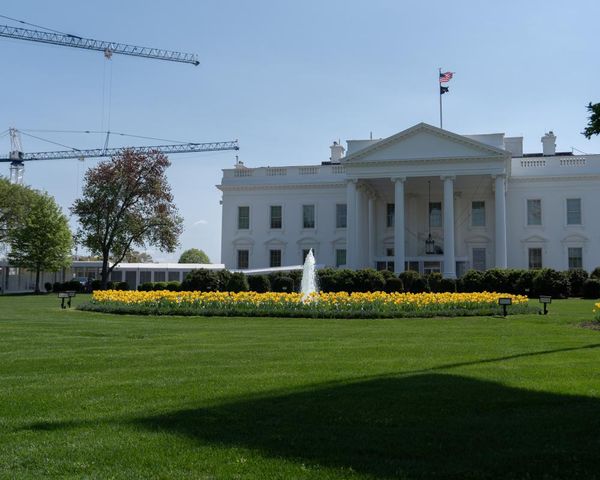
President Donald Trump said on Thursday he was confident the coronavirus may have originated in a Chinese virology lab, but declined to describe the evidence, ratcheting up tensions with Beijing over the origins of the deadly outbreak.
Trump did not mince words at a White House event on Thursday, when asked if he had seen evidence that gave him a "high degree of confidence" the virus came from the Wuhan Institute of Virology.
"Yes, yes I have," he said, refusing to give specifics. "I can't tell you that. I'm not allowed to tell you that."
The Chinese state-backed Wuhan Institute of Virology has dismissed the allegations, and other US officials have downplayed their likelihood. Most experts believe the virus originated in a market selling wildlife in Wuhan and jumped from animals to people.
Mr Trump has shown increasing frustration with China in recent weeks over the pandemic, which has cost tens of thousands of lives in the United States alone, sparked an economic contraction and threatened his chances of re-election in November.
Read more below:

Parks and museums in Beijing have reopened after shutting their doors during the coronavirus outbreak.
The Forbidden City is among the many attractions to be welcoming visitors, but only 5,000 people will be allowed to visit the past home of China's emperors in Beijing, down from 80,000.
Large-scale group activities in remain on hold and visitors must book tickets to visit parks, according to Gao Dawei, deputy director of the Beijing Gardening and Greening Bureau.
Beijing has downgraded its level of emergency response to the virus from first to second tier, but temperature checks and social distancing remain in force.
The change comes at the start of the five-day May holiday and in advance of China's rescheduled gathering of the National People's Congress on 22 May.
The two-week annual meetings, which were due to take place in March, are largely ceremonial, with the legislature rubber-stamping decisions reached earlier by Communist Party leaders.

Up to 3,000 jobs across pilots and cabin crew will be cut at Ryanair.
Britain may have hit its daily target of 100,000 tests, or come close, putting in place the beginnings of a network to test, track and trace people through the pandemic, housing minister Robert Jenrick said on Friday.
"I don't have the figures yet, they'll be published later today. But it looks like we'll either meet the target or come close so we will have very significantly increased the amount of testing in this country," he told the BBC.
Even if the UK government falls short of its target, Mr Jenrick said testing for Covid-19 will have been a “success”.
"This in itself is just a stepping stone, we need to go beyond 100,000, but we have seen now a very substantial increase in testing in quite a short period of time, so in that sense it's been a success, but there's more to be done."
The Australian government said on Friday it would meet a week ahead of schedule to decide whether to ease social distancing restrictions, as the numbers of new coronavirus infections dwindle and pressure mounts for business and schools to reopen.
The country has reported about 6,700 cases of Covid-19 and 93 deaths, well below the levels reported in the US and Europe. Growth in new infections has slowed to less 0.5 per cent a day, compared to 25 per cent a month ago.
Prime minister Scott Morrison said it was imperative to lift social distancing restrictions as early as possible, as 1.5 million people were now on unemployment benefits and the government forecast the unemployment rate to top 10 per cent within months.
"We need to restart our economy, we need to restart our society. We can't keep Australia under the doona," Mr Morrison said, using an Australian word for quilt.
Morrison's government has pledged spending of more than 10 per cent of GDP to boost the economy but the central bank still warns the country is heading for its worst contraction since the 1930s.
Ryanair says it will cut up to 3,000 jobs, mainly pilots and cabin crew, in response to the coronavirus pandemic. It will also impose unpaid leave and pay cuts of up to 20 per cent, and close some bases, “until traffic recovers”.
The airline is currently flying around 1,700 passengers a day on a much-reduced network of Irish Sea and Continental services.
Between July and September it expects to fly no more than half of the planned service of almost half-a-million passengers per day.
Travel correspondent Simon Calder reports:

Health secretary Robert Jenrick has suggested that face masks could become a staple part of day-to-day life in Britain once lockdown measures are eased.
"The advice in the past has been that face masks have only quite a modest difference from a health perspective, they do help us to protect others, and it might be particularly useful if you're asymptomatic so you don't know if you've got symptoms but you could still be spreading the virus," he told the BBC.
Russia reported 7,933 new cases of Covid-19 on Friday, a record daily rise, bringing its nationwide tally to 114,431.
The official nationwide death toll rose to 1,169 after 96 people with the virus died in the last 24 hours, Russia's coronavirus crisis response centre said.
'“There was one I saw two days ago,” she says. “I sent them an email and they got back to me this morning saying they are going to send me a £40 Tesco voucher. That’s all I can rely on now.”'
Undocumented migrants are among thousands of people falling through the cracks during the pandemic and becoming dependent on food banks for support, Mark Critchley reports:

The number of passengers travelling through Heathrow last month was down by around 97 per cent compared with April 2019, the airport has announced.
It expects passenger demand will "remain weak" until governments around the world "deem it safe to lift travel restrictions".
Heathrow recorded an 18.3 per cent year-on-year decline in demand to 14.6 million passengers between January and March, while earnings before tax and interest fell by 22.4 per cent to £315 million.
The airport insisted its financial position is "robust", with £3.2 billion in liquidity, which is "sufficient to maintain the business at least over the next 12 months, even with no passengers".

It is calling for the UK to lead the way in developing a common international standard for safe air travel.
"When we have beaten this virus, we will need to get Britain flying again so that the economy can recover as fast as possible."
- Johnson insists austerity ‘certainly not part’ of government’s economic response
- Coronavirus economic impact will be far worse than 2008 financial crash, warns Alistair Darling
- Pub and restaurant owners join forces to demand payouts from insurers

The government's "stay at home" message may have been "slightly too successful" a leading statistician has warned amid polling data which shows Britons are fearful about any easing of the lockdown.
A recent survey for Ipsos Mori suggested that more than 60 per cent of Britons would feel uncomfortable carrying out their usual activities - like going to bars or restaurants, or using public transport - if the lockdown is eased.
Professor Sir David Spiegelhalter, of Cambridge University, told BBC Radio 4's Today programme: "It's much harder to frighten to people to stay at home than it is to reassure them they can go out again.
"Maybe our whole campaign has been, if anything, slightly too successful."
Sir David also warned against taking a "Eurovision approach" and making "naive comparisons" in contrasting the UK with other countries' Covid-19 deaths.
Though the government has introduced a voucher system for pupils eligible for free school meals in an effort to stop them going hungry, there are still parents who say their children have gone some nights eating just toast or even skipped meals.
New figures published by the Trussell Trust, the UK’s largest network of food banks, showed there was an 81 per cent increase in emergency food parcels given out during the last two weeks of March compared to the same period in 2019 – including a 122-per-cent rise in parcels given to children.
Meanwhile, the Independent Food Aid Network reported a 59 per cent rise in need from February to March – an increase 17 times higher than the same period last year.
Read more below:

David Nabarro, the World Health Organisation's special envoy on Covid-19, said it would be "perfectly reasonable" for the UK to start easing the lockdown before a full contact tracing system is up and running.
Since the nation was placed in lockdown on Monday 23 March amid the coronavirus pandemic, it has been reported that cases of domestic abuse in homes have increased.
Reports of domestic abuse sent to UK police forces by Crimestoppers have risen by nearly 50 per cent in the time period, while charity Hestia, which supports adults and children in crisis, has seen a 47 per cent rise in victims using its free domestic abuse support app Bright Sky.
From Friday 1 May, survivors will be able to contact domestic abuse support services in “safe spaces” installed in Boots consultation rooms.
Read more below:

Conservative government cuts have "emaciated" the testing system and made the ability to track down coronavirus cases more difficult, a public health professor has claimed.
Gabriel Scally, a former regional director of public health, said he was "very worried" about the country's ability to get to the levels of contact tracers needed, saying 10 years ago it would have been possible - but cuts have damaged this.
"The resilience has been stripped systematically out of the system, you cannot, when a big problem like this hits, you can't just reinvent things and put them back the way you wish they were," said the Bristol University professor.
"If you make the system as lean and emaciated as it is there will not be the public health staff there, there will not be the health visitors, there will not be the environmental health officers and you can't magic them up out of nowhere.
"Simply testing key workers, health service workers and the over 65s really won't cut it, so it needs to be a comprehensive programme."