Boris Johnson has blamed a "mutant algorithm" for this summer's exams chaos in an attempt to dodge responsibility for the downgrading of thousands of students’ grades.
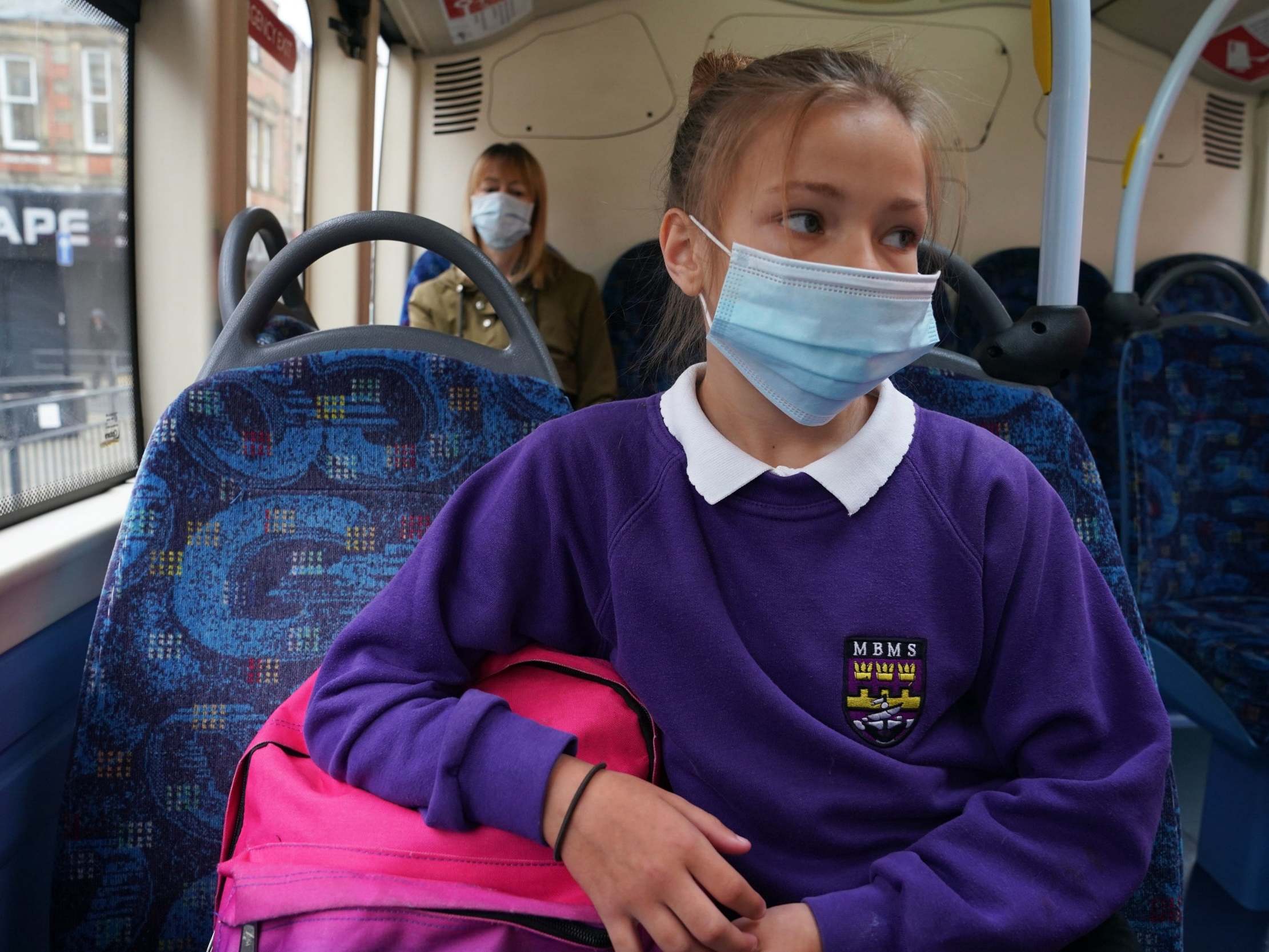
Meanwhile, the guidance on face masks in schools has changed following the latest government U-turn on coronavirus, with secondary school pupils now told to wear masks in parts of England.
Face coverings will be required in communal areas of schools in parts of the country where local lockdowns are in place, while headteachers elsewhere will have the option to ask pupils to wear them.
It came as the government announced that the Department for Education’s top civil servant, Jonathan Slater, would step down next week following the controversy around exam results this month.
Please allow the live blog a moment to load...
Boris Johnson has dropped advice against the use of face coverings in English schools after coming under pressure from unions, opposition parties and teachers.
From 1 September, staff and pupils in secondary schools in local lockdown areas will be required to wear face coverings when moving around the building and in communal areas where social distancing is difficult to maintain.
However, masks will not be mandated in the classroom and school leaders will have discretion over whether to require face coverings elsewhere in the country.
Our political editor, Andrew Woodcock, has the full story below:

Further guidance on face coverings in schools in England has been published by the government, setting out when they are required and which pupils are exempt.
The guidance says in local lockdown areas face coverings should be worn by staff and students moving around schools in communal areas and corridors from 1 September.
If new local restrictions are imposed, schools will need to communicate new arrangements “quickly and clearly” to staff, parents and pupils.
It says that all schools and colleges will have the discretion to require face coverings in communal areas where social distancing cannot be safely managed - such as when the layout of a school makes it difficult to do so.
If a student or staff member is struggling to access a mask, of if it is soiled or unsafe, the guidance says schools should take steps to have a “small contingency supply” available.
The guidance adds that no-one should be excluded on the grounds that they are not wearing a face covering.
Exemptions to the new measures include those who cannot put on, wear or remove a face covering because of a physical or mental illness or impairment, or disability, or if a person is speaking to or providing assistance to someone who relies on lip reading, clear sound or facial expression to communicate.
The two-metre social distancing rule used around the world to limit the spread of coronavirus is based on “outdated science”, experts have said.
A group of British scientists have called for the one-size-fits-all system to be replaced by “graded recommendations" for different settings.
The researchers, writing in the British Medical Journal (BMJ), said more flexible guidance would enable “a return towards normality in some aspects of social and economic life”.
Our reporter, Vincent Wood, has the full story below:

Education secretary Gavin Williamson has said the “best” scientific and medical advice indicates that the wearing of face coverings in all schools is not necessary.
“We always follow and listen to the best scientific and medical advice, and that's why we're not recommending that face coverings should be mandatory right across the country in all schools,” Mr Williamson told Sky News.
“The best scientific and medical advice says that that isn't necessary.”
However, he said masks were being introduced as “an extra precautionary measure” in some parts of the country with high rates of coronavirus transmission.
“When we do look at school return, the key thing, the thing that has informed us most of all, yes, it is for scientific and medical advice and it's been on the basis of how we ensure that all schools are as safe as possible,” he added.
Boris Johnson is facing a furious backlash from Conservative MPs over the U-turn on face masks in schools, with one backbencher calling on him to “get a grip on our scientists”.
Huw Merriman said the treatment of young people during the coronavirus pandemic had been an “absolute disgrace” and the public was “sick and tired” of seeing advice constantly changing.
He warned the U-turns made it look like the government was “making it up as we go along”.
Our political editor, Andrew Woodcock, has the full story below:

Gavin Williamson has ruled out mandatory requirements for face coverings in schools being extended further.
When asked by the BBC if measures could be enhanced, Mr Williamson replied: “No, no, there's no intention of extending it beyond that because as both [Dr Jenny Harries] said and [schools minister Nick Gibb] said is that actually that isn't what is required.
“But where you're seeing in local lockdown areas, we recognise the importance in making sure that we maintain education in every part of the country.”
He added: “The last thing that we ever want to see close is schools and we need to ensure that all schools are open so that children are able to access our world-class education that we all want to see them benefiting from.”
A deputy headteacher at a school in Manchester has said staff are “dizzy” from all the government’s U-turns this summer over education.
Tara O'Halloran, deputy headteacher at Flixton Girls' School, Greater Manchester, told BBC Radio 4’s Today programme that the sudden change in advice from the government had been confusing for teachers.
“Well firstly I think we’re a bit dizzy from all the U-turns that have happened this summer,” Ms O'Halloran said.
“I agree with what Geoff Barton said yesterday from our school that we’re educational professionals not medical or scientific experts and I think at present if we’ve been advised by the World Health Organisation that students should wear them in public spaces or communal spaces then I think we have to go with that guidance.”
She added: “It is confusing with the U-turn when [advice] has previously been quite dismissive about the use in schools but I think what we need to do is adopt all mitigating measures to make sure our community is safe in schools."
The educational divide between rich and poor pupils in the UK had stopped narrowing even before the coronavirus pandemic caused mass disruption to children’s education, researchers have found.
Experts fear the pandemic could exacerbate the attainment gap for less affluent children as pupils are constrained by a lack of access to technology, individual tutorship and stable learning environments.
Our reporter, Vincent Wood, has the full story below:

Spanish actor Antonio Banderas has said he has now recovered from coronavirus after testing positive earlier this month.
Mr Banderas wrote on Instagram that he was spending his 60th birthday in quarantine following his diagnosis but he was feeling “relatively well, just a little more tired than usual”.
Our reporter, Sabrina Barr, has the full story below:

Australian researchers have said they hope to start human trials for a coronavirus antibody therapy in early 2021, while a large-scale trial of a vaccine could begin by the end of this year.
Melbourne's Walter and Eliza Hall Institute has made good progress in identifying the most potent antibodies that could neutralise the spike protein on the virus that causes Covid-19, stopping it from being able to enter human cells, researcher Wai-Hong Tam said.
Antibody therapies would be most useful for the elderly and people with weakened immune systems, she said.
Almost 64 per cent of Australia's 549 deaths from Covid-19 have occurred among residents of aged-care homes, mostly in Victoria.
“If we're very hopeful, we are looking at clinical trials early next year,” Ms Tam told reporters.
Separately, the University of Queensland (UQ) said its scientists had reported to the International Society for Vaccines that their “molecular clamp” vaccine had been found to be effective in hamsters and could be manufactured at scale.
Assuming the team's ongoing phase 1 clinical trial shows adequate safety and immune responses, its partner, CSL Ltd, could start a large-scale study before the end of this year, UQ project co-leader Keith Chappell said.
The “molecular clamp” technology adds a gene to viral proteins to stabilise them and trick the body into thinking it is seeing a live virus so it makes antibodies against it.
Pupils are returning to classes at some schools in Leicester, with travel safety measures in place to protect against coronavirus.
About 20 schools in the city are reopening for some pupils on Wednesday, with children at a further 92 set to return to classes next Tuesday.
Leicester City Council said extra buses would operate on busy public transport routes because fewer passengers are allowed on each vehicle due to social distancing measures.
The authority has issued maps with “safe routes” for cycling and walking to encourage more pupils to travel on foot or by bike.
For many students, it will be their first time in class since March.
“We've been working with schools over the last few weeks to help us get the messages out to parents that they should walk or cycle to school if at all possible, and if they have to rely on public transport or car-sharing, how to do so as safely as possible,” Elly Cutkelvin, Leicester's assistant city mayor responsible for schools, said.
“All schools are busy at drop-off and pick-up times, and measures to help maintain social distancing, reduce traffic congestion and reinforce the key public health messages will all help to manage the situation as safely as possible.”
She added: “Returning to the routine of school life after such a long time away is quite a significant milestone for many families, and we want to ensure they get all the help they need to feel confident and safe in doing so.”
The UK is set to lose £700 per second in 2020 from the absence of visitors during the coronavirus pandemic.
The World Travel and Tourism Council (WTTC) said the predicted £22bn cost of missing tourists and business travellers this year was partly due to “continuing uncertainty around travel restrictions”.
In 2019, about 41 million overseas visitors who came to the UK spent £28.4bn - while spending by international arrivals in 2020 is expected to fall to just 22 per cent of the levels last year.
Our travel correspondent, Simon Calder, has the full story below:

The Liberal Democrats have called for education secretary Gavin Williamson to resign over his handling of the return of schools and exams during the coronavirus pandemic.
“It is incredibly disappointing that Gavin Williamson has refused to take responsibility for the combination of initial school return failure and the more recent exam fiasco,” the party said.
“He is simply not the person [to] deliver a safe return to schools and must resign.”
The NASUWT teachers’ union has said it is “deeply regrettable” that the government’s U-turn on face masks in schools has come at the last possible moment after weeks of warnings.
Dr Patrick Roach, general-secretary of the NASUWT, said the announcement raised “serious questions” about whether the government was following scientific advice in its push to get schools open in September.
“The NASUWT has been pressing the government to address the contradiction between its general advice requiring the use of face masks and face coverings in many public places and its position on their use in schools,” Dr Roach said.
“It is deeply regrettable that the government has failed to heed concerns until the last possible moment.”
He added: “This latest government U-turn will raise questions about the statement issued by the UK’s Chief Medical Officers last Sunday that there is a low risk of coronavirus transmission in schools.”
There are no plans to get all staff to return to offices full-time in the near future among 50 of the UK’s biggest employers, mainly due to difficulties with social distancing measures, a survey has found.
The BBC asked 50 big employers, from banks to retailers, to find out when employees might be asked to return to workplaces permanently.
About 24 firms said they did not have any plans in place yet to ask workers to return to the office.
Our reporter, Kate Ng, has the full story below:

Japan’s prime minister Shinzo Abe will consult with doctors before holding a news conference on Friday amid worries about his health after two recent hospital examinations, three sources have told Reuters.
Mr Abe is expected to provide an explanation about his health and talk about the government's handling of the coronavirus pandemic, local media reported.
The consultations with the doctors on Friday could involve another visit to the hospital or may be carried out by phone, the sources, who spoke on condition of anonymity, said.
Mr Abe has been to hospital twice in the last two weeks, including one visit of 7-1/2 hours, but he has not detailed what the visits were for.
Yasutoshi Nishimura, the economy minister, said on Wednesday that Mr Abe looked “a bit tired” over the last two weeks but seemed “very well” on Tuesday and “gave us various instructions in the usual manner”.
“We want him to continue to look after his health and show us his leadership,” Mr Nishimura said, according to Kyodo news.
Mr Abe, who is the country's longest serving prime minister, has been in the role since 2012.
He resigned abruptly from an earlier term in 2007 because of struggles with ulcerative colitis, a disease he has kept in check with medicine that was not previously available.
Authorities in Berlin have banned several protests which have drawn support from the German far-right planned for the weekend against coronavirus measures in the city.
Officials said those protesting would likely have breached rules on social distancing amid a recent upswing in infections in Germany.
Authorities in the capital cited a rally against Covid-19 restrictions on 1 August during which participants ignored mask-wearing and distancing rules and other conditions imposed on the protest.
“We need to weigh the basic right of freedom of assembly against the sanctity of life,” Andreas Geisel, Berlin’s top security official, said in a statement.
“We chose life.”
Mr Geisel said police would act to stop any large gatherings of people and indicated that authorities would not tolerate a tent camp that protesters have erected near the German parliament.
“I'm not prepared to accept that Berlin is abused a second time as a stage for corona deniers ... and right-wing extremists,” he said.
Numerous leading figures from the country's far-right, including members of the Alternative for Germany (AfD) party, had announced they would participate in rallies in Berlin on Saturday.
Education secretary Gavin Williamson has said the government is preparing “fallback measures” to determine results in case students are unable to sit exams next year.
Mr Williamson said the measures would be “different and better” than the controversial algorithm used by Ofqual to grade pupils in England this summer, which led to an embarrassing government U-turn and widespread anger from students, parents and schools.
Our political editor, Andrew Woodcock, has the full story below: