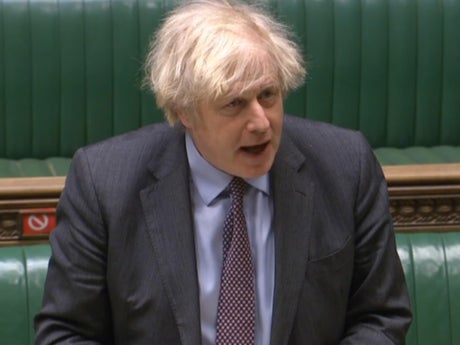
Boris Johnson received the backing of his chief medical and scientific advisers Chris Whitty and Patrick Vallance as he unveiled his “cautious but also irreversible” plan for lifting lockdown restrictions in England.
The prime minister said life could be back to normal by as early as 21 June as he defended his plan as a “one way road to freedom” and insisted he would not be “buccaneering” with people’s lives.
“The crocus of hope is poking through the frost and spring is on its way both literally and metaphorically,” he said during a live public briefing at Downing Street.
Under the road map, all schools in England will be expected to reopen on 8 March, while up to six people or two households will be allowed to meet outdoors from 29 March.
Other restrictions will be eased at five week intervals from 12 April, which chief medical officer Chris Whitty said would give time to assess whether infections were still under control.
The details were outlined as new research found that Covid-19 vaccines distributed across the UK substantially reduced the risk of hospital admissions.
Both the Pfizer/BioNTech and Oxford/AstraZeneca jabs were found to cut hospitalisations with the disease by up to 85 per cent and 94 per respectively. The research, which has yet to be peer-reviewed, is the first of its kind confirming the impact of the UK’s vaccine rollout.
- Lockdown timetable: What is reopening and when?
- When is Boris Johnson’s lockdown speech today, and what do we expect from it?
- Life virtually back to normal by 21 June at earliest, Boris Johnson announces
- When can I go on holiday in the UK
- We must be cautious about coming out of lockdown – the prime minister cannot get this wrong again