This live blog is now closed – the new one is here where you can join Rebecca Ratcliffe for continuing coverage.
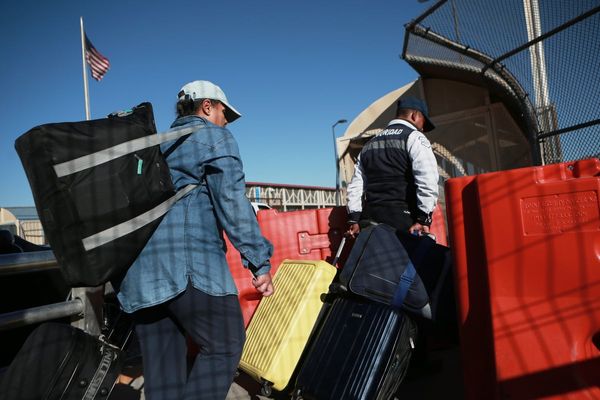
Tens of thousands of impoverished migrant workers are on the move across India, walking on highways and railway tracks or riding in trucks, buses and crowded trains in blazing heat, Associated Press reports.
Some are accompanied by pregnant wives and young children, braving threats from the coronavirus pandemic. They say they have been forced to leave cities and towns where they had toiled for years building homes and roads after they were abandoned by their employers casualties of a nationwide lockdown to stop the virus from spreading.
On Saturday, at least 23 laborers died in northern India when a truck they were traveling in smashed into a stationary truck on a highway. Last week, a train crashed into a group of tired workers who fell asleep on the tracks while walking back home in western Maharashtra state, killing 16.
The government and charities have tried to set up shelters for them, but their numbers are simply overwhelming, leaving them little choice but to head on a perilous journey home.
Brazil confirmed 14,919 new coronavirus cases on Saturday, as well as 816 related deaths, according to data from the country’s health ministry.
Brazil has now registered 233,142 confirmed coronavirus cases since the start of the pandemic, the fifth highest in the world, and 15,633 deaths.
Hello, I’m taking over from my colleague Jedidajah Otte in London.
If you think we’ve missed a story or want to draw our attention to something please do get in touch. My email is rebecca.ratcliffe@theguardian.com and I’m @rebeccarat on Twitter.
Summary - the latest developments at a glance
-
Italy’s prime minister Giuseppe Conte announced the easing of a series of lockdown restrictions, including the reopening of all shops, bars, restaurants and hairdressers, from 18 May, and free travel to Italy for people coming from EU countries from 3 June without having to undergo quarantine.
- Nepal has reported its first coronavirus death late on Saturday, a 29-year-old woman who recently gave birth, as the total number of people infected in the country reached 281.
- Ireland recorded 92 more cases, the lowest daily number in nine weeks, with the total now at 24,048. A further 15 people with Covid-19 have died in Ireland, which brings the country’s official death toll to 1,533.Turkey records lowest death toll since end of March
- Turkey’s health ministry said 41 more people have died from Covid-19 in the 24 hours to Saturday, bringing the death toll to 4,096. The daily death toll is the lowest registered since the end of March.
- Dozens of people were detained in the Polish capital of Warsaw during a protest by business owners against coronavirus restrictions. 19 protesters were arrested in London, and police dispersed rallies in several German cities.
- Tens of thousands of India’s migrant workers on the move, as impoverished workers are leaving cities and walking on highways and railway tracks towards their home communities as they see themselves forced to leave cities and towns after they were abandoned by their employers amid the nationwide coronavirus lockdown.
- Schoolchildren and their families will be tested for coronavirus if they develop symptoms, the British education secretary Gavin Williamson announced on Saturday in a bid to reassure parents and appease unions, as some children in England are set to go back to school on 1 June.
- The Israeli government has approved the resumption of school for all grades in areas that are not considered coronavirus hotspots, starting on Sunday. Beaches will officially open on Wednesday.
- The Spanish government will seek to extend its coronavirus state of emergency for the last time until late June, as the country’s daily death toll reached a near eight-week low.
- Lockdown easing is driving up infections in New York, the governor of New York, Andrew Cuomo, said on Saturday. The state’s new confirmed Covid-19 cases are predominantly coming from people who left their homes to go shop, exercise or socialise, and not from essential workers. The state’s daily death toll was 157 and half the regions in the state are now in the process of reopening.
That’s all from me, thanks for reading and writing in. It’s midnight in London now but my colleagues over in Australia are just gearing up for another day of news, which you can follow here:
I’m now handing over to my colleague Rebecca Ratcliffe.
Updated
The British government is to invest £93m ($112m) to bring forward the opening of a new vaccine-manufacturing centre ready to begin production if a coronavirus vaccine is found.
The Department for Business, Energy and Industrial Strategy (Beis) said on Saturday that the Vaccines Manufacturing and Innovation Centre (VMIC) will now open in summer 2021 - 12 months earlier than planned, the Press Association reports.
The not-for-profit facility, located on the Harwell Science and Innovation Campus in Oxford, will have the capacity to produce enough doses for the entire UK population in as little as six months.
A further £38m is being invested in a rapid deployment facility which will be able to begin manufacturing at scale from the summer of this year if a vaccine becomes available before the new centre is complete.
Officials said the VMIC would also boost the UK’s long-term capacity for dealing with future viruses and accelerate the production of vaccines for existing illnesses such as the flu virus.
Announcing the investment, business secretary Alok Sharma said: “Once a breakthrough is made, we need to be ready to manufacture a vaccine by the millions.”
Updated
New mother first Covid-19 death in Nepal
Nepal has reported its first coronavirus death late on Saturday, a 29-year-old woman who recently gave birth, as the total number of people infected in the country reached 281.
The victim, who was from Sindhupalchowk district, some 90 kilometres (about 55 miles) from the capital Kathmandu, was on her way to a hospital for treatment when she died, Agence France-Presse reports.
Canadian prime minister Justin Trudeau said on Saturday that his government had approved the first Canadian clinical trials of a potential Covid-19 vaccine, at Dalhousie University’s Canadian Center for Vaccinology in Nova Scotia.
The candidate vaccine was developed by Chinese pharmaceutical company CanSino Biologics, two Canadian government spokesmen said, according to Reuters.
Canada’s National Research Council on Tuesday said it was collaborating with CanSino to “pave the way” for future Canadian trials.
The council will work with manufacturers so that the vaccine can be produced in Canada if the trials are successful, Trudeau said.
Trudeau also said he would look at possible ways to help airlines further, but laid out no new measures after the country’s biggest airline announced mass layoffs due to the coronavirus pandemic.
Air Canada said on Friday it would cut its workforce by up to 60% as the airline tries to save cash amid the Covid-19 pandemic and adjust to a lower level of traffic.
The World Health Organization has warned countries ending lockdown that now should be a “time for preparation, not celebration”, to avoid a deadly winter surge in new infections, my colleague Emma Graham-Harrison reports.
The US Centers for Disease Control and Prevention (CDC) reported a total of 1,435,098 coronavirus cases on Saturday, an increase of 22,977 cases from its previous count, and said the number of deaths had risen by 1,325 to 87,315.
The CDC reported its tally of Covid-19 cases, caused by the new coronavirus, as of 15 May, compared with its count a day earlier, Reuters reports.
The former US president Barack Obama criticised some officials overseeing the coronavirus response on Saturday, telling college graduates in an online commencement address that the pandemic shows many officials “aren’t even pretending to be in charge”.
Obama spoke on Show Me Your Walk, HBCU Edition, a two-hour livestreaming event for historically black colleges and universities broadcast on YouTube, Facebook and Twitter.
His remarks were surprisingly political and touched on current events beyond the virus and its social and economic impacts.
“More than anything, this pandemic has fully, finally torn back the curtain on the idea that so many of the folks in charge know what they’re doing,” he said.
Obama did not name president Donald Trump or any other federal or state officials.
Here my colleague Jessica Glenza’s story:
Updated
Schools and beaches in Israel will reopen this week as the country further lifts its lockdown, Haaretz reports.
The government has approved the resumption of school for all grades in areas that are not considered coronavirus hotspots.
The return to school starting on Sunday will be at the discretion of local authorities. Some regional councils have already announced that they will delay the opening of schools by a day due to difficulties in organising school buses at such short notice.
Beaches will officially open on Wednesday, but thousands of people already flocked to Tel Aviv’s beaches over the weekend despite a ban still being in place.
Palestinian prime minister Mohammad Shtayyeh announced that the Palestinian government will allow shops to reopen from Saturday and up until next Friday, from morning until the evening and during the Ramadan break-fast meal.
The Spanish government will re-open some airports on several islands and in the southern part of the country to international travel, the country’s transport minister Jose Luis Abalos, announced on Saturday.
More details are expected Sunday, Abalos said, according to CNN.
“Tomorrow [Sunday] I will sign a resolution so the airports of Tenerife Sur, Alicante-Elche, Sevilla, Menorca and Ibiza become designated points of entry, capable of handling international public health emergencies,” Abalos tweeted. “Little by little, other centers will be opened.”
Updated
Here is another amazing picture of today’s Bundesliga match between Borussia Dortmund and Schalke 04 that was played in “eerie silence” at the Signal Iduna Park stadium in Dortmund, Germany on Saturday.
Soccer: Eerie silence across stadiums as Bundesliga restarts https://t.co/O5AArO6FEU pic.twitter.com/odPIVIQAAO
— Reuters (@Reuters) May 16, 2020
US swing states such as Michigan and Wisconsin helped bring Donald Trump to power in 2016. How they handle the pandemic may well be crucial at the presidential election this November too, writes my colleague David Smith.
Updated
Restaurants can now reopen in New Orleans, a city famous for its cuisine, but they must take reservations and limit the number of diners, the Associated Press reports.
US officials cautiously eased more restrictions on Saturday regarding eateries, shops and outdoor venues as they tried to restart local economies without triggering a surge in new coronavirus infections.
New Orleans took its first steps on Saturday to loosen restrictions that have been in place for two months, one day after the rest of Louisiana state did the same.
The city is restricting buildings to 25% of capacity, like the rest of the state, but also requires restaurants, nail salons and other businesses to take customers by reservation.
New Orleans has capped the number of people allowed in houses of worship and movie theatres at fewer than 100.
Malls and retail stores can reopen, but casinos, video poker, live entertainment and bars are still closed.
Some restaurateurs in the city decided to try reopening. Others planned to stick to takeout or stay closed all together.
So far, the pandemic has killed more than 88,000 people in the US.
Updated
Italy announces staggered ending of lockdown
Italy’s prime minister Giuseppe Conte has announced the easing of a series of lockdown restrictions, including the reopening of all shops, bars, restaurants and hairdressers, from 18 May, provided that the regional guidelines aimed at containing the risk of infection are observed.
In an address to the nation on Saturday evening, Conte said efforts to control the coronavirus outbreak had brought results, and that Italy was ready for a new phase in the fight against the pandemic, provided there was enough trust and responsibility in the population.
On 25 May, gyms, swimming pools and sports centres will be able to open, but will be required to adhere to safety protocols.
From 3 June, people can travel from region to region, unless the Italian government exercises containment measures based on the risk of infection in any given area, and people arriving from EU member states will no longer be subject to a mandatory quarantine.
Conte added that specific restrictions could be introduced at local level if necessary.
More certainties were needed, he said, before the country’s top football league, Serie A, could resume games, but said teams were allowed to resume full squad training from 18 May.
“We are taking a calculated risk, aware that the contagion curve could rise again,” Conte told reporters in the courtyard of his official Rome residence, according to Bloomberg.
“We are taking this risk and we have to accept it, otherwise we could not restart. We cannot wait for a vaccine.”
Updated
Schoolchildren and their families will be tested for coronavirus if they develop symptoms, the British education secretary Gavin Williamson announced on Saturday in a bid to reassure parents and appease unions.
With some children in England set to go back to school on 1 June under proposals announced last week, relations between teaching unions and the government became fraught in recent days.
My colleague Mattha Busby has more:
Ireland records fewest new cases since mid-March
A further 15 people with Covid-19 have died in Ireland, which brings the country’s official death toll to 1,533.
There have also been 92 new cases of the virus, the lowest daily number in nine weeks, with the total now at 24,048, the Department of Health confirmed on Saturday, according to RTE.
“Today is the first time we have seen the number of confirmed cases fall below 100 since mid-March,” said Tony Holohan, chief medical officer in the department.
“While the past nine weeks have been particularly difficult for those cocooning, and for parents with young children, today’s numbers give reassurance that we have all learned and adopted new behaviours of handwashing, respiratory etiquette and social distance that will serve us well as we work together to re-open retail, business and society.”
Tens of thousands of impoverished migrant workers are on the move across India, walking on highways and railway tracks or riding in trucks, buses and crowded trains in blazing heat.
Some are accompanied by pregnant wives and young children, and say they have been forced to leave cities and towns after they were abandoned by their employers amid the nationwide coronavirus lockdown, the Associated Press reports.
The government and charities have tried to set up shelters for them, but their numbers are simply overwhelming, leaving them little choice but to head on a perilous journey home.
Last week, a train crashed into a group of tired workers who fell asleep on the tracks while walking back home in western Maharashtra state, killing 16.
“I dont know what the future holds for me,” said Hari Ram, a 28-year-old mason who set out for his village in central India this week on foot, hoping to hitch a ride on the way.
“One thing is certain: If I die, I will die in my home. I will never set foot in New Delhi again,” he said.
Half of India’s population earns less than $3 a day. Over 90% of the workforce is employed in the informal sector, without access to social protection benefits such as paid sick leave or insurance, according to the World Bank.
The exodus of these migrant workers is causing worries for India’s top consumer goods companies, which fear a possible labour shortage as they resume production.
Updated
A group of migrants rescued off the coast of Fuerteventura have been placed in mandatory quarantine on arrival as Spain moves to reduce the likelihood of imported virus cases, local officials said Saturday.
Their boat was pulled to safety by the Spanish coastguard on Friday night and all 38 migrants were taken to a port on Fuerteventura in the Canary Islands, Agence France-Presse reports.
The migrants were rescued on the day that Spain began imposing a new mandatory 14-day quarantine on any incoming travellers arriving by sea or air in a bid to avoid any imported coronavirus cases.
The new measures will remain in force until 24 May when the state of emergency expires, although the government on Saturday signalled its intent to extend the restrictions until the end of June.
Tourists from England have continued to flout the stricter lockdown rules in Wales and have travelled to the country’s tourist destinations, the Press Association reports.
The lockdown rules have been relaxed in England so people can now “drive to other destinations” and meet one person outside their households outdoors.
But in Wales the stricter stay-at-home rules remain in force and people must exercise locally.
Police forces across Wales have continued to patrol beaches, coastal areas, and other public spaces, with the weather forecast to be sunny, and have also been conducting checks on motorists.
Updated
A tourist from New York was arrested in Hawaii after he posted beach pictures on Instagram while he was supposed to be in quarantine, CNN reports.
The 23-year-old man was arrested for violating Hawaii’s mandatory 14-day quarantine rule and for “unsworn falsification to authority,” the Hawaii governor’s office said in a statement.
He arrived in O’ahu on Monday and quickly posted numerous pictures of himself on the beach on Instagram.
He allegedly used public transportation to get to the many places he was pictured, the statement said.
“Authorities became aware of his social media posts from citizens who saw posts of him - on the beach with a surfboard, sunbathing, and walking around Waikiki at night,” the governor’s office added.
Updated
Turkey records lowest death toll since end of March
Turkey’s health ministry says 41 more people have died from Covid-19 in the past 24 hours, bringing the death toll to 4,096.
The daily death toll is the lowest registered since the end of March.
Minister Fahrettin Koca tweeted on Saturday that 1,610 new infections had been confirmed, bringing the total number of cases to 148,067 in the country of 82 million people.
Fifteen provinces, including Istanbul, are on a four-day lockdown, one of a series of temporary and regional lockdowns Turkey has instituted to combat the pandemic, the Associated Press reports.
People under 20 and above 65 have been stuck at home for weeks, but are now allowed to leave for a few hours on allotted days.
Other easing measures have gone into effect, including the opening of malls, barbershops and hair dressers. The number of provinces under lockdown on weekends and national holidays has dropped from 31 to 15.
Also on Saturday, Turkey’s tourism minister Mehmet Nuri Ersoy told private broadcaster NTV he hoped for domestic tourism to begin after 28 May, subject to coronavirus statistics continuing on a downward trend.
Updated
Churches in New York are being used as temporary coronavirus testing centres in an effort to bolster outreach to Black and Latinx neighborhoods, the Huffington Post reports.
People queued in a long socially distanced line around the block to get tested at Bethany Baptist Church, a congregation in Brooklyn, New York, just one day after it had launched its testing site.
Bethany Baptist is one of 11 temporary Covid-19 testing sites that opened at New York churches this week.
Burundi holds its first competitive presidential election next week since a civil war erupted in 1993, but simmering political violence and fears that campaign rallies could accelerate the spread of the coronavirus have marred campaigning, Reuters reports.
President Pierre Nkurunziza, who has faced accusations of political repression at home and abroad, is stepping down after 15 years in office, although the former rebel leader is set to remain a prominent force in the east African nation, one of the poorest countries in the world.
Opponents boycotted the 2015 poll, accusing the government of election abuses and rights violations, charges it denied.
Updated
French health authorities reported 96 new coronavirus deaths on Saturday, bringing the total to 27,625, the fourth highest in the world.
The health ministry said the number of people in hospitals fell to 19,432 from 19,861 on Friday and the number of people in intensive care units dropped to 2,132 from 2,203 on Friday.
Dozens of people, including a senator, were detained during a protest by business owners in the Polish capital against coronavirus restrictions, while police used tear gas against protesters, the Associated Press reports.
The city of Warsaw said the gathering was illegal because it had not been previously approved.
Jacek Bury, a senator for the opposition Civic Platform party, said he was hurt by police when trying to defend another protester.
Warsaw police said they faced cases of aggression against police officers. Police denied using force against Bury.
In Britain, anti-lockdown and anti-vaccine protesters held a gathering in Hyde Park in central London and were met by a heavy police presence.
Officers tried to disperse the groups, threatening them with fines if they didn’t comply. 19 people were arrested, the London metropolitan police service said.
Police in several German cities enforced distancing rules as thousands of people gathered on Saturday to express a mix of frustrations at restrictions battering the economy and a perceived loss of civic freedom.
Updated
The popularity of India’s prime minister Narendra Modi has soared since the pandemic has started, with some approval ratings reaching 80 and even 90 per cent, the New York Times reports.
But not everyone is rallying around Modi.
An app designed to help control the spread of Covid-19 that was downloaded by 50 million users in one day is raising concerns that India’s increasingly authoritarian government may be using the pandemic to further erode civil liberties.
People living in low-infection zones of France, so-called green zones, were able to go to the beach after the government began easing restrictions on Monday. Local officials reopened selected beaches in Northern France and Mediterranean coasts on Saturday.
Bathers took a dip in the sea or strolled along Nice’s promenade on the French Riviera on Saturday, with many wearing protective masks, as the beach reopened to the public for the first time since a nationwide coronavirus lockdown in mid-March, Reuters reports.
But there are new rules: individual activities such as swimming, fishing or surfing are allowed, provided social-distancing is respected, but sunbathing or staying on a beach for hours is not permitted.
Interior minister Christophe Castaner went to Veules-Les-Roses beach in the northern region of Normandy to check on the situation.
“The virus is still around. We must learn to live with it. One can go fishing but not linger on the beach for hours. We are all responsible in the fight against Covid-19,” he said, warning that the easing of the restrictions would be reversed if people didn’t respect the rules.
The easing of France’s eight-week lockdown, one of the strictest in Europe, started on 11 May, allowing non-essential shops, factories and other businesses to re-open.
To date, France has recorded 141,919 cases and 27,529 deaths from the disease.
Theatres, restaurants and bars will remain closed across the country until at least June.
Updated
The governor of New York, Andrew Cuomo, said in a press briefing on Saturday that the state’s new confirmed Covid-19 cases are predominantly coming from people who left their homes to go shop, exercise or socialise, and not from essential workers.
“That person got infected and went to the hospital or that person got infected and went home and infected the other people at home,” he said during his daily news conference.
State data showed that the number of new cases statewide has fluctuated between 2,100 and 2,500 per day. The number of new cases decreased to 2,419 on Saturday from 2,762 on Friday.
Cuomo said he had theorised last week that new cases were coming from essential workers.
“That was exactly wrong,” he said. “The infection rate among essential workers is lower than the general population and those new cases are coming predominantly from people who are not working and they are at home.”
Hospitalisations in the state were down again, as well as the number of new reported cases.
The daily death toll was 157, Cuomo said, and half the regions in the state were now in the process of reopening.
“We just want to make sure we don’t go back to the hell that we’ve gone through,” he said.
“The problem here are crowds and gatherings,” he said, stressing that economic activity would have to resume “without the crowds”.
As we phase reopening we are looking for all opportunities to reopen economic activity without crowds.
— Andrew Cuomo (@NYGovCuomo) May 16, 2020
For example, horse racing tracks across the state can open June 1 without fans.
Updated
Italy records lowest daily death toll in 10 weeks
Italy’s coronavirus death toll has risen to 31,763, as a further 153 deaths were reported, its lowest 24-hour increase in deaths since 9 March.
Lombardy, the region most severely affected by coronavirus, registered 39 deaths, down from 115 on Friday, my colleague Angela Giuffrida reports.
New infections rose by 875, up by 86 from Friday, with 399 of the cases in Lombardy.
The day before, 242 deaths had been reported, the Civil Protection Agency said, while the daily tally of new cases increased to 875 from 789 on Friday.
The country’s total official death toll now stands at 31,763 the agency said, the third highest in the world after those of the United States and Britain.
Italy has 224,260 confirmed cases of Covid-19 to date, including the deaths and 122,810 survivors.
People registered as currently carrying the illness fell to 70,187 from 72,070 the day before.
There were 775 people in intensive care on Saturday, down from 808 on Friday, maintaining a long-running decline.
Updated
Domestic flights resume in Pakistan
Domestic flights between major cities in Pakistan took off again for the first time in nearly two months on Saturday.
Passengers are required to wear face masks and vacant seats need to be left between passengers, officials said, according to Reuters.
International flights will remain suspended till 31 May.
“In view of the difficulties faced by passengers in traveling between major cities, the Federal Government has allowed limited domestic flight operations from five major airports, Islamabad, Karachi, Lahore, Peshawar and Quetta with effect from May 16,” said a statement issued by the Aviation Division.
Domestic and chartered flight operations will require disinfection of the aircraft prior to boarding. No food and beverages will be allowed during domestic flights, the statement added.
Prime minister Imran Khan on Friday said that the country could not afford an indefinite lockdown and the nation would have to learn to live with the pandemic.
Dozens of babies born to Ukrainian surrogate mothers are trapped in lockdown and unable to join their adoptive parents abroad as the country’s borders remain closed, CNN reports.
Lyudmila Denisova, the Ukrainian parliament’s human rights ombudsman, said in a briefing on Thursday that she is working with the country’s Foreign Ministry to help their parents get permits to enter the country.
BioTexCom, a reproduction clinic, said in a video posted online that 46 babies are currently in its care at the Hotel Venice, a facility in Kiev that parents from US, UK, Spain and other countries are trying to travel to so they can take home their children.
“We ask other countries to make an exception from their policy and to let their citizens to unite with their children,” BioTexCom lawyer Denis Herman said.
Canada’s prime minister, Justin Trudeau, just announced an increase to the country’s child benefit, which was introduced four years ago, to help families struggling because of the pandemic.
The Canada Child Benefit is helping parents make ends meet, lifting kids out of poverty, and building a better future for our young people. And during this uncertain time, families across the country are counting on this benefit more than ever. So we’re going to increase it.
— Justin Trudeau (@JustinTrudeau) May 16, 2020
“To all the moms and dads out there: This means that your monthly CCB payments will go up this July to help you pay for things like food, clothes, and activities you and your family can do together at home. And next week, you’ll get an extra one-time payment of $300 per child,” Trudeau wrote on Twitter.
“You should be able to focus on what matters most right now: raising your kids and keeping your family healthy. And by increasing your monthly CCB payments, we’re making sure that’s exactly what you can do,” he added.
Canada’s death toll has increased to 5,595, up from 5,499, as the country’s number of confirmed coronavirus infections has risen to 74,993 from 73,818, according to Reuters.
Updated
Several US states are beginning to reopen, but are struggling to come up with effective tracing programs, my colleague Joanna Walters reports.
Local health departments charged with tracking down everyone who has been in close contact with those who test positive for coronavirus are still scrambling to hire the number of people they need to do the job.
Read the full report here:
Some beaches in Greece, France and Italy opened today, and there are various reports that people wasted no time to take the opportunity.
More than 500 beaches reopened across Greece, although with strict physical distancing rules, and citizens in Athens flocked to the city’s shores, according to MailOnline.
Government guidelines state no more than 40 people are allowed per 1,000 sq metres (10,750 sq ft), while umbrella poles have to be 4 metres (13 ft) apart, with canopies no closer than 1 metre.
If you visited a Greek, Italian or French beach this weekend I’d love to hear from you and see your pictures.
Updated
Spanish government aiming to extend state of emergency
The Spanish government will seek to extend its coronavirus state of emergency for the last time until late June, the prime minister, Pedro Sánchez, said on Saturday as the country’s daily death toll reached a near eight-week low.
“The path that we are taking is the only one possible,” Sanchez said at a news conference, saying he would ask parliament for an extension of about a month until the end of June when most of the hard-hit nation should be returning to normality, according to Reuters.
Spain first introduced a state of emergency decree on 14 March. Officials say that while the outbreak has been brought largely under control, restrictions must stay in place a bit longer as the lockdown is gradually phased out.
The country’s Covid-19 death toll rose by 102 to 27,563 on Saturday, the lowest daily increase since 18 March. Confirmed coronavirus cases climbed to 230,698 from 230,183, the health ministry said.
After pushing four previous extensions through parliament, support for Sanchez’s left-wing coalition is waning among lawmakers and voters.
Some small protests against the government’s handling of the coronavirus crisis and its economic fallout sprang up around Madrid this week, with demonstrators gathering to bang pots and pans and call for the government to resign.
“It doesn’t matter what the demonstrations are about. The important thing is to maintain social distancing,” Sanchez said.
Updated
I’m handing this live blog over to my colleague Jedidajah Otte now. Thanks for your company over the past few hours, and for all your emails and tweets.
Zimbabwe will keep its coronavirus lockdown for the time being, though businesses will be allowed to open for longer and the restrictions will be reviewed every two weeks, the president, Emmerson Mnangagwa, has confirmed.
The southern African nation, which has reported 42 cases and four deaths from coronavirus, went into lockdown on 30 March and has been gradually easing the measures to help revive its troubled economy.
“Zimbabwe will ... continue on the level two lockdown for an indefinite period. The country needs to ease out of the lockdown in a strategic and gradual manner,” Mnangagwa said in a live broadcast.
Reuters reports that Mnangagwa said informal street markets, where millions of Zimbabweans eke a leaving selling everything from used clothes to vegetables, will remain shut while the government consults health specialists on how to reopen them safely.
Businesses such as manufacturers, supermarkets and banks, which have been allowed to continue operating, will now be able to work between 8am and 4.30pm, compared with the six-hour day imposed previously. Shared taxi minibuses will remain banned, forcing commuters to use buses operated by the state, which have struggled to cope with demand.
Updated
If you’re in the UK – and plenty of other places, for that matter – then you might consider there is no time better spent than a Saturday afternoon holed up in the pub. Nowadays, it’s takeaway pints if you are very lucky. This piece in the New York Times asks a troubling and pertinent question: will such a fundamental pillar of British life survive the Covid-19 crisis?
Updated
Our US coronavirus live blog is now up, with Joanna Walters. The vast majority of states are reopening for some form of business this weekend, and all the latest is here:
Updated
Thousands of Germans protest over government restrictions
Thousands of Germans have taken to the streets to protest against restrictions imposed by the government to contain the coronavirus pandemic, according to police and organisers.
Germany’s death toll from the virus has been lower than most of its European neighbours and some lockdown measures have already been relaxed, Reuters reports. However, protests against the measures the chancellor, Angela Merkel, insists are needed to slow down the coronavirus outbreak have become more vocal and demonstrators have filled the streets for the second weekend in a row.
Derided on social media as “covidiots” who risk causing a second wave of infections that could lead to a tightening of restrictions, protesters staged demonstrations at several locations across the capital Berlin and the surrounding state of Brandenburg.
In Stuttgart, where some protesters last weekend had been flouting social distancing rules and not wearing face masks, police expected another rally of up to 5,000 people.
In Munich, organisers asked authorities to give the green light for a rally of up to 10,000 people on the Thersienwiese, a large square in the city centre on which Munich normally stages its world famous Oktoberfest beer festival. But city officials pointed to the need to respect social distancing rules and allowed a demonstration of up to 1,000 people.
The hard core of protesters is being led by several new groups. One group is Resistance 2020, led by a lawyer from eastern Leipzig and a doctor from south-west Germany who question official corona statistics and view the main political parties as constructs of an elitist rule.
Another group called Compact describes itself as the “sharp sword against imperial propaganda”. German media have suggested Russia could be behind a misinformation campaign that is spurring on protesters.
Coronavirus has so far infected more than 173,000 people in Germany and killed nearly 7,900. Most Germans approve of Merkel’s crisis management, with polls showing support for her conservative CDU/CSU alliance surging to 40%. A survey released on Thursday showed 56% of the population back the current lockdown measures.
Updated
Kenya’s president, Uhuru Kenyatta, has banned movement across the country’s borders with Tanzania and Somalia to help curb the spread of coronavirus.
He exempted cargo trucks but said drivers would have to be tested for Covid-19. “There will be a cessation of movement of persons and any passenger-ferrying automobiles and vehicles into and out of the territory of Kenya through the Kenya-Tanzania international border,” Kenyatta said in a televised address.
The same measures would apply on the border with Somalia, he said. Reuters reports that Kenyatta also extended an existing dusk-to-dawn curfew by 21 days, as well as a ban on movement in and out of areas of Kenya worst hit by the coronavirus outbreak.
“I know there is growing global pressure for easing of measures against this disease and for all of us to get back to normal,” he said. “We are going to step up our defence by employing stricter, more localised prevention actions.”
Kenya has 830 confirmed cases of coronavirus, with 50 deaths.
UK's Covid-19 death toll rises by 468
The UK’s death toll from confirmed coronavirus cases has risen by 468 and now stands at 34,466. There have also been 3,451 new positive tests, making a total of 240,161 confirmed cases.
Our UK live blog is covering this, and other developments from the United Kingdom, in full.
Updated
Donald Trump’s top health officials, Drs Deborah Birx and Anthony Fauci, reappeared at Friday’s taskforce press briefing but – like other experts – have recently been absent from the media. This piece from Kenya Evelyn investigates their fluctuating public presence.
As the White House increased control over communications and refocused its message toward reopening the economy, appearances by the pair and others had all but stopped.
Before Friday, Birx and Fauci’s most recent televised interviews occurred on 4 and 5 May, respectively. Other health officials, including the Centers for Disease Control and Prevention (CDC) director, Robert Redfield, surgeon general, Jerome Adams, and Food and Drug Administration (FDA) commissioner, Stephen Hahn, had not appeared in interviews since April.
Here is the article in full:
Updated
Hungary’s government will gradually lift lockdown restrictions in Budapest from Monday, two weeks after it ended the lockdown in the rest of the country, the prime minister, Viktor Orbán, said on his official Facebook page.
“It has become clear that we have managed to curb the epidemic in Budapest as well,” Orbán said in a video, as reported by Reuters. “Therefore, we can shift to the second phase of defence in Budapest as well, cautiously ... and thus we lift the lockdown.”
Updated
Saudi Arabia passes 50,000 Covid-19 cases
The number of coronavirus cases in Saudi Arabia has topped 50,000, according to the country’s health ministry.
An official reported 2,840 new cases, taking the cumulative total to 51,980. That was up from an average of around 1,500 new cases a day over the past week. The death toll in the kingdom increased by 10 to 302, the official said on state television. Saudi Arabia recorded its first Covid-19 infection on 2 March.
Updated
Germany’s top football division, the Bundesliga, will restart in a few minutes after its hiatus of more than two months. The big game is Borussia Dortmund v Schalke 04, probably the country’s most hotly-contested local “derby”. Some may see it as welcome escapism in troubled times; others may regard it as needless folly. Whichever camp you sit in, our sport team are covering it with this live blog by Scott Murray:
I’m back with you for the next couple of hours now. You can contact me at nick.ames@theguardian.com or @NickAmes82.
Thanks for following the Guardian live feed. I am running it for the next half an hour or so while Nick has a break. Please do send me your thoughts, comments and news tips.
Twitter: @sloumarsh
Instagram: sarah_marsh_journalist
Email: sarah.marsh@theguardian.com
Thailand on Saturday extended a ban on international passenger flights until the end of June, the country’s aviation regulator said, as new cases in the country dwindle.
The Civil Aviation Authority’s ban extends a previous order that was set to run until the end of May.
The announcement comes as the country begins to relax local restrictions after reporting single-digit increases of infections from the new coronavirus this month.
On Sunday the government will allow malls and department stores to re-open. It will also shorten a nighttime curfew by one hour, to 2300 to 0400, from 2200 to 0400.
The aviation regulator first introduced the suspension of international flights in April in a bid to curb the spread of the coronavirus. Thailand has reported a total of 3,025 cases of the coronavirus and 56 fatalities.
The Watford manager, Nigel Pearson, has raised the possibility of a coronavirus-related death should the Premier League season resume too quickly.
English top-flight teams could return to some type of training next week following a Premier League meeting on Monday where medical protocols will be voted on and there are plans to get matches going again by mid-June.
Pearson, however, has doubts about “Project Restart” with much of Britain still in lockdown due to Covid-19.
“God forbid we have a fatality,” he told the Times. “People are closing their eyes to the threat. Yes, we would like to restart it but it’s got to be safe. We should be cautious. To ignore possibilities is foolhardy. It’s about safeguarding people’s health.”
Pearson, whose Watford side are just above the relegation zone on goal difference alone, added: “We have to try to believe [the British government] advice that we’re being given that we’ve reached the peak but there’s still an incredible number of people losing their lives through this.
“The death toll in the UK is anything between 33,000 and 38,000. That’s filling our stadium and then filling it half again. It’s a sobering thought.”
Here is our story:
Updated
Kenya’s president, Uhuru Kenyatta, on Saturday ordered a cessation of movement between the country and neighbouring Tanzania and Somalia to help curb the spread of coronavirus. He exempted cargo trucks but said drivers would have to be tested for the disease.
Updated
Iran reported 35 new deaths from the coronavirus on Saturday – the lowest number since 7 March despite infections rising –and announced a further relaxation of Covid-19 closures.
“Despite the unfortunate loss of 35 of our compatriots in the past 24 hours, this number is the lowest in the past 70 days,” health ministry spokesman Kianoush Jahanpour said.
The new deaths brought the overall toll to 6,937, he added.
But in an ominous sign, Iran on Friday reported its highest number of new infections in more than a month.
“We are in no way in a normal situation yet,” Jahanpour said.
He said 1,757 new coronavirus cases had been confirmed across Iran in the 24 hours to Saturday, bringing the overall total to 118,392.
Updated
Austria’s borders with the Czech Republic, Slovakia and Hungary will fully reopen on 15 June, the interior ministry said on Saturday, extending an easing of eastern border controls previously agreed with many of its neighbours to the west.
The announcement follows a previously coordinated step to fully remove barriers on travel between Germany, Austria, Switzerland and Liechtenstein from 15 Juneonwards and ease restrictions on who is allowed transit in the meantime. Restrictions remain in place for transit from Italy.
“Our goal is to have as much freedom as possible and as few restrictions as necessary,” the country’s interior, foreign and Europe ministers said in a joint statement. “These easings create a bit more normality for people in the border region and make it easier for commuters to lead a smoother everyday life.”
The European Union on Wednesday pushed to reopen internal borders and restart travel, but recommended Europe’s external borders remain closed for most travel at least until mid-June.
Updated
Hello everyone, as Nick just said I am taking over the Guardian’s live feed. Please do get in touch to share your thoughts, comments and news tips with me.
Twitter: @sloumarsh
Instagram: sarah_marsh_journalist
Email: sarah.marsh@theguardian.com
Updated
My colleague Sarah Marsh will be at the helm for the next hour while I take a lunch break.
If you’re on lockdown, wherever you are, solace can be taken in nature. Lucy Jones writes on the comfort we can take by being curious about our surroundings.
Our lives are made from the things we pay attention to. Slowing down and observing – these are radical things to do in our accelerated age. It is only by being in lockdown that I have seen new treasures that I’d previously have overlooked: the bright pink cones of the larch tree, blankets of blue speedwell, neon red velvet mites. The more we pay attention, the more we see.
The senses can help us notice more. I have heard a cuckoo twice this last week for the first time since childhood, in two different spots. It must be a combination of fewer aircraft and cars, and a craving and alertness for as much life as possible during that precious time outside.
The German finance minister, Olaf Scholz, is working on an aid package worth €57bn to help municipalities cope with plunging tax revenues caused by the coronavirus crisis, shows a ministry document.
Scholz’s aid package aims to help cities and towns stabilise their finances, according to the finance ministry document seen by Reuters. The plan also contemplates extra relief for some heavily indebted municipalities.
“This protective shield should not only bring cities and municipalities through the current difficult situation, but also enable them to do their job even better,” Scholz was quoted as saying in the strategy paper.
The federal government wants the 16 state governments to shoulder half of the costs, with parliament expected to approve the plan before the end of this year, the document said. Under Germany’s federal system, local authorities are in charge of a large chunk of public investments such as building roads and bridges as well as modernising schools and hospitals.
Scholz is expected to present further details of his plan later today. He said earlier this week that plunging tax revenues would not stop the government from unleashing another fiscal stimulus package next month and that the measures should include emergency aid for struggling municipalities.
In March, the German parliament suspended a debt brake and approved an initial rescue package worth more than €750bn to help the economy cope with the fallout of the pandemic. The first package already included a debt-financed supplementary budget of €156bn.
Updated
Qatar’s number of coronavirus infections topped 30,000 on Saturday, according to a Reuters tally based on official figures. The health ministry reported 1,547 new cases on Saturday, according to the state-run Qatar News Agency. That took the cumulative total to 30,972, according to the Reuters count. So far the country has recorded 14 deaths attributable to Covid-19.
New Zealand’s prime minister, Jacinda Ardern, found out there are no exceptions when it comes to physical distancing after she was initially turned away from a cafe because it was too full under coronavirus guidelines.
Mattha Busby has more:
Updated
The Covid-19 pandemic is causing major issues in Latin American prisons, with inmates rioting for better protection. We have a report from Clavel Rangel, Joe Parkin Daniels and Tom Phillips.
“I thought the death penalty was illegal in Colombia but we’re all on death row now,” said the man, who gave his name as Nelson and said he was one of 12 inmates in a cell designed for four.
Villavicencio’s prison has become the centre of Colombia’s Covid-19 outbreak, reporting nearly 900 cases – over 7% of the country’s confirmed total. Images circulating on social media show harrowing scenes inside, with dozens of inmates crammed into tight spaces, often without face masks. In late April, authorities discovered a tunnel dug by inmates desperate to escape the infection-ridden prison.
“This virus is spreading like crazy. Someone help us. We’re going to die here,” Nelson said by phone.
Read it in full here:
Updated
Summary
- A nine-year-old child from Marseille, France, is reported to have died of Kawasaki disease, the rare inflammatory disorder which has been linked to Covid-19. The boy is the first victim of the disorder in France and the second in Europe after a teenager died in London last week. Although Kawasaki disease is said to mainly affect children under five, those diagnosed in France are aged from one to 14. About 230 suspected cases have been reported across Europe.
- Afghanistan’s health ministry has warned of a surge in deaths if the country’s lockdown is not adhered to. Confirmed cases of Covid-19 reached 6,402 amid war raging on across the country. “If people continue to not heed, we will witness a big catastrophe among families,” said Wahid Majroh, the deputy health minister.
- Russia has recorded its highest daily Covid-19 death toll. The country reported 9,200 new confirmed cases of coronavirus on Saturday, with 119 deaths over the last 24 hours. The latter figure is the highest daily figure of deaths the country has recorded so far.
- Burundi is pushing on with plans to hold a controversial election on Wednesday despite concerns over the Covid-19 pandemic. It could be the first truly peaceful transfer of authority in the east African nation since independence in 1962.
- The Trump administration has fired the state department’s inspector general, Steve Linick. He is reported to have been investigating the secretary of state, Mike Pompeo, for a potential abuse of office.
- Spain has reported lowest rise in Covid-19 deaths since mid-March. Spain’s overnight death toll from Covid-19 was 102 on Saturday, the health ministry has said, marking the country’s lowest 24-hour rise in eight weeks.
Updated
Spain reports lowest rise in Covid-19 deaths since mid-March
Spain’s overnight death toll from Covid-19 was 102 on Saturday, the health ministry has said, marking the country’s lowest 24-hour rise since mid-March. The cumulative death toll rose to 27,563. Meanwhile, the number of confirmed coronavirus cases rose to 230,698 on Saturday from 230,183 on Friday.
Updated
If you are just joining the blog, remember you can email me at nick.ames@theguardian.com or send a direct message @NickAmes82 if you have any tips, observations or feedback.
At least 25 migrant workers have been killed after a truck they were packed into hit another vehicle in northern India during a nationwide coronavirus lockdown.
The pre-dawn accident in Uttar Pradesh state was the latest involving some of the millions of migrants left stranded and jobless by the seven-week shutdown, AFP reports.
Scores have died in road and rail accidents and even from exhaustion walking home. The vehicle, carrying about 40 men, women and children, struck another truck also carrying labourers and their families that was parked at a roadside cafe in Auraiya district, local magistrate Abishek Singh said.
The dead were all men, but women and children were among about 30 injured, Singh said. He said the driver of the truck was suspected to have fallen asleep.
The prime minister, Narendra Modi, called the accident “extremely tragic” in a Twitter post. He said relief work was in “full swing” at the scene.
Many businesses shut down overnight after the government-imposed lockdown began on 25 March, leaving millions of migrant workers destitute.
Desperate to return to their home states, many have walked hundreds of kilometres or hitched rides on trucks. More than a dozen labourers were killed earlier this month when a train ran over them as they slept on a railway track. Many others have been killed in road accidents. The lockdown is due to be eased from Monday.
Updated
Talking of sport, Germany’s Bundesliga restarts in about three hours and 40 minutes. It’s a big topic that cuts right across the board of Covid-19 issues – is it safe, is it moral, is it economically necessary, does it give a green light for top-level sport of all kinds to return globally? Later on I’ll direct you to our live coverage, but for now this is a good primer from Andy Brassell:
Updated
At the WHO/IOC press conference, Thomas Bach has been asked how all the physical contact involved in sport can be safely managed at next year’s Olympics, given there is no vaccine in prospect for Covid-19 yet. He replied:
“We are one year and two months away from these games. We will take all the necessary decisions at the right time, relying on the advice of the WHO, discussing it in our joint taskforce. I think nobody can at this moment in time really give you a reliable answer on how the world will look like in July 2021. So we have to be vigilant and we have to be patient, at the same time, to take the right measures to ensure the safe participation of everybody in the games.”
Updated
Our UK live blog is up and running alongside this global blog – you can join my colleague Lucy Campbell here:
As Wuhan, the Chinese city where the Covid-19 pandemic began, revs up a massive testing campaign, some residents crowding the testing centres have expressed concern that the very act of getting tested could expose them to the coronavirus.
Safety has become a hot topic on social media groups among the 11 million residents of Wuhan, people told Reuters as they converged on open-air test sites at clinics and other facilities. Many said, though, that they supported the voluntary campaign.
Wuhan health authorities sprang back into action after confirming last weekend the central Chinese city’s first cluster of new infections since it was released from virtual lockdown on 8 April. The new cases – all of them people who had previously shown no symptoms of the disease – spurred Wuhan authorities to launch a citywide search for asymptomatic carriers of the virus, aiming to gauge the level of Covid-19 risk.
Although Wuhan’s cinemas and banquet halls remain shut to curb large gatherings, the testing requires people to wait in long, sometimes messy, queues. “Some people have expressed worry in the [social media] groups about the tests, which require people to cluster, and whether there’s any infection risk,” said one Wuhan resident. “But others rebutted those worries, saying such comments are not supportive of the government.”
The unprecedented scale of testing indicates the official level of concern, some experts say. Others say it is an extremely costly exercise and question its effectiveness.
Residents said the authorities have not told them when they would get the results of their tests. To cope with the surge in work, more Wuhan hospitals have been asked to set up testing points, and other institutions have been roped in to help process tests, said a doctor involved in the exercise.
“We are now working 24 hours a day,” he said. “There is a lot of pressure.” China has confirmed 82,941 cases of Covid-19 as of Friday and 4,633 deaths. The government does not include people found to be asymptomatic carriers of the virus in its tally and does not publish a cumulative number of asymptomatic cases.
National Health Commission spokesman Mi Feng told reporters 194 asymptomatic carriers were confirmed in the first half of May, down 62% from the second half of April.
Updated
At the WHO/IOC press conference, Bach is stressing the need for sport to play a crucial part in governments’ Covid-19 recovery programmes.
“Sport is not only a very important economic factor, offering millions of jobs, it is also an extremely important social and health factor. The crisis has told us how important health is for the basis of everything we do in society. I’m really calling on governments to honour this and make sport an important part of their programmes.”
The World Health Organization director general, Tedros Adhanom Ghebreyesus, and the International Olympic Committee president, Thomas Bach, are holding a press conference.
You can watch it here:
Updated
A nine-year-old child from Marseille, France, is reported to have died of Kawasaki disease, the rare inflammatory disorder which has been linked to Covid-19. The boy is the first victim of the disorder in France and the second in Europe after a teenager died of the syndrome in London last week.
Doctors treating the French boy said he had developed a form of coronavirus but had no symptoms. He was admitted to hospital on 2 May suffering from what medics at first thought was scarlet fever. After being given treatment for scarlet fever he was allowed to return home as doctors said his symptoms were mild.
Later the same day the child was rushed to hospital by ambulance and admitted to intensive care where he was diagnosed as suffering “signs of Kawasaki disease”. He died six days later on 8 May after suffering a heart attack that caused brain damage.
There are believed to be 144 diagnosed cases of Kawasaki disease in France, most of them in the Paris area, more than half of whom have tested positive for Covid-19. The French public health authority, Santé Publique France, said research suggested the little-known syndrome appeared on average around four weeks after the children were infected by Covid-19, and was possibly a reaction to the virus. This has yet to be confirmed by scientific research.
Although Kawasaki disease is said to mainly affect children under five, those diagnosed in France are aged from one to 14. About 230 suspected cases have been reported in Europe, including in the UK where a 14-year-old boy died last week at the Evelina London Children’s Hospital.
Updated
Trump fires state department inspector general
The Trump administration has fired the state department’s inspector general, who is reported to have been investigating the secretary of state, Mike Pompeo, for a potential abuse of office, reports Julian Borger.
The inspector general, Steve Linick, was given notice of his dismissal late on Friday night and is to be replaced by Stephen Akard, a close ally of the vice-president, Mike Pence, from his home state of Indiana. A state department spokesperson said that Akard, who has been running the office for foreign missions, would take over immediately as acting inspector general.
According to a Democratic congressional aide, just before his abrupt dismissal Linick had opened an investigation into allegations that Pompeo had been using a political appointee at the state department to run personal errands for him and his wife, Susan.
Under US law the president is required to give 30 days’ notice before firing an inspector general, to allow Congress to investigate the reasons for dismissal. In recent months Congress has not used that month-long notice period to prevent the termination of other watchdog officials fired by the president.
Here is the piece in full:
Updated
Afghan health ministry warns of "big catastrophe" if lockdown unheeded
Afghanistan’s health ministry warned of a surge in deaths as confirmed cases of Covid-19 reached 6,402 amid war raging on across the country.
Wahid Majroh, the country’s deputy health minister, said 1,113 suspected patients were tested over 24 hours, of whom 349 came back positive. Fifteen Covid-19 deaths were recorded overnight, pushing the toll to 168. There have been 788 recoveries.
“If people continue to not heed, we will witness a big catastrophe among families,” Majroh said in a press conference in Kabul. He said the ministry had a three-phase plan to ease the lockdown. “According to our plan, the lockdown should be in place for one year so we can get back to normal life,” he said.
Despite a government-authorised lockdown in several provinces, streets are still crowded, raising fears of a surge in number of death and infections. Experts fear the real number of people with Covid-19 may be much higher than reported by the ministry as testing capacity remains low.
“We talk about our concerns about the virus in the country each day, but people still go out and break the lockdowns, which will help the numbers to go higher,” Majroh said.
The ministry has pledged to increase number of daily tests. Majroh said this week that the country was waiting to receive more testing kits to increase daily testing capacity to around 2,500 in the first phase, “5,000 in the second, and 10,000 tests each day”. So far, 21,969 patients have been tested in Afghanistan.
Most of the new cases and deaths reported on Saturday were in the country’s capital, Kabul, with 126 new cases and six deaths. The total number of infections in Afghanistan’s worst-affected area is 1,844, with 25 deaths.
The eastern province of Paktia, where a car bomb killed at five civilians this week, reported its biggest one-day rise of infections – with 56 cases reported out of 119 tests today. Paktia has so far recorded 234 confirmed cases and five deaths from Covid-19.
The number of new infections in southern province of Kandahar has slowed compared with recent days, as 10 new cases were reported over the past 24 hours. The eastern province of Nangarhar recorded 37 new cases; concerns are high in the province as six cases were confirmed in its prison last week.
Meanwhile, war rages on across the country. The president, Ashraf Ghani, in response to an attack on a maternity hospital in Kabul, ordered a resumption of a full offensive against the Taliban and other militant groups, ending a period of reduced military activity ahead of US-brokered peace talks that had been expected to start this year.
Updated
Burundi is pushing on with plans to hold a controversial – but crucial – election on Wednesday 20 May despite concerns over the Covid-19 pandemic.
The election will end the divisive and bloody 15-year rule of the country’s president, Pierre Nkurunziza, reports AP. It could be the first truly peaceful transfer of authority in the east African nation since independence in 1962.
But coronavirus poses a threat to the vote. Burundi has kicked out World Health Organization workers after concerns were raised. The WHO Africa director messaged the Africa Centres for Disease Control and Prevention chief about political rallies the day that Burundi’s campaigning launched and images of crowds circulated online.
Authorities have been accused by critics of downplaying the pandemic and citing divine protection. But the government appears to be using virus measures to limit election observers, warning the east African regional bloc on 8 May that arriving foreigners face a 14-day quarantine.
More than the virus, however, the fear of violence weighs on many of the more than 5 million people eligible to vote. Government agents have been accused of harassing the main opposition party, the CNL, whose leader, Agathon Rwasa, is believed to be in a close race with Nkurunziza’s chosen successor in the ruling CNDD-FDD, Evariste Ndayishimiye.
More than 145 CNL members have been arrested since campaigning began on 27 April, according to SOS Medias Burundi, a group of independent journalists. Police spokesman Pierre Nkurikiye has accused Rwasa of making incendiary and defamatory remarks and inciting revolt.
Rwasa, the deputy parliament speaker, has drawn large crowds despite the risks of openly supporting him, according to an online group of activists known as i-Burundi. The group worries that a rigged election could spark the kind of street demonstrations that marked the previous vote in 2015.
Rwasa feels it is important not to boycott the election even if the outcome is not expected to be fair. “Everything has its right time,” he said. “Right now, it is not the time to give up and abandon our people.”
Updated
Russia reports its highest daily Covid-19 death toll
Russia reported 9,200 new confirmed cases of coronavirus on Saturday, with 119 deaths over the last 24 hours. The latter figure is the highest daily figure of deaths the country has recorded so far.
The rise is down on the 10,598 new cases reported on Friday. The number of confirmed cases nationwide stands at 272,043 and the official death toll is 2,537.
On Thursday, Russia defended its methods of recording data on Covid-19 deaths:
Updated
Singapore has registered 465 new coronavirus infections, according to its health ministry. That figure takes the city-state’s total to 27,356 cases.
The vast majority of the newly-infected people are migrant workers living in dormitories, the ministry said in a statement. Four are permanent residents. To date, Singapore has recorded 21 deaths from Covid-19.
Attempts to combat Covid-19 in western Uganda have been severely complicated by a series of devastating floods and rockslides that are believed to have affected as many as 173,000 people, Samuel Okiror reports. Many now find themselves in temporary displacement camps in schools or churches.
Samuel’s report quotes Stephen Oluka, the director of Uganda’s national emergency coordination and operations centre:
Oluka says overcrowding in makeshift centres had complicated efforts to combat Covid-19. “The guidelines have been compromised. I didn’t see anyone [displaced] in the camps with a mask. The leaders are telling people to maintain social distancing but it’s not attainable. There is overcrowding in camps.”
He adds: “I don’t think they are now bothered about coronavirus, which they haven’t seen. They are bothered about what has affected them now [floodings], safety from waters and their livelihoods.”
Here is the piece in full:
Leopards, jackals and other creatures living in Islamabad’s tree-covered hills have been enjoying rare respite from the throngs of hikers and joggers that normally pack the trails of Pakistan’s capital, reports AFP.
Rangers in the Margalla Hills National Park saw animal activity increase soon after the city was locked down in March to counter the coronavirus. Islamabad’s normally reclusive leopards have been roaming onto deserted pathways, and social networks are rife with talk of purported sightings.
Motion-triggered wildlife cameras have been clicking away as animals explore areas they had long been nervous to visit. “There is a big increase in the number of animals [seen] in the national park,” ranger Imran Khan – not to be confused with the namesake prime minister – said.
Images the park provided include pictures of leopards padding along paths, an inquisitive jackal and a muddy boar. “Wildlife is comfortable as there are no visitors here. They are wandering here comfortably, which is a good sign for the jungle,” Khan said.
The park was locked down for about a month and foot traffic remains light as families, picnickers and walkers stay away during the fasting period of Ramadan.
Hello everyone. I’ll be taking you through the next eight hours or so of Coronavirus news and updates from around the world. As ever, we’d be glad to hear any tips, information, feedback or observations from you. My email address is nick.ames@theguardian.com or you can send me a direct Twitter message @NickAmes82.
That’s it from me, Helen Sullivan for today. Thank you for following along. My colleague Nick Ames will be taking it from here.
I’m signing off from my home in Sydney, where I’ve been reunited with several lip balms that had been in the pockets of various long-unused jackets.
I flew to Greece and began solo IVF. Then the world shut down
It is 7.53am, the last Wednesday in March, and at a courier depot in Athens, the sperm of a Bermudian mechanical engineering student arrives, carried in a nitrogen tank. For the last three days, I have followed the tank’s journey across Europe, loading and reloading the courier website as it made its way from a cryobank in Denmark through Germany to mainland Greece.
The continent has been shutting down, borders closing as coronavirus spreads, and as the days have passed, the improbability of this delivery, its chances of ever reaching its destination, have seemed increasingly slim.
Here’s one way to get suited up for a hospital shift:
This is a lovely South African celebration of our frontline workers - worth a look. pic.twitter.com/UwYwA6vA3C
— Adam Habib (@AdHabb) May 15, 2020
Global report: Democrats push for $3tn stimulus as experts track Covid-linked syndrome
The US House of Representatives has narrowly approved a $3tn bill pushed for by Democrats to battle the coronavirus and stimulating a faltering economy. But Republicans who control the Senate have vowed to block the bill, though some support its provisions aimed at helping state and local governments.
Donald Trump has promised to veto the bill if it ever reaches his desk. But its House passage could trigger new negotiations with the president. Nancy Pelosi, the Democratic Speaker of the House, called it a “starting point” for talks. Earlier on Friday the House also approved a change in its rules to allow members to temporarily cast their votes by proxy during the crisis if Pelosi deems it necessary.
The Trump administration is set to restore partial funding to the World Health Organization, Fox News reported late on Friday, citing a draft letter. The Trump administration would “agree to pay up to what China pays in assessed contributions” to the WHO, Fox reported, quoting from the letter.
Trump has announced details of a “warp-speed” effort to create a coronavirus vaccine by the end of the year, even as experts warn that such a breakthrough could take longer than 18 months.
Earlier in the week, Fauci, director of the National Institute of Allergy and Infectious Diseases, warned: “There’s no guarantee that the vaccine is actually going to be effective.”
The number of deaths in the US is projected to exceed 100,000 by 1 June, the CDC director, Robert Redfield, has said.
UK papers, Saturday 16 May
Saturday’s GUARDIAN: Reopening schools on 1 June is too dangerous, say doctors #TomorrowsPapersToday pic.twitter.com/0pMyJx73wW
— Helen Miller (@MsHelicat) May 15, 2020
Saturday’s TELEGRAPH: ‘Squabbling’ unions told to get back to school #TomorrowsPapersToday pic.twitter.com/lYFrBgT0k4
— Helen Miller (@MsHelicat) May 15, 2020
Saturday’s INDEPENDENT: No 10: Restrictions may be eased by area #TomorrowsPapersToday pic.twitter.com/S5QCcn6HJ9
— Helen Miller (@MsHelicat) May 15, 2020
Saturday’s TIMES: Schools to defy unions and reopen next month #TomorrowsPapersToday pic.twitter.com/xi7GTgsDU6
— Helen Miller (@MsHelicat) May 15, 2020
FT WEEKEND: Teachers and Downing St face off over back-to-school timetable #TomorrowsPapersToday pic.twitter.com/AjRySL7mwF
— Helen Miller (@MsHelicat) May 15, 2020
Invisible deaths: from nursing homes to prisons, the corona toll is out of sight – and out of mind?
John Delano was six years old when the contagion struck his neighborhood in New Haven, Connecticut. There was a morgue just down the road. Coffins began spilling on to the sidewalk. It made the perfect stage for an exciting new game.
“We thought, ‘Boy, this is great,’” he recalled. “‘It’s like climbing the pyramids.’ Then one day, I slipped and broke my nose on one of the coffins. My mother was very upset. She said, didn’t I realize there were people in those boxes who had died?”
Delano’s account, recorded in Catharine Arnold’s history of the 1918 Spanish flu pandemic, encapsulates a crucial aspect of that disaster: the public nature of death. Coffins became a feature of daily life, stacked on sidewalks and in people’s front rooms. Roads were jammed dawn to dusk with horse-drawn hearses, heading for the cemeteries.
A century on, death has disappeared from the streets of America. The 2020 pandemic is memorable not for coffins piled high but for data modeling and statistics. For most Americans, the figure of 85,901 deaths in the US is as visceral as it gets.
A virus that is in itself invisible has spawned a nationwide response in which the most extreme manifestation of the disease, loss of life, is invisible too. You can’t play coffin pyramids when funerals have been transferred to that great resting place in the cyber-sky: Zoom.
Summary
-
Global number of confirmed cases passes 4.5m. According to researchers at Johns Hopkins University at least 4,542,910 people are known to have been infected and 307,696 people have died worldwide since the pandemic began. The figures are likely to represent a significant underestimate of the true scale of the pandemic.
- Democrats push $3tn response bill forwards. The US House of Representatives has narrowly approved a $3tn bill crafted by Democrats to provide more aid for battling the coronavirus and stimulating a faltering economy. But Republican leaders, who control the Senate, and Donald Trump have vowed to block it, despite some Republican support for provisions aimed at helping state and local governments.
- Trump unveils ‘warp-speed’ drive for vaccine by year’s end. Donald Trump has announced details of a “warp-speed” effort to create a coronavirus vaccine by the end of the year, even as experts warn that such a breakthrough could take longer than 18 months. During remarks in the White House Rose Garden on Friday that had to compete with honking from protesting truck drivers, the US president also urged schools to reopen in the autumn and insisted: “Vaccine or no vaccine, we’re back.”
- Mexico sees highest daily confirmed infections. As Mexico moves toward a gradual reactivation of its economy from Monday, the number of new coronavirus infections grows higher every day, raising fears of a new wave of infections that other countries have seen after loosening restrictions, AP reports. There were 2,437 new coronavirus test confirmations Friday, the highest daily total yet and the second straight day with over 2,000 new cases.
- Trump to restore partial funding to WHO - report. Donald Trump’s administration is set to restore partial funding to the World Health Organization, Fox News reported late on Friday, citing a draft letter. The Trump administration will “agree to pay up to what China pays in assessed contributions” to the WHO, Fox News reported, quoting from the letter. Trump suspended US contributions to the WHO on 14 April, accusing it of promoting China’s “disinformation” about the coronavirus outbreak.
- Italy to allow travel to and from abroad from 3 June. Italy’s government has approved a decree allowing travel to and from abroad from 3 June, moving to unwind one of the world’s most rigid coronavirus lockdowns. The government will allow free travel across the country from that same day. Some regions had pushed for a swifter rollback but the prime minister, Giuseppe Conte, has insisted on a gradual return to normal to prevent a second wave of infections.
Tens of thousands of impoverished migrant workers are on the move across India, walking on highways and railway tracks or riding trucks, buses and crowded trains in blazing heat, the AP reports.

Some are accompanied by pregnant wives and young children, braving threats from the coronavirus pandemic.
They say they have been forced to leave cities and towns where they had toiled for years building homes and roads after they were abandoned by their employers casualties of lockdown to stop the virus from spreading.
The government and charities have tried to set up shelter homes for them but their numbers are simply overwhelming, leaving them little choice but to head on a perilous journey home.
Last week, a train crashed into a group of tired workers who fell asleep on the tracks while walking back home in western Maharashtra state, killing 16. On Saturday, at least 23 labourers died in northern India when a truck they were travelling in smashed into a stationary truck on a highway.
‘People still need to laugh’: how lipsyncing spoofs saved lockdown
In the TikTok videos going viral across social media, the voices are familiar: a rambling presidential whine, or a patronising prime minister. But the people apparently speaking are altogether – and hilariously – different.
In uncannily calibrated lipsyncs, Donald Trump is shown as a hectoring schoolteacher or drunken clubgoer, while Boris Johnson reads a bedtime story to a petulant Theresa May.
As unsettling as the effect may be, the videos are enormously popular – and the women behind them are at the forefront of a boom in self-produced political comedy on both sides of the Atlantic, highlighting the limits to our leaders’ authority by making them look ridiculous.
“I look at it as taking off the emperor’s clothes,” explains Sarah Cooper, the US comedian behind a series of Trump videos highlighted by the Guardian earlier this week. “I’ve basically taken away the podium and the suit and the people behind him nodding … That’s why it highlights how ridiculous his words are.”
‘We’re on virus time’: Las Vegas on edge amid reopening gamble
Brittany Bronson reports for the Guardian from Las Vegas:
On Tuesday evening, the parade of cars backed up traffic for miles as occupants honked their horns and held signs out their windows that read “transparency = safety” and “don’t roll the dice with workers’ lives”.
Led by housekeepers, bartenders and frontline workers, the event was organized by Unite Here’s Culinary Union Local 226 to demand that casino companies “share their full reopening plans”. The union’s 60,000 members in Las Vegas have been out of work since mid-March, when the Nevada governor, Steve Sisolak, ordered the mandatory closure of all non-essential business to curb the spread of the coronavirus.
As Nevada begins to reopen, there is uncertainty among workers, residents and tourists about what a post-pandemic Vegas will look like. The hospitality-centered economy has been strained under the shutdown and has pushed the state government into deficits, stripped its primary tax revenue, and drained the unemployment fund dry. Now, many are worried the public and private sectors can’t hold out for much longer.
Although Nevada has appeared to reach a plateau in Covid-19 cases, many fear the possibility of a second wave, particularly in the “petri dish” environment of casinos.
Summary
- Confirmed cases worldwide top 4.5m. According to the Johns Hopkins University tracker, there are 4,531,811 confirmed cases worldwide. The number of people who have lost their lives is 307,001 according to official tolls, but the true number is likely to be much higher.
- Trump administration to restore partial funding to World Health Organization - Fox News. US President Donald Trump’s administration is set to restore partial funding to the World Health Organization, Fox News reported late on Friday, citing a draft letter. The Trump administration will “agree to pay up to what China pays in assessed contributions” to the WHO, Fox News reported, quoting from the letter. The United States was the WHO’s biggest donor. If the US matches China’s contribution, as the Fox report adds, its new funding level will be about one-tenth of its previous funding amount of about US$400 million per year.
- US House of Representatives narrowly approves $3tn response bill. The US House of Representatives on Friday narrowly approved a $3 trillion bill crafted by Democrats to provide more aid for battling the coronavirus and stimulating a faltering economy rocked by the pandemic, Reuters reports.“The bill no chance of moving forward. The Republican-led Senate opposes the bill, and the White House has vowed to veto it,” AP reports.
- The number of deaths in the US is projected to exceed 100,000 by 1 June, according to the CDC director Robert Redfield. The agency came to the conclusion after tracking 12 different forecasting models; all of which predicted at least that number of deaths. Trump has oscillated, but has previously said the toll would be lower.
- Brazilian health minister resigns as record cases confirmed again. Brazil’s health minister resigned Friday after less than a month on the job in a sign of continuing upheaval over how the nation should battle the coronavirus pandemic, quitting a day after President Jair Bolsonaro stepped up pressure on him to expand use of the antimalarial drug chloroquine in treating patients.
- Record increase in cases in Brazil. Brazil has confirmed 15,305 new cases; a record for a 24-hour period, as well as 824 related deaths, according to data from the country’s Health Ministry. Brazil has registered 218,223 confirmed cases since the start of the pandemic, as well as 14,817 deaths.
- Italy to allow travel to and from abroad from 3 June. Italy’s government on Saturday approved a decree which will allow travel to and from abroad from 3 June in a major development as it moves to unwind one of the world’s most rigid coronavirus lockdowns.
- Mexico sees highest daily confirmed infections. As Mexico moves toward a gradual reactivation of its economy Monday, the number of new coronavirus infections grows higher every day, raising fears of a new wave of infections that other countries have seen after loosening restrictions. There were 2,437 new coronavirus test confirmations Friday, the highest daily total yet and the second straight day with over 2,000 new cases. There were 2,409 on Thursday.
- Beijing increases pressure on European states to reject Taiwan’s WHO inclusion. China has stepped up the pressure on European states to reject Taiwan’s call to be represented at next week’s assembly of the World Health Organization, arguing that its presence can only be justified if it accepts that it is part of China.The World Health Assembly is being held virtually on Monday, and Taiwan’s attendance – as well as a possible international inquiry into the start of the pandemic – are likely to be the two big political flashpoints between China and the west.
- US president Donald Trump said on Friday the US government was working with other countries to develop a coronavirus vaccine at an accelerated pace. Trump expressed his hope that a vaccine would be in place before the end of the year at an event in the White House Rose Garden and said his administration would mobilise its forces to get a vaccine distributed once one was in place.
-
UK’s reproduction rate still close to 1, bringing lockdown-easing steps into question. The latest official estimate places the national R value - the rate at which people are passing on infections to others – at between 0.7 and 1. An R value above 1 means the epidemic will start to grow exponentially again, which would result in a new surge of cases.
- Europe could face deadly second wave of winter infections, WHO warns. Dr Hans Kluge, director for the WHO European region, warned countries beginning to ease their lockdown restrictions that now is “time for preparation, not celebration”.
From anger over lockdown measures to a purported vaccine plan by Bill Gates: a growing wave of demonstrations in Germany by conspiracy theorists, extremists and anti-vaxxers has alarmed even Chancellor Angela Merkel, AFP reports.
Initially starting as a handful of protesters decrying tough restrictions on public life to halt transmission of the coronavirus, the protests have swelled in recent weeks to gatherings of thousands in major German cities.
Thousands are set to mass again in Stuttgart, Munich and Berlin on Saturday, with police out in force after some protests turned violent.

The growing demonstrations have sparked comparison to the anti-Muslim Pegida marches at the height of Europe’s refugee crisis in 2015, raising questions over whether the strong support that Merkel is currently enjoying due to her handling of the virus crisis could evaporate.
Just like it won popularity by fanning anti-migrant sentiment five years back, the far-right AfD party is now openly encouraging protesters and repositioning itself as an anti-lockdown party.
A recent poll commissioned by the Spiegel news magazine found that almost one in four Germans surveyed voiced “understanding” for the demonstrations.
The development has shocked the political establishment, with Merkel reportedly telling top brass of her centre-right CDU party of the “worrying” trend that may bear some hallmarks of Russia’s disinformation campaigns.
In the US, as uncertainty about the spread of Covid-19 continues, the biggest university system in the United States decided this week to make fall term classes virtual, one of the first to do so, amid fears of a second wave of infections in the month ahead.
California State University said almost all classes across its 23 university campuses would be online at least until the end of the fall term. Programs such as the maritime academy, which holds classes aboard a training ship, may be among a handful of exceptions. The Cal State university system serves 482,000 students.

“As the largest four-year system of higher education in the country, while the spotlight is on us in terms of the decision, we weren’t hoping to influence anyone,” said Cal State spokesperson Mike Uhlenkamp.
“This is a decision that the chancellor and the campus presidents arrived at that we feel is in the best interests of our students and our employees.”
Colleges and universities across the United States are grappling with similar decisions. But it was the timing of Cal State’s announcement that came to some as a surprise. Other colleges and universities have said their decisions would come later in the summer.
In case you missed it:
The US House of Representatives on Friday narrowly approved a $3 trillion bill crafted by Democrats to provide more aid for battling the coronavirus and stimulating a faltering economy rocked by the pandemic.

By a vote of 208-199 Democrats won passage of a bill that Republican leaders, who control the Senate, have vowed to block despite some Republican support for provisions aimed at helping state and local governments.
Republican President Donald Trump has promised a veto if it were to reach his desk.
However, the Democrats’ measure could trigger a new round of negotiations with congressional Republicans and Trump, who have been talking about the need for new business liability protections in the age of coronavirus or additional tax cuts.
Democrats oppose both of those ideas.
Following the vote, House Majority Leader Steny Hoyer announced that May 27-28 would be set aside for voting on some sort of coronavirus-related bill if one is ready by then.
He provided no details on the contents of such a bill.
The US economy has suffered a devastating blow from the coronavirus outbreak. Some 36.5 million people - or more than one in five workers - in the United States have filed for unemployment since the crisis began.
The 1,800-page relief bill passed on Friday, called the Heroes Act, would extend to all corners of the US economy. It includes $500bn in aid to struggling state governments, another round of direct payments to individuals and families to help stimulate the economy, and hazard pay for healthcare workers and others on the front line of the pandemic.
Updated
Trump administration to restore partial funding to World Health Organization - Fox News
US President Donald Trump’s administration is set to restore partial funding to the World Health Organization, Fox News reported late on Friday, citing a draft letter.
The Trump administration will “agree to pay up to what China pays in assessed contributions” to the WHO, Fox News reported, quoting from the letter.
Trump suspended US contributions to the WHO on 14 April, accusing it of promoting China’s “disinformation” about the coronavirus outbreak and saying his administration would launch a review of the organization, Reuters reports.
WHO officials denied the claims and China has insisted it was transparent and open.
The United States was the WHO’s biggest donor. If the US matches China’s contribution, as the Fox report adds, its new funding level will be about one-tenth of its previous funding amount of about US$400 million per year.
Updated
In Australia, the state of Victoria on Saturday reported 11 new cases, including some linked to known clusters at a meat factory and a McDonald’s restaurant. The state is struggling to curb the spread of the coronavirus while the rest of Australia has begun relaxing a two-month lockdown, Reuters reports.
The nationwide tally of new cases had still to be compiled for Saturday, but on Friday the southeastern state had accounted for 20 of the 31 new cases reported across the country.
New South Wales, the most populous state, has been hardest hit by Covid-19, but new cases there have subsided, with just three reported on Saturday.

For the first weekend since mid-March, restaurants, cafes and bars were re-opening in most parts of Australia, including New South Wales, but Victoria retained most of its lockdown measures.
The northeast state of Queensland, where just one case was reported on Saturday, also eased its restrictions over the weekend, allowing restaurants, cafes and beauty salons to reopen, and groups of 10 people to meet for recreational purposes in parks, at playgrounds or for barbecues.
Australia has recorded just over 7,000 Covid-19 cases, including 98 deaths, significantly below levels reported in North America and Europe, but health officials continued to urge vigilance and encouraged people to stay home.
Earlier this week, Australia reported record high job losses as a result of the lockdown and Prime Minister Scott Morrison warned that worse was still to come.
Updated
Get in touch on Twitter @helenrsullivan.
Mainland China reported eight new confirmed Covid-19 cases for 15 May, up from four the previous day, the National Health Commission (NHC) said in a statement on Saturday.
Six of the eight confirmed cases are so-called imported infections, while two are locally transmitted in northeastern Jilin Province.
The number of new asymptomatic cases of the coronavirus rose to 13 from 11, the NHC said.
The number of confirmed cases in the mainland stands at 82,941 and the death toll at 4,633.

Italy to allow travel to and from abroad from 3 June
Italy’s government on Saturday approved a decree which will allow travel to and from abroad from 3 June in a major development as it moves to unwind one of the world’s most rigid coronavirus lockdowns.
The government will allow free travel across the country from that same day. Some regions had pushed for a swifter rollback, but Prime Minister Giuseppe Conte has insisted on a gradual return to normal to prevent a second wave of infections.
More than 31,600 Italians have died of Covid-19 since the outbreak came to light on 21 February, the third-highest death toll in the world after that of the United States and Britain.

Shops are due to open on 18 May and the government decided that all movement within individual regions should be allowed that same day, meaning people will be able to visit friends, Reuters reports.
The inter-regional and foreign travel ban will remain in place until after Italy’s 2 June Republic Day holiday, preventing any mass travel over that long-holiday weekend.
But all travel curb will be lifted from 3 June - a major milestone on Italy’s road to recovery, with the government hoping to salvage the forthcoming vacation season, when Italians traditionally escape the cities for their annual summer breaks.
The number of confirmed coronavirus cases in Germany increased by 620 to 173,772, data from the Robert Koch Institute (RKI) for infectious diseases showed on Saturday.
The reported death toll rose by 57 to 7,881, the tally showed.

In other news from Germany, the country has fallen into recession following the sharpest economic slump since the 2008 financial crisis, as the coronavirus pandemic causes severe damage for growth and jobs across the eurozone.
Europe’s largest economy shrank by 2.2% in the three months to the end of March, the country’s second-largest decrease since reunification:
‘It still meets the test’: Hancock defends easing of lockdown as R number shown to increase - video
The UK health secretary on Friday defended the easing of lockdown restrictions despite the R number being close to 1. Matt Hancock said the R number was based on data collected weeks ago, so there was a ‘lag’. However, he insisted that the number remained below 1. The reproduction level, or R number, is a measure of the average number of people that will be infected by one individual with coronavirus. An R value above 1 means the epidemic will start to grow again, resulting in a surge of new cases:
JC Penney, the more than 100-year old US department store chain, filed for bankruptcy on Friday, making it the latest business to hit bottom amid the coronavirus pandemic.
The chain, known for selling family apparel, cosmetics and jewelry, is the latest in a series of victims of the pandemic-induced economic downturn. With its 850 stores and almost 90,000 workers, it is also reportedly the largest retail casualty so far.
The Covid-19 fallout represented a final blow to the company, which had been struggling for some time.
Many brick-and-mortar retailers are also battling to stay afloat, according to a report from the Associated Press. In the past two weeks, J Crew, Neiman Marcus and Stage Stores have filed for bankruptcy protection.
US House of Representatives narrowly approves $3tn response bill
The US House of Representatives on Friday narrowly approved a $3 trillion bill crafted by Democrats to provide more aid for battling the coronavirus and stimulating a faltering economy rocked by the pandemic, Reuters reports.
“The bill no chance of moving forward. The Republican-led Senate opposes the bill, and the White House has vowed to veto it,” AP reports.
By a vote of 208-199 Democrats won passage of a bill that Republican leaders, who control the Senate, and President Donald Trump have vowed to block despite some Republican support for provisions aimed at helping state and local governments.

But the measure could trigger a new round of negotiations with congressional Republicans and Trump, who have been talking about the need for new business liability protections in the age of coronavirus or additional tax cuts.
Democrats oppose both of those ideas.
Following the vote, House Majority Leader Steny Hoyer announced that May 27-28 would be set aside for voting on some sort of coronavirus-related bill if one is ready by then. He provided no details on the contents of such a bill.
The 1,800-page relief bill passed on Friday, called the Heroes Act, would extend to all corners of the US economy. It includes $500 billion in aid to struggling state governments, another round of direct payments to people and families to help stimulate the economy, and hazard pay for healthcare workers and others on the front line of the pandemic.
Updated
Trump unveils ‘warp-speed’ effort to create vaccine by year’s end
Donald Trump has announced details of a “warp-speed” effort to create a coronavirus vaccine by the end of the year, even as experts warn that such a breakthrough could take longer than 18 months.
During remarks in the White House Rose Garden on Friday that had to compete with honking from protesting truck drivers, however, the US president also urged schools to reopen in the autumn and insisted: “Vaccine or no vaccine, we’re back.”
Unveiling details of “Operation Warp Speed”, a name that references a concept popularised by Star Trek and other science fiction, Trump said: “That means big and it means fast. A massive scientific, industrial and logistical endeavour unlike anything our country has seen since the Manhattan Project.”
He added: “Its objective is to finish developing and then manufacture and distribute a proven coronavirus vaccine as fast as possible. Again, we’d love to see if we can do it prior to the end of the year.”
Standing just behind him, Anthony Fauci, an infectious diseases expert wearing a face mask, cast his glance down and reached to adjust his tie. Trump did not wear a face mask.
US President Donald Trump has retweeted a video of protestors expressing anger at a journalist:
“FAKE NEWS IS NOT ESSENTIAL!”https://t.co/5286zgRVWQ
— Donald J. Trump (@realDonaldTrump) May 16, 2020
Despite an earlier failed attempt, Democrats tried again Friday to adopt a massive expansion of voting by mail during the coronavirus outbreak, including $3.6bn in funding for states to adjust their election systems to deal with the pandemic, AP reports.

The money was included in a $3tn coronavirus response bill that was passed Friday by the Democratic-led House. But it has no chance of moving forward. The Republican-led Senate opposes the bill, and the White House has vowed to veto it.
#BREAKING New $3 tn recovery package clears US House, fate uncertain in Senate pic.twitter.com/VwGUFykZhm
— AFP news agency (@AFP) May 16, 2020
The most controversial aspect of the election funding section of the bill is another round of mandates that Democrats wish to place on states to ensure they have fair and safe elections at a time when crowded polling stations are a potential health risk.
The bill would require states to end requirements that voters get a legal excuse to request an absentee ballot, mandate 15 days of early voting and order states to mail a ballot to every voter during emergencies.
The Senate blocked similar requirements in a coronavirus relief bill in March.
Get in touch on Twitter @helenrsullivan.
Five sailors on the US aircraft carrier sidelined in Guam due to a Covid-19 outbreak have tested positive for the virus for the second time and have been taken off the ship, according to the Navy.
The resurgence of the virus in the five sailors on the USS Theodore Roosevelt underscores the befuddling behavior of the highly contagious virus and raises questions about how troops that test positive can be reintegrated into the military, particularly on ships.

All five sailors had previously tested positive and had gone through at least two weeks of isolation. As part of the process, they all had to test negative twice in a row, with the tests separated by at least a day or two before they were allowed to go back to the ship.
The Roosevelt has been at port in Guam since late March after the outbreak of the virus was discovered. More than 4,000 of the 4,800 crew members have gone ashore since then for quarantine or isolation. Earlier this month hundreds of sailors began returning to the ship, in coordinated waves, to get ready to set sail again.
Mexico sees highest daily confirmed infections
As Mexico moves toward a gradual reactivation of its economy Monday, the number of new coronavirus infections grows higher every day, raising fears of a new wave of infections that other countries have seen after loosening restrictions, AP reports.
There were 2,437 new coronavirus test confirmations Friday, the highest daily total yet and the second straight day with over 2,000 new cases. There were 2,409 on Thursday.
The numbers suggest the pandemic has not yet peaked in Mexico, while the daily number of deaths rose by 290, below the one-day peak of 353 deaths reported Tuesday. Mexico has seen a total of 4,767 deaths so far.
President Andrés Manuel López Obrador is straddling the issue, telling the public that the fight against the virus depends on continued social distancing in many places while describing how other areas will begin to return to work Monday.

“We’re at the point where we begin to have fewer cases,” López Obrador said Friday. “But in these days we have to be more careful, not relax the discipline, don’t trust ourselves.”
The comments came on the same day the government clarified guidelines for the construction, mining and automotive industries to return to work Monday. The next two weeks will serve as a period to formalise their protocols to keep workers safe, but if they do so and get approval they can open any time before 1 June.
Updated
UK lockdown causing ‘serious mental illness in first-time patients’
People with no history of mental illness are developing serious psychological problems for the first time as a result of the lockdown, amid growing stresses over isolation, job insecurity, relationship breakdown and bereavement, the Royal College of Psychiatrists has disclosed.
Adults and children are having psychotic episodes, mania and depression, with some taken to hospital because of the heavy toll on their mental wellbeing.
Men aged 18-25 are reported to have been badly affected by first-time mental health issues. Previous research has suggested they feel the worst affected by restrictions on their movement, and are most likely to flout the lockdown.
Eight weeks into lockdown measures, the Royal College of Psychiatrists is warning that services could be overwhelmed by “a tsunami of mental illness”.
Hundreds of people in Aden, southern Yemens main city, have died in the past week with symptoms of what appears to be the coronavirus, local health officials said in interviews with The Associated Press.
The officials fear the situation is only going to get worse: Yemen has little capacity to test those suspected of having the virus and a 5-year-long civil war has left the health system in shambles.
One gravedigger in Aden told AP he had never seen such a constant flow of dead even in a city that has seen multiple bouts of bloody street battles during the civil war.

Officially, the number of coronavirus virus cases in Yemen is low 106 in the southern region, with 15 deaths. Authorities in the Houthi rebel-controlled north announced their first case on May 5 and said only two people had infections, one of whom a Somali migrant died.
But doctors say the Houthis are covering up an increasing number of cases to protect their economy and troops. And the surge in deaths in Aden more than 500 in just the past week, according to the city registrar has raised the nightmare scenario that the virus is spreading swiftly in a country with almost no capacity to resist it.
The upswing in suspected Covid-19 cases in Yemen is sounding alarms throughout the global health community, which fears the virus will spread like wildfire throughout the worlds most vulnerable populations such as refugees or those impacted by war.
As Donald Trump spoke to the press in his Rose Garden on Friday, a low hum could be heard from outside the White House grounds.
The president said the sound was truckers “showing support” and insisted: “They love their president.”
In fact, the noise, which grew to include the honking of airhorns, was a protest.
According to a long-haul trucking industry website, the Trucker, the protest has been active for 15 days.
The drivers involved say they have not received targeted support in any coronavirus stimulus package and do not have adequate access to protective equipment and healthcare.
They have also voiced serious concerns about the rates they are getting through brokers who connect them with people needing to ship goods.
UK researchers hope dogs can be trained to detect coronavirus
Dogs are to be trained to try to sniff out the coronavirus before symptoms appear in humans, under trials launched with £500,000 of government funding.
Dogs have already been successfully trained to detect the odour of certain cancers, malaria and Parkinson’s disease, and a new study will look at whether labradors and cocker spaniels can be trained to detect Covid-19 in people.

Researchers at the London School of Hygiene and Tropical Medicine will carry out the first phase of a trial in collaboration with Durham University and the charity Medical Detection Dogs.
The initial stage of the research will see odour samples collected from coronavirus patients in London hospitals. Six specialist dogs will then undergo training to identify the virus from the samples.
The number of deaths in the US is projected to exceed 100,000 by 1 June
In case you missed it:
The number of deaths in the US is projected to exceed 100,000 by 1 June, according to the CDC director Robert Redfield.

The agency came to the conclusion after tracking 12 different forecasting models; all of which predicted at least that number of deaths.Trump has oscillated, but has previously said the toll would be lower.
The US toll, the highest in the world, currently stands at 87,493.
Brazilian health minister resigns as record cases confirmed again
Brazil’s health minister resigned Friday after less than a month on the job in a sign of continuing upheaval over how the nation should battle the coronavirus pandemic, quitting a day after President Jair Bolsonaro stepped up pressure on him to expand use of the antimalarial drug chloroquine in treating patients.
Dr. Nelson Teich, an oncologist and health care consultant, took the job 17 April faced with the task of aligning the ministry’s actions with the presidents view that Brazil’s economy must not be destroyed by restrictions to control spread of the virus.

Brazil confirmed 15,305 new cases on Friday; a record for a 24-hour period, as well as 824 related deaths, according to data from the country’s Health Ministry.
Teich’s predecessor, Luiz Henrique Mandetta, also had rejected the use of chloroquine, which also had been touted by US President Donald Trump as a treatment.
“Life is made up of choices and today I decided to leave,” Teich told journalists in capital Brasilia. He did not explain why he left the job and refused to answer questions.
Officials say almost 15,000 people have died in Brazil from Covid-19, though some experts say the figure is significantly higher due to insufficient testing. The peak of the crisis has yet to hit Latin Americas largest nation, experts say.
General Eduardo Pazuello, who had no health experience until he became the Health Ministry’s No 2 official in April, will be the interim minister until Bolsonaro chooses a replacement.
Updated
Summary
Hello and welcome to today’s live coverage of the coronavirus pandemic from around the world.
I’m Helen Sullivan and I’ll be with you for the next few hours.
As Brazil again sees a record daily increase in cases, the health minister has resigned, less than a month into the job. Dr. Nelson Teich quit a day after President Jair Bolsonaro stepped up pressure on him to expand use of the antimalarial drug chloroquine in treating patients.
Meanwhile the director of the US Centers for Disease Control says deaths in the US are projected to exceed 100,000 by 1 June – just over two weeks’ time. The US toll currently stands at 87,427.
Here are the main developments from the last few hours:
- Confirmed cases worldwide top 4.5m. According to the Johns Hopkins University tracker, there are 4,531,811 confirmed cases worldwide. The number of people who have lost their lives is 307,001 according to official tolls, but the true number is likely to be much higher.
- The number of deaths in the US is projected to exceed 100,000 by 1 June, according to the CDC director Robert Redfield. The agency came to the conclusion after tracking 12 different forecasting models; all of which predicted at least that number of deaths. Trump has oscillated, but has previously said the toll would be lower.
- Record increase in cases in Brazil. Brazil has confirmed 15,305 new cases; a record for a 24-hour period, as well as 824 related deaths, according to data from the country’s Health Ministry. Brazil has registered 218,223 confirmed cases since the start of the pandemic, as well as 14,817 deaths.
- Beijing increases pressure on European states to reject Taiwan’s WHO inclusion. China has stepped up the pressure on European states to reject Taiwan’s call to be represented at next week’s assembly of the World Health Organization, arguing that its presence can only be justified if it accepts that it is part of China.The World Health Assembly is being held virtually on Monday, and Taiwan’s attendance – as well as a possible international inquiry into the start of the pandemic – are likely to be the two big political flashpoints between China and the west.
- US president Donald Trump said on Friday the US government was working with other countries to develop a coronavirus vaccine at an accelerated pace. Trump expressed his hope that a vaccine would be in place before the end of the year at an event in the White House Rose Garden and said his administration would mobilise its forces to get a vaccine distributed once one was in place.
-
UK’s reproduction rate still close to 1, bringing lockdown-easing steps into question. The latest official estimate places the national R value - the rate at which people are passing on infections to others – at between 0.7 and 1. An R value above 1 means the epidemic will start to grow exponentially again, which would result in a new surge of cases.
- Europe could face deadly second wave of winter infections, WHO warns. Dr Hans Kluge, director for the WHO European region, warned countries beginning to ease their lockdown restrictions that now is “time for preparation, not celebration”.
- Second health minister resigns in Brazil after less than a month on the job. Brazil’s health minister, Nelson Teich, handed in his resignation on Friday, his office said, after less than a month on the job as the country becomes a world hotspot for coronavirus. Teich is believed to have disagreed with the rightwing president, Jair Bolsonaro. Brazil has now surpassed Germany and France and had more than 200,000 confirmed cases of the virus as of Thursday.
- Spain hails large-scale antibody study as a key tool in the fight against the coronavirus. The Spanish government has hailed a large-scale antibody study as a key tool in the fight against the coronavirus, but warned that any premature or irresponsible relaxation of restrictions could have “enormous consequences” given that only 5% of Spaniards have had the disease.
- Denmark reports zero coronavirus-related deaths for the first time since March. The country reported zero coronavirus-related deaths in the last 24 hours for the first time since 13 March