That’s it for this blog for today. We’ve launched a new one at the link below:
Hello, Helen Sullivan with you now. A reminder that you can get in touch with me on Twitter @helenrsullivan.
I’ll be firing up a new blog soon, but in the meantime here is a summary of the most important developments from the last few hours:
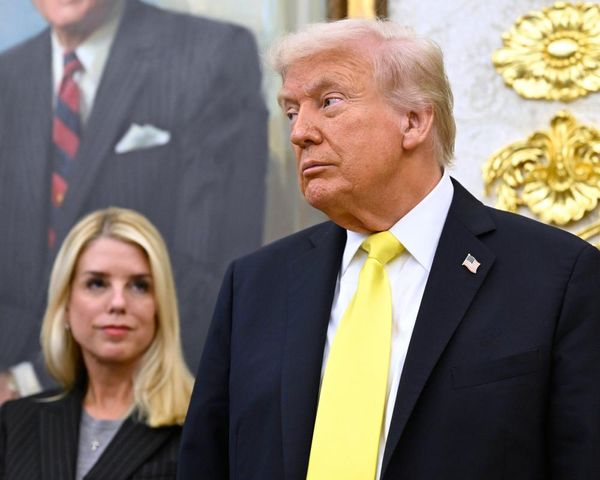
- Trump said the White House coronavirus task force would “continue on indefinitely,” a reversal from his comments yesterday suggesting the group’s work would be winding down. The president said today he “had no idea how popular the task force is.”
- Trump suggests more deaths a necessary price. US President Donald Trump has again suggested the country may need to accept the reality of more deaths in order to start reopening the economy.“We have to be warriors,” Trump told Fox News’ John Roberts when asked if Americans should expect additional deaths as the country looks to reopen. “We can’t keep our country closed down for years.”
- Coronavirus threatens eurozone’s future, Brussels warns. The eurozone faces an existential threat if the economic recoveries of its 19 member states are insufficiently even, the EU’s economic commissioner warns. Some countries are expected to suffer significantly more than others during what is expected to be the deepest recession since the Great Depression.
- WHO warns of more lockdowns if transition not managed carefully. The director general of the World Health Organization warns of the risks of returning to lockdown if countries emerging from pandemic restrictions do not manage transitions “extremely carefully and in a phased approach”. preparedness.
- Germany eases restrictions but retains ‘emergency brake’. The country’s top football league, the Bundesliga, is set to resume this month – one of various restrictions to be lifted as Germans are once again allowed to meet a limited number of friends and family and some shops are allowed to reopen.
- UK could start easing virus lockdown next week. The British government will set out details of its plan to ease lockdown on Sunday, the prime minister, Boris Johnson, says, adding his hope that some measures could come into force the following day. Speaking in parliament for the first time since being hospitalised with Covid-19, Johnson says “every death is a tragedy”, calling the statistics “appalling”.
- Spain extends state of emergency after bitter political dispute. Pred Sanchez’s Socialist-led coalition government secured an extension until 24 May. Congress’s approval for the latest extension of the crisis powers comes after days of bitter rowing and frantic negotiations.
- Diplomatic split widens amid virus origin row and China shrugs off US claims and calls for focus on beating pandemic. China will not invite international experts in to investigate the source of Covid-19 while the pandemic is still raging, its UN ambassador says. China’s foreign ministry says the US secretary of state, Mike Pompeo, is wrong to claim he has evidence suggesting the virus originated in a Chinese lab. The US-China relationship is one of disappointment and frustration, the White House press secretary Kayleigh McEnany has said, highlighting the deepening rift between Washington and Beijing.
- Sweden nears 3,000 deaths. “We are starting to near 3,000 deceased, a horrifyingly large number,” Sweden’s state epidemiologist, Anders Tegnell, says. The country’s public health agency reports that a total of 23,918 cases have been confirmed and 2,941 deaths recorded; an increase of 87 deaths from the day before. Rather than enforcing a lockdown, Sweden has allowed many businesses to remain open, while asking citizens to keep their distance.
- Iran warns of ‘rising trend’ as virus cases top 100,000. Iran records 1,680 new infections, the highest daily figure since 11 April, taking its overall caseload beyond the 100,000 mark. The country’s apparent success in controlling the epidemic has gone into reverse, with a sharp rise in the number of new daily infections over the past four days.
- ‘More than 90,000 health workers infected worldwide’. At least 90,000 healthcare workers globally are believed to have been infected, the International Council of Nurses (ICN) says, noting that the the true figure could be as much as twice that. It says more than 260 nurses have died amid reports of continuing shortages of protective equipment, as it urges authorities to keep more accurate records.
Brazil’s health ministry has announced 615 more deaths from coronavirus, with a total of 8,536 people now having died. The number of confirmed cases has risen to 125,218.
An unidentified player at the Serie A club Torino has tested positive in the first round of testing before the side’s planned return to training on Friday.
Serie A teams have begun returning to training this week after Italy’s eight-week lockdown, the longest in Europe, although there has still been no decision on when, or if, the season can start again. The club said:
During the first medical examinations carried out on the players of Torino, a positive result emerged for Covid-19. The player, currently asymptomatic, was immediately placed in quarantine and will be constantly monitored.
The spokesman for Brazil’s far-right president has tested positive, the former’s office has said, raising further questions about Jair Bolsonaro’s own exposure to the virus.
Otávio do Rêgo Barros is quarantined in his home and has no symptoms, while his staff are awaiting test results in their own homes, his office added.
Updated
Diplomatic split widens amid virus origin row
The US-China relationship is one of disappointment and frustration, the White House press secretary Kayleigh McEnany has said, highlighting the deepening rift between Washington and Beijing.
The remarks, delivered during a White House press briefing, come as China and the United States clash over the origins of the virus.
Paris will hold a men’s fashion week in virtual format from 9 to 13 July for the Men Spring/Summer collections 2021, organisers have said. A statement from the Federation de la Haute Couture et de la Mode read:
This event will be structured around a dedicated platform. Each house will be represented in the form of a creative film/video.
In late March, organisers said they had to cancel the men’s and haute couture fashion weeks in Paris because of the pandemic.
The US Centers for Disease Control and Prevention (CDC) has reported 2,523 more deaths; taking the total in the world’s worst-affected country to 70,802.
The CDC said 22,303 new cases have been identified, making 1,193,813, overall.
The former UK prime minister Gordon Brown has described the level of testing being carried out in the country as “almost criminal”.
The British government is carrying out significantly fewer than the 100,000 tests per day it promised to be doing by now. Nevertheless, the current prime minister Boris Johnson is now claiming he wants to increase capacity, if not actual testing, to a potential 200,000 per day.
But Brown has told ITV’s Peston programme that that number – even if it represented actual completed tests – would still be insufficient.
You’ve got to do more than 200,000 and you’ve got to over time be able to say to the one and a half million health service workers, the one and a half million in the care sector, 1.7 million in construction, three million in retail, one million that have got contact with the public – police, fire – teachers and everything else, you’ve got to be able to say to them: ‘We can reassure you that you’ll go back to work because we are going to offer you the testing that will find out whether you’ve got it or whether other people you are working with have got it so we can actually isolate those people that have it’.
Brown, who served as the most recent Labour prime minister from 2007 to 2010, added:
You take old people’s homes ... why is it the case that every resident and every care worker is not being tested?
It seems to me almost criminal that you’ve got to a stage where people are dying and where the only time that testing comes in apart from the random testing, is when people identify someone who’s a carrier of the disease.
You’ve got to test before because people have no symptoms and they’re passing on the disease. So you’ve got to have prior testing, and every old people’s home, every care worker, every health service worker, every person who’s a frontline, making contact with the public, they’ve got to be tested over the next few weeks.
Scientists who advise the UK government on its coronavirus strategy have warned they are being drawn into politics after the leading infectious disease modeller Prof Neil Ferguson stepped down as one of the cabinet’s most prominent advisers, Ian Sample, Kate Proctor and Rowena Mason write.
Ferguson, the head of the Imperial College team whose modelling persuaded ministers that Britain needed to order a lockdown to prevent hundreds of thousands of deaths, resigned from the Scientific Advisory Group for Emergencies (Sage) on Tuesday night.
Ferguson left the position after it emerged his lover had visited his home on two occasions in March and April in a breach of the government’s official guidance on social distancing.
One scientific adviser to the government said Ferguson’s resignation had created “an awful lot of concern” and that the mood in the community was “very depressed”. The events revealed how university academics who lent their advice to government were having to cope with an increasingly difficult situation, the adviser added.
He’s an academic researcher. He doesn’t make decisions. He’s not paid for any of this. We are being drawn into a political situation which is very unpleasant.
Senior advisers to the White House on dealing with the pandemic, Dr Anthony Fauci and Dr Deborah Birx, will continue to hold their positions on the coronavirus task force, Trump has said.
.@realDonaldTrump says Dr Fauci and Dr Birx will remain on the coronavirus task force in their current roles. pic.twitter.com/Zn6sIGOyhW
— Jeff Mason (@jeffmason1) May 6, 2020
Trump suggests more deaths a necessary price
The US president Donald Trump has again suggested the country may need to accept the reality of more deaths in order to start reopening the economy.
“We have to be warriors,” Trump told Fox News’ John Roberts when asked if Americans should expect additional deaths as the country looks to reopen. “We can’t keep our country closed down for years.”
The president added, “Hopefully that won’t be the case ... but it could very well be the case.”
Trump similarly said yesterday while visiting a mask production facility in Arizona, “Will some people be affected? Yes. Will some people be affected badly? Yes. But we have to get our country open and we have to get it open soon.”
Mexico’s president has claimed reports of violence against women have not increased during a nationwide lockdown, despite official data showing an increase in instances of physical abuse.
Domestic violence is rising across Latin America, with strict limits on movement to curb the spread of the new coronavirus leaving many women isolated at home with abusive partners, rights groups say.
Emergency calls reporting attacks on women in Mexico increased 20% in March compared to the previous month, according to government data seen by the Thomson Reuters Foundation.
But the charitable arm of Thomson Reuters reports that Mexico’s president Andrés Manuel López Obrador has claimed there has “been no increase in complaints.” The leftist leader said:
Yes there’s machismo but there’s also a lot of family fraternity.
Concern over domestic abuse has risen globally, with fears victims are being silenced in Italy, calls for help from women increasing in Spain, and systems to prevent child abuse in the United States hampered by the lockdown.
Rights groups said López Obrador’s comments contradicted the government’s own data. Tania Renaum, the executive director of Amnesty International Mexico, said:
It’s a very bad signal that the president says violence hasn’t increased when the (hotline calls) gives clear, uncontroversial data.
The White House appeared to be in fresh disarray on Wednesday as Donald Trump insisted that his coronavirus taskforce would remain in place – less than 24 hours after suggesting it would be disbanded.
The US president reversed course following a backlash against moves to wind down the taskforce even as the country reports about 30,000 new cases a day and the death toll moves past 70,000, the highest in the world.
But Trump did confirm a switch in focus to reviving America’s devastated economy, fuelling anxiety that he has made a cold political calculation to put his re-election chances ahead of saving lives.
Updated
For the fourth time in five days, Chile has reported a daily increase of more than 1,000 cases, representing an alarming uptick in the country’s contagion rate.
As recently as last week, the government had called for a “gradual return to normality”. However, with 84% of today’s 1,032 new cases and 67% of the national total located in the capital, the health minister Jaime Mañalich has taken to referring ominously to the situation as the “battle for Santiago”.
According to official statistics released by the health ministry, Chile had largely kept its epidemic under control. However, the country now has 23,048 confirmed cases and 281 people have died having tested positive.
Chile has maintained the highest level of testing in Latin America with more than 230,000 tests carried out. And the government has suggested an increase in testing could have contributed to the recent uptick in cases.
But the pandemic has also pushed out of the wealthier western suburbs of Santiago into more deprived, poorer-equipped areas of the capital. And the government has announced that 12 more districts will go into quarantine from Friday as part of its “dynamic” approach to enforcing and lifting lockdowns.
Checkpoints will also be set up around the nearby coastal cities of Viña del Mar and Valparaíso – the country’s second-largest population centre – where cases are currently far lower than in the capital.
Amid the rise in cases, the government has also softened its rhetoric with regard to a passport-style scheme that it had said would certify “immunity”. A WHO directive has since urged caution regarding such policies.
Nonetheless, the government has said the first cards will be issued on Friday, although they will simply confirm that a person has tested positive for the virus, not that they are immune.
Updated
Iceland has all but eliminated the virus as 97% of infected patients have recovered and only two new cases have been confirmed in the last week, the country’s chief epidemiologist Thorolfur Gudnason has said.
We have been pleasantly surprised to see a very fast deceleration of the pandemic in Iceland. However, it is extremely important to remain vigilant and minimise the risk of a renewed outbreak.
Updated
A genetic study of samples from more than 7,500 infected people suggests the virus spread quickly around the world after it emerged in China sometime between October and December last year.
Scientists at University College London’s Genetics Institute have said they found almost 200 recurrent genetic mutations of SARS-CoV-2, which they said showed how it was adapting to its human hosts as it spread.
In a study published in the journal Infection, Genetics and Evolution, the research team co-led by Francois Balloux wrote:
Phylogenetic estimates support that the Covid-2 pandemic started sometime around 6 October 2019 to 11 December 2019, which corresponds to the time of the host jump into humans.
Balloux said the analysis also found that the virus was and is mutating, as normally happens with viruses, and that a large proportion of the global genetic diversity of the virus causing Covid-19 was found in all of the hardest-hit countries.
That suggests SARS-CoV-2 was being transmitted extensively around the world from early on in the epidemic, he said.
Updated
In the UK, a Cambridge University statistician has demanded that the prime minister stop citing his article as evidence that no international comparisons should be made.
Speaking to the Commons today, Johnson quoted the piece by Prof David Spiegelhalter in the Guardian and added that there will be a time later to look at what went wrong.
Spiegelhalter has tweeted:
Polite request to PM and others: please stop using my Guardian article to claim we cannot make any international comparisons yet. I refer only to detailed league tables-of course we should now use other countries to try and learn why our numbers are high https://t.co/VQCwoYROK2
— David Spiegelhalter (@d_spiegel) May 6, 2020
Updated
That’s it for me today, I’m handing over the blog to my colleague Kevin Rawlinson.
Thanks to everyone who got in touch and as always, thanks for reading along.
Summary
Coronavirus threatens eurozone’s future, Brussels warns. The eurozone faces an existential threat if the economic recoveries of its 19 member states are insufficiently even, the EU’s economic commissioner warns.
Some countries are expected to suffer significantly more than others during what is expected to be the deepest recession since the Great Depression. “Such divergence poses a threat to the single market and the euro area – yet it can be mitigated through decisive, joint European action,” Paolo Gentiloni says.
WHO warns of more lockdowns if transition not managed carefully. The director general of the World Health Organization warns of the risks of returning to lockdown if countries emerging from pandemic restrictions do not manage transitions “extremely carefully and in a phased approach”.
Dr Tedros Adhanom Ghebreyesus lists a series of steps needed before countries should lift restrictions, such as surveillance controls and health system preparedness.
Germany eases restrictions but retains ‘emergency brake’. The country’s top football league, the Bundesliga, is set to resume this month – one of various restrictions to be lifted as Germans are once again allowed to meet a limited number of friends and family and some shops are allowed to reopen.
The country still has a long way to go, its chancellor, Angela Merkel, says, and its 16 states will each be able to operate an “emergency break” if faced with a surge in new infections.
UK could start easing virus lockdown next week. The British government will set out details of its plan to ease lockdown on Sunday, the prime minister, Boris Johnson, says, adding his hope that some measures could come into force the following day.
Speaking in parliament for the first time since being hospitalised with Covid-19, Johnson says “every death is a tragedy”, calling the statistics “appalling”.
Spain extends state of emergency after bitter political dispute. Pred Sanchez’s Socialist-led coalition government secured an extension until 24 May. Congress’s approval for the latest extension of the crisis powers comes after days of bitter rowing and frantic negotiations.
China shrugs off US claims and calls for focus on beating pandemic. China will not invite international experts in to investigate the source of Covid-19 while the pandemic is still raging, its UN ambassador says. And, continuing the diplomatic back-and-forth between Beijing and Washington, China’s foreign ministry says the US secretary of state, Mike Pompeo, is wrong to claim he has evidence suggesting the virus originated in a Chinese lab.
Sweden nears 3,000 deaths. “We are starting to near 3,000 deceased, a horrifyingly large number,” Sweden’s state epidemiologist, Anders Tegnell, says. The country’s public health agency reports that a total of 23,918 cases have been confirmed and 2,941 deaths recorded; an increase of 87 deaths from the day before.
Rather than enforcing a lockdown, Sweden has allowed many businesses to remain open, while asking citizens to keep their distance.
Iran warns of ‘rising trend’ as virus cases top 100,000. Iran records 1,680 new infections, the highest daily figure since 11 April, taking its overall caseload beyond the 100,000 mark. The country’s apparent success in controlling the epidemic has gone into reverse, with a sharp rise in the number of new daily infections over the past four days.
‘More than 90,000 health workers infected worldwide’. At least 90,000 healthcare workers globally are believed to have been infected, the International Council of Nurses (ICN) says, noting that the the true figure could be as much as twice that.
It says more than 260 nurses have died amid reports of continuing shortages of protective equipment, as it urges authorities to keep more accurate records.
Updated
US demands WHO invite Taiwan to meeting
The United States has urged the World Health Organization to defy Chinese pressure and invite Taiwan to its annual meeting, which will discuss the coronavirus pandemic.
The United States itself has yet to confirm its participation in the 18-19 May talks of the World Health Assembly, which comes after President Donald Trump vowed to slash funding for the UN body.
The US secretary of state, Mike Pompeo, told reporters:
I want to call on all nations, including those in Europe, to support Taiwan’s participation as an observer at the World Health Assembly and other relevant United Nations venues.
I also call upon WHO Director-General Tedros (Adhanom Ghebreyesus) to invite Taiwan to observe this month’s WHA, as he has the power to do, and as his predecessors have done on multiple occasions.
China, which wields a veto on the UN Security Council, considers Taiwan a province awaiting reunification and fights to block it from all international institutions.
China’s defeated nationalists fled to Taiwan in 1949 but the island has evolved into a vibrant, self-ruling democracy.
Taiwan has become a model for its swift response to the coronavirus outbreak, with just six deaths despite its close proximity and economic ties with China, and has donated masks and other supplies around the world.
The US state department did not reply to questions on whether the United States would take part in the World Health Assembly, which sets global health policy and is generally attended by health ministers or other senior officials.
Until Trump’s announcement, the US was the top contributor to the WHO, giving more than $400m a year to help global efforts on fighting myriad illnesses including malaria and polio.
Updated
The US president, Donald Trump, has said he will announce new members of his coronavirus taskforce by Monday, as its focus turns to medical treatments and easing restrictions on businesses and social life.
The Republican president said at a White House event honoring National Nurses Day that he had thought he would be able to wind down the taskforce sooner, but had no idea how popular it was.
Updated
Spain extends state of emergency after bitter political dispute
Spain’s Socialist-led coalition government has secured another extension of the state of emergency, which will now last until 24 May.
Congress’s approval for the latest extension of the crisis powers comes after days of bitter rowing and frantic negotiations.
The conservative People’s party (PP) and the far-right Vox party had both opposed any extension, saying the state of emergency was no longer necessary or proportionate.
They were joined by the pro-independence Catalan Republican Left party, which objects to the centralisation of powers under the emergency measures.
However, the minority government managed to enlist the support of the centre-right Citizens party and other smaller, regional parties.
The PP eventually abstained, allowing the government to win a simple majority - more yes votes that no - in Wednesday afternoon’s vote.

Addressing the country’s 350-seat congress before the vote, the prime minister, Pedro Sanchez, said the measure were needed to help safeguard Spain’s advances against the virus.
He also dismissed suggestions that the continued lockdown was too drastic.The prime minister added:
The disease is being controlled and Spain is beginning to recover, but we must be careful and we need the legal and constitutional tool of this state of emergency.
To date, the virus has killed 25,857 people and infected more than 220,000 in Spain.
Updated
The UK will only consider support for individual aviation firms as a last resort, the housing minister Robert Jenrick has said.
British aerospace and aviation firms must look at existing government schemes and self-help measures before individual packages for companies are considered, he said.
At a news conference about possible job cuts at engine-maker Rolls-Royce, Jenrick told reporters:
We want to support the aviation sector in any way that we can.
We’ve said before that we’re willing to consider situations where we would support individual firms, but obviously only when they’ve worked through the existing government schemes and other ways in which they might be able to raise finance commercially, or through existing shareholders.
Updated

Updated
The European Union is backing calls for a timely review of the international response to the coronavirus pandemic, including the World Health Organization’s performance, according to a draft resolution.
European diplomats said the United States and China have taken part in negotiations on the EU resolution, but gave no details of their input.
A Chinese spokesman confirmed Beijing had been involved, but US officials declined comment.
WHO director general, Tedros Adhanom Ghebreyesus, has defended the UN agency against fierce criticism by the US president, Donald Trump, but has promised a review of its performance after the pandemic eases, including by its independent oversight body.
An initial draft of the EU resolution, to be debated by WHO health ministers meeting virtually on 18-19 May at the World Health Assembly, includes wording on “commending the WHO leadership” but calls for “an evaluation ... at the earliest appropriate moment on lessons learnt from the international health response to Covid-19”.
The draft, seen by Reuters, says the evaluation should address the long-term consequences on health and “gaps in pandemic preparedness” and reminds the 194 WHO member states they must report outbreaks of disease in a “timely manner”.
“Negotiations have begun. The Americans, Chinese and Europeans are taking part, almost everyone is. It’s a very good sign that everyone is engaged,” a European diplomat said.
If confirmed, the US involvement in discussions about the text would signal that Washington is engaging in diplomacy at the WHO, despite suspending its funding for the agency last month, accusing it of being “China-centric” and issuing bad advice.
China has been consulted despite criticism by several countries, including the United States, that it mishandled the early stages of the pandemic and was slow to reveal the extent of the threat it posed.
Updated
The United States will provide $225m in emergency aid to Yemen to support food programmes, the US secretary of state, Mike Pompeo, said, as aid groups in the country are forced to scale down operations due to Houthi interference and amid a spreading coronavirus outbreak.
“This assistance will provide the UN World Food Program’s emergency food operation in southern Yemen, as well as a reduced operation in northern Yemen, which the WFP was forced to scale down earlier this month because of the ongoing interference of (the) Iran-backed Houthis,” Pompeo told a news conference.
Yemen is already grappling with the world’s biggest humanitarian crisis caused by a war between the Saudi-led coalition seeking to restore the internationally recognised government, and the Houthi movement that drove the government from power in Sanaa in late 2014.

Around 80% of Yemen’s population, or 24 million people, rely on aid, and 10 million are facing famine. Yemen has the world’s fourth highest internally displaced population and healthcare is scarce in rural areas.
The country has reported a total of 26 coronavirus infections with six deaths but due to inadequate testing and a shattered health system aid groups fear a devastating outbreak.
According to WHO only 200 tests with results have been delivered nationwide.
Updated
France will discard 10m litres of beer - four Olympic-sized swimming pools full - due to expire undrunk, with consumers in coronavirus lockdown, the national brewers’ association said.
Most of the wasted brew is craft beer, which is often unpasteurised unlike traditional blonde lagers, and quicker to spoil, said the Brasseurs de France.
“These are very hoppy beers, and if they are kept for too long, when they spend more than two to three months in storage, the olfactory and taste effects, the aroma, disappears,” brewery association boss Maxime Costilhes told AFP.

The body blamed the closure of cafes and restaurants, an abrupt halt to tourism and the cancellation of festivals and expos under France’s strict lockdown for leaving more than 10m litres of beer unconsumed, most still in casks.
The number was compiled from the association’s 300-odd members, which represent 98% of beer production in France.
It represents but a drop of the estimated 22.5m hectolitres of beer the country is set to produce in 2020, but nevertheless comes at a loss of millions of euros to producers.
The country, better known for its wine, has seen beer sales soar in recent years, spurred by an increase in craft brewing.
Updated
At a press conference today, Mike Pompeo was pressed on his claim on Sunday that there was “enormous evidence” that the Sars-CoV-2 virus originated in a Wuhan laboratory, a claim that was in conflict with statements from Anthony Fauci, the top US scientific voice on the outbreak, and the chairman of the joint chiefs of staff, General Mark Milley.
The secretary of state got a little testy telling a BBC reporter who had raised the inconsistencies: “Your efforts to try and find, to spend your whole life trying to drive a little wedge between senior American officials, it’s just false.”
He said everyone was singing from the same song sheet.
Every one of those statements is entirely consistent.
We’re all trying to figure out the right answer. We’re all trying to get to clarity. There are different levels of certainty assessed at different places.
That’s highly appropriate. People stare at datasets and come to different levels of confidence.
Finally, after more questioning, he repeated his assertion that there was strong evidence of a lab accident, but not before becoming irritable again.
He said: “I’m not sure what it is about the grammar that you can’t get. We don’t have certainty. There is significant evidence that this came from the laboratory. Those statements can both be true.”
For context, General Milley has said the evidence of the origins are inconclusive, but the “weight of evidence seems to indicate natural” evolution.
Dr Fauci said: “Everything about the stepwise evolution over time strongly indicates that it evolved in nature and then jumped species.”
Updated
Brazil has seen its largest daily increase in its coronavirus death toll, despite erroneous suggestions from its president, Jair Bolsonaro, that the worst of the crisis was over.
Brazil – which is now considered a major global centre of the pandemic – reported 633 Covid-19 deaths on Tuesday, taking its total to nearly 8,000.
Three of Brazil’s 27 states this week announced the country’s first official lockdown measures to try to slow the spread of the disease.
But speaking to reporters outside his presidential palace on Tuesday afternoon, Bolsonaro suggested his country was passing its Covid-19 peak.
I don’t know yet if the number of deaths is less than yesterday. But if it is, if I’m not mistaken, it’ll be the sixth consecutive day in which the number of deaths has fallen.
That’s a sign that the worst is over, and I ask God for this to be true.
It was not true. Just a few hours later, Brazil’s health ministry announced that the number of reported deaths had in fact risen. Under-reporting and a lack of testing also means the true numbers are almost certainly much higher.
Updated
British construction firms should restart work if it is safe to do so in order to help maintain and improve the country’s infrastructure, housing minister Robert Jenrick said.
“We want infrastructure and construction work to begin again wherever it’s safe to do so,” he told reporters.
The New York governor, Andrew Cuomo, said that he believes states reopening their economies while seeing growing rates of infections from Covid-19 are making a mistake.
“You have states that are opening where you are still on the incline,” Cuomo told a daily briefing. “I think that’s a mistake.”
The spread of Covid-19 in India has been catastrophic for millions of its poorest and marginalised residents who are bearing the brunt of the world’s biggest shutdown.
The Guardian’s south Asia correspondent Hannah Ellis-Peterson tells us how coronavirus and the lockdown is further dividing the country along class and religious lines.
Coronavirus threatens future of eurozone, Brussels warns
The coronavirus pandemic threatens the future of the eurozone by creating huge economic divisions between its 19-member states during what is expected to be the deepest recession since the Great Depression, the European commission has warned.
The EU’s economic commissioner, Paolo Gentiloni, said there was an urgent need to mitigate the inevitable exacerbation of existing social and economic fissures, as countries emerge at different speeds from the unprecedented economic downturn.
The economic output of the eurozone is likely to shrink by a record 7.75% in 2020 and rebound by just 6.25% in 2021, with unemployment rising from 7.5% in 2019 to 9.5%.
Gentiloni said economic activity in the EU as a whole had “dropped by around one-third practically overnight” owing to the lockdowns imposed by European governments.
More than 1.1 million people have contracted the virus across Europe and more than 137,000 have died, according to the European Centre for Disease Prevention and Control (ECDC).
Updated
The coronavirus pandemic is “under control” in Turkey, the country’s health minister said on Wednesday, but warned citizens they still needed to take the necessary precautions.
The number of deaths per day in Turkey has fallen in the past week, remaining under 100 within a 24-hour period since 26 April.
And new infections are sharply down on the peak of over 5,000 in one day last month.
“The pandemic is under control but the realities of the virus have not changed. Your homes remain the safest place against the virus,” health minister Fahrettin Koca said.
He said Turkey had “completed the first phase in the fight against the coronavirus” but said people must now have a “controlled social life”.
Koca warned that the “second phase” would only be successful if people followed rules when outside such as wearing masks and practising social distancing.

Shopping centres will reopen on 11 May with only a limited number of people allowed inside, but Koca stressed that restaurants and cafes inside the malls will not open.
Barbers and hairdressers will also be allowed to open but weekend lockdowns will continue in 31 cities including Ankara and Istanbul.
Turkey has so far recorded 3,520 coronavirus deaths and nearly 130,000 confirmed infections.
Updated
The Netherlands will begin a phased easing of its almost two-month-long coronavirus lockdown on Monday, according to a report by the national broadcaster NOS.
The prime minister, Mark Rutte, is set to announce the reopening schedule in a live TV broadcast at 5pm GMT on Wednesday evening, the NOS said, citing anonymous sources.
From next week, elementary schools will reopen, with classes split and rotated to enable greater distancing.
Beauty salons and hairdressers will also be allowed to reopen, and non-contact outdoor sports such as tennis will be permitted, the NOS said.
Public transport will resume normal schedules from 1 June, but with just 40% of seats available to allow for social distancing, and with the wearing of face masks compulsory. High schools will also reopen in June.
The number of confirmed coronavirus cases in the Netherlands rose by 232 to 41,319 on Wednesday, with 36 new deaths for a total of 5,204, the National Institute for Health said in its daily update.
Britain’s Covid-19 death toll has risen by 649 to 30,076, according to figures announced by government minister Robert Jenrick.
The figures, which reflect deaths in all settings following positive tests for coronavirus, cover the period up to 4pm GMT on Tuesday.
Deaths from the Covid-19 epidemic in Italy climbed by 369 on Wednesday, against 236 the day before, while the daily tally of new infections also rose, increasing by 1,444 against 1,075 on Tuesday.
The total death toll from the outbreak now stands at 29,684, the Civil Protection Agency said. The number of confirmed cases amounts to 214,457.
The number of those currently infected fell sharply to 91,528 from a previous 98,467, while there were just 1,333 people in intensive care on Wednesday against 1,427 the day before.
Of those originally infected, 93,245 were declared recovered compared with 85,231 on Tuesday. Many of the newly recovered patients came from Lombardy and the region said the revised number reflected data from several days and not just the last 24 hours.
The agency said 1.55 million people had been tested for the virus against 1.51 million the day before, out of a population of around 60 million.
WHO warns of more lockdowns if transition not managed carefully
The head of the World Health Organization has warned of the risks of returning to lockdown if countries emerging from pandemic restrictions do not manage transitions “extremely carefully and in a phased approach”.
The WHO director general, Tedros Adhanom Ghebreyesus, listed a series of steps countries should take before lifting measures to control the spread of Covid-19, such as surveillance controls and health system preparedness.
He said at a virtual briefing in Geneva:
The risk of returning to lockdown remains very real if countries do not manage the transition extremely carefully and in a phased approach.
He also said it was not possible to return to business as usual when the pandemic eventually ebbs, stressing the need for investment in health systems.
“The Covid-19 pandemic will eventually recede but there can be no going back to business as usual,” he said.
Updated
Brazil airline Gol Linhas Aereas Inteligentes said on Wednesday its planes were nearly as full in April as they were a year ago despite the coronavirus crisis, bucking an industry trend of empty planes.
Gol said in its monthly traffic report that its planes had been 80% occupied on average during the month, compared with 81% in April 2019.
Like most airlines around the world, Gol is operating minimal flights while keeping most of its fleet grounded.
Still, reports in the United States and elsewhere have highlighted empty flights that sometimes carry just one passenger, despite similar capacity reductions.

Gol’s results were in sharp contrast with those of Aeromexico, the region’s only other airline to have reported April traffic figures. Aeromexico said its planes were 48% occupied in April, compared with 82% a year ago.
Gol said it operated about 39 flights a day in April, 94% fewer takeoffs and landings than a year ago.
In a conference call with investors earlier this week, Gol said government officials were over represented in its flights compared to normal times.
Gol’s chief executive, Paulo Kakinoff, said he was aware that there could be a spike in coronavirus cases within the company, but that “it is not happening so far”.
“And most of our crew members are still being exposed every single day,” Kakinoff said, noting there were eight coronavirus cases at Gol.
Updated
The French government has taken down a Covid-19 “fake news” page after accusations that it had overstepped its constitutional role and infringed press freedoms.
A page called Desinfox – a play on the word desintox (detox) – appeared on the government’s website last week. It claimed to be busting disinformation about coronavirus in the French media.
After the country’s journalists’ union reported the government to the Conseil d’État, the highest administrative court in the country, France’s culture minister, Franck Riester, announced that the page would be removed.
The Syndicat National des Journalists (SNJ) had filed an emergency appeal with the court requesting that a judge order the prime minister, Édouard Philippe, to delete the page and “put an immediate stop to the serious and manifestly illegal attack on the principles of pluralism in the expression of opinions and on the neutrality of public authorities”.
The union’s lawyers argued that while claiming to fight disinformation, “the government is making a selection of information considered reliable and that which could be considered fake news”.
They said the Desinfox page created “a confusion between the media who deserve to be cited by the government, at the risk of introducing into the mind of the reader suspicions over the relations between the press and the political world”.
Updated
Dozens of patients marched out of an isolation centre in north-east Nigeria yesterday, protesting against their conditions under quarantine.
The patients, who had tested positive for Covid-19 in Gombe State, streamed out of the facility, blocking a local major highway and mixing with nearby residents.
The incident has raised fears that Covid-19 cases could further spread within communities in Gombe, the fifth most affected state in Nigeria, with 98 of the country’s 2,950 cases.
Angry patients told local media they had been poorly looked after and largely abandoned by medical staff since being quarantined.
Some said they were poorly fed and were frustrated that they were being forced to quarantine as they were not showing symptoms and felt physically fine.
The state government said the patients did not fully understand the procedures and asymptomatic patients didn’t need treatment but were being isolated to prevent community spreading.
The situation lays bare the challenge the country’s authorities are facing in clearly communicating the threat of Covid-19, and the struggle to effectively contain the outbreak.
In Lagos, where half of Nigeria’s Covid-19 infections have occured, and in the capital, Abuja, health procedures, testing and tracing have been largely effective.
Yet in poorer states, with weaker health systems and large rural populations, containment has been more challenging.
Gombe does not have a testing laboratory meaning samples have had to be transported outside the state, delaying results by days.
Cases in Nigeria have doubled in under a week, while just 21,000 tests have been administered; 481 people have recovered and 98 people have lost their lives.
Updated
Three hundred and seventy-six mafia bosses have been released from prisons across Italy and placed under house arrest due to the risk of Covid-19 infection, sparking a row in the country.
Since the beginning of the coronavirus crisis, Italian judges have set free ageing mobsters suffering from specific illnesses because they are “at risk of complications in case of Covid-19 infection”.
Prosecutors, anti-mafia associations and parties have protested against the judges’ decisions, fearing mafia bosses could leverage the coronavirus crisis to secure their release.
Mobsters recently released from prison and placed under house arrests include Cosa Nostra’s influential boss Francesco Bonura, 78, who was serving a 23-year sentence, and alleged ’Ndrangheta bosses Vincenzino Iannazzo, 65, and Rocco Santo Flipppone, 72.
Judges feared that a Covid-19 infection could be lethal for Filippone since he suffers from serious cardiovascular disease.
Another Cosa Nostra mafia boss, Franco Cataldo, 85, was released on Monday. Cataldo was among those convicted of kidnapping 15-year-old Giuseppe Di Matteo, son of informant Santino Di Matteo. The boy was later strangled and dissolved in acid at the orders of superboss Giovanni Brusca.
The justice minister, Alfonso Bonafede, clarified last week that the decision to release Mafiosi was not taken by the government and on Monday called for a new norm to revise rules on releasing mafia bosses to house arrest.
Updated
As Canada’s first province prepares to re-open schools, measures to protect students and staff portend a dramatically different classroom experience.
Under new guidelines issued in Quebec, students will not have the opportunity to take music, art or drama classes, nor will they have physical education lessons.
Class sizes will be capped at 15 students and any activities outside will require students to maintain two metres of physical distancing. School buses will only be permitted shuttle a maximum of 12 students at a time.
Any person with fever, coughing or a sudden loss of taste or smell will be prevented from entering a school.
Some students may not return to the same teacher or class: the government has suggested staff over the age of 60 temporarily refrain from returning to schools.
“This reality will be difficult for both the teachers and the students,” Ann Marie Matheson, the director of the English Montreal school board told families in a letter, acknowledging that the return to schools “will not be normal” with the looming threat of the coronavirus.
“It is important that all parents understand and accept this reality when making their decision to send their child back to school or not.”
Quebec has experienced the worst outbreak of Covid-19 in the country, with Montreal at its centre. The province has recorded 2,398 deaths from the virus and 33,400 cases.
While elementary schools are slated to open next week, premier François Legault has also signalled he may push back the date if worries persist.
No other Canadian province has indicated it will attempt re-open schools in the coming months.
German states will operate "emergency brake" to halt local outbreaks
Angela Merkel has agreed with premiers of Germany’s 16 states that they will each operate an “emergency break” if faced with a surge in new infections locally, she said on Wednesday.
If new infections rise to above 50 people in every 100,000 in a district over a seven-day period, then it will be up to the local authority in the affected area to reimpose restrictions.
“We are following a bold path,” said Merkel. “We can afford to be a bit bold but we must remain cautious.”
The chanceller said there will be a lot more contact between people in the next phase of the coronavirus response in the country, and authorities are completely reliant on people cooperating.
Agreed easing of restrictions includes:
- People from two households will be able to meet and eat together
- Elderly residents in nursing homes and facilities for disabled people will be allowed visits from one specific person
- All restrictions on shops will be lifted, although masks must be worn and social distancing maintained
- Schools will reopen gradually this term
The German football league, the Bundesliga, has been given the green light to kick off for the first time since March, with a decision on the exact date being made by football authorities on Thursday.
Games (without spectators) could start from mid-May providing players undergo a two week quarantine in the form of a training camp.
Updated
Kenya’s health minister announced on Wednesday that one suburb of the capital Nairobi, as well as a part of the port city of Mombasa, will be cordoned off due to skyrocketing cases of coronavirus in those areas.
Cases of the virus have crept up slowly in Kenya, as in many other African countries, however in recent days it has become clear the virus is fast spreading in several hotspots.
Eastleigh, a suburb in Nairobi with a large Somali population, has recorded 68 cases, while Mombasa’s Old Town has 64 infections, out of a total 582 cases in the country. There have been 26 deaths nationwide.
The health minister Mutahi Kagwe said that from Wednesday, for the next 15 days, “there shall be cessation of movement” in and out of Eastleigh and Mombasa’s Old Town.
Let me be clear, there will be no movement to or out of the two places from 7pm (1600 GMT) today. Within those areas people are free to move but we encourage people to stay in their houses.
No such measures were announced for the informal settlement Kawangware, where 24 cases of the virus have been recorded.
Kenya has stopped short of ordering a full lockdown, like many of its neighbours. Observers have warned to do so would be a disaster for the millions of urban poor who live hand to mouth in slums in the capital.
The country has imposed a dusk-to-dawn curfew and blocked movement in and out of Nairobi, three coastal towns, and the north-eastern county of Mandera, as well as two refugee camps housing some 400,000 people.
As the coronavirus pandemic eats its way into the Amazon, raising fears of a genocide of its vulnerable indigenous tribes, the government of the far-right president, Jair Bolsonaro, and its supporters are dismantling rules shielding protected reserves.
Key environment officials have been sacked, and environmentalists and indigenous leaders fear the pandemic is being used as a smokescreen for a new assault on the rainforest.
They say a presidential decree awaiting congressional approval and new rules at the indigenous agency Funai effectively legalise land grabbing in protected forests and indigenous reserves.
Alessandra Munduruku, an indigenous leader from Pará state, said:
The indigenous peoples are alone and we have to fight against the virus, the loggers and the wildcat miners. We don’t know which is worse.
Bolsonaro, notorious for racist remarks about indigenous people and a nationalist argument in favour of developing the Amazon, is popular among farmers, wildcat miners, loggers and land grabbers.
He said the Yanomami indigenous reserve – Brazil’s largest – was too big and attacked environment agencies for fining people for environmental crimes.
Sweden nears 3,000 deaths from coronavirus
Swedish officials said the country, which has taken a softer approach to curbing the spread of the coronavirus, was nearing 3,000 deaths from Covid-19.
The country’s Public Health Agency reported that a total of 23,918 cases had been confirmed and 2,941 deaths had been recorded, an increase of 87 deaths from the day before.
“We are starting to near 3,000 deceased, a horrifyingly large number,” state epidemiologist Anders Tegnell told a press conference.
Sweden has not imposed the kind of extraordinary lockdowns seen elsewhere in Europe, instead opting for an approach based on the “principle of responsibility”.
The Scandinavian country has allowed schools for under-16s, cafes, bars, restaurants and businesses to stay open while urging people and businesses to respect social distancing guidelines.
The Swedish approach has received criticism both domestically and internationally as its death toll has leapt much higher than its Nordic neighbours, which have all instituted more restrictive containment measures.
Sweden’s virus death rate of 291 per million inhabitants is far higher than Norway’s death rate of 40 per million, Denmark’s rate of 87, or Finland’s rate of 45.
In the United States, which has suffered the most coronavirus deaths, the toll per million inhabitants is lower than Sweden’s at 219.
Swedish officials have nonetheless insisted their plan is sustainable in the long-term, rejecting drastic short-term measures as too ineffective to justify their impact on society.
On Tuesday, the Swedish Civil Contingencies Agency published a survey showing that most Swedes had changed their behaviour and were sticking to those changes.
“Almost nine in ten respondents (87%) state that they are keeping a greater distance from other people in shops, restaurants and on public transport this week, compared with 72%,” the agency said in a statement.
Updated

China could have prevented the deaths of hundreds of thousands of people around the world by being more transparent about the coronavirus, the US secretary of state, Mike Pompeo, has said.
Pompeo told reporters:
China could have spared the world a descent into global economic malaise. They had a choice but instead China covered up the outbreak in Wuhan.
China is still refusing to share the information we need to keep people safe.
Updated
A US federal judge has dismissed a worker advocacy group’s lawsuit accusing Smithfield Foods, the world’s largest pork processor, of failing to adequately protect employees from coronavirus at a plant in Missouri.
Smithfield is already taking many of the steps called for by the Rural Community Workers Alliance (RCWA), including screening production-line workers for symptoms and installing barriers between them, US district judge Greg Kays said in his ruling on Tuesday.
Kays also said that under president Donald Trump’s executive order in April requiring meatpacking plants to remain open during the pandemic, the federal government, and not the courts, were responsible for overseeing working conditions.
Virginia-based Smithfield, which is owned by China’s WH Group Ltd, did not immediately respond to a request for comment.

David Muraskin, a lawyer for the advocacy group, said the decision was disappointing but that the lawsuit had spurred Smithfield to make changes in response to workers’ concerns.
“We wish that Smithfield would do more, but the decision shows that workers can organize and move companies to make changes, and that’s a really important development,” Muraskin said.
Smithfield has closed other pork-processing plants in Missouri, Wisconsin and South Dakota after outbreaks of coronavirus cases among workers. Companies like Tyson Foods, Cargill and National Beef Packing have also shut US meat plants during the pandemic.
Updated
Germany to ease lockdown as Merkel hails end of first pandemic phase
Chancellor Angela Merkel has announced a range of steps agreed with Germany’s 16 federal state leaders to ease the coronavirus lockdown, saying the first phase of the pandemic had passed, although there is still a long way to go.
Merkel said
I think we can safely state that the first phase of the pandemic is behind us.
But we need to be very much aware we are still in the early phases and we’ll be in it for the long haul.
We are at a point where our goal of slowing the spread of the virus has been achieved and we have been able to protect our health system ... so it has been possible to discuss and agree on further easing measures.
People from two households will be allowed to meet and more shops will open, provided hygiene measures are in place, but guidelines on keeping a distance of 1.5 metres apart and wearing mouth and nose masks on public transport remain.
Updated
Belgium’s prime minister, Sophie Wilmès, has said a limited increase in socialising will be allowed from this weekend, as she gave further details of the easing of the national lockdown.
From Sunday 10 May, a household can welcome up to four people into their home for repeat visits, as long as they are the same four people.
Guests must keep to the approved 1.5m distance and it is suggested meetings happen (if possible) in gardens or on terraces, rather than indoors.
From the same day, people will also be allowed to go for a walk or run with up to two other people, whereas currently outings are only permitted with those who live under the same roof.
Wilmès said: “Monitoring these rules is very complicated, but we are counting on your civic-mindedness and sense of responsibility.”

As planned, non-essential shops can reopen from Monday, as long as they don’t get too crowded. Government guidance recommends no more than one customer per 10 square metres, apart from adults with children.
Wearing masks will be compulsory on public transport, but is only recommended in shops.
However the Brussels commune of Etterbeek, a large central district next to the EU quarter, is mandating the wearing of masks in some public spaces, such as popular shopping streets.
The latest details emerged as daily admissions to hospital for patients with Covid-19 returned to levels not seen since Belgium went into lockdown on 18 March.
The most recent figures showed there were 116 new arrivals in hospital on Tuesday, compared to 290 patients who were discharged.
In the last 24 hours, 110 new deaths were recorded, sharply lower than previous weeks, bringing the total to 8,339.
France has drawn up a plan to reintroduce the lockdown if there is a spike in coronavirus cases after restrictions are eased on 11 May.
With days to go to the end of the strict lockdown measures imposed on 17 March, French ministers have repeatedly warned the end of the national “confinement” could be put back if there is not a sufficient drop in the number of Covid-19 infections.
On Wednesday, Jean Castex, who is in charge of drawing up the official end of lockdown plan and has been nicknamed ‘Monsieur Deconfinement’, told French senators he had also made provision for a reintroduction of measures in areas. He said:
If the virus begins to circulate again intensively, we need to give ourselves the means locally to act immediately. I have proposed to also have ready an eventual plan for locking down again.
We have learned from the acute phase of the crisis. We will have a (reconfinement) plan ready, but that’s not my goal.
Castex said the government’s coronavirus maps that show the departments where the virus is circulating and the pressure on hospital intensive care units would be a vital element in identifying new clusters.
French departments have been divided into “red”, “orange” and “green” depending on how many new coronavirus cases are being reported and how the hospitals are coping.
On Thursday, a definitive map will be published on which the easing of the end of lockdown restrictions will be based. Orange departments will become either red, in which there are stricter restrictions or green, where the lockdown is more relaxed.
“Progressive is the key word,” Castex told the Sénat. He said the behaviour of the French people in respecting social distancing and barrier measures like washing hands, was “the key to the success of the fight against the pandemic”.
“I feel I’ve seen people letting go a little, which is not good. If we don’t respect the barrier gestures…we risk a relapse,” he said.
Russian president Vladimir Putin has said he supports proposals by Moscow mayor Sergei Sobyanin to gradually ease some restrictions aimed at preventing the spread of coronavirus.
Sobyanin said some businesses could return to work from 12 May, but urged citizens to continue observing self-isolation measures where possible.
Donald Trump has announced over Twitter that the White House coronavirus taskforce will “continue on indefinitely’, despite the vice-president’s comments yesterday that it would start to wind down in the coming weeks.
In a tweet thread this morning, the president said the taskforce had done a “fantastic job” addressing the coronavirus crisis.
“Because of this success, the Task Force will continue on indefinitely with its focus on SAFETY & OPENING UP OUR COUNTRY AGAIN,” Trump wrote.
“We may add or subtract people … to it, as appropriate. The Task Force will also be very focused on Vaccines & Therapeutics.”
Follow all the latest developments in the US in more detail with our US live blog, headed by my colleague Joan Greve.
Updated
Norwegian Cruise Line has raised over $2.2bn through debt and equity offerings, giving the cash-strapped cruise operator much-needed funds to survive extended voyage suspensions due to the Covid-19 pandemic.
The company warned on Tuesday that it might not have funds to keep its business running for the next 12 months.
With the new fund raising, the company now expects to have $3.5bn in liquidity, enough to last it for more than 12 months of voyage suspensions.
The pandemic has halted international travel and effectively shut down the cruise ship and airline industries, with companies now bleeding cash and scrambling for new funds to ride out the slowdown that could last longer than expected.
Norwegian previously said it planned to restart cruise operations on 1 July.
Uber will cut about 3,700 full-time jobs and CEO Dara Khosrowshahi will forgo his base salary for the remainder of the year, the company said, as the Covid-19 pandemic decimates its ride-hailing business.
The company said the layoffs included its customer support and recruiting teams, and it expects to incur about $20m in costs for severance and related charges.
Uber and rival Lyft have already withdrawn their full-year financial outlooks as demand for app-based rides dropped sharply across the world after governments imposed stay-at-home orders to curb the transmission of the coronavirus.
But Uber, which operates in more markets around the world than Lyft, could recover some lost revenue with its food delivery business.
On Monday, Uber’s Middle East business Careem said it was cutting 536 jobs this week, 31% of the Dubai-headquartered company’s workforce.
Lyft will report its quarterly results on Wednesday and Uber is expected to report earnings on Thursday. Uber shares opened 3% lower on Wednesday.
Updated
Bundesliga set for go-ahead to resume in second half of May
The Bundesliga is set to get the go-ahead to resume in the second half of May after a meeting involving the chancellor, Angela Merkel, and state premiers.
Under the plan, the league (DFL) will be able to choose the appropriate date for games in the first and second divisions to restart and and matches will be held behind closed doors.
Clubs in Germany’s top division have been training for around a month amid Covid-19 testing and the DFL has been keen to finish the season by the end of June, when contracts expire.
The push to resume has not been universally welcomed. The DFL said on Monday there had been 10 positive tests for coronavirus among 36 clubs in the Bundesliga and second division, adding that 1,724 tests were carried out over two rounds among players and staff.
Cologne last Friday reported three positive cases. The tests were part of the DFLs hygiene concept, which says teams will also undertake a mandatory training camp under quarantine conditions before a return to playing.
This week, Salomon Kalou was suspended “with immediate effect” by his club Hertha Berlin after posting a video on Facebook of him breaking physical distancing rules with his teammates.
Updated
Economic activity in Russia has fallen 33% when compared with levels before lockdown measures were imposed to curb the spread of the novel coronavirus, economy minister Maxim Reshetnikov said.
Businesses across the country have been forced to temporarily close or work remotely in an effort to reduce coronavirus infections since late March.
Hundreds of Indian police have tested positive for the coronavirus in recent days, raising alarm among an over-stretched force as it attempts to enforce the world’s largest lockdown.
The 3 three million-strong force is trying to ensure that the vast majority of India’s 1.3 billion population stays home, with TV footage early in the crisis showing police beating back migrant workers as they tried to board city buses to reach their villages.
India has been under lockdown since 25 March and has confirmed nearly 50,000 coronavirus cases and some 1,694 deaths.
A senior officer in the western state of Maharashtra said the number of cases had nearly doubled in the police force there in the last week. Maharashtra, the hardest-hit state, has reported a total 15,525 cases as of Tuesday.
“More than 450 people from the state police force have now tested positive and four have died due to the virus,” the officer said on condition of anonymity.
Control rooms were being set up exclusively to deal with health issues faced by police in Maharashtra, according to the state’s home minister, Anil Deshmukh.

Six senior police in at least six states said dozens of police in their states were seeking sick leave, fearing becoming infected.
An official with India’s home ministry said it was aware of the matter and was monitoring the situation.
“Patrolling and crowd control in Covid-19-affected areas is becoming more dangerous than fighting criminals,” said Salunkhe, a Mumbai policeman who agreed to be quoted using his last name. “At least in those cases we can see the enemy.”
In Gujarat, at least 155 police and some paramilitary personnel had been infected, according to a senior official.
Updated
Over 90,000 health workers infected worldwide - nurses group
At least 90,000 health care workers worldwide are believed to have been infected with Covid-19, and possibly twice that, amid reports of continuing shortages of protective equipment, the International Council of Nurses (ICN) said.
The disease has killed more than 260 nurses, it said in a statement, urging authorities to keep more accurate records to help prevent the virus from spreading among staff and patients.
“The figure for health care workers infections has risen from 23,000 to we think more than 90,000, but that is still an underestimation because it is not (covering) every country in the world,” Howard Catton, ICN’s chief executive officer, told Reuters.
The 90,000 estimate is based on information collected on 30 countries from national nursing associations, government figures and media reports.
The ICN represents 130 national associations and more than 20 million registered nurses.
Catton, noting that 3.5 million cases of Covid-19 have been reported worldwide, said: “If the average health worker infection rate, about 6% we think, is applied to that, the figure globally could be more than 200,000 health worker infections today.” He added:
The scandal is that governments are not systematically collecting and reporting on this information.
It looks to us as though they are turning a blind eye which we think is completely unacceptable and will cost more lives.
The World Health Organization, which is coordinating the global response to the pandemic, says that its 194 member states are not providing comprehensive figures on health worker infections.
The WHO last said on 11 April that some 22,000 health workers were thought to have been infected.
Updated
A Bangladeshi cartoonist was among 11 people charged on Wednesday for “spreading rumours” on social media about the coronavirus outbreak in the country, where experts say official figures likely understate the scale of the health crisis.
Police have arrested at least 40 people in recent weeks under controversial digital security laws that activists say are being used to suppress criticism of the government’s handling of the contagion.
The impoverished South Asian nation has reported 11,719 virus cases and 186 deaths so far, but experts say limited testing by authorities means the true figures could be much higher.
The 11 have been charged with “spreading rumours and misinformation on Facebook about the coronavirus situation,” Dhaka metropolitan police assistant commissioner Shamim Ahmed told AFP.
They are also accused of “undermining the image” of the late Sheikh Mujibur Rahman, the father of current prime minister Sheikh Hasina and the nation’s founding leader.

Two of the 11 were cartoonist Ahmed Kabir Kishore and writer Mushtaq Ahmed.
Kishore was working on a “Life in the Time of Corona” cartoon series that included caricatures of ruling party leaders and allegations of health sector corruption.
Ahmed has been a vocal online critic about the alleged shortage of protective gear for doctors.
They were charged under the Digital Security Act passed in 2018 which critics say is a serious threat to freedom of expression in the nation of 168 million people.
“It is seen as an assault to freedom of expression, to the right to life and livelihood,” human rights activist Rezaur Rahman Lenin told AFP after the latest charges.
“The government should instead nurture a free press... which can greatly help in curbing the pandemic.”
Updated
Pompeo has no evidence about virus lab leak, says China
China has hit back at the US secretary of state, Mike Pompeo, over his claims that the coronavirus originated in a lab in Wuhan, saying he “doesn’t have any” evidence.
Washington and Beijing have clashed repeatedly over the virus, which emerged in China late last year.
Conspiracy theories that the virus came from a maximum-security virology lab in Wuhan have swirled since earlier this year, but were brought into the mainstream last month by US government officials.
Pompeo said on Sunday there was “enormous evidence” to show that coronavirus originated in a Chinese lab.
At a regular press briefing, foreign ministry spokeswoman Hua Chunying said:
I think this matter should be handed to scientists and medical professionals, and not politicians who lie for their own domestic political ends.
Mr Pompeo repeatedly spoke up but he cannot present any evidence. How can he? Because he doesn’t have any.
Most scientists believe the new virus jumped from animals to humans, with suspicion around a market in Wuhan that sold wildlife for meat.
US president Donald Trump has been increasingly critical of China’s management of the outbreak, saying last week he had seen evidence linking the virus to the Wuhan lab and threatening new trade tariffs against Beijing.
Beijing has accused the US of trying to divert attention from its domestic handling of the outbreak. Hua said:
We urge the US to stop … shifting the focus to China.
It should handle its domestic affairs properly first. The most important thing now is to control the US’ domestic pandemic spread and think of ways to save lives.
The US is the worst-hit country in the world, with more than 70,000 deaths from coronavirus.
Updated
The German government and the 16 federal states agreed at a meeting on Wednesday to extend until 5 June social distancing measures designed to help fight the spread of the novel coronavirus, two participants said.
The sources said chancellor Angela Merkel and the premiers of the states had agreed to loosen the restrictions, with members of two households to be allowed to meet.
Ending lockdown abruptly would be 'unforgivable': Spain PM
The Spanish prime minister, Pedro Sánchez, warned that abruptly ending nearly eight weeks of lockdown would be “unforgivable” as he sought parliamentary approval to re-extend the state of emergency.
“Ignoring the risk posed by the epidemic and lifting the state of emergency very quickly would be absolutely wrong, a total, unforgivable error,” he told parliament as he sought support for a fresh extension of the measure, which has been rejected by his rightwing opponents.
In place since 14 March, the state of emergency has allowed the leftwing coalition government to order a strict confinement of nearly 47 million Spaniards under one of the tightest lockdowns in the world, that has only recently been slightly eased.
Extended three times as Spain has sought to fight a virus that has now killed 25,857 people and infected more than 220,000 in the country, the current measures are to expire at midnight on Saturday.

The latest daily death toll on Wednesday showed a slight increase, rising to 244 after three days when it stayed below 200 - a far cry from the 950 deaths of 2 April when the epidemic peaked.
“We are progressing very well. It would be very sad if through leaving the lockdown faster than recommended we lost everything we’ve worked for,” warned Fernando Simon, who heads the health ministry’s emergencies department.
Earlier this week, Spain’s main opposition Popular Party said it would not support any extension of the state of emergency.
The coronavirus crisis seems to be encouraging belief in radical change, writes Timothy Garton Ash.
What kind of historical moment will this turn out to be, for Europe and the world? It could lead us to the best of times. It could lead us to the worst of times.
Updated
The number of confirmed coronavirus cases in the Netherlands rose by 232 to 41,319 on Wednesday, with 36 new deaths, health authorities said.
The country’s death toll stands at 5,204, the National Institute for Health (RIVM) said in its daily update. The RIVM cautioned that it only reports confirmed cases, and actual numbers are higher.
UK could start easing virus lockdown next week
The British prime minister, Boris Johnson, has said his government will set out details of its plan to ease lockdown on Sunday, hoping that some measures could come into force the next day.
Speaking in parliament for the first time since being hospitalised with Covid-19, Johnson said that “every death is a tragedy”, calling the statistics “appalling”, but said there was not yet enough data to make international comparisons.
In particular, he said he “bitterly regrets” the deaths in care homes, which stand at more than 6,000, but added that there had been a “palpable improvement” in the last few days.
The wider death rate is coming down, six weeks after the government imposed stay-at-home orders to stem the rate of infection, and the lockdown measures are up for review on Thursday, after which the government will produce a plan for easing restrictions.
“We will of course be setting out the details of that plan on Sunday,” Johnson told parliament after being asked by opposition Labour leader, Keir Starmer, about people returning to work. He added:
The reason for that (setting out the plan on Sunday) is very simply that we have to be sure that the data is going to support our ability to do this, but that data is coming in continuously over the next few days.
We’ll want if we possibly can to get going with some of these measures on Monday. I think it would be a good thing if people had an idea of what is coming
However, the government has previously stressed that measures would only be lifted gradually.
Johnson repeated on Wednesday: “It would be an economic disaster for this country if we were to pursue a relaxation of these measures now in such a way as to trigger a second spike.”
Updated
Russia’s culture minister, Olga Lyubimova, has tested positive for Covid-19, Reuters reports.
Lyubimova has mild symptoms and is continuing to work remotely, conducting meetings online, her press secretary Anna Usacheva said, according to the TASS news agency.
The country’s coronavirus crisis response centre said earlier on Wednesday that the number of cases had risen by more than 10,000 for a fourth consecutive day and now stood at 165,929.
Even as the state endured its largest increase in coronavirus cases on Monday, Missouri’s Republican governor, Mike Parson, decided to press ahead with his plan to allow businesses to reopen and to lift restrictions on social gatherings imposed as the pandemic crept closer six weeks ago.
But for all the fury of gun-toting protests against lockdowns and stay-at-home orders in some parts of America, only a smattering of Liberty’s shops and restaurants opened their doors.
While many people were pleased to see the restrictions eased, some also harbored doubts about whether it might lead to a resurgence of Covid-19, with Missouri recording more than 8,700 confirmed cases and a total of 358 deaths by Monday, and projections that 3,000 people a day could be dying across the US in a month.
Updated
China’s coronavirus prevention and control still faces great uncertainty, president Xi Jinping was quoted as saying on Wednesday, as the cabinet plans more measures to alleviate firms’ tax burdens and boost credit support.
In a separate cabinet meeting led by premier Li Keqiang on Wednesday, the government said it will support banks to issue more unsecured loans, while extending loan and interest payment forbearance for firms who keep staff, state television reported.
Slovakia reopened restaurant terraces, hotels, all shops outside large malls and other businesses on Wednesday, expediting plans to revive the economy thanks to better-than-expected progress in containing the coronavirus outbreak.
The government, which opened small shops on 22 April, also gave the green light for religious services and weddings to take place with a limited number of guests.
Wednesday’s moves, under which hairdressers could also return to work, came after tests showed 11 consecutive days of single-digit growth in new infections.
The latest figures showed 1,429 cases in total, with 25 deaths, and more than half of those infected already recovered.

The central European country of 5.5 million people has recorded far fewer cases of Covid-19 than its neighbours after acting faster than most to shut borders and impose other tough measures to curb contagion.
Slovakia was one of the first countries in Europe to ban international passenger travel. It imposed a compulsory 14-day quarantine in state-run centres for people returning from abroad and ordered compulsory wearing of face masks in public.
The prime minister, Igor Matovič, has said the next stage will be launched at the earliest on 20 May and allow shopping malls, theatres and cinemas to return to business.

The final stage would include reopening schools and kindergartens while allowing mass public and sporting events.
The Slovak economy is expected to record its worst-ever performance this year due to the virus-induced lockdown. The central bank last week predicted the gross domestic product would shrink by between 5.8% and 13.5% in 2020.
The number of international visitors to Spain plunged 64.3% in March from the same month a year ago, as hotels and apartments emptied of guests due to the coronavirus pandemic.
Spain, which had recorded seven consecutive years of record tourist arrivals and ranks as the world’s second most popular holiday destination, received just 2 million visitors in March, the national statistics office said on Wednesday.
In turn, tourist spending also collapsed 64% year-on-year to €2.2bn ($2.4bn) in March, the data showed.
Tourism is one of the most important pillars of Spain’s economy, contributing around 12% of economic output and millions of jobs.

After Spain declared a state of emergency on 14 March in response to the outbreak, hotels and other tourist accommodation were shut down and borders closed as the government banned non-essential travel. Airlines also cancelled flights.
Spain’s economy shrunk by 5.2%, its biggest amount on record, in the first three months of 2020 and official forecasts say it could shrink as much as 9.2% this year.
Holiday islands such as the Balaeric Islands are desperate to reopen, even if in a reduced capacity, and hotels are lobbying government for solutions like allowing limited travel between Germany and Mallorca.
Updated
The Russian president, Vladimir Putin, will later on Wednesday hear details of a government plan to gradually ease restrictions imposed over the coronavirus crisis, the Kremlin said.
The country’s coronavirus crisis response centre said earlier on Wednesday that the number of cases had risen by more than 10,000 for a fourth consecutive day and now stood at 165,929.
The French president, Emmanuel Macron, said he was looking into more financial aid for the country’s arts and culture sectors that have been hit hard by the coronavirus, including the closure of museums and the postponement of major events.
Macron said he also wanted to “defend European creativity” in the face of competition from areas such as the US and China.
Updated
India will begin flights on Thursday to bring home some 400,000 citizens stranded overseas by travel restrictions due to the coronavirus pandemic, prompting concerns that imported infections could fuel contagion in the country.
India’s coronavirus cases totaled 49,390 as of Wednesday, with 1,694 deaths, and there is still no sign of the curve in new cases flattening despite a stringent, weeks-long lockdown in the world’s second most populous country.
But responding to the distress among India’s huge diaspora, the government has asked national carrier Air India to provide aircraft to bring back Indians who want to return from the Middle East, Singapore, the United Kingdom and the United States.
The Indian Navy has also been asked to help by sending two ships to evacuate citizens from the Maldives, in the Indian Ocean.
Migrant workers, students and business people were left with no way home after India suspended air travel in March, just before entering a nationwide shutdown that remains in force until 17 May.
There have been numerous tales of hardship, both financial and emotional, from people desperate to see sick relatives and attend funerals or births, while others have lost their jobs and are running out of money stranded abroad.
“Priority will be given to workers in distress, elderly people, urgent medical cases, pregnant women, as well as to other people who are stranded in difficult situations,” the Indian consulate general in Dubai said.
The first round of evacuations would bring back around 200,000 people by the middle of May and then by mid-June a total of 350,000-400,000 would be flown back, a foreign ministry official said.
“By then, we are hopeful that foreign travel will be re-opened,” the official said.
Four of the ten flights that Air India will operate on Thursday will bring back people from Dubai, Abu Dhabi, Riyadh and Doha and all into the southern state of Kerala, according to a seven-day flight plan released by the government.
Nearly 300,000 have signed up for the flights from the Middle East for which Air India is charging a little less than a normal commercial fare.
Passengers will be screened at the departing airport and only those who are asymptomatic will be allowed to board. Once they land, they will be quarantined for two weeks, the government said.
World must beat pandemic before investigating source - China UN envoy
China will not invite international experts to investigate the source of Covid-19 until after securing the “final victory” against the virus, Beijing’s UN ambassador in Geneva said.
China’s priority is first beating the pandemic - and countering the “absurd and ridiculous” politicisation of the coronavirus, Chen Xu told reporters in an online briefing.
The World Health Organization says it is waiting on an invitation from China to take part in its investigations into the animal origins of the virus, first reported in the city of Wuhan in December.
Asked when the WHO could expect an invitation, Chen replied:
The top priority, for the time being, is to focus on the fight against the pandemic until we win the final victory.
We need the right focus and allocation of our resources.
“It’s not that we are allergic to any kind of investigations, inquiries or evaluations,” he said, as they could aid international efforts to prepare for future public health emergencies. He added:
We need to race with time to save lives as much as we can.
For whether or how the invitation will take place, we need to have the right priority setting at this moment, and on the other hand, we need the right atmosphere.
A host of celebrities and scientists including Madonna, Robert de Niro and a clutch of Nobel Prize winners have called for radical change in the world rather than “a return to normal” after the coronavirus lockdowns.
Hollywood stars Cate Blanchett, Jane Fonda, Marion Cotillard and Monica Bellucci also added their names to the open letter published in the French daily Le Monde pleading for an end to unbridled consumerism and a “radical transformation” of economies to help save the planet.
“We believe it is unthinkable to ‘go back to normal’,” said the letter which was also signed by Nobel laureates for medicine, chemistry and physics as well as peace prize winner Muhammad Yunus.
They said the pandemic was a tragedy but it was a chance for humanity to “examine what is essential”.
“Adjustments are not enough. The problem is systemic,” the letter added. It said:
The ongoing ecological catastrophe is a meta-crisis. Unlike a pandemic... a global ecological collapse will have immeasurable consequences.
The 200 signatories said it was time for leaders “to leave behind the unsustainable logic that still prevails and to undertake a profound overhaul of our goals, values, and economies.
The pursuit of consumerism and an obsession with productivity have led us to deny the value of life itself: that of plants, that of animals, and that of a great number of human beings.
Pollution, climate change, and the destruction of our remaining natural zones has brought the world to a breaking point.
Professor Salim Abdool Karim, the South African government’s chief adviser, has been talking to foreign journalists this morning about the country’s much-praised effort to tackle the threat posed by the pandemic.
Karim said South Africa had been on a similar trajectory to the UK for three weeks before its epidemic “took a different turn”.
President Cyril Ramaphosa moved rapidly and decisively to impose one of the strictest lockdowns in the world in late March.
Authorities also rolled out a very proactive screening and testing programme which has meant the country of 56 million has suffered just 148 deaths and has just over 7,000 confirmed cases.
“We put 30,000 community health workers on the ground and decided to actively go out and look for outbreaks, and stem the tide before cases reached hospitals,” he said.

The biggest challenges for South Africa have been in crowded, poor townships where around a third of the population live and where social distancing measures are impractical.
Karim, a globally respected epidemiologist, said he expected to see continuing outbreaks in prisons, hospitals, pharmacies, bakeries and “all over” because of the “nature of South African society” but that health authorities would “deal with it and resolve the problems” when they came up.
The peak of the outbreak in South Africa will come between July and early September, Karim said, with different mathematical models suggesting different timescales.
The relatively low number of cases across Africa have prompted speculation that populations were less vulnerable to Covid-19 for some so far unclear reason.
This was unlikely, Karim said though the lower proportion of elderly might mean lower fatality rates. “I don’t know of any special characteristic that we have [in South Africa]. There’s no way we can escape this”.
The total confirmed cases of Covid-19 across Africa are now approaching 50,000, with nearly 2,000 deaths - though there is plenty of evidence that large numbers of victims are going uncounted in many countries.
Turkish Airlines plans a gradual resumption of flights from June and will take four months to return to near full operation, a draft plan seen by Reuters showed, as the economy reopens following a slowdown in coronavirus cases.
The flag carrier, which flew to 126 countries before the coronavirus outbreak but was forced to shut down all international passenger flights, will fly to just 19 countries next month, the April-dated plan proposed.
It plans to gradually build up the number of destinations to 99 countries in September, according to the plan, which the company told Reuters may be subject to change in line with developments.

Turkish Airlines, which carried more than 74 million passengers last year, has suspended passenger flights until 28 May after borders were shut down to stem the spread of Covid-19.
It plans to resume 60% of domestic flights in June, according to the draft plan.
Ankara has launched efforts to gradually revive the economy from late May after the spread of the virus slowed over the past two weeks. Turkey has about 130,000 confirmed coronavirus cases, the highest total outside western Europe, the United States and Russia.
Fake news laws and political interference along with growing financial pressures has left many independent media groups in developing countries fighting to survive during the pandemic.
News outlets around the world have faced measures to muzzle critical reporting in an environment that has already seen dozens of journalists harassed, arrested and censored by governments, according to editors and press freedom groups.
Press freedom group Reporters Without Borders, which has launched a dedicated tracker to record the impact of coronavirus on journalism, has reported abuses in more than a dozen countries, including Iran, Egypt and Brazil.
In the group’s annual global report on press freedom last week, secretary general Christophe Deloire said the pandemic had given countries the chance “to take advantage of the fact that politics are on hold, the public is stunned and protests are out of the question, in order to impose measures that would be impossible in normal times”.
Ibiza welcomes more than three million visitors during the summer months, pumping billions into its economy.
Close to 75% of the island’s 147,000-plus population get their income from tourism, directly and indirectly – besides the fabled nightclub scene, there’s the hotels, Airbnbs, restaurants, bars, shops, taxis, and other businesses that exist because of the pull of the clubs.
As clubs on the White Isle start to cancel their events, workers who survive on summer income are facing disaster. Pete Tong and others explain what happens next.
Iran warns of 'rising trend' as virus cases top 100,000
Iran warned of a “rising trend” in its coronavirus outbreak on Wednesday as it said 1,680 new infections, the highest daily figure since 11 April, took its overall caseload beyond the 100,000 mark.
The country’s success in bringing Covid-19 under control appears to have gone into reverse, with a sharp rise in the number of new daily infections over the past four days.
The rise has coincided with a relaxation of Iran’s restrictions on movement, and also some new ways of collating statistics from hospitals.
“We are witnessing a rising trend in the past three or four days, which is significant,” health ministry spokesman Kianoush Jahanpour told a televised news conference.
The rise was “based on our behaviour, especially in the past two weeks, considering that a part of society has apparently had a change of attitude,” he added.
The number of new infections had been falling steadily reaching 802 five days ago, but that number has now nearly doubled over the past four days.
Iran’s leadership has been struggling to balance the conflicting demands for a return to work, and those warning the disease is not yet under control.

In its latest batch of statistics published on Wednesday, Iran’s ministry of health said the total number of infections now stands at 101,650 and the total death toll has risen to 6,418, with 78 dying in the past 24 hours.
Out of those hospitalised, 81,587 had recovered and were discharged, while 2,735 were in critical condition.
One of the worst renewed outbreaks is in Khuzestan, a south western province bordering Iraq. Local health officials in the province have blamed non-compliance with health protocols, and warned offices will be closed again if necessary.
In white cities, those declared largely virus free, the government is planning to allow the reopening of mosques for individual prayers.
Hairdressers were reopening in many towns this week. Traffic restrictions have been widely lifted, and although social distance requirements exist in reopened workplaces, they are enforced haphazardly, including on overcrowded public transport.
Restrictions are also being imposed on Iranians returning from abroad. Schools remain closed.
Updated
A genetic analysis of samples from more than 7,500 people infected with Covid-19 suggests the virus spread quickly around the world late last year and is adapting to its human hosts.
A study by scientists at University College London’s (UCL) Genetics Institute found almost 200 recurrent genetic mutations of the coronavirus - SARS-CoV-2 - which the researchers said showed how it may be evolving as it spreads in people.
Francois Balloux, a UCL professor who co-led the research, said results showed that a large proportion of the global genetic diversity of SARS-CoV-2 is found in all of the hardest-hit countries. That suggests that the virus was already being transmitted extensively around the globe from early on in the epidemic.
Balloux said:
All viruses naturally mutate. Mutations in themselves are not a bad thing and there is nothing to suggest SARS-CoV-2 is mutating faster or slower than expected.
So far we cannot say whether SARS-CoV-2 is becoming more or less lethal and contagious.
Balloux said the 198 small genetic changes, or mutations, that the study identified appeared to have independently occurred more than once.
These may hold clues to how the virus is adapting and help in efforts to develop drugs and vaccines. Ballouz explained:
A major challenge to defeating viruses is that a vaccine or drug might no longer be effective if the virus has mutated.
If we focus our efforts on parts of the virus that are less likely to mutate, we have a better chance of developing drugs that will be effective in the long run.
The UCL team’s findings, published on Wednesday in the journal Infection, Genetics and Evolution, confirm that the virus emerged in late 2019, Balloux said, before quickly spreading across the globe.
The study was not able to confirm the exact starting point or location.
A study by French scientists published earlier this week found a man there was infected with Covid-19 as early as 27 December, nearly a month before France confirmed its first cases.
The World Health Organization said the French case was “not surprising” and urged countries to investigate any other early suspicious cases.
Twitter said it would tackle the spread of damaging conspiracy theories linking mobile phone technology and coronavirus with a prompt to direct people searching for 5G to British government-verified information.
The theory, which has spread on social media, has resulted in attacks on mobile telecoms masts and abuse directed at engineers in Britain.
Scientists, phone companies and the government have said it is completely untrue.
Twitter said the search prompt would inform users that the government had seen no link between 5G and Covid-19, and include a link to a government website with credible, factual and verified information in relation to 5G.
Katy Minshall, Twitter UK’s head of government, public policy and philanthropy, said the move was the latest step in its focus on connecting people with authoritative information regarding Covid-19.
“Our partnerships throughout this pandemic have allowed us to take proactive steps in bringing people the information most relevant and useful for them,” she said.

Facebook and Google have also taken steps to counter misinformation about Covid-19 on their platforms. However, the tech companies have been criticised for not doing enough to counter misinformation.
Representatives from all three were questioned by lawmakers last Thursday about the steps they had taken.
The chairman of the UK parliament’s digital and media committee, Julian Knight, said the position they had adopted was “deeply unhelpful and failed in clarifying what they are doing to tackle the threat posed by record levels of misinformation and disinformation online about Covid-19, some of it deadly”.
Facebook recently removed the official page of the British conspiracy theorist David Icke, who has promoted the 5G theory, for violating its policies on harmful misinformation. Google terminated Icke’s YouTube channel for the same reason.
Updated
The lead US airport security agency is weighing the possibility of requiring masks or face coverings for passengers who pass through checkpoints, Reuters reports.
The move is part of a broader rethinking of how to limit the spread of the Covid-19 during air travel, an effort that could bring some of the most significant changes to the industry since the 11 September 2001 attacks.
Travellers passing through US Transportation Security Administration (TSA) checkpoints will see other changes, including additional barriers to protect security officers, more extensive cleaning regimes and upgraded screening equipment to speed travellers through lines faster, according to current and former US officials and industry experts familiar with the plans.
TSA officers are allowed to wear masks at checkpoints but are not required to do so. The agency is considering such a requirement, sources said.

News of potential changes came as the Senate Commerce Committee was set to hold a hearing Wednesday on the state of the aviation industry.
The number of US air travellers plunged by 95% in March as lockdowns went into effect across the country.
But with restrictions ending in some states, US officials, airports and airlines are grappling with how air travel must change to operate more safely.
Nearly every major US airline said in the past week they will require passengers to wear face masks onboard flights. The San Diego international airport and San Francisco international airport already require face coverings.
Russian soldiers and medical workers providing coronavirus assistance in Italy will start returning to Russia from Thursday, the Interfax news agency cited defence minister Sergei Shoigu as saying on Wednesday.
Russia began sending doctors, nurses and medical equipment to disease-stricken Italy in late March in a goodwill operation that Moscow dubbed “From Russia with love”.
Despite a decade-old financial crisis that decimated its hospitals, Greece appears to have handled the coronavirus pandemic well, with a far lower death toll than many other European nations.
Dr Yota Lourida, head of the Covid-19 clinic at Sotiria hospital in Athens, explains how her department dealt with the crisis, and the steps taken by the country to mitigate against potentially catastrophic outcomes.
Hi everyone, it’s Jessica Murray here, I’ll be running the live blog for the next few hours as we follow the latest coronavirus developments around the globe.
As always, I’m keen to hear your own comments and experiences, so feel free to email me at jessica.murray@theguardian.com, or contact me via Twitter (@journojess_)
If you’re looking for UK-specific coronavirus and politics news, my colleagues Andrew Sparrow and Lucy Campbell are heading up the UK live blog, covering the fallout from yesterday’s news that Professor Neil Ferguson stepped down after breaking lockdown rules.
Good news from Cyprus where the country’s leading virologist says he believes the novel virus is on course to being eradicated.
“It’s a matter of time now,” university professor Leontios Kostrikis was quoted as telling the Politis 107.6 radio station, saying once epidemics have completed their cycle they disappear. The virologist, who has gained international recognition in the field of HIV and Aids, also said he did not think there would be another big outbreak in the winter, but rather small flare-ups that would be manageable.
The Mediterranean island has one of the lowest per capita death rates of any EU member state after its government, deferring to medical advice, enforced draconian lockdown measures, including a night curfew, early on. Thus far, 878 coronavirus cases have been confirmed by health ministry officials in Cyprus’ internationally recognised Greek-run south where an estimated 7,333.3 tests are carried out for every 100,000 of the population.
On Monday retail stores opened and the construction sector was allowed back to work as the restrictions gradually began being reversed. The death toll rose to 15 on Tuesday after it was announced that a 56-year-old man, who had contracted coronavirus, had died although the fatality was linked to underlying causes. The island’s breakaway Turkish- run north has reported 108 cases and four deaths with no new infections being announced for almost two weeks.
Pope Francis: respect the dignity of workers during Covid-19 pandemic
Pope Francis has urged employers to respect the dignity of workers, particularly migrants, in the face of economic difficulties brought on by the Covid-19 pandemic.
Speaking at the end of his general audience, held from the papal library instead of St Peter’s Square because of Italy’s lockdown, he said:
It’s true that the crisis is affecting everyone but the dignity of people must always be respected.”

He said he had received a series of messages about labour problems on May 1, the day most countries celebrate workers’ rights. Francis said he wanted to defend “all exploited workers and I invite everyone to turn the crisis into an occasion where the dignity of the person and the dignity of work can be put back at the centre of things.”
He highlighted the exploitation of farmworkers in Italy, the majority of whom are migrants. It comes after a series of arrests in recent weeks of farm owners and gangmasters in Italy who recruit and supervise field workers. Last week, three farm owners and a Gambian migrant were arrested on charges of exploiting about 50 migrant farmworkers in the southern Puglia region.
According to Reuters, in another recent case three Albanians who worked as gangmasters for a winery in northern Italy were arrested on charges of forcing migrants to work for up to 10 hours a day without a break and paying them low wages.
Updated
Baseball fans will be let back into Taiwanese stadiums this week as the government begins relaxing some controls implemented to prevent the spread of coronavirus.
Taiwan has been relatively successful at controlling the virus, with 439 cases to date and six deaths, and 100 active infections, thanks to early prevention and detection efforts. The island has never gone into total lockdown, though the government has promoted social distancing and face masks.
Both the baseball and football seasons got under way in Taiwan last month, but without spectators, providing rare live action for fans at home at a time when the pandemic has shut down most professional sport around the globe.
The health minister, Chen Shih-chung, told reporters that 1,000 spectators would be allowed in to baseball matches on Friday in Taipei and the central city of Taichung. “Starting from the eighth, fans will be allowed in for professional baseball games,” said Chen.
Europe will experience worst recession since Great Depression, says European commission
Europe will experience a recession this year of a depth unmatched since the Great Depression and the UK will be one of the hardest hit, the European commission has said.
Economic forecasts provided by commission on Wednesday suggest that the UK will experience an 8.3% drop in gross domestic production by the end of the year, with investment down by 14% and a doubling of unemployment.
In terms of the drop in GDP – the total value of goods and services produced in a country in a year – only Italy, Greece, Spain and Croatia among the EU member states will endure a bigger loss to the economy.
The commission said that the coming recession will be of historic proportion. The EU economy is forecast to contract by 7.5% in 2020 and grow by around 6% in 2021. But countries will be impacted and find they are able to recover to greater and lesser degrees. Valdis Dombrovskis, commissioner for the economy, said:
At this stage, we can only tentatively map out the scale and gravity of the coronavirus shock to our economies. While the immediate fallout will be far more severe for the global economy than the financial crisis, the depth of the impact will depend on the evolution of the pandemic, our ability to safely restart economic activity and to rebound thereafter. This is a symmetric shock: all EU countries are affected and all are expected to have a recession this year.”
The UK’s GDP is predicted to bounce back by 6% by the end of 2021, according to the commission’s predictions, although this presumes the continuation of the status quo between Britain and the EU in its trading relationship.
Updated
Teenagers in Wuhan, the Chinese city where the Covid-19 pandemic began, have returned to school wearing masks and walking in single file past thermal scanners.
In 121 schools, older pupils were back in classrooms – sitting at individual desks spaced a metre apart – for the first time on Wednesday since the city was forced into shutdown in January.
Returning pupils had to navigate thermal scanners at school gates, with anyone displaying a high temperature barred from entry.

It is the latest step in the return to normal life for the city, which reopened last month after being locked down for 76 days while it battled the virus. According to AFP, only the province’s oldest students, vocational students and seniors who are due to take the make-or-break university entrance exams, were present on Wednesday.
Officials in Wuhan say students and staff must all have had virus tests before going back to school, and campuses have been disinfected and cleaned. In preparation for reopening, some schools spaced out their desks and organised smaller class sizes, according to local media.
State-run China Daily said some places arranged staggered arrival times for teachers and students. Armed police officers were seen standing guard at the entrance of Wuhan No 17 Middle School, with officers also pictured outside other schools around the province.
Elsewhere in China, schools that have been closed or online-only since January began gradually reopening last month, with Beijing and Shanghai letting some students return last week.
Updated
Spain looks set to extend its state of emergency for two more weeks as it eases Covid-19 lockdown measures, with the country’s prime minister expected to secure enough parliamentary votes today to make the move.
Prime minister Pedro Sanchez’s weak coalition government has the support of the regional Basque nationalist party PNV, as well as the centre-right Ciudadanos party, which said last night it would back an extension to the state of emergency set to expire on Saturday.
In an increasingly fraught politicial government, it means the government will guarantee enough votes to approve the state of emergency decree. It comes after the government lost the support of opposition conservatives, the People’s party (PP), for any further extensions.

Small businesses such as hairdressers started to open this week with restrictions while Spaniards, under strict confinement since mid-March, are now allowed out of their houses for exercise under timetables.
The decree will be the fourth two-week extension to the state of emergency which Sanchez says is necessary to restrict movement as the country tentatively emerges from what was one of Europe’s strictest lockdowns.
The coronavirus epidemic has killed more than 25,000 people in Spain, where the economy shrunk by its biggest amount on record, 5.2%, in the first three months of 2020 due to the impact of the crisis.
Updated
In Russia, the number of new Covid-19 cases surged by 10,559 over the past 24 hours, bringing the countrywide tally to 165,929, the country’s coronavirus crisis response centre has announced.
It is the fourth consecutive day that cases have risen by more than 10,000. The crisis response centre also reported 86 new coronavirus deaths, meaning the death toll in Russia has reached 1,537.

Afghanistan has asked for international to help fight the pandemic, as number of confirmed Covid-19 deaths has passed 100 in the war-torn country amid continued surge of transmission in the capital Kabul.
Wahid Majroh, the country’s deputy health minister, has requested international donors to “help with Afghan people and its government in this critical stage as the nation needs more cooperations”.
He confirmed 168 new coronavirus cases and nine deaths over past 24 hours, pushing the total number of infections to 3,392 and death toll to 104. Most of new infections confirmed in Kabul which is the country’s worst affected area with 909 confirmed cases, 68 reported today.
#Afghanistan has announced 168 new #Coronavirus cases and 9 deaths over past 24 hours, raising the total number of infections to 3,392 and death toll to 104
— Akhtar Mohammad Makoii (@akhtar_makoii) May 6, 2020
In Herat, which borders Iran and recorded first case of Covid-19 in the country, there were 32 new cases and five deaths recorded overnight. More than 250,000 Afghans have returned home from neighbouring Iran since the beginning of the year, fanning out across the country without being tested or quarantined. The number of new infections has slowed down in Kandahar compared with recent days as 14 new cases were reported in the province.
Majroh has warned that the threat of the coronavirus is currently at its “highest level” and asked the people to cooperate with health workers and stay at home.
The Afghan government pledged to distribute bread to poor people via Kabul bakeries and started doing so over the weekend, but the health ministry warned it may worsen the situation. “Some bread is being distributed in the bakeries, but more people gathering. It has more disadvantages than advantages because the virus is spreading rapidly,” said Wahidullah Mayar, a spokesman for the health ministry.
The Kabul municipality distributed bread to 250,000 families across Kabul city via 2,500 bakeries, but some poor residents say that wealthy people are also included on the list to receive bread.
Meanwhile, war intensified across the country, as the defense ministry said insurgents carried out attacks in around 20 provinces on Tuesday as the Taliban rejected multiple offers of ceasefire.
A delayed rotation of US marines to a defence base in Australia will now go ahead but with strict adherence to Covid-19 measures including the troops undergoing a 14-day quarantine, Australia’s defence minister has announced.
Up to 2,500 U.S. Marines had been scheduled to arrive in the country’s northern city of Darwin in April, in a major defence alliance cooperation exercise but the move was postponed in March because of the pandemic.
The remote northern territory, which has recorded just 30 coronavirus cases, closed its borders to international and interstate visitors in March, and any arrivals must now undergo mandatory quarantine for 14 days.

Defence Minister Linda Reynolds said in a statement that she and US secretary of defense Mark Esper had agreed a modified rotation could proceed, with marines required to undergo the 14-day quarantine and comply with other COVID-19 requirements.
The U.S. rotation may be reduced in size or duration upon advice from health authorities, Reynolds’ spokeswoman added.
Immunity to Covid-19 is only building very slowly in the Czech Republic and probably does not cover more than 4-5% of the population, the country’s health ministry has said.
The preliminary figures came from a mass testing for antibodies that started in April, the ministry added.
According to figures compiled by John Hopkins University, there have been 7,896 confirmed cases and 257 Covid-19 deaths so far in Czech Republic. The country, which has a population of 10.7 million, was one of the swiftest in Europe to impose curbs on travel and border crossings and shut most shops and restaurants in March.
The preliminary results from the study found immunity levels were likely lower in the two biggest cities of Prague and Brno. Overall, it found 107 positive cases after testing 26,549, making it one of the largest studies in Europe. The study estimated the number of people infected by the virus but not showing symptoms could range from 27-38%.
Updated
Germany to reopen shops and restart amateur sport, according to draft report
In Germany, all shops will reopen and amateur outdoor sports restart under certain conditions as part of an easing of lockdown measures, the federal government and states have agreed according to a draft document.
The paper seen by Reuters was prepared by federal chancellery chief Helge Braun and the heads of the regional chancelleries for a telephone conference Chancellor Angela Merkel is due to hold with premiers of the 16 states later today.

Dated 5 May, the document shows that based on infection levels, states will decide on their own about a gradual opening of universities, restaurants, bars, hotels, trade fairs, cosmetic studios, brothels, theatres, fitness studios, cinemas and discos all under certain hygiene and distancing concepts. States will also decide on limiting contact between people, it adds.
It comes as Germany has been more successful than other large European countries in containing the virus’ spread, with 164,807 cases and 6,996 deaths.
Though it is unclear from the document when Germany’s top-flight football league, the Bundesliga, will restart, some states want it to kick off again on 15 May. Two people familiar with the preparations have told Reuters it is probably set to be given the green light to restart then.
The draft document says the start of matches must be preceded by two weeks of quarantine, possibly at a training camp.
In a bid to prevent a second widespread coronavirus outbreak, the federal and state governments agreed in preliminary talks that if the number of new infections rises after restrictions on public life are eased, local restrictions should be reintroduced immediately.
The plan is for this threshold to be set at “more than 50 new infections per 100,000 inhabitants within the last seven days” in districts. If there is a limited outbreak, such as in a nursing home, restrictions might only be applied there, the paper showed.
“If there is a dispersed regional outbreak and infection chains are unclear, general restrictions, such as those in force in Germany before 20 April, must be consistently reintroduced regionally,” the paper says.
This would include restricting travel to and from these regions, it added.
Updated
Morning folks, it’s Simon Murphy here in the UK taking over the global live blog for the next few hours to keep you updated with events across the world as they unfold.
Summary
Here are the most important developments from the last few hours:
- Global confirmed cases exceed 3.65 million. Researchers at Johns Hopkins University say at least 3,656,644 people have been infected since the outbreak began, while at least 256,736 are known to have died. The figures, which are based on official and media reports, are likely to significantly underestimate the true scale of the outbreak.
- White House wants to wind down Covid-19 taskforce. Mike Pence has confirmed that the Trump administration is reportedly looking to wind down the coronavirus taskforce in the coming weeks, even as the rate of new infections continues to rise across most of the US. Meanwhile, at least 70,847 people are now known to have died in the US, according to data compiled by Johns Hopkins University. That represents more than a quarter of all pandemic-linked deaths reported across the world.
- Donald Trump says it’s time to reopen businesses. Speaking in Arizona at a factory manufacturing medical masks, Trump said it was time to reopen businesses. “Will some people be affected? Yes. Will some people be affected badly? Yes. But we have to get our country open and we have to get it open soon.” he said.
- New York subway shuts for cleaning. New York City’s subway system went silent in the early morning hours of Wednesday, as part of a plan for the normally round-the-clock system to shut down for train cleaning. The trains, which had been running on a reduced schedule since late March, are now going to be stopped from 1am to 5am each day, AP reports.
- Asia Pacific nations push to end lockdown. Several Asia Pacific countries are aiming to ease their lockdowns and kickstart their economies, including South Korea, Australia and Hong Kong. Vietnam is also easing its restrictions but the country’s economy, in which tourism plays a major role, faces a severe test.
- Record daily deaths in Brazil. According to the country’s health ministry, there have been 6,935 new cases of the novel coronavirus in Brazil since Monday evening and 600 new deaths. The previous record of 474 deaths came on 28 April. Meanwhile, the capital of tropical Maranhão state ground largely to a halt on Tuesday, becoming the first major Brazilian city to enter a lockdown in the hopes of preventing the coronavirus pandemic from overwhelming the health care system of one of the country’s poorest states.
- UK youth unemployment may reach 1 million. Youth unemployment in Britain will reach 1 million over the coming year, a thinktank has warned, saying Britain faces the risk of a “dole queue” future for young people unless the government provides job guarantees or incentives for school leavers and graduates to stay on in education.
- Covid-19 lockdown risks 1.4 million extra TB deaths by 2025: study. The global lockdown caused by Covid-19 risks a “devastating” surge in tuberculosis cases, with nearly 1.4 million additional deaths from the world’s biggest infectious killer by 2025, new research showed on Wednesday.
- New Zealand reports one new case after two days with no cases. After two consecutive days of zero new corona cases reported, New Zealand reported one new case of the virus on Wednesday, and one new death.
- The pandemic has cost Walt Disney US$1.4bn in the last three months. Walt Disney will kick off its strategy next week to begin restoring its lucrative parks business that has suffered $1bn in lost profits from the coronavirus-led shutdown. Disney said on Tuesday it will reopen its Shanghai Disneyland park on 11 May but severely limit the number of guests and enforce strict social distancing measures on rides and in restaurants.
Updated
New York subway shuts for cleaning
New York City’s subway system went silent in the early morning hours of Wednesday, as part of a plan for the normally round-the-clock system to shut down for train cleaning.
The trains, which had been running on a reduced schedule since late March, are now going to be stopped from 1am to 5am each day, AP reports.
Fewer trains would be running in the overnight hours anyway, but the shutdown allows for daily cleanings and for city workers to move homeless people who have been more visible in subway cars during the coronavirus.

The New York Police Department has assigned more than 1,000 officers to secure many of the system’s 472 stations, as fewer than 200 can be physically locked up.
Outreach teams made up of officers and nurses are being sent to 29 end-of-line stations to roust homeless people from trains that are headed out of service for cleaning, Chief of Department Terence Monahan said Tuesday.
New York City normally has the country’s busiest public transit system, with a weekday ridership of more than 5 million. But the impact of the coronavirus and people staying at home has been severe, with overall mass transit use dropping more than 90% in the past several weeks.
Updated
UK papers, Wednesday 6 May
Here’s a look at this morning’s front pages:
GUARDIAN: UK coronavirus death toll is now the worst in Europe #TomorrowsPapersToday pic.twitter.com/VpPbL8te2S
— Neil Henderson (@hendopolis) May 5, 2020
INDEPENDENT DIGITAL: NHS tracing app ‘open to malicious false alerts’ #TomorrowsPapersToday pic.twitter.com/ilmr86i3fq
— Neil Henderson (@hendopolis) May 5, 2020
TELEGRAPH : Lockdown professor steps down #TomorrowsPapersToday pic.twitter.com/LtJltucIQF
— Neil Henderson (@hendopolis) May 5, 2020
TIMES: State aid for workers to be cut by @RishiSunak #TomorrowsPapersToday pic.twitter.com/VJ617vUuYW
— Neil Henderson (@hendopolis) May 5, 2020
FT: @VirginAtlantic to cut third of jobs and exit @Gatwick_Airport in survival fight #TomorrowsPapersToday pic.twitter.com/7Vf7Jd3cJo
— Neil Henderson (@hendopolis) May 5, 2020
I: Highest death toll in Europe #TomorrowsPapersToday pic.twitter.com/rzg8RxcxU1
— Neil Henderson (@hendopolis) May 5, 2020
In Australia, representatives of an international group that calls itself a “healing church” and promotes industrial bleach as a cure for coronavirus say they should be allowed to continue selling the potentially toxic “miracle” solution on religious freedom grounds.
The ABC reported on Tuesday the Australian chapter of the Genesis II Church of Health and Healing is selling chlorine dioxide – marketed as Miracle Mineral Solution – online.
The website selling the product in Australia states the solution is the formulation “approved” by church founder, Jim Humble, who has published claims that people with Covid-19 recovered after taking MMS.
Guardian Australia spoke with an Australian representative of the church’s MMS Australia Foundation, which is selling the solution online and operates from an address in Hervey Bay, Queensland. The man would not identify himself due to “hate mail and hate phone calls” received in recent days.
“Do you go into the Catholic church and question them about the wine or the bread that they serve in the Eucharist? No, so why doesn’t the world leave us alone?” he said.
“These are our sacraments and we should be free to use it and teach other people to use it.”
Global report: nations in Asia-Pacific pass Covid-19 peak and plot return to work
Countries across the Asia-Pacific region have announced plans to cautiously reopen for business as governments around the world race to reboot economies devastated by the coronavirus pandemic.
Hong Kong, South Korea and Australia have all vowed to get their residents back to school and work in the coming days as Covid-19 infection rates slow. Financial markets have become caught between concern about cratering economies and rising US-China tension, and the prospect of more countries reopening for business:
Get in touch on Twitter @helenrsullivan.
Chinese youngsters in the global virus epicentre of Wuhan filed back to class on Wednesday, wearing masks and walking in single file past thermal scanners, AFP reports.
Senior school students in 121 institutions were back in front of chalk boards and digital displays for the first time since their city – the ground zero of the coronavirus pandemic – shut down in January.
“School is finally reopening!” posted one user of Weibo, China’s Twitter-like short messaging platform.
“This is the first time that I’m so happy to go back to school, although I have to sit a monthly examination on the 8th.”
Teenagers sat at individual desks spaced a metre apart, seeing their teachers in the flesh after months of distance learning.

Wednesday’s back-to-school was the latest step in a gradual normalising of life in Wuhan and surrounding Hubei province. Return dates have not yet been confirmed for junior and middle school students.
Officials in Wuhan say students and staff must all have had virus tests before going back to school, and campuses have been disinfected and cleaned. Thermal scanners greeted everyone walking through school gates, and anyone with a high temperature was not allowed in.
Elsewhere in China, schools that have been closed or online-only since January began gradually reopening last month, with Beijing and Shanghai letting some students return last week.

Summary
-
Global confirmed cases exceed 3.65 million. Researchers at Johns Hopkins University say at least 3,656,644 people have been infected since the outbreak began, while at least 256,736 are known to have died. The figures, which are based on official and media reports, are likely to significantly underestimate the true scale of the outbreak.
- US death toll surpasses 70,000. At least 70,847 people are now known to have died in the USA, according to the data compiled by Johns Hopkins University. That represents more than a quarter of all pandemic-linked deaths reported across the world.
- Britain’s death toll from the coronavirus has passed Italy’s to become the second-highest worldwide after the United States, and most impacted in Europe.
- The White House is looking to wind down its coronavirus task force. Mike Pence has confirmed that the Trump administration is reportedly looking to wind down the coronavirus task force in the coming weeks, even as the rate of new infections continues to rise across most of the US.
- Donald Trump said it’s time to reopen businesses. Speaking in Arizona, he said, “Will some people be affected? Yes. Will some people be affected badly? Yes. But we have to get our country open and we have to get it open soon.” he said.
- Record daily deaths in Brazil. According to the Health Ministry, there have been 6,935 new cases of the novel coronavirus in Brazil since Monday evening and 600 new deaths. The previous record of 474 deaths came on 28 April.
- Youth unemployment in Britain will reach the 1 million mark over the coming year unless the government provides job guarantees or incentives for school leavers and graduates to stay on in education, a thinktank warns.
- Top UK adviser resigns over lockdown breach. Professor Neil Ferguson, the epidemiologist credited with convincing the UK government to abandon thoughts of pursuing herd immunity in favour of physical distancing has resigned amid allegations he breached lockdown rules.
- Covid-19 lockdown risks 1.4 million extra TB deaths by 2025: study. The global lockdown caused by Covid-19 risks a “devastating” surge in tuberculosis cases, with nearly 1.4 million additional deaths from the world’s biggest infectious killer by 2025, new research showed Wednesday.
- New Zealand reports one new case, after two days in a row with no cases. After two consecutive days of zero new corona cases reported, on Wednesday New Zealand reported one new case of the virus, and one new death.
- Mexico’s government and the auto industry have drafted protocols to prepare for an easing of coronavirus lockdown measures, a lobby group said on Tuesday, as President Andres Manuel Lopez Obrador signaled some factories could open in coming weeks.
-
The pandemic has cost Walt Disney US$1.4bn in the last three months as it shut down its theme parks around the world and halted film and TV productions, the company has announced.
- Italy records lowest increase in cases for two months. Deaths in Italy climb by 236 on Tuesday, against 195 the day before, while the daily tally of new infections stands at 1,075, against 1,221 on Monday. It is the lowest number of new cases for two months.
- WHO urges investigation of possible early cases. The recent discovery that a man in France was possibly infected before the virus was even reported to the World Health Organization (WHO) by Chinese authorities has prompted the body to investigate other suspicious cases. The WHO said the findings were not surprising but gave a “whole new picture on everything”.
- Major foreign travel to be limited this summer – Macron. It is unlikely French people will be able to undertake major foreign trips this summer and even trips within Europe may have to be limited to reduce the risk of a resurgence of the epidemic, said the French president, Emmanuel Macron.
- Face masks should be worn on flights in future. The International Air Transport Association, which represents global airlines, says it is recommending the wearing of masks on flights, though normal seat allocation can be maintained.
-
Virgin Atlantic to cut jobs and quit Gatwick. Virgin Atlantic 28plans to cut more than 3,000 jobsand shut its operations at Gatwick airport.
Majority of new Spain cases among medics. More than 70% of new cases detected in Spain over the past 24 hours are among medical staff, the health ministry says. With the epidemic receding after peaking more than a month ago, Spain has begun moves to ease out of the lockdown. - Israel and Netherlands studies claim progress in antibody trials. Separate studies in Israel and the Netherlands claim to have created antibodies that can block the infection, a potential future treatment touted as a game-changer until a vaccine becomes available.
- No guarantee Tour de France will go ahead. “Many people are begging me to keep the Tour even behind closed doors,” French sports minister, Roxana Mărăcineanu told France television. “I hope it will take place but I am not sure. We do not know what the epidemic will be like after lockdown.”
Updated
Jacinda Ardern says New Zealand’s Covid response makes it a ‘safe haven’ for businesses
New Zealand’s success in curbing the coronavirus has given it a “safe haven” advantage, allowing the country to be open for investment, Prime Minister Jacinda Ardern said on Wednesday.
With just two new infections this week, New Zealand has held down community spread of the virus after a strict lockdown brought social and economic activity to a standstill for more than a month.
Economic activity is slowly resuming, though many social restrictions remain, and Ardern will decide next week on further easing.

“We are ready to welcome quality investments and offer a safe place for operations in both the health and business sense,” Ardern told a news conference. “By tackling the virus we have positioned our economy to be able to rebuild ahead of many others globally...that is our safe haven strategic advantage.”
The comments came after Microsoft Corp announced plans to set up its first datacentre region in New Zealand. Ardern welcomed the move, saying New Zealand was open to similar strategic investments, with her government making more efforts to spread the word.
“New Zealand’s brand has always been that we are a sound, high-quality and reliable place to invest,” she added. “I would like to think our response to this health crisis only further underpins that approach.”
Podcast: will my allergies make a difference when it comes to Covid-19?
As hay fever season approaches, Nicola Davis asks Prof Stephen Durham about the differences between the immune response to an allergen, such as pollen, and a pathogen, like Sars-CoV-2. Should those with allergies should be concerned about Covid-19?
Are fewer Australians than usual dying during the coronavirus pandemic?
The Australian Bureau of Statistics will examine the impact of Covid-19 and social distancing measures on the overall death rate, amid suggestions fewer people than normal may have died during the lockdown period.
While Australia has seen 97 deaths related to Covid-19, doctors and nurses are reporting that emergency departments have been quieter overall, with people spending longer indoors, causing reductions in sport and work-related injuries.
Royal Melbourne hospital confirmed its emergency department was seeing about 80% of the presentations it would usually, but this fell to 60% earlier in the pandemic. Mental health and drug and alcohol presentations are back up close to normal.
Here’s a video of Trump touring battleground state Arizona while flagging a wind down of the coronavirus task force:
Dr. Anthony Fauci, the National Institute of Allergy and Infectious Disease director who has at times openly contradicted Trump’s assertions about the pandemic, has become a lightning rod of scorn from the president’s supporters on the far right.

Before departing the White House on Tuesday, Trump was asked by a reporter why he would allow Fauci to testify next week before a committee of the Republican-controlled US Senate but not the Democratic-majority House of Representatives.
“Because the House is a setup. The House is a bunch of Trump haters,” the Republican president answered. “They, frankly, want our situation to be unsuccessful, which means death, which means death, and our situation is going to be very successful.”
Trump, who had staked his November re-election bid on a robust US economy before the pandemic struck, said Democrats “want us to fail so they can win an election, which they’re not going to win.”
US President Donald Trump on Tuesday accused Democrats of hoping his coronavirus response fails “so they can win the election,” as the Republican governor of Texas moved to further relax business shutdowns aimed at quelling the pandemic, Reuters reports.
Trump’s latest partisan commentary on the public health crisis and resulting economic meltdown engulfing his presidency came hours before he visited a face-mask factory in Arizona.
At the plant, Trump said he planned to wind down the White House coronavirus task force led by Vice President Mike Pence as the country shifts into a new phase focusing on the aftermath of the outbreak.
“We can’t keep our country closed for the next five years,” Trump said, when asked why it was time to wind down the task force.
He said two leading medical experts who have played prominent roles on the task force – Dr. Anthony Fauci and Dr. Deborah Birx – would stay on as advisers after the group was dismantled.

Mexico’s auto industry prepares to ease lockdown measures
Mexico’s government and the auto industry have drafted protocols to prepare for an easing of coronavirus lockdown measures, a lobby group said on Tuesday, as President Andres Manuel Lopez Obrador signaled some factories could open in coming weeks.
Working with officials, three of Mexico’s auto-sector lobbies have drawn up guidelines that companies should follow as a prelude to being able to relaunch production, according to an industry document published on Tuesday.
The auto industry is the backbone of Mexico’s manufacturing sector and is heavily integrated with the rest of North America.

US business leaders and politicians have pushed their government to press Mexico to synchronise its restart with the United States so as not to disrupt key supply chains.
Detroit automakers could restart vehicle production in the United States on 18 May, after a major labor union gave the green light on Tuesday.
No date has yet been set for reopening Mexico’s auto sector, although Lopez Obrador aims to relax containment measures in some regions from 17 May and nationwide at the end of the month.
The president said on Tuesday that Mexico would gradually reopen construction sites, mines, auto factories and then tourist hot spots as the curbs are eased in line with medical advice.
Updated
US airlines are collectively burning more than US$10bn in cash a month and averaging fewer than two dozen passengers per domestic flight because of the coronavirus pandemic, industry trade group Airlines for America said in prepared testimony seen by Reuters ahead of a US Senate hearing on Wednesday.
Even after grounding more than 3,000 aircraft, or nearly 50% of the active US fleet, the group said its member carriers, which include the four largest US airlines, were averaging just 17 passengers per domestic flight and 29 passengers per international flight.

Net booked passengers have fallen by nearly 100% year-on-year, according to the testimony before the Senate Commerce Committee. The group warned that if air carriers were to refund all tickets, including those purchased as nonrefundable or those canceled by a passenger instead of the carrier, “this will result in negative cash balances that will lead to bankruptcy.”
Separately, Eric Fanning, who heads the Aerospace Industries Association, will ask Congress to consider providing “temporary and targeted assistance for the ailing aviation manufacturing sector,” in testimony made public by the group.
China reported 2 new coronavirus cases for 5 May and 20 new asymptomatic cases, data from the national health authority showed on Wednesday.
This compared with 1 new coronavirus case and 15 new asymptomatic cases reported a day earlier. The two new cases were so-called imported cases involving travellers from overseas, compared with one such case a day earlier.
China’s total number of coronavirus cases now stands at 82,883, while the death toll remained unchanged at 4,633, the National Health Commission said in a statement.

Updated
Hong Kong authorities are preparing to give every resident a specially-designed reusable mask.
Called the CuMask+, it contains several layers of materials and small quantities of copper “capable of immobilising bacteria, common viruses and other harmful substances”, the government website says.
The mask serves as “an effective barrier to droplets” and will last for 60 washes before needing a replacement filter.
People with Hong Kong ID cards can register online to receive them within two weeks.
The news has been received wryly by some Hong Kongers, coming as it does when the city’s virus figures are at such low levels that social distancing measures are being relaxed.
Hong Kong suffered major shortages in face masks as far back as February, with reports of thousands of people queuing overnight for shops to restock. In mid February private firms were handing out free masks to residents in need, as anger towards the government grew. Chief executive Carrie Lam said her government had sought help from China’s Central Government, RTHK reported at the time.
The government-issued masks also come six months after the government passed a law banning masks (in response to mass protests), and which it has continued to defend in court.
The Hong Kong government is offering one free reusable face mask to every resident...six months after invoking a colonial era law to ban the use of face masks... #hkprotests https://t.co/qyxIzqHkaL
— Rachel Blundy (@rachelblundy) May 5, 2020
gov to give away reusable masks by the end of June - that’s really bit late considering Hong Kong is now full of excess mask supply
— Kris Cheng (@krislc) May 5, 2020
Get in touch on Twitter @helenrsullivan.
Podcast: Protecting domestic violence victims in lockdown
Kate, a call handler for a domestic violence charity, discusses the challenges of trying to deal with the rising number of calls during lockdown. Guardian reporter Helen Pidd has been reporting on the domestic violence cases being heard at Manchester magistrates court over the past few weeks:
Walt Disney Co will kick off its strategy next week to begin restoring its lucrative parks business that has suffered $1bn in lost profits from the coronavirus-led shutdown.
Disney said on Tuesday it will reopen its Shanghai Disneyland park on May 11 but severely limit the number of guests and enforce strict social distancing measures on rides and in restaurants.
The plans provide a glimpse at how the company - which in previous quarters generated a third of its revenue from parks, experiences and consumer products - will recover from the pandemic.
In case you missed it, here is my colleague Dominic Rushe on the coronavirus pandemic costing Walt Disney $1.4bn in the last three months:
New Zealand reports one new case, after two days in a row with no cases
After two consecutive days of zero new corona cases reported, on Wednesday New Zealand reported one new case of the virus, and one new death, a woman in her 60s with underlying health conditions from the Rosewood rest home in Christchurch. 88% of people infected with the virus have now recovered.
Director-general of Health Dr Ashley Bloomfield said New Zealand wasn’t out of the woods yet and needed to stay the course. “We need everyone to stick to the plan and follow the rules.. not doing so risks undoing all of the good work we’ve done so far. Do not give it an inch” Dr Ashley Bloomfield said.
Australia’s magazine industry is in crisis with more than 200 staff losing their jobs and seven fashion, lifestyle and celebrity magazines dropping out of circulation in less than a week.
On Monday, days after acquiring Seven West Media’s magazine publishing arm Pacific Magazines for $40m, Bauer Media laid off 60 of the 160 staff it inherited and stood down a further 15 without pay or access to jobkeeper.
Staff were told via Zoom that several of the magazines, believed to be InStyle, Men’s Health and Women’s Health, would cease printing until further notice. The company has refused to comment on which titles it is suspending or to confirm the numbers of people affected.
Covid-19 lockdown risks 1.4 million extra TB deaths by 2025: study
The global lockdown caused by Covid-19 risks a “devastating” surge in tuberculosis cases, with nearly 1.4 million additional deaths from the world’s biggest infectious killer by 2025, new research showed Wednesday.
TB, a bacterial infection that normally attacks patients’ lungs, is largely treatable yet still infects an estimated 10 million people every year, AFP reports.
In 2018, it killed around 1.5 million people, according to the World Health Organization, including more than 200,000 children.
Since effective medication exists, the world’s TB response is centred on testing and treating as many patients as possible.
But as Covid-19 forces governments to place populations on lockdown, new disease models showed that social distancing could lead to a disastrous rebound in TB infections - the effects of which are set to persist for years.
This is because social distancing will make it impossible for health care workers to test vulnerable populations and for patients to access ongoing treatments.
Youth employment in Britain could reach 1 million over coming year
Youth unemployment in Britain will reach the 1 million mark over the coming year unless the government provides job guarantees or incentives for school leavers and graduates to stay on in education, a thinktank warns.
The Resolution Foundation (RF) said that in the absence of action an extra 600,000 people under the age of 25 would swell dole queues, with a risk of long-term damage to their career and pay prospects.
The thinktank’s report said the “corona class of 2020” – the 800,000 school leavers and graduates due shortly to join the labour market – was the most exposed age group to the likely unemployment surge caused by the economic fallout from the Covid-19 pandemic.
The latest figures from the Office for National Statistics showed that 408,000 people in the 18-24 age group were unemployed.
Updated
Trump heads to Arizona mask plant to make case for reopening US
Donald Trump used his first cross-country trip since the pandemic began to visit an Arizona plant manufacturing medical masks, seeking to demonstrate America’s readiness to reopen the economy even as public health experts warned it was too soon.
His visit to the battleground state on Tuesday came as the White House signalled a desire to wind down the coronavirus taskforce in the coming weeks despite a continued threat from the virus.
“I’m not saying anything is perfect,” Trump told reporters in Arizona. “Will some people be affected? Yes. Will some people be affected badly? Yes. But we have to get our country open and we have to get it open soon.”
The visit is meant to underscore the administration’s efforts to nudge a cautious nation, still grappling with economic and public health disasters inflicted by the virus, to return to a more normal way of life. Trump has cheered moves by some governors to reopen their economies, despite a failure to meet guidelines for lifting safety restrictions issued by the White House and concern from public health officials that states are acting too quickly.
Mexico registered 1,120 new cases of the novel coronavirus on Tuesday and 236 new deaths, a health official said, bringing the total in the country to 26,025 known cases and 2,507 deaths.
However, Mexico has conducted a very low number of tests.
The government said on Sunday that the real number of cases was above 104,000, according to a statistical model.

Vietnam crushed the coronavirus outbreak, but now faces severe economic test
Chris Humphrey reports for the Guardian from Hanoi:
Vietnam didn’t just flatten its coronavirus curve, it crushed it. No deaths have been reported, official case numbers have plateaued at just 271, and no community transmissions of the virus have been reported in the last two weeks. On 23 April, the nation eased lockdowns in its major cities and life is gradually returning to normal. It is a stark contrast to many other nations including the US, where more Americans have died from Covid-19 than during the entire Vietnam war.
Kidong Park, the World Health Organisation’s representative to Vietnam, has praised the country’s response to the crisis.
Quarantining tens of thousands in military-style camps and vigorous contact tracing procedures have helped Vietnam to avoid the disasters unfolding in Europe and the US. After testing over 213,000 people, the nation has the highest test-per-confirmed-case ratio of any country in the world. A creative public information campaign featuring viral handwashing songs and propaganda-style art helped, but it was decisive early action – hastened by a government praised for its response to Sars in 2003 – that proved most effective.
The capital of tropical Maranhão state ground largely to a halt Tuesday, becoming the first major Brazilian city to enter a lockdown in the hopes of preventing the coronavirus pandemic from overwhelming the health care system of one of the country’s poorest states.
Some 1.5 million people in São Luís and three neighboring cities have been confined to their homes, except for a handful of essential tasks, like buying groceries and visiting pharmacies. The vast majority of businesses have been shuttered, as have schools and public transport. Parks are closed, and residents cannot go out to exercise.

Hours after the order went into effect, Maranhão state’s health secretary said the capital city looked like a ghost town. Almost no one was on the main streets, according to Carlos Eduardo Lula. Police manned roadblocks on the main avenues, and those wishing to pass through had to prove that they held essential jobs or had a receipt from a supermarket or pharmacy run.
The decree from Governor Flávio Dino will last 10 days to begin with and applies to one-fifth the states population.
The order comes despite President Jair Bolsonaro’s insistence that only the elderly and other high-risk populations should stay home. The president and his followers have repeatedly criticized local leaders who imposed more stringent restrictions in the face of surging coronavirus cases.
European Union leaders host a summit on Wednesday with their six Balkan counterparts whose praise for Chinese and Russian support during the coronavirus crisis has ruffled feathers in the bloc, officials and diplomats said.
The EU says it has not been given enough credit for the €3.3bn ($3.6bn) it is providing, which officials said outweigh medical supplies Beijing and Moscow sent to Serbia and Bosnia in the early phase of the epidemic, Reuters reports.
The summit, planned for the Croatian capital Zagreb 20 years after the first ever EU-Balkan gathering, will take place via video, linking the heads of Serbia, Kosovo, Montenegro, Albania, Bosnia and North Macedonia with the 27 EU leaders.
Still scarred by 1990s wars, all six countries aspire to join the EU, though the response to the Covid-19 disease is likely to dominate.
“The summit itself is the message, to say: we want you to join,” said a senior EU diplomat involved in preparing the summit. “But we will also say that you cannot pander to the Chinese and the Russians when it suits you.”
China and Russia flew doctors and medical supplies to Bosnia and Serbia in March to help halt spreading of the coronavirus at a time when the EU’s initial response was slow.
The United States and Britain launched formal negotiations on a free trade agreement on Tuesday, vowing to work quickly to seal a deal that could counter the massive drag of the coronavirus pandemic on trade flows and the two allies’ economies, Reuters reports.
The talks, to be conducted virtually, will involve over 300 US and UK staff and officials in nearly 30 negotiating groups, US Trade Representative Robert Lighthizer and UK trade minister Liz Truss said in a joint statement.
The first round of talks began as new US data showed a record drop in US. exports and a contraction in the vast US service sector for the first time in over a decade.
It is Washington’s first major new trade negotiation in 2020. London has also been working out trade terms with the European Union following its exit from the bloc in January.
US President Donald Trump also urged China to be transparent about the origins of the novel coronavirus outbreak that has killed more than a quarter of a million people since it started in the Chinese city of Wuhan late last year.
Speaking before leaving on a trip to Arizona, Trump said the United States would release a report detailing the origins of the virus, but gave no details or timeline.
“We will be reporting very definitively over a period of time,” Trump told reporters.
While taking aim at China as the source of the outbreak and warning that it would be held to account, Trump and officials in his administration have expressed differing levels of confidence about the exact origin of the virus.

Trump poised to wind down Covid-19 taskforce as US death toll tops 70,000
Donald Trump is preparing to wind down the White House coronavirus taskforce even as the US death toll has topped 70,000 and experts warn that the worst is yet to come.
Mike Pence, the vice-president and taskforce chair, said on Tuesday that coordination of the pandemic response could be transferred back to federal agencies in late May or early June.
But in the wake of a leaked internal White House report suggesting that the daily US death toll will climb to 3,000 per day by June, the move is likely to fuel concerns that Trump has all but abandoned a public health strategy in favour of economic imperatives.
The Guardian’s Dan Collyns has this report:
The Siekopai, an indigenous Amazon tribe in Ecuador numbering just 744 members, has confirmed 15 cases of Covid-19 after two elders were suspected to have died from the virus.
Their case has struck alarm among the 500,000 indigenous peoples belonging to eleven nations in the small Latin American country, as a dozen more cases have been confirmed in other communities.
Almost all indigenous Amazon peoples are in self-isolation fearing the worst. The case of the Siekopai comes as a stark reminder of their vulnerability after the first cases emerged in Brazil at the beginning of last month, as reported in The Guardian.
Siekopai community members raised the alarm in mid-April following the death of one of their elders who had coronavirus symptoms including fever and coughing. They were finally offered tests for the virus at the end of the month.

“We can’t be excluded from medical attention,” said Justino Piaguaje, the Siekopai’s leader. “In the 19th century, we were already victims of this type of disease. Today, we do not want to see history repeat itself.”
On Monday, the Inter-American Commission on Human Rights called on the Ecuadorian State to urgently “adopt efficient measures to protect the right to health and the integrity of the Siekopai people, as well as other peoples facing similar risks during this pandemic.”
A regional network called the Indigenous Organisations of the Amazon Basin, or COICA, which represents 4 million peoples from the Amazin basin, is appealing for contingency funds faced with a threat of a Covid-19 “ethnocide”.
Record daily deaths in Brazil
Brazil confirmed its highest daily coronavirus deaths on Tuesday, indicating that the nation is still in the thick of its battle against the virus, even as some areas of the country are beginning to open up, Reuters reports.
According to the Health Ministry, there have been 6,935 new cases of the novel coronavirus in Brazil since Monday evening and 600 new deaths. The previous record of 474 deaths came on 28 April.
The nation has now tallied 114,715 confirmed cases of the virus and 7,921 deaths, the ministry said, making it by far the hardest-hit country in Latin America.
New cases increased roughly 6.4% from Monday evening, while deaths increased roughly 8.2%.

Updated
Summary
Hello, and welcome to today’s live coronavirus news blog with me, Helen Sullivan.
You can get in touch with me at any time on Twitter @helenrsullivan.
As US deaths passed 70,000, accounting for more than a quarter of deaths worldwide, President Donald Trump said while visiting a mass-production facility in Arizona that it was time for businesses to reopen. “Will some people be affected? Yes. Will some people be affected badly? Yes,” he said. Meanwhile US daily coronavirus deaths are reportedly projected to double to 3,000 by June.
Meanwhile in the UK more people have died than anywhere else in Europe. More people have lost their lives in the country than anywhere in Europe, and it is the second-worst affected worldwide after the US.
- Global confirmed cases exceed 3.65 million. Researchers at Johns Hopkins University say at least 3,651,010 people have been infected since the outbreak began, while at least 256,239 are known to have died. The figures, which are based on official and media reports, are likely to significantly underestimate the true scale of the outbreak.
- US death toll surpasses 70,000. At least 70,847 people are now known to have died in the USA, according to the data compiled by Johns Hopkins University. That represents more than a quarter of all pandemic-linked deaths reported across the world.
- Britain’s death toll from the coronavirus has passed Italy’s to become the second-highest worldwide after the United States, and most impacted in Europe.
- The White House is looking to wind down task force. Mike Pence has confirmed that the Trump administration is reportedly looking to wind down the coronavirus task force in the coming weeks, even as the rate of new infections continues to rise across most of the US.
- Donald Trump said it’s time to reopen businesses. Speaking in Arizona, he said, “Will some people be affected? Yes. Will some people be affected badly? Yes. But we have to get our country open and we have to get it open soon.” he said.
- Top UK adviser resigns over lockdown breach. Professor Neil Ferguson, the epidemiologist credited with convincing the UK government to abandon thoughts of pursuing herd immunity in favour of physical distancing has resigned amid allegations he breached lockdown rules.
-
The pandemic has cost Walt Disney US$1.4bn in the last three months as it shut down its theme parks around the world and halted film and TV productions, the company has announced.
- Italy records lowest increase in cases for two months. Deaths in Italy climb by 236 on Tuesday, against 195 the day before, while the daily tally of new infections stands at 1,075, against 1,221 on Monday. It is the lowest number of new cases for two months.
- WHO urges investigation of possible early cases. The recent discovery that a man in France was possibly infected before the virus was even reported to the World Health Organization (WHO) by Chinese authorities has prompted the body to investigate other suspicious cases. The WHO said the findings were not surprising but gave a “whole new picture on everything”.
- Major foreign travel to be limited this summer – Macron. It is unlikely French people will be able to undertake major foreign trips this summer and even trips within Europe may have to be limited to reduce the risk of a resurgence of the epidemic, said the French president, Emmanuel Macron.
- Face masks should be worn on flights in future. The International Air Transport Association, which represents global airlines, says it is recommending the wearing of masks on flights, though normal seat allocation can be maintained.
-
Virgin Atlantic to cut jobs and quit Gatwick. Virgin Atlantic 28plans to cut more than 3,000 jobsand shut its operations at Gatwick airport.
Majority of new Spain cases among medics. More than 70% of new cases detected in Spain over the past 24 hours are among medical staff, the health ministry says. With the epidemic receding after peaking more than a month ago, Spain has begun moves to ease out of the lockdown. - Israel and Netherlands studies claim progress in antibody trials. Separate studies in Israel and the Netherlands claim to have created antibodies that can block the infection, a potential future treatment touted as a game-changer until a vaccine becomes available.
- No guarantee Tour de France will go ahead. “Many people are begging me to keep the Tour even behind closed doors,” French sports minister, Roxana Mărăcineanu told France television. “I hope it will take place but I am not sure. We do not know what the epidemic will be like after lockdown.”