We’ve launched a new blog at the link below – head there for the latest:
Here is the full story on Trump’s plasma treatment announcement:
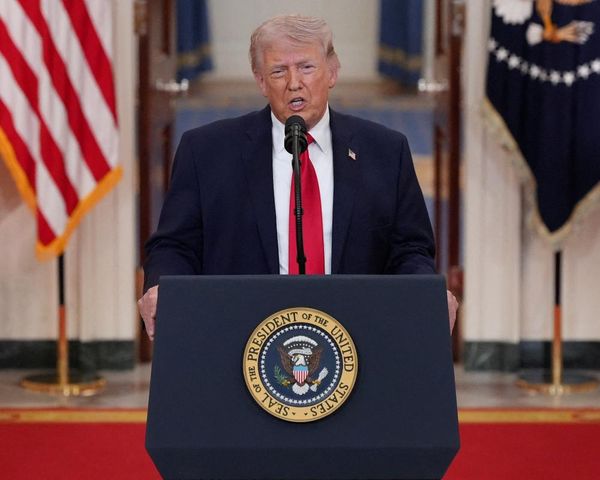
After expressing frustration at the slow pace of approval for coronavirus treatments, and causing controversy by publicly linking the Food and Drug Administration to the “deep state” conspiracy theory, Donald Trump on Sunday announced the emergency authorization of convalescent plasma, a method which has been used to treat flu and measles, for Covid-19 patients.
Covid-19 has killed more than 175,000, cratered the economy and upended the president’s hopes of re-election. The White House has sunk vast resources into an expedited process to develop a vaccine, known as Operation Warp Speed, which aides hope will produce an “October surprise” before the presidential election on 3 November.
Making the announcement at a press conference, and with FDA commissioner Stephen Hahn standing with him, Trump added to days of White House officials suggesting politically motivated delays in approving a vaccine and therapeutics.
“This is what I’ve been looking to do for a long time,” Trump told reporters on Sunday at the White House. “I’m pleased to make a truly historic announcement in our battle against the China virus that will save countless lives.”
Critics say that name for the virus, based on where it originated, is racist. Furthermore, though more than 64,000 Covid-19 patients in the US have already been given convalescent plasma, a go-to tactic for new diseases, there is no solid evidence that it fights the virus:
Updated
Hi, Helen Sullivan joining you now from a crispy morning in Sydney, Australia.
I’ll be bringing you the latest coronavirus news from around the world for the next few hours.
As always, we welcome your questions, comments, tips and news from your part of the world. You can send me these things on Twitter @helenrsullivan or via email: helen.sullivan@theguardian.com.
Brazil's death toll increases by 494
Brazil reported 23,421 new cases of coronavirus and 494 deaths in the past 24 hours, the health ministry said on Sunday.
Brazil has registered 3,605,783 cases of the virus since the pandemic began, while the official death toll from Covid-19 has risen to 114,744, the second highest total after the US.
Boris Johnson urges parents to send children back to school in September
Boris Johnson has issued a plea to parents to send their children back to the classroom when schools reopen next month.
The UK prime minister said the risk of contracting coronavirus in schools is “very small”, and that pupils face greater harm by continuing to stay away from the classroom.
Many pupils in England have not been to class since March when schools were closed except to look after vulnerable children and those of keyworkers.
Schools in Scotland reopened earlier this month, while those in England, Wales and Northern Ireland are expected to welcome all pupils from the beginning of September.
Johnson said: “I have previously spoken about the moral duty to reopen schools to all pupils safely, and I would like to thank the school staff who have spent the summer months making classrooms Covid-secure in preparation for a full return in September.
“We have always been guided by our scientific and medical experts, and we now know far more about coronavirus than we did earlier this year.
“As the Chief Medical Officer has said, the risk of contracting Covid-19 in school is very small and it is far more damaging for a child’s development and their health and wellbeing to be away from school any longer.
“This is why it’s vitally important that we get our children back into the classroom to learn and to be with their friends. Nothing will have a greater effect on the life chances of our children than returning to school.”
In response, Liberal Democrat education spokeswoman Layla Moran said: “The government must rapidly upscale Test and Trace and ensure schools have the mental health support, financial resources and the use of community spaces they need ahead of opening fully.
“The country, and seemingly the prime minister, has lost faith in Gavin Williamson [the education secretary]. To restore confidence among parents, pupils and teachers the best thing the prime minister could do is sack him, rather than speak for him.”
Updated
Monday’s Guardian front page.
GUARDIAN: @BorisJohnson moves to seize control of schools agenda after exams chaos #TomorrowsPapersToday pic.twitter.com/4w9rNyQ011
— Neil Henderson (@hendopolis) August 23, 2020
The front page of the Telegraph newspaper in the UK.
DAILY TELEGRAPH: PM’s plea to parents over return to school #TomorrowsPapersToday pic.twitter.com/ewz2rRgRk7
— Neil Henderson (@hendopolis) August 23, 2020
Monday’s Times front page in the UK.
TIMES:Teachers spread virus more than their pupils #TomorrowsPapersToday pic.twitter.com/PdUS9j6lQT
— Neil Henderson (@hendopolis) August 23, 2020
Blood plasma treatment given green light in the US
The US Food & Drug Administration (FDA) said it has authorised the use of blood plasma from patients who have recovered from Covid-19 as a treatment for the disease, a day after President Donald Trump blamed the agency for impeding the rollout of coronavirus vaccines for political reasons.
The announcement from the FDA of a so-called “emergency use authorisation” comes as Trump has announced a news briefing for today where he is likely to make an announcement on the topic.
The FDA early evidence suggests blood plasma can decrease mortality and improve the health of patients when administered in the first three days of their hospitalisation. It was not immediately clear what the immediate impact of this decision would be.
Patients who benefited the most from this treatment are those under 80 years old and who were not on a respirator, the agency said. Such patients had a 35 percent better survival rate a month after receiving the treatment.
“It appeared that the product is safe and we’re comfortable with that and we continue to see no concerning safety signals,” said Peter Marks, director of the Food and Drug Administration’s Center for Biologics Evaluation and Research, on a conference call with reporters.
The agency also said it determined this was a safe approach in an analysis of 20,000 patients who received this treatment. So far, 70,000 patients have been treated using blood plasma.
Updated
The front page of The Scotsman.
SCOTSMAN: Pubs stay shut as Aberdeen eases out of local lockdown #TomorrowsPapersToday pic.twitter.com/KNIK0PQvaM
— Neil Henderson (@hendopolis) August 23, 2020
A selection of some of Monday’s front pages in the UK, starting with the i.
I: Get children back to school, says Johnson #TomorrowsPapersToday pic.twitter.com/TqDJzKvm4x
— Neil Henderson (@hendopolis) August 23, 2020


Updated
The front page of Monday’s Financial Times in the UK leading on President Donald Trump’s vaccine plans.
FT: Trump eyes fast tracking UK Covid 19 vaccine before election #TomorrowsPapersToday pic.twitter.com/dNhcxAnJLY
— Neil Henderson (@hendopolis) August 23, 2020
Barcelona football club confirm new signing Miralem Pjanic has tested positive for coronavirus.
The Bosnia and Herzegovina international will be in quarantine for 15 days and will miss the start of pre-season.
Get well soon! We're waiting for you. 💙❤️ https://t.co/QO0rcPqXC3
— FC Barcelona (@FCBarcelona) August 23, 2020
A summary of today's developments
- France reported almost 4,900 new coronavirus cases over the last 24 hours, its highest figure since May.
- The number of daily coronavirus cases recorded in Italy has nearly doubled in the past five days, rising to more than 1,200 on Sunday. Italy recorded 1,210 cases in the past 24 hours, compared with 642 on Wednesday, latest official figures showed.
- The UK recorded 1,041 new cases of Covid-19 on Sunday, down from 1,288 on Saturday, government figures showed. It is the fourth day in a row that new infections have been more than 1,000 in 24 hours.
- President Donald Trump will announce that a coronavirus treatment involving blood plasma has received an emergency use authorisation from US regulators, according to reports in the US. The president is expected to make the announcement at a press briefing on Sunday evening.
- Former Ukrainian prime minister Yulia Tymoshenko has tested positive for Covid-19 and is in a serious condition with a fever, Reuters reports. Tymoshenko, who twice served as leader before her defeat in the 2010 presidential election, became the first high-profile Ukrainian politician known to have contracted Covid-19.
- The Greek island of Lesbos was added to a list of areas under heightened Covid-19 vigilance, officials said. The move came as health authorities announced a new daily infection high of 284 cases nationwide in the last 24 hours.
- French regional health authorities said there had been a very worrying outbreak of coronavirus at a naturist holiday resort on the Mediterranean coast, with more than 100 holidaymakers so far testing positive.
- Sicily’s governor Nello Musumeci has ordered all migrant residences on the Italian island to be shut down by Monday, part of a pushback by Italian regions alarmed by a surge in Covid-19 cases.
Updated
In France, the Cap d’Agde resort in the Herault region, hugely popular among naturists, saw 38 positive tests on Monday and another 57 on Wednesday, the health authority said.
The rate of infection was four times higher among naturists in the resort than in the village itself, it added.
Another 50 holidaymakers had also tested positive after returning home and results of more tests were expected next week.
The figures are “very worrying” it said, adding an alert had been issued over the resort.
The outbreak comes as France on Sunday reported almost 4,900 new coronavirus cases over the last 24 hours, its highest figure since May.
Updated

Updated
After France reported almost 4,900 new coronavirus cases over the last 24 hours, its highest figure since May, the country’s health minister acknowledged there were risks in the surging infection levels.
“We are in a situation where there are risks,” Olivier Veran said in an interview with the Le Journal du Dimanche newspaper as the French prepare to return to work from the summer holidays.
He emphasised however that the situation was “not the same as it was in February” when the virus began spreading in France, with Covid-19 now circulating four times as much among the under 40s as the over 65s.
Testing had now been ramped up so France can undertake 700,000 tests a week, he added but acknowledged the risk was that young people could pass on the virus to the elderly.
Veran lamented that most infections were happening in “festive situations” attended by young people where social distancing was not respected.
However, he insisted a new nationwide lockdown was “not on the agenda” and unlike in the spring “we have more knowledge and means at our disposal” with targeted local measures the best action to take.
Veran said he was aware of speculation that the virus was now less deadly because it had mutated but said the argument “alas” had no scientific basis.
“The Covid that is spreading is the same that has killed 30,000 French. Only the profile of the patients has changed, they are younger and have fewer symptoms,” he said.
Updated
Austria strengthened coronavirus controls on its border with Slovenia on the weekend, causing traffic chaos and angering Slovenian police until authorities relented on Sunday.
From Saturday until noon on Sunday, Austria stopped every car entering from Slovenia to record personal data from all passengers to help track infections after a spike in cases.
Long stretches of cars - many driven by German and Dutch tourists returning from summer holidays - were backed up from the Karawanks and Loibl tunnels, busy crossing points between northern and southern Europe.
A Slovenian police spokesman told the APA news agency that authorities on their side of the border had not been informed of the change.
“We were in no way prepared for such slow and restrictive work methods on the part of the Austrian authorities,” the spokesman said.
“With such a system, as it was applied by the Austrian side yesterday and last night, the situation is not humane.”
Slovenian police said they took a child suffering from heatstroke in one of the cars to hospital.
There were 12 kilometres (seven miles) of traffic jams at the Karawanks entrance on Sunday, until local authorities on the Austrian side of the border eased the measures, unblocking traffic, which returned to normal on Sunday afternoon.
Vienna said it imposed the border controls as a third of the holidaymakers returning to Austria who tested positive for coronavirus over the last month were coming from Croatia, a popular beach destination south of Slovenia.
Croatia’s foreign ministry called for a solution to be found to shorten the “worryingly long” wait time at the Austrian border, the state-run HRT radio reported.
Updated
President Donald Trump will announce that a coronavirus treatment involving blood plasma has received an emergency use authorisation from US regulators, according to reports in the US.
The president is expected to make the announcement at a press briefing on Sunday evening.
Convalescent plasma uses blood from Covid-19 patients that have recovered and built antibodies against the virus and infuses it into people with the virus to prevent severe disease, according to the Mayo Clinic in the US which is conducting studies on the treatment.
However, clinical trials have not proven whether plasma can help patients with coronavirus.
Updated

Italy records a further 1,200 coronavirus cases
The number of daily coronavirus cases recorded in Italy has nearly doubled in the past five days, rising to more than 1,200 on Sunday.
The rise was linked to travel and summer entertainment for holidaymakers, according to an official report.
Italy recorded 1,210 cases in the past 24 hours, compared 642 on Wednesday, latest official figures showed.
On Saturday, 1,071 new cases were recorded, with 947 cases registered on Friday and 845 on Thursday.
The biggest number of cases was recorded in the northern Lombardy region with 239, followed by the Rome region where there were 184 further cases and the Venice region which had 145.
A further seven deaths were recorded on Saturday, bringing the total number of Italian coronavirus fatalities since the start of the pandemic to 35,437.
Despite the steady rise in cases, the country’s health minister Roberto Speranza ruled out any general return to lockdown, saying the situation was under control.
The country currently has 18,438 cases including 69 patients in intensive care.
The Trump administration is considering fast-tracking an experimental Covid-19 vaccine for use in the US ahead of the 3 November elections, according to the Financial Times.
One option being explored would involve the US Food and Drug Administration (FDA) awarding “emergency use authorisation” in October to the potential vaccine, which was developed by Oxford University and licensed to AstraZeneca, the newspaper reported.
Updated
Top Democrats and Republicans blamed each other for stalled talks on coronavirus aid legislation, a day after the House of Representatives approved $25 billion in new funds for the US Postal Service.
But Saturday’s vote failed to shift a stalemate over the next phase of coronavirus aid since 6 August, when talks between the White House and Democratic congressional leaders broke down over funding levels and unemployment benefits.
Senate majority leader Mitch McConnell said the Republican-controlled chamber would “absolutely not pass” the postal bill.
White House chief of staff Mark Meadows on Sunday criticised the Democratic vote as “a largely messaging bill” and blamed house speaker Nancy Pelosi for failing to agree on broader legislation that included supplemental unemployment benefits.
“And Trump gives bread and circuses without the bread. So we’ll see the circus this week with his convention.”
“I haven’t heard from the speaker yet. I am going to make a phone call to her today,” Meadows said on ABC’s “This Week”.
“My challenge to the speaker this morning would be this: If we agree on five or six things, let’s go ahead and pass those.”
Pelosi shot back on CNN’s State of the Union, saying Trump was stalling needed coronavirus relief for cities and children for political gain, signalling that negotiations were likely to make little progress during the Republican National Convention, which gets underway this week.
“This is like ancient Rome. Trump fiddles while Rome burns, while America burns,” she said.
Updated
The Greek island of Lesbos was on Sunday added to a list of areas under “heightened” Covid-19 vigilance, officials said.
The move came as health authorities announced a new daily infection high of 284 cases nationwide in the last 24 hours.
The civil protection authority placed the Aegean island on a list of over a dozen other areas, including Athens, Thessaloniki and several tourist islands, with alarming infection clusters.
From Monday until 1 September, Lesbos restaurants and bars must close at midnight and outdoor gatherings are limited to 50 people, except where social distancing rules are applied.
Migrant camps on the island have already been under lockdown since March until the end of August.
Greece has so far recorded over 8,600 cases and 242 deaths from coronavirus.
Updated
France records highest daily increase in cases since end of lockdown
The number of confirmed coronavirus cases in France has increased by 4,897 in the past 24 hours, compared to an increase of 3,602 on Saturday, the country’s health ministry said.
It marks the highest daily level since the end of a two-month lockdown in May and brings the total to around 280,000.
The death toll has increased by one to bring the total to 30,513.
The Guardian’s Latin America correspondent, Tom Phillips, reflects on the humanitarian disaster that has gripped the region in recent months.
Three people have been jailed this week for failing to quarantine after returning to the Isle of Man from the UK.
Under the island’s strict Covid-19 rules, returning travellers must self-isolate at home for 14 days.
The Isle of Man has recorded no new cases of coronavirus since 20 May, leading the government to dispense with most of its lockdown restrictions in mid-June, before the UK.

Police in Massachusetts are looking for a man who allegedly gave a shopper in Walmart a so-called “Covid hug.”
The police department said the incident took place on August 15 around 7:10 p.m.
The suspect, whom the victim had never seen before, took an item out of his hand and then gave him a hug.
“Just giving you a Covid hug. You now have Covid,” the suspect said before laughing and walking away, according to police.
The victim is a cancer survivor, the police department said, adding that the suspect did the same thing to several other customers.
Updated
Covid-19 infections and outbreaks were “uncommon” in schools in England after they reopened in June, according to a Public Health England report.


UK records more than 1,000 cases for the fourth consecutive day
The UK recorded 1,041 new cases of Covid-19 on Sunday, down from 1,288 on Saturday, government figures showed.
It is the fourth day in a row that new infections have been more than 1,000 in 24 hours.
Six people died after testing positive for coronavirus, compared with 18 deaths announced on Saturday, bringing the total in all settings to 41,429.
A tweet from the World Health Organization’s director general, Tedros Adhanom Ghebreyesus, following a meeting in Geneva with Canadian officials.
Thank you for an excellent meeting, @FP_Champagne, Foreign Minister, #Canada. Health is the key mover of humanity & that’s why we need to combat #COVID19 together. @WHO greatly appreciates 🇨🇦’s support & leadership in the COVAX initiative.https://t.co/iaArzsUCFh
— Tedros Adhanom Ghebreyesus (@DrTedros) August 23, 2020
Sicily’s governor Nello Musumeci has ordered all migrant residences on the Italian island to be shut down by Monday, part of a push-back by Italian regions alarmed by a surge in Covid-19 cases.
But while some new migrants have tested positive, vacationers returning from Mediterranean Sea resorts abroad as well from the Italian island of Sardinia lately have accounted for far more of Italy’s new coronavirus infections.
In Sicily, all migrants who reach the island by sea are to be transferred. All centres housing migrants awaiting processing of asylum applications will be closed by the end of Monday.
Musumeci’s order, effective through September 10, also forbids any boat, including charity vessels, to bring migrants to the island.
On Saturday, Italy registered 1,071 new cases, the highest daily number since mid-May and only weeks after the nation had seen the number of day-to-day new infections plunge to about 200.
The Lazio region, which includes Rome, surpassed hard-hit Lombardy on Saturday for the highest daily new caseload, as returning travelers got tested at Rome-area airports and a port north of the Italian capital.
On the mainland, most of the latest cases were linked to travelers coming from abroad. Those arriving from Spain, Malta, Greece and Croatia must be tested within 48 hours of entering Italy, after those places started experiencing worrisome upticks in coronavirus infections.
And many recent coronavirus clusters have been traced to people who vacationed on Sardinia.
With many people taking ferries from Sardinia to the Italian mainland, Lazio set up a testing facility at Civitavecchias dock, so those driving vehicles off the boats could line up for immediate testing.
Lazio governor Nicola Zingaretti appealed to the governor of Sardinia to test vacationers before they sail or fly from the island to the mainland, saying his region would do the same for travelers leaving for Sardinia.
Sixty police officers are undergoing testing for Covid-19 after an outbreak at two stations in Northern Ireland, PA reports.
A total of eight officers have been diagnosed with the infection, the Police Service of Northern Ireland said.
The number testing and self-isolating has increased from 51 on Saturday.
Antrim and Newtownabbey stations have been closed for deep cleaning.
Assistant Chief Constable Alan Todd said:
Yesterday we confirmed that eight of our officers had tested positive for Covid-19. This number has not increased.
However, the number of officers who are currently self-isolating and undergoing testing for Covid-19 has increased from 51 yesterday to 60 officers today.
In line with public health guidance, we are taking all appropriate steps to address and manage the issue.
While we hope to return frontline officers to their duties in the coming days, our officers’ health and welfare is of paramount importance and we will ensure they return to duty when it is safe to do so.
In the UK, an illegal rave attended by more than 150 young people in a coronavirus hot-spot was broken up by police on Sunday.
The gathering was at Entwistle reservoir, between Blackburn and Bolton, both areas where extra restrictions are in place due to the pandemic.
The man who organised the event was arrested by officers and had his equipment taken off him.
Disappointed to see illegal rave started at Entwistle reservoir overnight.Force resources mobilised & it was stopped quickly.Organiser identified at scene,arrested,his van & all sound/other equipment seized. 150 plus young people now off back to families to possibly pass virus on pic.twitter.com/QrFsT6bw7y
— DCC Terry Woods (@DCCWoods) August 23, 2020
Dr Sakthi Karunanithi, director of public health at Lancashire County Council, tweeted: “Unacceptable behaviour by organiser. 1000s of young people & households are sacrificing their freedom whilst a small minority behave irresponsibly. Please please avoid social mixing.
“Serious consequences to our health and economy if this leads to more cases.”
Covid-19 death toll in Wales rises by two to 1,592
The total number of people to die after testing positive for Covid-19 in Wales has risen by two to 1,592, according to Public Health Wales.
Meanwhile, new cases increased by 20, bringing the revised confirmed cases to 17,727.
The latest number of confirmed cases of Coronavirus in Wales has been updated.
— Public Health Wales (@PublicHealthW) August 23, 2020
Data dashboard:
💻https://t.co/zpWRYSUbfh
📱https://t.co/HSclxpZjBh
Find out how we are responding to the spread of the virus in our daily statement here: https://t.co/u6SKHz0zsG pic.twitter.com/Y08sQVjTkZ
Scotland records 83 new Covid-19 cases
The total number of coronavirus cases in Scotland has increased by 83 in the past 24 hours.
Official figures show that a total of 19,811 people have tested positive for the virus since the start of the outbreak.
There were no reported deaths registered on Saturday, meaning the death toll remains at 2,492. A total of 245 people were in hospital with confirmed Covid-19 – two in intensive care.
The Peruvian government has condemned a Lima nightclub owner for hosting an illegal party in which 13 people were crushed to death by revellers attempting to flee a police raid.
The nation’s interior ministry blamed the deaths on the “criminal irresponsibility of an unscrupulous businessman” in a statement.
Peru’s women’s minister, Rosario Sasieta, called for harsh penalties for the club’s management who organized the event.
“I ask for the maximum sanction for the owners of this place, which has really been irresponsible, and we are talking about a malicious homicide for profit,” Sasieta told journalists during a visit to the site on Sunday morning.
“Knowing that there is a health emergency, knowing that not even at home you can meet with relatives who do not live there, you have the irresponsibility of opening a place for 120 people to enter?” Sasieta added.
An interior ministry statement said the revellers tried to squeeze en masse through the only entrance door and became trapped between the door and a staircase leading to the street.
Former Ukranian PM in 'serious condition' after positive Covid-19 test
Former Ukrainian prime minister Yulia Tymoshenko has tested positive for Covid-19 and is in a serious condition with a fever, Reuters reports.
Tymoshenko, 59, who twice served as premier before her defeat in the 2010 presidential election, became the first high-profile Ukrainian politician known to have contracted Covid-19. Parliament has been on summer vacation since mid-July.
“Her condition is assessed as serious, her temperature is up to 39 (Celsius),” the spokeswoman for her Fatherland party said, declining to say whether Tymoshenko had been hospitalised or give further detail.

Ukraine has experienced a sharp rise in infections this week, with a new 24-hour total of 2,328 cases reported on Saturday. The overall number of infections reached 104,958 along with 2,271 deaths.
Tymoshenko rose to prominence as co-leader of Ukraine’s Orange Revolution in 2004 in which pro-Western Viktor Yushchenko was confirmed as president after a court declared the election result to have been rigged in favour of his pro-Moscow foe.
She served twice as prime minister under Yushchenko before the two fell out after years of political turmoil.
Summary
- Covid-19 infections and outbreaks were “uncommon” in English schools after they reopened in June, according to a Public Health England report. It comes as the UK’s chief medical officers warn children are more at risk of long-term harm if they do not attend school than if they return to the classroom despite coronavirus.
- German lawmakers have suggested a temporary ban on private parties after the number of coronavirus infections reached a four-month high. “We must not risk that day care centres and schools will close again and that children are forced to remain at home for weeks because we have accepted higher infection rates due to lax rules at family parties,” Saskia Esken, co-leader of the Social Democrats, told the Frankfurter Allgemeine Sonntagszeitung (FAS) newspaper.
- The EU’s trade commissioner, Phil Hogan, has issued a “fulsome and profound” apology for attending a golf dinner during the pandemic amid mounting calls for his resignation. Ireland’s deputy prime minister, Leo Varadkar, had initially called for Hogan to consider his position but has now welcomed the Irishman’s apology.
- The Italian government is not considering a new coronavirus lockdown despite a steady rise in cases over the past month, health minister Roberto Speranza has said. “We will not have a new lockdown,” Speranza told daily newspaper La Stampa on Sunday, saying the current situation cannot be compared to February and March, when the disease was spreading out of control and it was difficult to track and isolate infected people.
- At least 13 people were crushed to death or asphyxiated as partygoers attempted to flee a Lima nightclub raided by police because it was in breach of Covid-19 restrictions. At least six were injured, including three police officers, as around 120 people tried to escape the Thomas Restobar club on Saturday night. Police arrived to break up a party on its second floor, national police and government officials said.
This is Aaron Walawalkar in London here, steering you through the latest global developments in the pandemic. Please do send me any tips or suggestions for coverage by DM on Twitter @AaronWala.
Updated
Ban private parties to curb Covid-19 infections, German politicians urge
German lawmakers have suggested a temporary ban on private parties after the number of coronavirus infections reached a four-month high.
The number of confirmed cases in Germany rose by 2,034 to 232,082, data from the Robert Koch Institute (RKI) for infectious diseases showed on Saturday, the highest level since late April. The reported death toll rose by seven to 9,267.
“We must not risk that day care centres and schools will close again and that children are forced to remain at home for weeks because we have accepted higher infection rates due to lax rules at family parties,” Saskia Esken, co-leader of the Social Democrats, told the Frankfurter Allgemeine Sonntagszeitung (FAS) newspaper.

Ralph Brinkhaus, leader of the CDU/CSU conservative parliamentary bloc, said: “Unfortunately since the start of summer a certain recklessness has spread.”
The remarks come ahead of a planned meeting of Chancellor Angela Merkel with the premiers of Germany’s federal states on Thursday to discuss a unified approach to the next steps.
“Private festivities are a great danger,” Ursula Nonnemacher, health minister of the state of Brandenburg, told FAS, adding there was a real risk of “hard contact restrictions” should new infections continue to rise.
Updated
Ireland’s deputy prime minister, Leo Varadkar, has welcomed European trade chief Phil Hogan’s apology for attending an event that may have breached Covid-19 rules, but said a further explanation was required.
Hogan will not resign over the matter, despite pressure from the leaders of Ireland’s coalition government, an EU official close to him told Reuters said on Sunday.
Following Hogan’s apology, Varadkar told RTE Radio:
It is our view that an apology is welcome but he also needs to account for himself and answer any questions that might arise, not just in relation to the dinner but also in relation to his movements around Ireland ... If he can’t do that, then he needs to consider his position.
He added that Hogan may not have been as familiar with the coronavirus situation in Ireland because he was not based in the country.
Updated
EU trade commissioner apologises for golf dinner during pandemic
The EU’s trade commissioner has issued a “fulsome and profound” apology for attending a golf dinner during the pandemic amid mounting calls for his resignation.
Irishman Phil Hogan has been urged to consider his position by the leaders of the Republic’s coalition government, Micheal Martin and Leo Varadkar, after the event at a hotel in the west of Ireland with more than 80 people present.

He is a senior Irish politician with significant standing in Brussels who would be deeply involved in any deal with Britain after Brexit.
1) I wish to apologise fully and unreservedly for attending the Oireachtas golf society dinner on Wednesday night last.
— Phil Hogan (@PhilHoganEU) August 23, 2020
In a statement Hogan said:
I acknowledge my actions have touched a nerve for the people of Ireland, something for which I am profoundly sorry.
I realise fully the unnecessary stress, risk and offence caused to the people of Ireland by my attendance at such an event, at such a difficult time for all, and I am extremely sorry for this.
Police are investigating whether coronavirus regulations were broken in holding the Irish parliament’s golf society event two days after the government announced it intended to curb the numbers permitted to gather together.
A resurgence in Covid-19 cases in recent weeks has led Ireland to backtrack on some of its plan to reopen society after lockdown.
The function was held across two rooms in the hotel in Clifden.
Other attendees including the then agriculture minister Dara Calleary have resigned.
A Supreme Court judge was among others on the guest list.
Mr Hogan said:
I acknowledge that the issue is far bigger than compliance with rules and regulations and adherence to legalities and procedures.
All of us must display solidarity as we try to stamp out this common plague.
I thus offer this fulsome and profound apology, at this difficult time for all people, as the world as a whole combats Covid-19.
Updated
AFP has this report from Rakhine state in Myanmar:
Rohingya in Myanmar’s conflict-wracked Rakhine state are concerned a coronavirus outbreak could reach their overcrowded camps, after a spate of infections sent the state capital into lockdown.
Nearly 130,000 Rohingya Muslims live in what Amnesty International describes as “apartheid” conditions in camps around Sittwe.
The city has recorded 48 cases in the past week, making up more than 10 percent of the about 400 cases so far registered in Myanmar.
“We are extremely worried about the virus because we are living in limbo and it won’t be easy to control,” said Rohingya Kyaw Kyaw.

Authorities visited the Thae Chaung camp this week to talk about social distancing – an impossibility as 10 families typically squeeze into a single house – and gave out hand sanitiser and face masks.
“But if the lockdown is for a long time, we will ... need help,” Kyaw Kyaw told AFP, adding that everyone in the camps had locked themselves indoors.
Sittwe’s streets were empty Sunday, with masked residents encountering barricaded roads as they tried to run errands.
Street vendors hawked plastic face shields and surgical masks.
An overnight curfew order has been in place since Friday, while all public transport - including domestic flights - into the capital was suspended.
Rakhine state has long been a flashpoint for ethnic and religious conflict.
The embattled Rohingya Muslim minority are widely regarded as foreign “Bengalis,” despite having lived in Myanmar for generations. They lack citizenship rights and their freedom of movement is restricted across the country.

A local Rakhine parliamentarian this week blamed the Rohingya for the virus spread in a Facebook post that was later taken down.
Some 750,000 Rohingya fled to neighbouring Bangladesh following a military crackdown in 2017 - operations that Myanmar is currently facing genocide charges for at the UN’s top court.
Further north in the state, the military is also battling the Arakan Army, a rebel group seeking more autonomy for the state’s ethnic Rakhine Buddhists, and violent clashes have displaced thousands of civilians from their homes.
In Mrauk-U – where three cases were found this week – Rakhine residents feared a halt to food donations to the displacement camps, said camp leader Hla Maung Oo.
“We have nowhere to run if the virus becomes widespread because we also can’t go back to our villages,” he told AFP.
Updated
How South Korea’s evangelical churches found themselves at the heart of the Covid crisis
Four months ago, South Korea was basking in international praise for containing the coronavirus pandemic. But now it stands on the brink of a second serious outbreak, and much of the blame is again being directed at the country’s evangelical churches.
Health authorities say a recent surge in cases traced to Sarang Jeil, an ultra-conservative church in Seoul, have contributed to an outbreak that is now affecting major cities across the country. Some members of its congregation also attended a large anti-government rally in the capital last weekend that officials believe could have helped the virus spread.
Read the full report:
Here is a clip of England’s chief medical officer, Chris Whitty explaining why failing to return children to school in September would pose a greater risk to them than catching Covid-19.
Following the release of Public Health England’s report into Covid-19 transmission within schools, a union boss has urged the government to issue schools clear guidance for dealing with outbreaks.
Kevin Courtney, joint general secretary the National Education Union (NEU), said:
Government advice needs to cover the possible self-isolation of bubbles and, in extremis, moving to rotas or to more limited opening.
It needs to cover advice to heads about the protections needed for staff in high-risk categories if infection rates rise.
Government should be employing more teachers and seeking extra teaching spaces to allow education to continue in a Covid-secure manner if infections rise.
Travellers from the UK to France are required to self-certify that they are not suffering coronavirus symptoms or have been in contact with a confirmed case within 14 days preceding travel.
The requirement to self-certify has been added to the UK government’s travel advice for those visiting France.
Meanwhile, those travelling to the UK from France must still quarantine for 14-days after France was removed from the travel corridor list from August 15.
Russia aims to ramp up production of its potential Covid-19 vaccine to between 1.5 million and 2 million doses a month by the end of the year, Reuters reports.
Industry minister Denis Manturov said on Sunday that the nation hopes to eventually produce 6m doses a month, according to the RIA news agency.
There has been a rising chorus of concern among scientists over Russia’s vaccine, stemming from its opaque development and the lack of mass testing.
Earlier this month, virologist Kevin Gilligan warned of the potential for an inadequately tested vaccine to be “disease-enhancing” – making the situation worse than not doing any vaccination at all.
Russia has described claims its potential vaccine is unsafe as groundless.
Large-scale testing of the vaccine, developed by Moscow’s Gamaleya institute, is due to start in Russia next week.
What will learning look like in the UK this autumn?
When 18-year-old Nia Bolland returns to Cambridge University in September, it will be a very different environment to the one she dreamed about in sixth-form.
Bolland, who’s just finished her first year of a human, social and political sciences degree, returned home for lockdown with her family in Herefordshire, where she’s been studying remotely. “At Cambridge we’re quite lucky, because we have ‘supervisions’, which are basically 60-90-minute-long lessons in very small groups of between one and five people,” she says. “This means that lectures being cancelled hasn’t mattered as much as it might at other unis.”
Read the full report:
England's schools had 67 Covid-19 cases in June, PHE report finds
A total of 67 coronavirus cases and 30 outbreaks were detected in schools across England in June, according to Public Health England.
The health agency on Sunday released the findings of a study into levels of coronavirus transmission in educational settings following their reopening on June 1.
It found that Covid-19 infections and outbreaks were “uncommon”. In June, the number of children attending any educational setting increased from 475,000 to more than 1.6 million.
The report adds that there is a strong correlation between the regional incidence of Covid-19 and the number of outbreaks in educational settings, which “emphasises the importance of controlling community transmission”.
The 67 cases occurred mainly in primary school and early years settings and were made up of 30 students and 37 staff.
No children were admitted to hospital, but one teacher was hospitalised and was admitted to intensive care for respiratory support.
Updated
German finance minister Olaf Scholz said the European Union’s recovery package is a long-term measure rather than a short-term coronavirus crisis fix, contradicting chancellor Angela Merkel, AFP reports.
“The recovery fund is a real step forward for Germany and for Europe, one we won’t go back on,” Scholz, who is also the centre-left Social Democratic Party (SPD) candidate to succeed Merkel in 2021 elections, told the Funke newspaper group on Sunday.
Steps taken under the plan, including EU nations agreeing to jointly issue debt “represent fundamental changes, perhaps the biggest changes since the introduction of the euro” single currency around the turn of the millennium, Scholz said.
“These steps forward will inevitably lead to a debate about joint resources for the EU, something that’s a condition for an improved European Union that works better,” he added.

Long and intense debates were needed before the 27 EU countries reached agreement in July on their historic 750-billion-euro recovery scheme, more than half of which will be paid out as direct grants.
For the first time, leaders gave their green light to joint debt – an idea Germany had long rejected until the Covid-19 pandemic hobbled many European economies that had already spent a decade struggling to recover from the last financial crisis.
Scholz added that the way voting works at EU level should be reformed to make reaching decisions easier.
“The EU must be able to act collectively,” he said. “For that we need to have qualified majority voting in foreign and budgetary policy, rather than enforced unanimity.”
In European Council votes, a “qualified majority” is reached with 55% of countries, which must include member states representing 65% of the bloc’s 450-million-strong population.
The Covid doctor who quit over Cummings
Dr Dominic Pimenta resigned from his cardiology post after Boris Johnson’s chief advisor made his controversial car journey.
Was it the right decision?
Alex Moshakis speaks to Pimenta three months on to find out:
The Philippines recorded 2,378 new coronavirus infections on Sunday, Reuters reports.
It is smallest daily spike in nearly four weeks, but the nationwide tally rose to 189,601, still the highest in Southeast Asia.
In a bulletin, the Department of Health also reported 32 more fatalities, bringing the country’s death toll to 2,998.
Israeli police have arrested 30 demonstrators after thousands rallied to demand prime minister Benjamin Netanyahu resign over corruption charges and his handling of the coronavirus crisis.
As many as 10,000 people were estimated to have gathered near the premier’s official residence in Jerusalem on Saturday night, with some playing musical instruments and others chanting “Crime Minister” and “You’re fired”.
A police statement released early Sunday morning said there were outbreaks of violence during the rally and that officers were hurt.
“During the protests three policemen were injured by protesters,” police said.
Three of those arrested would appear in court on Sunday, the statement added.

Protests demanding that Netanyahu resign over several corruption indictments and his handling of the coronavirus crisis have been mounting in recent weeks, and the premier has been scathing in his counter-attack.
Earlier this month, Netanyahu accused Channel 12 and another private TV station, Channel 13, of “delivering propaganda for the anarchist left-wing demonstrations” through extensive coverage of the rallies.
Israel won praise for its initial response to the coronavirus pandemic, but the government has come under criticism amid a resurgence in cases after restrictions were lifted starting in late April.
Netanyahu has himself acknowledged that the economy was re-opened too quickly.
Italy 'not considering new lockdown to curb infections'
The Italian government is not considering a new coronavirus lockdown despite a steady rise in cases over the past month, health minister Roberto Speranza has said.
Italy, one of Europe’s worst-hit countries with more than 35,000 deaths, reported 1,071 new coronavirus infections on Saturday, exceeding 1,000 cases in a day for the first time since the government eased its rigid lockdown measures in May.
“We will not have a new lockdown,” Speranza told daily newspaper La Stampa on Sunday, saying the current situation cannot be compared to February and March, when the disease was spreading out of control and it was difficult to track and isolate infected people.

“I am optimistic, although prudent. Our national health service has become much stronger.”
Speranza added that Italy has doubled the number of beds in intensive care units.
The number of new infections remains considerably lower than those registered in Spain and France and daily death tolls are low.
In a separate interview with newspaper Corriere della Sera, health undersecretary Sandra Zampa said she was convinced Italy would not impose a nationwide lockdown but did not rule out restrictions on territories where there are spikes in infection numbers.
Thirteen people crushed to death as Peruvian police raid illegal party
At least 13 people were crushed to death or asphyxiated as partygoers attempted to flee a Lima nightclub raided by police because it was in breach of Covid-19 restrictions, Reuters reports.
At least six were injured, including three police officers, as around 120 people tried to escape the Thomas Restobar club on Saturday night. Police arrived to break up a party on its second floor, national police and government officials said.
Neighbours had alerted police about the raucous event at the club in the Los Olivos district of the Peruvian capital.
“In these circumstances when people begin to fight to get out, it’s tumultuous, everyone goes against each other,” Orlando Velasco of the National Police told local radio station RPP.
An interior ministry statement said the revellers tried to squeeze en masse through the only entrance door and became trapped between the door and a staircase leading to the street.
Police detained at least 23 partygoers, the ministry said.
Peru ordered the closure of nightclubs and bars in March and banned extended family gatherings on 12 August. A Sunday curfew is also in effect.
Peru had recorded a total of 585,236 coronavirus cases as of Saturday, double the number reported on July 2, while the known death toll has risen to 27,453.
Updated
Reopening schools could lead to coronavirus infections rising and force the reintroduction of some local lockdown measures, the UK’s most senior medical advisers warn today.
In a joint statement last night, the chief and deputy chief medical officers from across the UK said while there were “no risk-free options”, further time out of the classroom would increase inequalities, reduce the life chances of children and could exacerbate physical and mental health issues.
Read the full report:
Updated
The renaissance in illegal raves is not unique to England, with French authorities attempting to crack down on a boom in summertime mass gatherings. AFP has this report:
Ravers, called “teufeurs” in French back slang, speak of “resistance” against a crackdown by security forces encouraged by locals to restore order.
“The more they stop us from partying, the more we party,” teufeur and activist Gregoire aka Pontu, who uses an alias to protect himself against the authorities.
France’s “free party” movement has since the 1990s brought together techno music lovers who follow a nomadic lifestyle, often living in small communities with a libertarian or anarchist ideology.
“Because of the pandemic there have been fewer events this year than previous years,” free party organiser Robin told AFP, asking not to use his full name.
“But a lot of attention has been focused on those events and the crackdown has been much tougher.”
He works for the Sound Fund, an association that offers legal support for rave organisers who face fines or have equipment confiscated by the police.
The association has been called on to help in 22 confiscation cases this year, including four over the August 15 bank holiday weekend. The number is twice as high as in 2019, Robin noted.
The national gendarmerie police force said it would not respond to AFP’s questions on the situation.
However one regional official said that the latest national strategy was to try to restrict the size of gatherings once they get started by blocking all access roads. The official added that site evacuations remained a rarety.

“We cannot allow 5,000, 6,000 people to get together, without shirts, masks or any respect for virus rules,” said junior interior minister Marlene Schiappa in July at the site of a rave that drew 4,000 people to the Nievre department in central France.
Police in the southern Lozere region blocked off a plateau in the Cevennes national park where 7,000 people, including small children, attended an illegal three-day festival in mid-August.
Lozere, France’s least populated department, has been spared the worst of the Covid-19 pandemic, which has so far claimed more than 30,000 lives nationwide.
With infection rates rising again, locals were furious about the risks posed by the event.
About 200 gendarmes blocked off the mountainous site before slowly filtering out ravers and seizing material such as speakers and electricity generators.
Through the confiscations the authorities can sometimes track down the event organisers who risk fines of up to 3,500 euros for illegal parties.
If the fine includes “noise aggression”, the punishment can climb to a year in prison and 15,000 euros.
Updated
The UK government has extended its ban on removing tenants by a month, but they still face harassment and violence from landlords in unregulated market, my colleague Tom Wall reports:
Hadie Touray perches nervously on the edge of his bed in a windowless room in Leyton, east London. He has been living by candlelight since rent collectors working for his landlord ripped the fuse out of the converted garage’s meter box. Now they are threatening to turn off his water supply and even use violence if he isn’t gone by the weekend.
As the threat of a soon-to-be introduced £10,000 fine looms large over England’s illegal rave organisers, James Tapper looks at how fortysomethings are participating in a more socially-distanced revival of 90s clubbing culture:
It began with DJs livestreaming their sets on social media. From there, it was a short step to organised events like Moondance and Zoom Dance, with thousands tuning in from their sofas to listen and dance to jungle, old school hardcore and classic house.
Read the full report:
Hello, it’s Aaron Walawalkar in London here. I’ll be steering you through the latest global developments in the pandemic for the next few hours.
Please feel free to get in touch with story ideas or suggestions for coverage by DM on Twitter @AaronWala or by email.
On Sunday morning India had passed three million coronavirus cases, with the country leading the world in new infections.
It comes as Mexico passed 60,000 deaths and South Korea reported its highest daily Covid-19 tally since early March, with outbreaks continuing to spread from a Seoul church and from political demonstrations its members had attended.
Read the full report from my colleague Alison Rourke:
In the UK, our main story this morning looks at government plans to reopen schools in September, which Labour leader Keir Starmer says are now at “serious risk” from the incompetent handling of the exams fiasco.
The Labour leader said:
I want to see children back at school next month, and I expect the prime minister to deliver on that commitment. However, the commitment is now at serious risk after a week of chaos, confusion and incompetence from the government.
It comes as the country’s chief medical officers warned that further time out of the classroom would increase inequalities and reduce the life chances of children, and could exacerbate physical and mental health issues.
In a separate interview, Chris Whitty, England’s chief medical officer, said the chances of children dying from Covid-19 were “incredibly small”.
Read the full report here:
Updated
That’s all from me - I’m now handing over to my colleague in London, Aaron Walawalkar, who will keep you posted with the latest developments.
This explainer from Robin McKie, science and environment editor for the Observer, explores why coronavirus fatalities remain low when infection numbers are rising.
Is the Covid-19 virus becoming less deadly?
This idea is supported by some scientists. They point to the fact that most viruses tend to lose their most lethal attributes because they gain nothing from killing off their hosts. This could be happening with the Covid-19 virus, they say. Other researchers disagree, saying such a process is unlikely to be happening this quickly. One alternative suggestion is that infectious doses of the Covid-19 virus, transmitted from one person to another, may be getting smaller thanks to social distancing. Lower doses would then be easier for our immune systems to tackle, so death rates would drop.In the end, these issues remain unresolved and will require many more months, if not years of research, to work out, scientists warn.
Updated
On the front page of today’s Observer, Labour leader Keir Starmer warns plans to reopen schools in September are now at “serious risk” due to the government’s incompetent handling of the exams fiasco.
Tomorrow’s front page pic.twitter.com/UE4tJRaHgI
— The Observer (@ObserverUK) August 22, 2020
Updated
England introduces fines for illegal raves
In England, fines of up to £10,000 for those organising illegal raves will come into force ahead of the bank holiday, PA media reports.
The move comes as officers respond to a surge in unlicensed music events. In Birmingham, officers said they attended more than 70 unlicensed street and house parties on Saturday night, while police in Huddersfield broke up an illegal rave involving some 300 people.
The Metropolitan Police received information on more than 200 events across London in a single weekend, responding to more than 1,000 illegal events in the capital since the end of June.
Elsewhere, West Midlands Police shut down 125 parties and raves - including one of up to 600 people - in one weekend.
Boris Johnson said that new fines were to be introduced for those hosting raves when he announced a further easing of England’s lockdown last week.
People facilitating or organising illegal raves, unlicensed music events or any other unlawful gathering of 30 people or more may face a 10,000 fine. Participants can continue to be issued with fines of 100, while those who have already been fined will see the amount double on each offence, up to a maximum of 3,200.
Updated
Australia’s chief nursing and midwifery officer, Alison McMillan, gave the nation’s Covid-19 update today, sending her condolences to the families of the 17 people diagnosed with the virus who have died in the past 24 hours. She also sent her appreciation to health care workers for the job they are doing.
Asked whether or not Australians can trust any forthcoming Covid vaccine, given the speed with which vaccines are being developed, she said:
We are extremely encouraged in Australia about all the work going on across the world in relation to finding a vaccine for this virus. Australia has very, very strong regulatory systems in place to ensure that if and when any vaccine becomes available, it will go through all those necessary checks and balances to ensure that it is provided safely and effectively for the Australian community. And we won’t sidestep those necessary requirements. Obviously there is a great focus on the moment on the Oxford vaccine, but there are numerous other vaccines coming to clinical trials across the world.”
McMillian also said that for the foreseeable future, hugs and handshakes and other contact, outside of your household, were out.
I suggest that we have reached a point at the moment where a handshake is no longer something we should be doing socially. It has become very much part of our culture over a very long time. Handshakes are something we should avoid at this point in time.
When it comes to hugs, I encourage you, if you are within your family unit, the people you live with, with your children or your loved one, of course if they live with you you can hug.
But when it comes to the broader community, and hugging others outside of your family unit, then no, we really think at this point in time we need to think of innovative and different ways to show a welcome or a greeting to somebody, but is not a hug.
I think at some point perhaps in the future we may reach a point where we would see hugging again, but not at this point in time.”
Summary
- India’s coronavirus caseload has topped 3 million, as the virus spreads in the country’s southern states. There is concern that authorities are using cheaper, faster but less accurate tests to scale up testing, and that cases may be going undetected.
- Mexico’s confirmed coronavirus deaths have now passed 60,000, though new cases have eased since reaching a record daily number at the start of August.
- South Korea reported its highest daily rise in coronavirus cases since early March on Sunday, as outbreaks continued to spread from a Seoul church and from political demonstrations its members had attended.
- In Australia, the Covid-19 death toll has topped 500, with many new fatalities again coming from the aged care sector in virus-hit Victoria.
- England’s chief medical officer, Chris Whitty, said it would be “foolish” to plan for winter on the basis of having a coronavirus vaccine. “I would obviously be delighted if it came earlier, but I’d be quite surprised if we had a highly effective vaccine ready for mass use in a large percentage of the population before the end of winter,” he said.
- Irish premier Micheal Martin announced on Sunday he would recall parliament following a scandal over politicians breaching coronavirus rules.
- US president Donald Trump accused members of an alleged “deep state” at the Food and Drug Administration (FDA), without providing evidence, of working to slow testing of Covid-19 vaccines until after the November presidential election.
- The World Health Organization (WHO) said children aged 12 and over should wear masks to help tackle the corornavirus pandemic under the same conditions as adults.
Updated
Here is the Guardian’s latest global report on the coronavirus pandemic:
Australia's death toll passes 500
In Australia, the Covid-19 death toll has topped 500, with many new fatalities again coming from the aged care sector in virus-hit Victoria, Australian Associated Press reported.
A further 11 deaths in Victorian aged care facilities were reported on Sunday out of a total of 17. It takes the state’s toll to 415 and the national total to 502.
Federal Labor on Monday will keep the heat on the Morrison government over its handling of the aged care sector during the coronavirus pandemic when parliament sits for the first time for 10 weeks.
Opposition health spokesman Chris Bowen says the number of deaths in aged care homes during the crisis has been heartbreaking. “At every test for the federal government they’ve failed when it comes to aged care,” Mr Bowen told Sky News’ Sunday Agenda program.
Defending the government’s approach to the crisis, Finance Minister Mathias Cormann said aged care was a vulnerable sector in the pandemic.
“If you have got a jurisdiction like Victoria where there is a massive outbreak ... the aged care sector inevitably is particularly exposed,” Senator Cormann told reporters on Sunday.
He said the government had put more than $1 billion in place to support the sector during the pandemic.
“But in the end, in the face of this sort of pandemic, there is a practical limit to how effective that sadly can be in the context of a virus like this,” Senator Cormann said.
Victoria also reported 208 new infections on Sunday, the first time above the 200 mark in three days. Victorian chief health officer Brett Sutton said although the daily case numbers were “jumping around”, he expected they were on a downward trajectory.
Updated
Associated Press has some further details on the situation in India, where authorities are using cheaper, faster but less accurate tests to scale up testing. It is feared that cases are going undetected, contributing to the spread of the virus.
The use of these rapid tests boosted India’s testing levels nearly five-fold within two months. But government numbers suggest some parts of the country might have become over reliant on the faster tests, which can miss infections. Experts warn that safely using them requires frequent retesting, something that isnt always happening.
Cases surged faster than labs could scale up testing once India’s harsh lockdown was relaxed. So far authorities have rationed the use of the more precise molecular tests that detect the genetic code of the virus. But on June 14, India decided to bolster these with faster tests that screen for antigens, or viral proteins.
Albeit less accurate, these tests are cheap and yield results in minutes. Most don’t require a lab for processing or any specialized equipment or trained personnel. The plan was to rapidly increase testing to identify infected people and prevent them from spreading the virus. Samples tested using both tests increased from 5.6 million in mid-June to 26 million two months later, and nearly a third of all tests conducted daily are now antigen tests, health officials say.
But India’s experience also highlights the inherent pitfalls of relying too heavily on antigen tests, at the expense of more accurate tests. The danger is that the tests may falsely clear many who are infected with Covid-19, contributing to new spread of the virus in hard-hit areas.
India's caseload tops 3 million
India’s coronavirus caseload has topped 3 million, as the virus spreads in the country’s southern states.
India has the third-highest caseload in the world after the US and Brazil, Associated Press has reported. But with the rate of infection growing in recent weeks, experts fear India could soon surpass those countries.
For 18 consecutive days, India has reported the most new cases in the world. At the same time, the mortality rate has dropped to 1.87% far lower than in the other hardest-hit countries.
The rise in new infections has since leveled off in India’s two largest cities, New Delhi and Mumbai, with serological surveys showing widespread prevalence among populations. New hotspots have emerged in Karnataka, Andhra Pradesh, Tamil Nadu, Maharashtra and Uttar Pradesh.

Updated
Germany reports 782 new coronavirus cases and two deaths
The number of confirmed coronavirus cases in Germany increased by 782 to 232,864, data from the Robert Koch Institute (RKI) for infectious diseases showed on Sunday. The reported death toll rose by two to 9,269, the tally showed.
Updated
Irish PM to recall parliament as politicians flout Covid rules
Irish premier Micheal Martin announced Sunday he would recall parliament following a scandal over politicians breaching coronavirus rules, Agence France-Presse has reported.
Martin and his coalition government partners, deputy prime minister Leo Varadkar and cabinet minister Eamon Ryan, “have agreed that the Dail (parliament) should be recalled”, a spokesman said.
The news came after two days of political turmoil following revelations that swathes of lawmakers and senior politicians attended a parliamentary golf society dinner in breach of coronavirus guidelines.
The Irish Examiner newspaper revealed 82 high profile figures - including EU trade commissioner Phil Hogan - attended the Oireachtas (parliament) Golf Society dinner on Wednesday night.
The event was held just 24 hours after the government announced fresh COVID-19 restrictions to curb a new surge in cases, including no “formal or informal events or parties” to be held at hotel restaurants.
It was reported that attendees at the dinner sat at tables of 10 in breach of coronavirus guidelines, and organisers erected a room divider in a bid to skirt legislation banning gatherings of more than 50.
But police on Friday said they had opened an investigation into the event for alleged breaches of that same legislation.

Updated
New Zealand records one new coronavirus case
New Zealand has recorded one new coronavirus case, a household contact of a someone linked to the recent cluster in South Auckland. A further three cases are under investigation. In addition, two new infections have been identified in official quarantine facilities.

Updated
Western Australia records one new coronavirus case
The Australian state of Western Australia has recorded one new case of Covid-19 overnight, taking the state’s total to 652. There are nine active cases.
The new case is an interstate traveller who has returned from overseas and is currently in hotel quarantine.
Updated
Agence France-Presse has the following update on the global spread of the coronavirus, which has now led to more than 800,000 deaths worldwide:
Western Europe, particularly Spain, Italy, Germany and France, has been hit with infection levels not seen in many months, sparking fears of a fully-fledged second wave.
And in Asia, South Korea became the latest country to announce it would boost restrictions to try to stem a new outbreak, after largely bringing the virus under control.
Across the world, the number of deaths has doubled to just over 800,000 since June 6, with 100,000 fatalities in the last 17 days alone, while more than 23 million cases have been reported.
Latin America is the region the most affected, while more than half the global fatalities have been reported in the hardest-hit US, Brazil, Mexico and India.

Updated
South Korea reports highest daily rise, with 387 new infections
South Korea reported its highest daily rise in coronavirus cases since early March on Sunday, as outbreaks continued to spread from a Seoul church and from political demonstrations its members had attended, Reuters reported.
The Korea Centers for Disease Control and Prevention (KCDC) confirmed 397 new infections as of midnight Saturday, up from the previous day’s 332 and marking more than a week of daily three-digit rises.
That brings South Korea’s total to 17,399 infections of the new coronavirus with 309 COVID-19 deaths, it said.
From Sunday, the government imposed second-tier social-distancing rules in areas outside Seoul, banning in-person church meetings and closing nightclubs, buffets and cyber cafes.
Health authorities say they may eventually deploy the toughest stage 3 social-distancing rules, where schools and business are urged to close, if the rate of increase in new infections does not slow soon.

Updated
In England, fines of up to 10,000 for those organising illegal raves will come into force ahead of the bank holiday as authorities clamp down on unlawful gatherings, PA Media reports.
Officers have responded to a surge in unlicensed music events in recent weeks amid warm weather and an easing of lockdown restrictions. Tougher measures targeting those breaching coronavirus regulations on large gatherings will come into effect on Friday, ahead of an August bank holiday weekend.
Prime minister Boris Johnson said that new fines were to be introduced for those hosting raves when he announced a further easing of England’s lockdown last week.
People facilitating or organising illegal raves, unlicensed music events or any other unlawful gathering of 30 people or more may face a 10,000 fine. Participants can continue to be issued with fines of 100, while those who have already been fined will see the amount double on each offence, up to a maximum of 3,200.
The moves come on another busy weekend for police in regard to unlawful gatherings.
Birmingham Police said they attended more than 70 unlicensed street and house parties on Saturday night, while police in Huddersfield broke up an illegal rave involving some 300 people.
The Metropolitan Police received information on more than 200 events across London in a single weekend, responding to more than 1,000 illegal events in the capital since the end of June.
Police in the Australian state of Victoria have fined 199 people for breaching coronavirus restrictions, according to Australian Associated Press.
Of the people fined in the 24 hours to Sunday, 73 were in breach of the 8pm to 5am curfew in metropolitan Melbourne, 20 were pinged for failing to wear a mask when leaving home and 14 were picked up at vehicle checkpoints.
Five men found inside a vehicle in Airport West told police they were “just out chilling”.
A man was also seen leaving a petrol station in Glen Eira after curfew. He told police he had been buying chocolate for a friend with diabetes who had low blood sugar. “When asked to produce chocolate he admitted to lying and produced cigarettes he had just purchased,” police said in a statement on Sunday.
Police conducted 3,869 spot checks on people at homes, businesses and public places across the state. Some 316,136 spot checks have been conducted since 21 March.

Updated
The Australian Capital Territory has recorded no new Covid-19 cases over the past 24 hours, meaning the tally of infections remains at 113. Of these infections, 110 have recovered.
There are no Covid-19 patients in Canberra hospitals. In total, three deaths have been recorded.
South Africa’s retail industry is feeling the pain from the coronavirus pandemic on two fronts - store closures during lockdown and the sharply reduced purchasing power of households, reports Agence France-Presse.
South Africa, the continent’s most industrialised economy, went into strict lockdown at the end of March, with people only allowed to shop for essential items such as food, medicine and winter clothing. It is also the African country that has been hardest hit by Covid-19, with more than 600,000 cases and at least 2,500 deaths.
Restrictions have been gradually rolled back since June. Alcohol and tobacco sales were allowed to resume this week and, generally, business is now almost back to normal.
Nevertheless, retailers are reeling from the economic effects of months of suffocating restrictions.
South Africa’s Massmart - majority-owned by US giant Walmart - said on Thursday that it expected half-year losses to widen by as much as 42% as a result of the nationwide lockdown.
Massmart was already in dire straits before the pandemic and closed a 23-store electronic retail chain and 11 wholesale outlets shortly before the lockdown came into effect.
“Retailers that were already taking the strain” in an economy that was contracting even before the outbreak have found themselves vulnerable to the virus fallout, said Casperus Treurnicht, portfolio manager at Gryphon Asset Management.

Updated
Victoria's death toll reaches 415, bringing Australia's total fatalities from coronavirus to 502.
The 17 deaths from Covid-19 in Australia’s state of Victoria announced on Sunday included 11 people who had been in aged care facilities and took the state’s death toll beyond 400, to 415.
The state declared 208 new cases, and chief health officer Dr Brett Sutton said the trajectory of the outbreak was decreasing. He said: “We are not going to see three-hundreds or four-hundreds again – not under my watch.”
The latest deaths were one man and one woman in their 60s, three men in their 70s, four women and six men in their 80s and two men in their 90s.
Some 585 Victorians were in hospital with 32 in intensive care, including 21 on ventilators.
Victoria is now halfway through a six-week period of hard lockdowns.
The premier Daniel Andrews said if the state was to open up early, the freedom enjoyed by people would be short-lived and a third wave would be inevitable.
He said: “There’s going to be a massive job of repair but we are up to that.”

Updated
New South Wales reports four new Covid cases
Health authorities in New South Wales, Australia, reported Sunday morning four new cases of Covid-19, including a second security guard from a Sydney hotel.
Of the four new cases, two people had caught the disease while overseas and were in hotel quarantine and another was a household contact of a previous case linked to a cluster at the Apollo Restaurant.
An adviser to the country’s prime minister, Scott Morrison, has previously self-quarantined after visiting the same Greek restaurant at Potts Point.
A second security guard who had worked at the Sydney Marriott Hotel while it was being used for quarantine had also tested a positive result.
The NSW deputy chief health officer, Dr Jeremy McAnulty, said there was no indication of any additional risk to the community from the hotel. He said the state was currently treating 90 people, including seven in intensive care, where five people were on a ventilator.
Dr Jeremy McAnulty provides a COVID-19 update for Sunday 23 Augusthttps://t.co/NVLNQd5tO2
— NSW Health (@NSWHealth) August 23, 2020
Updated
China reported 12 new coronavirus cases on Sunday, all from overseas, state media has reported.
All 12 #COVID19 cases reported in the Chinese mainland in the past 24 hours are from overseas, marking the seventh consecutive day with no new domestically transmitted cases, according to officials on Sunday pic.twitter.com/vhJ0dAAJOi
— CGTN (@CGTNOfficial) August 23, 2020
Here’s some more detail on the comments from England’s chief medical officer, who has said it would be “foolish” to plan for winter on the basis of having a coronavirus vaccine.
He warned that going into winter there would be “real problems” with Covid-19 and said the country should plan on the basis of no vaccine being available. Whitty added:
I would obviously be delighted if it came earlier, but I’d be quite surprised if we had a highly effective vaccine ready for mass use in a large percentage of the population before the end of winter, certainly before this side of Christmas.
A lot of people are doing a huge amount scientifically, logistically to make sure that’s a pessimistic statement, to try and see if we can get a vaccine at extraordinarily fast speed, but we have to check it works and we have to make sure it’s safe.
So I think if we look forward a year, the chances are much greater than if we look forward six months.
We should plan on the basis we will not have a vaccine and then if one does prove to be effective and safe and available, we’re in a strong position to be able to use it.
Updated
Queensland 'not out of the woods yet', says premier
Queensland’s premier Annastacia Palaszczuk warned on Sunday morning the state was “not out of the woods yet” despite reporting only two new cases of Covid-19 linked to an outbreak at a youth detention centre.
Both cases – a woman in her 30s and an infant boy – were from the same family as a known case and had been already quarantining at their home west of Brisbane.
On Saturday morning, the state introduced new rules restricting the numbers of people who could gather in homes and outside to 10 people, but businesses and organisations with Covid plans in place could continue to operate as they had been.
Palaszczuk said there were now nine cases in the cluster linked to the detention centre outbreak. The state had 16 active cases. Among 6,875 tests carried out in the previous 24 hours, 202 detention centre staff and 11 inmates had returned negative tests, with a further 20 results from inmates still to be returned.
The state’s chief health officer Dr Jeanette Young said the results of testing so far were good, because they showed the current cluster had not expanded. “But it’s too early for us to relax,” she said.
She said police had been out across the state tracking young people who had been discharged from the detention centre since 22 July.
Because staff and inmates had been previously unaware they were at risk of carrying the disease, people had been moving around different suburbs and locations.
She added: “This is why this cluster is a risk to us. We need to do a lot more testing.”
Queensland Health released a long list of locations with timeframes and asked anyone who visited those places at those times to get tested “if they develop even the mildest of Covid-19 symptoms”.

Updated
Mexico's death toll passes 60,000
Mexico’s confirmed coronavirus deaths have now passed 60,000, Reuters has reported.
Mexico’s health ministry on Saturday reported 6,482 new confirmed cases of coronavirus infection and 644 additional fatalities, bringing the total in the country to 556,216 cases and 60,254 deaths. The government has said the real number of infected people is likely significantly higher than the confirmed cases
There are some signs of hope: new cases have eased since reaching a record daily number at the start of August. Earlier this week, the government said the outbreak is now in “sustained decline”.

Updated
Melbourne set of The Masked Singer shut down after virus cases
The Melbourne set of The Masked Singer has been shut down after several crew members tested positive for the coronavirus.
“The entire production team, including the masked singers, the host and panellists are now in self-isolation,” the Network 10 program posted on Twitter late on Saturday night.

“They are all being monitored closely and are in constant contact with medical authorities.”
The reality show hosted by Osher Günsberg involves masked celebrities competing against each other in a singing competition. The panellists include Dannii Minogue and comedian Dave Hughes.
Updated
Victoria confirms 208 cases and 17 deaths in last 24 hours
The Australian state of Victoria has recorded 208 new cases of coronavirus in the last 24 hours, and 17 deaths, health authorities have confirmed. More detail on the cases and deaths will be provided in a press conference later today.

Updated
Health authorities in the Australian state of Queensland have confirmed two new cases of coronavirus on Sunday morning.
A woman in her 30s and an infant, both from the same family in the West Moreton area near Ipswich, had returned positive tests for the disease. The state now has 16 active cases.
The state is managing an outbreak of the virus that emerged from the Brisbane Youth Detention Centre at Wacol, west of Brisbane.
In England, a report has found that nursing homes - where many coronavirus deaths occured - were pressured into accepting patients with Covid-19, while simultaneously being refused treatment for residents by hospitals and GPs.
A report by the Queen’s Nursing Institute (QNI) found homes were told hospitals had a blanket “no admissions” policy at the height of the pandemic. The QNI, a charity which focuses on the improvement of nursing care of people in their own home, found care home residents were regularly refused treatment in April and May.
One in four homes said it was difficult to get hospital treatment for patients, while a third said they had had difficulty accessing GPs and district nurses, according to the report, published by the Independent.
One nurse said: “The acute sector pushed us to take untested admissions. “The two weeks of daily deaths during an outbreak were possibly the two worst weeks of my 35-year nursing career.”
One nurse reported being told to change the status of all the home’s residents to “do not resuscitate” but said staff had refused to comply.
Updated
Hello and welcome to the Guardian’s live coverage of the coronavirus pandemic, with me, Rebecca Ratcliffe.
The number of global coronavirus cases has now passed 23,110,732, while 802,610 deaths have been recorded. The US has the highest number of recorded cases (5,664,736) and deaths (176, 317), followed by Brazil and India.
In Australia, Queensland is expected to announce two new infections. We will bring you that news as soon as we have confirmation of it.
In other developments:
- India announced on Saturday that the country has hit the milestone of one million tests per day. Globally India has been reporting the biggest daily rise in cases for 18 consecutive days. The disease has is now spreading across the country’s southern states after plateauing in the capital and Mumbai.
- US president Donald Trump accused members of an alleged “deep state” at the Food and Drug Administration (FDA), without providing evidence, of working to slow testing of Covid-19 vaccines until after the November presidential election.
- The World Health Organization (WHO) said children aged 12 and over should wear masks to help tackle the corornavirus pandemic under the same conditions as adults.
- England’s chief medical officer has said it would be “foolish” to plan for winter on the basis of having a coronavirus vaccine.
- Thousands of Israelis again took to the streets of Jerusalem on Saturday to protest against prime minister Benjamin Netanyahu.
- Ireland has reported 156 new coronavirus infections, the fourth highest daily tally since early May.