Summary
This blog has ended – our latest live coronavirus coverage can be found here. Here is a closing summary:
- Victoria state in Australia recorded 114 new cases of coronavirus and 11 new deaths.
- Brazil has registered another 758 coronavirus deaths over the last 24 hours and 41,350 new cases, taking the nation’s death toll to 120,262 and 3,846,153 confirmed infections.
- Far-right extremists tried to storm the German parliament building Saturday following a mass protest against the country’s pandemic restrictions in Berlin.
- France reported 5,453 new confirmed coronavirus cases on Saturday, and the health ministry described the situation as “worrying” following a spike the previous day when the country registered its highest number of cases since mid-March.
- Costa Rica’s government has requested $1.75bn (£1.31bn) in financial assistance from the International Monetary Fund (IMF) as the nation’s economy has been reeling from the coronavirus pandemic.
- Thousands of Israelis demonstrated again on Saturday in Jerusalem, demanding the resignation of prime minister Benjamin Netanyahu, who faces accusations of mishandling the coronavirus crisis.
-
The former head of the World Trade Organization (WTO) said countries across the world have been “selfish” in their handling of the pandemic.
- Authorities in Istanbul announced curbs on weddings and other ceremonies in Turkey’s largest city as the number of daily coronavirus cases and deaths hit their highest level nationwide in more than two months.
- India will reopen underground train networks and allow sports and religious events in a limited manner from next week, despite soaring coronavirus infections.
- The infection rate in New York state has stayed below 1% for 22 consecutive days, governor Andrew Cuomo said.
- The UK recorded 1,108 new confirmed cases over the last 24 hours, the government said on Saturday, down slightly from the figure recorded on Friday.
That’s all from me, over to my colleagues in Australia. Thanks for reading and writing in.
Updated

114 new cases in Victoria, Australia
Australia’s Victoria state has recorded 114 new cases of coronavirus and 11 deaths in the past 24 hours.
#COVID19VicData for 30 August, 2020. There were 114 new cases detected in Victoria yesterday. Sadly we report 11 lives lost - condolences to all affected. More information will be available later today via our media release. pic.twitter.com/4voh37S3oM
— VicGovDHHS (@VicGovDHHS) August 29, 2020
There were 94 new infections and 18 deaths yesterday, the first time the number of new cases in a 24-hour period had been below 100 in two months.
There will be more at the press conference later today.
Updated
Brazil has registered another 758 coronavirus deaths over the last 24 hours and 41,350 new cases, the health ministry said on Saturday.
The nation has now registered 120,262 coronavirus deaths and 3,846,153 confirmed cases.
In terms of total deaths, Brazil is the second-hardest hit country in the world after the United States.
However, daily new cases and deaths have begun to stabilise in recent weeks.

In Australia, the Queensland state government has added more locations to a public health alert in the south-east.
The ABC is reporting there are are now 120 locations under the alert, as identified by contact tracers.
The state reported another four cases yesterday and extended restrictions on gatherings to the Gold Coast.
No more than 10 people were allowed to gather in Brisbane, Ipswich, Logan or the Gold Coast without a Covid-19 safety plan.
The new rules will also come into effect in the Darling Downs from 8am Monday after health alerts were issued for the Southern Hotel and Queens’ Park Markets in Toowoomba.
All Saturday’s cases were linked to a correctional service training academy at Wacol, taking the corrective services cluster to 19 cases.
Far-right extremists tried to storm the German parliament building Saturday following a protest against the country’s pandemic restrictions, but were intercepted by police and forcibly removed.
The incident occurred after a daylong demonstration by tens of thousands of people opposed to the wearing of masks and other government measures intended to stop the spread of coronavirus.

Police ordered the protesters to disband halfway through their march around Berlin after participants refused to observe social distancing rules, but a rally near the capital’s iconic Brandenburg Gate took place as planned.
Footage of the incident showed hundreds of people, some waving the flag of the German Reich of 1871-1918 and other far-right banners, running toward the Reichstag building and up the stairs.
Police confirmed on Twitter that several people had broken through a cordon in front of Parliament and entered the staircase of the Reichstag building, but not the building itself.
“Stones and bottles were thrown at our colleagues,” police said. “Force had to be used to push them back.”
Mehrere Personen sind in den abgesperrten Bereich am Platz der Republik vorgedrungen & haben die Treppe des Reichstagsgebäudes betreten, nicht aber das Gebäude. Dabei wurden Steine & Flaschen auf unsere Kolleg. geworfen. Beim Zurückdrängen mussten wir auch Zwang anwenden.#b2908
— Polizei Berlin Einsatz (@PolizeiBerlin_E) August 29, 2020
Germany’s top security official condemned the incident.
“The Reichstag building is the workplace of our Parliament and therefore the symbolic center of our liberal democracy,” interior minister Horst Seehofer said in a statement.
“It’s unbearable that vandals and extremists should misuse it,” he said, calling on authorities to show “zero tolerance.”
Earlier, thousands of far-right extremists had thrown bottles and stones at police outside the Russian Embassy, AP reports.

Updated
Costa Rica’s government said on Saturday it has requested $1.75bn (£1.31bn) in financial assistance over three years from the International Monetary Fund (IMF) as the Central American nation’s economy has been reeling from the coronavirus pandemic.
On 12 July, Costa Rican president Carlos Alvarado said his administration would begin negotiations with the IMF to access a financial aid package to help offset the economic blow from Covid-19.
Details about the size of the aid package were not disclosed at the time.

In a letter dated 29 August and addressed to IMF managing director Kristalina Georgieva, Costa Rica’s central bank president Rodrigo Cubero and finance minister Elian Villegas requested financial aid “in the form of a 3-year arrangement under the Extended Fund Facility,” equivalent to $1.75bn.
“Despite our proactive policy efforts, the combined impact of the global shock and domestic containment measures on our country’s balance of payments and fiscal account is proving much sharper and protracted than expected, amid a resurgence in Covid-19 cases and a deeper contraction than initially envisaged,” the letter said, according to Reuters.
The financial aid aims to offset diminishing government revenue as the 2020 fiscal deficit looks set to exceed 9% of the gross domestic product, and the central bank’s debt is predicted to reach nearly 70% of GDP, according to the letter.
The central bank forecasts Costa Rica’s economy to contract by 5% in 2020, with only a gradual recovery over the medium term.
Updated
Thousands of Israelis demonstrated again on Saturday in Jerusalem, in a continuation of summer-long weekend rallies demanding the resignation of prime minister Benjamin Netanyahu, who faces a corruption trial and accusations of mishandling the coronavirus crisis.
Smaller protests also took place in other parts of Israel, including overpasses and outside Netanyahu’s private house in the upscale town of Caesaria, the Associated Press reports.
Netanyahu’s governing coalition temporarily survived collapse this week after an agreement with alternate prime minister Benny Gantz, his rival and main coalition partner, to delay a budget vote until December.

If the two coalition partners had failed to agree on delaying the budget’s approval, the government would have collapsed and Israel would have gone to its fourth general elections in less than two years.
The coronavirus crisis is fuelling the protest movement.
After controlling the virus in its first stages in the spring, Israel rushed to reopen the economy in May, leading to a spike in infections.
Israel’s confirmed cases now exceed 113,000 and the death toll is approaching 1,000.
Business owners, day-to-day workers and smaller, vulnerable entrepreneurs who were hard hit by lockdown measures built a core group of protesters taking part in anti-Netanyahu demonstrations, as the unemployment rate hovers above 20%.
Updated
Almost 3,000 Formula One fans will be allowed to attend next month’s Tuscany Grand Prix at Mugello, the Italian circuit said Saturday, ending a succession of races behind closed doors this season.
The race, on the weekend of 11-13 September, will also be the 1,000th in the sport for Ferrari.
However, the Italian Grand Prix, slated for Monza the week before Mugello, will remain behind closed doors, a legacy of the strict health protocols introduced in the wake of the coronavirus pandemic, AFP reports.

Updated
Countries across the world have been “selfish” in their handling of the coronavirus pandemic, Pascal Lamy, former head of the World Trade Organization (WTO), said at a conference in the Tyrolean mountain village Alpbach.
Many countries did not cooperate with each other despite medical necessity, the former EU commissioner said, according to the Standard newspaper.
Lamy pondered the question of how the international community will act if a reliable vaccine becomes available, and expressed fears that poorer countries would lose out.

Lamy emphasised that the pandemic had triggered the biggest economic crisis since the Second World War, and warned that problems of unequal distribution would be exacerbated by Covid in the future.
“We have to expect that the world will be more unequal and more divided,” he said.
“The world will be the same again, but worse.”
The European Forum Alpbach is an interdisciplinary platform for science, politics, business and culture and hosts an annual conference aiming to discuss the relevant socio-political questions of our time.
Updated
New restrictions for Istanbul as infections rise to two-month record
Authorities in Istanbul announced curbs on weddings and other ceremonies in Turkey’s largest city on Saturday as the number of daily coronavirus cases and deaths hit their highest level nationwide in more than two months.
From Monday indoor weddings, engagement parties and circumcision ceremonies will be banned, Istanbul’s governor’s office said, according to Reuters.
Children and people aged over 60 will be barred from outdoor ceremonies which still go ahead, it said.

The restrictions were published a few hours before health minister Fahrettin Koca said 1,549 new cases of coronavirus had been diagnosed in Turkey, the highest daily number since mid-June.
Thirty-nine people died, the most since mid-May, he said.
“The number of patients in serious condition continues to increase,” Koca said in a tweet.
“We cannot be relaxed about following the measures to curb the outbreak,” he added.
Updated
Berlin police broke up a mass protest against coronavirus curbs on Saturday and arrested 300 in the German capital after demonstrators failed to keep their distance and wear masks as instructed.
Around 38,000 protesters gathered for events across the city and police reported pockets of unrest.
Similar events took place in Paris, London and elsewhere on Saturday.
Members of the public took to social media to criticise that it took police several hours to properly disband the rally, and claimed police push-back had been more aggressive during previous demonstrations from left-wing campaign groups.
Participants on the other hand decried the use of pepper spray against protesters.
BERLIN LIVE: The police are using pepper spray against protesters. #BerlinProtest #BerlinDemo pic.twitter.com/jeudj0d88L
— Naomi Seibt (@SeibtNaomi) August 29, 2020
Berlin is asking for @realDonaldTrump‘s support. The German protesters are standing behind you. #BerlinDemo #BerlinProtests #Berlin2908 pic.twitter.com/M1Ffr8ON69
— Naomi Seibt (@SeibtNaomi) August 29, 2020
Massive QAnon turn-out at the anti-COVID measures demo in Berlin, Germany. Many flags / signs hailing @realDonaldTrump including in the colors of ultra right “Reichsbürger“ who want the German Reich back. Some told us they believe Donald Trump is an angel. #Germany #COVIDー19 pic.twitter.com/RGt54Dyjzr
— Frederik Pleitgen (@fpleitgenCNN) August 29, 2020
The “anti-corona” rally came after chancellor Angela Merkel announced tougher coronavirus measures amid rising infections since April.
On Friday, Germany announced a minimum €50 fine for people caught not wearing face masks where it is compulsory.
Updated
Shiite Muslims are observing the solemn holy day of Ashoura that they typically mark with large, mournful gatherings, in the shadow of the coronavirus pandemic.
Ashoura commemorates the seventh-century killing of Imam Hussein, the grandson of the prophet Muhammad, in the Battle of Karbala in present-day Iraq with the army of then caliph Yazid, to whom Hussein had refused to pledge allegiance.
The Day of Ashoura falls on the 10th of the Islamic month of Muharram and is preceded by days of commemorations and remembrance.
The public expressions of communal mourning are generally associated with Shiites.
For many Sunnis, Ashoura is a remembrance of more than one event, including the Moses-led exodus from Egypt.
In Iraq, pilgrims ordinarily converge on the holy city of Karbala, site of the battle and home to a shrine to Imam Hussein.
But with the pandemic, Iraq’s top Shiite cleric, grand ayatollah Ali al-Sistani, encouraged people to observe the mourning in other ways such as watching online or televised commemorations from home, the Associated Press reports.
Those attending public commemorations must adhere to health guidelines, including social distancing and wearing masks, with caps on the number of participants in accordance with the local regulations of different countries, a statement from his office said.

Updated
India to resume underground train service, sport and religious events
India will reopen underground train networks and allow sports and religious events in a limited manner from next month as part of the government’s efforts to revive the economy, despite soaring coronavirus infections.
The country reported 76,472 new coronavirus cases on Saturday, slightly lower than the numbers seen in the last couple of days, but extending a run that has made the country’s outbreak currently the world’s worst, Reuters reports.
The underground train network, a lifeline for millions in the capital city of New Delhi, will be reopened in a phased manner from 7 September, the federal home ministry said.

Social, academic, sports and religious events will be allowed with a maximum of 100 people from 21 September, it said.
Schools and colleges will remain closed until the end of September.
In all of the containment zones across the country – areas where the spread of infections is most severe – strict lockdown restrictions will remain in place, the government said.
India has reported a total of 3.46m coronavirus cases, behind the United States and Brazil in terms of total caseload.
But it has reported higher single-day case rises than both those countries for almost two weeks.
India’s Covid-19 death toll rose by 1,021 to 62,550, data from the federal health ministry showed.
Updated
France reported 5,453 new confirmed coronavirus cases on Saturday, and the health ministry described the situation as “worrying” following a spike the previous day when the country registered its highest number of cases since mid-March.
Friday’s “exponential” rise in the number of new cases to 7,379 marked the biggest daily figure reported since France imposed a lockdown at the height of the pandemic.
“In mainland France, the progression of the Covid-19 epidemic is exponential. The strong growth dynamics of transmission is very worrying,” the health ministry said on its website.
Despite the persistently high number of new cases, however, a doctor in Paris said the current situation was different from February and March when the virus spread uncontrollably.
“We have learned from our mistakes,” Karine Lacombe, head of the infectious diseases unit at the Saint-Antoine hospital in Paris, said in an interview on BFM TV.
“We have made a lot of progress in terms of treatment. For example, we know that dexamethasone ... works and has a positive effect on mortality”.
France has made compulsory the wearing of masks in Paris and other cites, as the government seeks to avoid another lockdown that could push the economy into a deeper recession.
Finance minister Bruno Le Maire reiterated on Saturday that the government would do its best to “save everyone” and prevent bankruptcies.
A rebound in consumption in May and June gives reasons to be optimistic about the economy, he said in an interview with France Inter radio, Reuters reports.
Care bosses have accused the British government of failing to deliver its promise of regular coronavirus testing for staff and residents of all care homes, nearly six months after the UK entered lockdown.
Prof Martin Green, the chief executive of Care England, said he had repeatedly asked ministers and senior officials to enact a pledge by Matt Hancock, the health secretary, on 8 June that “every care home” in England would receive regular testing for the virus.
Green said there were many parts of the UK where testing was not happening, preventing homes from allowing visits by relatives.
My colleage James Tapper has the full story.
Berlin police said on Twitter that an increasing number of demonstrators are leaving the area of the mass rally we reported on earlier, after large swathes of the crowd initially refused to break up.
“This also ensures that the [distancing rules] are now better adhered to. That is very gratifying,” the force said in a tweet, adding that “numerous” further arrests had been made.
“Among those arrested is an author of vegan cookbooks,” the force said.
An der Einmündung Unter den Linden / Schadowstraße mussten wir zahlreiche weitere Festnahmen durchführen, unter anderem wegen Flaschenwürfen, Gefangenenbefreiungen und weiteren Straftaten. Unter den Festgenommenen ist auch ein Autor veganer Kochbücher. #b2908
— Polizei Berlin Einsatz (@PolizeiBerlin_E) August 29, 2020
Updated
The governor of New York state, Andrew Cuomo, said on Saturday that of the 93,873 tests reported on Friday, 635 or 0.67% were positive.
The number of hospital admissions fell to 458.
“Sadly, there were 7 Covid fatalities yesterday,” Cuomo said in a tweet.
New York’s infection rates have stayed below 1% for 22 consecutive days.

Updated
France reported 5,453 new confirmed coronavirus cases on Saturday, down from 7,379 on Friday.
The health ministry said the cumulative number of Covid-19 deaths rose to 30,602 from 30,596.
The number of people in hospital with the disease was at 4,530, down slightly from 4,535 the day before and the number in intensive care rose to 400 from 387, Reuters reports.
As in other European capitals, people gathered in Paris on Saturday to rally against new mask rules and other restrictions prompted by rising infections in France.

Updated
German police just addressed a crowd of protesters in Berlin, which still hasn’t dispersed in parts of the capital, despite police having declared the march disbanded earlier.
Live streams show protesters standing in squares and streets, surrounded by police.
Announcements by police reminding the crowd that the rally is breeching corornavirus restrictions were met with whistling and booing.

Updated
My colleagues Damien Gayle and Molly Blackall are reporting from Trafalgar Square in London, where thousands of people have gathered to protest against coronavirus restrictions and reject mass vaccination campaigns.
Carrying placards railing against the World Health Organization, Bill Gates and government measures to reduce the spread of coronavirus, the demonstrators called for an end to movement restrictions and mandatory face coverings.
Many placards described the coronavirus pandemic as a hoax and a scam.
Updated
The UK recorded 1,108 new confirmed cases over the last 24 hours, the government said on Saturday, down slightly from the figure recorded on Friday.
A further 12 people have died within 28 days of testing positive for the disease.
Updated
Summary
Below is a summary of the latest coronavirus news from around the globe:
• Berlin police attempted to disband a mass protest in the German capital against coronavirus curbs a few hours after it had begun because marchers failed to keep their distance and wear masks as instructed. The protest came as infections rise across Europe and as public frustration at measures to contain the virus grows in some quarters. Similar events took place in Paris, London and elsewhere on Saturday.
• A further six people who tested positive for coronavirus have died in hospital in England, bringing the total number of confirmed reported deaths in hospitals in England to 29,547, NHS England said on Saturday.
• Coronavirus has killed at least 838,271 people since the outbreak emerged in China last December, according to a tally from official sources compiled by AFP at 1100 GMT on Saturday. At least 24,795,760 cases have been registered. Of these, at least 15,976,700 are now considered recovered. The US is the worst-hit country with 181,779 deaths from 5,918,381 cases. At least 2,118,367 people have been declared recovered.
•South Korea has recorded its 16th consecutive day of triple-digit rises in new coronavirus cases, heightening fears about a shortage of hospital beds in Seoul.
• In England, nationwide restrictions cannot be ruled out should there be a rise in coronavirus cases this winter, the health secretary said. Matt Hancock also hinted that restrictions may not be eased over Christmas to avoid an “uptick” in the number of Covid-19 cases.
• France reported a jump of 7,379 new coronavirus cases in 24 hours according to the Public Health France figures released on Friday evening. This is the highest figure for new cases since 31 March. A historic check of the government’s Covid-19 website suggests it is the second-highest since the figures began to be reported by the health authorities on 2 March.
Updated
Myanmar reported 77 new coronavirus infections on Saturday, the south-east Asian nation’s biggest daily rise, amid a recent resurgence of the virus after weeks without confirmed domestic transmission. On Wednesday Myanmar also reported 70 new cases.
The health ministry did not immediately say where the 77 new cases were found. Most recent infections have been in Sittwe, the capital of conflict-torn Rakhine state, where authorities have imposed a lockdown and curfew.
Myanmar’s outbreak has been relatively small compared with other countries in the region since it found its first case in March, with only six deaths and 733 infections reported so far.
Updated
In England, Mary Bousted, joint general secretary of the National Education Union, said the new government guidance should have been received “months ago”.
She said: “It is simply unacceptable that this guidance was altered immediately on what is a key issue for schools - what to do when pupils are found to have Covid-19. As it stands currently there is still no clarity on what should happen in a school where there is an outbreak.
“This does not build confidence in government’s competence to keep schools safe when it scores such an own goal.
“The NEU wrote to the PM on 10 June proposing an education recovery plan which anticipated much of what is in this guidance. The key difference, however, is that our plan required government investment. Yesterday’s government plan leaves schools to go it alone if they have to organise remote learning.
“This is simply not good enough. Remote learning requires significant extra resources, both in IT provision for students without laptops and internet access, and more teachers - like those working in schools cannot manage a full teaching timetable and plan for remote learning at the same time.
“In the end, this advice is better than none at all. But only just.”
Updated
Berlin police on Saturday disbanded a mass protest in the German capital against coronavirus curbs a few hours after it had begun after marchers failed to keep their distance and wear masks as instructed.
The protest came as infections rise across Europe and as public frustration at measures to contain the virus grows in some quarters. Similar events took place in Paris, London and elsewhere on Saturday.
“Unfortunately, we have no other option,” Berlin police said on Twitter, adding people had failed to comply with the safety conditions of the march.
Protesters were dispersing peacefully although there were some pockets of disturbance, such as a construction container fire and blocked roads, police said. Some 3,000 officers had been deployed to control crowds estimated at 18,000. Police had been preparing for possible violence as activists opposed to measures to contain the virus urged social media followers across Europe to arm themselves and gather in Berlin.
Earlier this week the city banned the protest but a German regional court overnight gave the final go-ahead by overruling the earlier decision.
Until now Germany has managed the coronavirus crisis better than many of its European counterparts, with rigorous testing helping to hold down infections and deaths. But new daily infections have accelerated in recent weeks, as in much of the world.
On Friday, the chancellor, Angela Merkel, urged citizens to keep up their guard against the virus. “This is a serious matter, as serious as it’s ever been, and you need to carry on taking it seriously,” she said.
Protesters had gathered before the Brandenburg Gate in central Berlin ahead of the march with signs reading: “Stop the corona lies” and “Merkel must go”.
About 200 anti-mask activists held a rally in Paris to protest against sanitary measures with slogans such as: “No to the health dictatorship” and “Let our children breathe”.
In London, several hundred demonstrators gathered in Trafalgar Square calling coronavirus a hoax and demanding an end to lockdown restrictions. Many carried banners saying “Fake News,” or “Masks are Muzzles” and rejecting any mandatory vaccination programmes.
The virus has killed more than 40,000 people in Britain.
Updated
A further six people who tested positive for coronavirus have died in hospital in England, bringing the total number of confirmed reported deaths in hospitals in England to 29,547, NHS England said on Saturday.
The patients were aged between 52 and 91 and only one 85-year-old patient did not have a known underlying condition. The dates of the deaths range from 23 June to 28 August, with the majority on or after 27 August.
Another five deaths have been reported with no positive Covid-19 test result.
Updated
German police Saturday halted a march by some 18,000 coronavirus sceptics in Berlin because many were not respecting social distancing measures.
The mass protest against pandemic restrictions had been allowed to go ahead after a bitter legal battle.
But it had barely begun at 0900 GMT at the city’s iconic Brandenburg Gate when it was forced to stop due to a police injunction.
“The minimum distancing is not being respected by most (of the demonstrators) despite repeated requests,” the police said. “There is no other option than to break up the gathering.”
After the announcement, the demonstrators shouted “Resistance” and “We are the people,” a slogan often used by the far-right, and sang the German national anthem.
Police had vowed to turn out in force and strictly monitor compliance with mask-wearing and social distancing at the protest.
Berlin police chief Barbara Slowik had warned that if the demonstrators did not adhere to virus safety rules, police would clear the area “very quickly”.
“We will not be able or willing to watch tens of thousands assemble and create infection risks,” she added.
Berlin city authorities had previously decided not to allow the Saturday demonstration to go ahead, fearing that the estimated 22,000 protesters would not keep a distance of 1.5 metres (five feet) apart or comply with face mask requirements.
The ban sparked outrage from organisers and their supporters who flooded social media with angry messages vowing to protest anyway, with some even calling for violence.
But on the eve of the demo, Berlin’s administrative court sided with the demonstrators, saying there was no indication that organisers would “deliberately ignore” social distancing rules and endanger public health.
Berlin police on Saturday disbanded a mass protest in the German capital against coronavirus curbs a few hours after it had begun after marchers failed to heed their orders to keep their distance and wear masks. The protest came as infections rise across Europe, with similar protests during the day in Paris and elsewhere.
In the UK, scores of creative workers have rallied outside the National Theatre in central London to protest against more than 1,000 “callous” job cuts along the South Bank.
Three major art institutions – the Tate, the National Theatre and the Southbank Centre – are making mass redundancies brought on by the coronavirus pandemic.
Workers are also campaigning for fair redundancy payouts and preferential rehiring for casual staff, and against the large salaries retained by bosses.
Paul Valentine, 32, visitor experience host at the Southbank Centre and chairman of the Public and Commercial Services union, described the cuts as “draconian”.
“We feel like the government has let us down,” he said.
“Obviously, to the public, £1.5bn sounds like a lot of money, but really that’s not going to the people that need it.
“These institutions pay lip service often to our more vulnerable colleagues who are making these institutions run.
“It’s really emotionally draining if you layer on all that trauma that a lot of our underprivileged groups are already experiencing.
“You’ve got the emotional labour of thinking: ‘I’m going to lose my job, how am I going to pay my rent?’
“A lot of us in the arts live week by week, sometimes month by month.”
Updated
In England, the rota system limiting the number of pupils attending secondary schools in person could be used in local lockdown areas, according to new guidance.
PA Media looks at the measures that could be introduced for schools ahead of pupils returning to classrooms next week.
What does the updated guidance say?
It sets out four tiers of restrictions for schools and colleges, to be used as an “absolute last resort” in areas under local lockdown.
All schools and colleges are opening for the start of term next week, with those in areas which have local restrictions at tier one.
What measures are in place for tier one?
All schools remain open in the first tier, with the only difference being that face coverings should be worn by staff and pupils when moving around, such as in corridors and communal areas.
Local authorities and directors of public health, alongside national Government, will be at the centre of deciding when to move out of tier one, according to the Department for Education (DfE).
What happens in tier two?
The guidance says all other measures, including restrictions on other sectors, will be taken into consideration before restricting attendance in schools.
If these have been exhausted, extra measures should kick in at the second tier, when secondary schools move to a rota system.
How does a rota system work?
The system will reduce how many people students come into contact with, helping to break transmission chains by pupils giving enough time at home for symptoms to become apparent, according to the guidance.
It says: “Schools should ideally operate a rota system that means pupils spend two weeks on-site followed by two weeks at home.
“However, schools can choose to operate a one-week rota (so, five days on-site, followed by nine days at home) if this is necessary for the effective delivery of the curriculum.”
Does tier two apply to children in primary schools?
No, as the guidance says “primary schools and younger children play a limited role in transmission”.
What is expected in tier three?
Tiers three and four introduce studying at home full time for wider groups of pupils. Most secondary school students would study from home in the third tier, excluding vulnerable pupils, children of key workers and selected year groups.
If there is a positive case at a school, what happens?
Schools should contact their local health protection team, which will carry out an assessment to confirm who had been in close contact with the positive case and ask them to quarantine for 14 days.
Any suspected coronavirus cases will need to self-isolate and get tested, according to the guidance.
Updated
The coronavirus has killed at least 838,271 people since the outbreak emerged in China last December, according to a tally from official sources compiled by AFP at 1100 GMT on Saturday.
At least 24,795,760 cases have been registered. Of these, at least 15,976,700 are now considered recovered. The US is the worst-hit country with 181,779 deaths from 5,918,381 cases. At least 2,118,367 people have been declared recovered.
The tallies, using data collected by AFP from national authorities and information from the World Health Organization (WHO), probably reflect only a fraction of the actual number of infections.
Many countries are testing only symptomatic or the most serious cases. On Friday, 5,751 new deaths and 287,081 new cases were recorded worldwide.
Updated
As in Berlin, more than 1,000 demonstrators have congregated in London’s Trafalgar Square to protest against lockdown restrictions.
At least a thousand anti-lockdown protestors have filled London’s Trafalgar Square pic.twitter.com/b1PuSPX87A
— Jason Rodrigues (@RodriguesJasonL) August 29, 2020
Updated
The Philippines recorded 3,637 new coronavirus infections and 94 more deaths on Saturday, the health ministry said in a bulletin.
This takes the country’s total number of cases to 213,131 and raises its death toll to 3,419.
The nation has the highest number of virus infections in south-east Asia, with a death toll second only to neighbouring Indonesia.
Updated
South Korea has recorded its 16th consecutive day of triple-digit rises in new coronavirus cases, exacerbating fears about a shortage of hospital beds in the capital of Seoul.
The Korea Centers for Disease Control and Prevention (KCDC) recorded 308 new cases as of midnight on Friday, the majority of them in the capital and surrounding areas. Despite attempts to scale up distancing regulations, outbreaks have continued to appear in churches, offices, nursing homes and medical facilities, putting strain on hospital resources.
As of Friday, the health ministry said that 4.5% of beds in greater Seoul were available for critical cases as of Friday, down from 22% a week earlier.
“Only about 15 beds are immediately available in the greater Seoul area for patients in critical condition as there were numerous patients who were in a serious condition and needed to be hospitalised,” Yoon Tae-ho, director general for public health policy at the health ministry, said at a news briefing on Saturday.
“But we should have a little more room shortly because more people are being released.”
Updated
Police in Berlin have started to dissolve a protest in the German capital against coronavirus restrictions, according to police social media and German news outlets.
The official account of Berlin police tweeted that they had “no other option” after demonstrators did not comply with requirements which German news outlets report were to social distance or wear masks.
The protest has been the subject of much legal and political contestation. City authorities had banned the planned protest, citing the flouting of social distancing by participants in a similar march that drew at least 17,000 people a few weeks ago, but a court overturned the ban.

Updated
India recorded a further 76,472 new coronavirus cases on Saturday, slightly lower than yesterday’s figures, which set a new national record for the country.
India’s daily infection rates are currently the highest of anywhere in the world. On Friday, the country reported more than 77,000 cases in 24 hours, just shy of the global one-day record tally held by the US.
India has reported a total of 3.46 million cases during the pandemic, giving it the third highest number of cases in the world, after the US and Brazil respectively.
The western Indian state of Maharashtra, home to India’s financial capital, Mumbai, recorded 331 fatalities - the steepest single-day increase among all states in the past two days.
Updated
Hello everyone, I’m Molly Blackall, taking over the blog for a little while as Sarah has a break.
If you spot something you think we should be reporting on in this blog, you can drop me a message on Twitter. I won’t always be able to reply but will do my best. Thanks in advance!
Russia said on Saturday 111 people had died from the new coronavirus in the last 24 hours, raising the official death toll to 17,025. Russia’s coronavirus taskforce reported 4,941 new cases, bringing its nationwide tally to 985,346, the fourth largest caseload in the world.
Operations have resumed at the world’s biggest gold mine in Indonesia, the company that runs it said on Saturday after workers blocked access to the site in protest at being stopped from visiting their families over virus concerns.
The miners at the Grasberg complex in the country’s easternmost Papua region reached an agreement with the US-based operator Freeport, which said it would resume bus services for workers to return home.
This week more than 1,000 employees demonstrated at the mine’s main entrance over the decision to cancel bus services to the city of Timika in response to fears about the spread of coronavirus infections.
Many workers had been unable to leave the site - a high-altitude open pit that is also a major copper mine - for six months.
Freeport spokesman Riza Pratama told AFP Saturday that the roadblock had been removed after a long negotiation period.
Updated
In Berlin, police, who deployed 3,000 officers to control crowds at a march expected to reach 20,000, have prepared for possible violence as activists opposed to the virus measures urge social media followers across Europe to arm themselves and gather.
Activists, angered by Berlin’s decision to ban protests after demonstrators at a recent rally failed to wear masks or keep their distance, flooded the city with thousands of applications for additional protest rallies this weekend.
“The gatherings planned by several initiatives for August 29 against the corona policy of the federal and state governments can take place,” the court ruled.
Responding to the ruling, Berlin’s interior minister, Andreas Geisel, said the court had given protesters a second chance to show they could comply with distancing measures.
“I appeal to everyone to gather in Berlin without violence,” he said.


Updated
In England, the government published guidance for schools on what to do if there is a coronavirus outbreak.
Paul Whiteman, general secretary of school leaders’ union NAHT, branded the timing of the new guidance “reprehensible”.
He said: “It was obvious weeks ago that lockdown advice was necessary. The government’s decision to publish this at 9pm on the Friday of the bank holiday weekend before most schools are due to return is nothing short of reprehensible and demonstrates a complete lack of regard for the wellbeing of school leaders and their teams.
“The decision confirms the government simply does not understand the commitment and professionalism of school leaders who will feel compelled act immediately.
Updated
Thousands of coronavirus sceptics are set to descend on Berlin on Saturday for a mass protest against pandemic restrictions.
Police said they woud turn out in force and strictly monitor compliance with mask-wearing and social distancing, with the Berlin police chief, Barbara Slowik, warning that if the demonstrators did not adhere to virus safety rules, police would clear the area “very quickly”.
“We will not be able or willing to watch tens of thousands assemble and create infection risks,” she added.
Berlin city authorities had previously decided not to allow the Saturday demonstration to go ahead, fearing that the estimated 22,000 protesters would not keep a distance of 1.5 metres (five feet) apart or comply with face mask requirements.
The ban sparked outrage from organisers and their supporters who flooded social media with angry messages vowing to protest anyway, with some even calling for violence.
But on the eve of the demo, Berlin’s administrative court sided with the demonstrators, saying there was no indication that organisers would “deliberately ignore” social distancing rules and endanger public health.
Updated
Hello everyone. My name is Sarah Marsh and I am a news reporter for the Guardian. I am bringing you the latest updates on coronavirus from the UK and beyond. Please do keep in touch while I work today if you have any news tips, comments or insights to share. You can get in touch via any of the channels below. Thanks so much in advance.
Twitter: @sloumarsh
Instagram: sarah_marsh_journalist
Email: sarah.marsh@theguardian.com
Azerbaijan has extended some coronavirus lockdown restrictions, including the closure of its borders, until 31 September after a further rise in the number of infections, the government said on Saturday.
Azerbaijan, which recorded a daily increase of coronavirus cases of between 130 and 180 in the past several weeks, will reopen museums and exhibition halls from 1 September, the government said.
But shopping malls will remain closed and public transport will be limited, while the ban on travelling between the regions remains in place, the government said.
Azerbaijan introduced measures to stem the coronavirus on 24 March and has extended them several times.
The South Caucasus country of about 10 million people had registered 35,986 confirmed cases of the new coronavirus and 527 deaths as of Saturday.
Updated
Confusion over lockdown guidelines is being used by some as an “excuse” to break the rules in England, a police chief has said.
Andy Rhodes, the chief constable of Lancashire Constabulary, said there was a “world of difference” between people acting sensibly and others who were “flagrantly” ignoring the rules.
“What we’re looking at here is being proportionate, so if we think that people have thought about it and they are confused, we turn up and deal with the situation,” he told BBC Breakfast on Saturday.
“The vast majority of times across the country the police are just giving advice out and asking people to do things differently.
“(But) we’ve had people who have clearly, flagrantly, ignored the rules and had a wedding for 200 people.
“There’s no one anywhere who could misinterpret the current rules to say that 200 people in your back garden or in your house or in an area is going to be OK.
“There’s a world of difference between good people who are doing their best to enjoy themselves and they’re a bit confused, and people that are clearly just ignoring the normal rules that the rest of us are trying to abide by.
“Being confused is becoming a bit of an excuse for some people at the moment.”
His remarks came as the home secretary, Priti Patel, promised a crackdown on illegal raves in the UK, with fines of up to 10,000 for organisers.
Rhodes said that changing restrictions would “inevitably” lead to confusion, but rule-breakers risked taking away some “freedoms” that have begun to return. He urged people to be sensible and “get the best” out of alternative social activities.
“Given it’s the bank holiday weekend, what we’re saying to people is be sensible, respect the work that some of the people have put into trying to arrange events sensibly, if they’re online, et cetera,” he said.
Updated
In the UK, decisions on easing or tightening local coronavirus lockdown restrictions should not be “imposed” by the government, the Greater Manchester mayor, Andy Burnham, has said.
The Labour former cabinet minister called for more negotiation and agreement between Westminster and local authorities on such issues. His comments came after the government moved to ease lockdown measures in some parts of the north-west from next week.
Burnham told BBC Breakfast: “I think we will better negotiate what lies ahead of us in the autumn and winter if the government listens to local leaders - they know their communities.
“It wasn’t just in Greater Manchester where they overruled us. In Bradford, basically communities were split there - some are still under restrictions, some not.
“You then have the situation where some people on one half of the street are under restrictions and others not.
“My main message to the government is you must not impose these things from London when you are going to affect communities in this way, it must be by negotiation and agreement.
“And that needs to be a core principle that we agree on before we go any further into the rest of what will be a very difficult year.”
Burnham said communities should be “worried” about the way decisions were being taken. “Imposition of decisions like this without agreement or negotiation is absolutely the wrong way to go.
Updated
In the UK, Conservative MP Tobias Ellwood said “draconian action” could be needed if the public did not stick to physical distancing rules, hinting the government could take stronger action than local lockdowns.
He told Times Radio: “It’s an enduring emergency and until a vaccine turns up there is a national resolve, there is a responsibility, a duty of every individual ... also the government needs to keep the nation safe and that’s where Matt Hancock’s work comes in and then Rishi Sunak needs to make sure the economy is working.
“If the nation, if individuals aren’t following the rules then ultimately ... we cannot break the chain of spread and therefore draconian action is required to take place.
“We’d prefer it to be local but absolutely, if that R-rating does go too high, this is a warning for every single listener: ensure that you do socially distance so we can actually contain it.
“This is an enduring emergency, I repeat. Until there’s a vaccine this is the new normal that we’ve got to get used to.”
Updated
Namibia will lift lockdown restrictions, allowing international travel, schools to reopen and onsite alcohol consumption from September, the president, Hage Geingob, announced Friday, but he extended an overnight curfew as Covid-19 cases continue to rise.
The southern African country of 2 million now has 6,906 confirmed Covid-19 cases and the disease is not yet contained - of its 65 deaths, 55 were in August alone.
But as with other southern African nations, leaders are weighing the impact of the virus against the huge economic and social damage done by lockdowns.
“The virus is likely to remain in our midst for a prolonged time and we must learn to live with it ... learning to live with the virus means adapting our attitudes and behaviours so that we can reduce the damage it can do to our country,” Geingob said in a televised address.
He announced an 8pm to 5am curfew in place in the capital, Windhoek, and the Erongo region – Covid-19 hotspots – will be introduced across the country.
But Hosea Kutako international airport will open its doors to international travellers from Tuesday, while schools, vocational education training providers and universities will be allowed to hold onsite classes from 7 September.
Restaurants and hotels outside worst-affected Windhoek and the Erongo region can start selling meals and alcohol to be consumed on the premises, the president announced.
Updated
In England, nationwide restrictions cannot be ruled out should there be a rise in coronavirus cases this winter, the health secretary said.
Matt Hancock also hinted that restrictions may not be eased over Christmas to avoid an “uptick” in the number of Covid-19 cases.
Speaking to the Times, Hancock said countries in other parts of the world were already experiencing a second wave, adding it was “a very serious threat”.
But he said the UK was managing to keep the number of new cases “flat” through the test and trace system and local lockdowns.
Describing the worst-case scenario, he said the UK could be battling bad flu and growth in coronavirus as people spend more time indoors.
He continued: “Cases go up again, and we have to use very extensive local lockdowns or take further national action. We don’t rule that out, but we don’t want to see it.”
BBC’s Newsnight reported that a “reasonable worst-case planning assumption” presented to the government warned there could be up to 81,000 excess deaths directly attributed to Covid-19 between July and next March.
The broadcaster said the scenario was laid out in a document signed off by the Scientific Advisory Group for Emergencies (Sage) for the Cabinet Office at the end of July.
Updated
France reported a jump of 7,379 new coronavirus cases in 24 hours according to the Public Health France figures released on Friday evening. This is the highest figure for new cases since 31 March.
A historic check of the government’s Covid-19 website suggests it is the second-highest since the figures began to be reported by the health authorities on 2 March.
The number of new patients admitted to hospital remains relatively stable (+241) as does the number of admissions to intensive care (+32). The number of deaths attributed to Covid-19 rose by 20 in the previous 24 hours to a total of 30,596 since the start of the epidemic. There are 320 clusters currently under investigation, 31 more than the previous day. The percentage of positive tests is 3.9%.
The increase cannot be solely explained by an increase in testing, currently running at well over 800,000 tests per week. The health authorities aim to reach 1m tests were week by the end of September.
Santé Publique France says the “dynamic of transmission (of the virus) is growing strongly and is very worrying”. There has been an increase in the number of people showing Covid-19 symptoms - as opposed to being asymptomatic as was reported the previous week. All ages are affected, but there is a continuing increase in cases among young adults.
The rise comes at the end of the long summer holidays and just before la rentrée, (the return) the great resumption of working and school life in the country next week. All pupils are expected back at school on Tuesday or Wednesday, wearing masks if they are over 11 years old. All school staff must wear masks.
It is now obligatory to wear masks in outside public spaces in Paris and three city suburbs as well as Marseilles and Strasbourg. Faced with a surge in cases in the Grand Est (eastern France) the authorities in the Bas-Rhin have made it obligatory to wear masks outside in all towns with more than 10,000 inhabitants.
Updated
In England, secondary schools in areas with large rises in Covid-19 cases could be put on a rota system limiting the number of pupils attending.
On Friday night, just days before millions of pupils go back to school, the government issued new guidance. The education secretary said the changes are an “absolute last resort”.
Geoff Barton, the general secretary of the Association of School and College Leaders, said: “Many [teachers] will be waking up to find after weeks of planning to open schools and asking for a plan B, finally as we go into a bank holiday weekend ... it has finally dropped in their inbox and the polite response is a weary resigned sense of inevitability.”
“Here we are again right at the last minute [getting something] that we have been accused of treachery for asking for.”
He said it was all very late and it was, “hugely frustrating to be on the back foot”.
Updated
Hello everyone, I am taking over the Guardian’s live feed. Please do send me any thoughts, comments or news tips while I work. I can be contacted via any of the channels below. Thanks so much.
Twitter: @sloumarsh
Instagram: sarah_marsh_journalist
Email: sarah.marsh@theguardian.com
I’m going to hand over to my colleague Sarah Marsh in London. I’ll leave you with a few of the key events so far today. Thanks for reading and stay safe.
- The number of new daily Covid-19 cases in the Australian state of Victoria dipped below 100 (to 94) for the first time in two months. There were another 18 deaths in the past 24 hours, 16 of those linked to aged care.
- Authorities in Germany are expecting thousands to protest in Berlin against coronavirus restrictions after a court ruled the protest could go ahead.
- Health authorities are monitoring community transmission in the Australian states of New South Wales and Queensland, particularly a cluster linked to the Sydney CBD.
- England’s children’s commissioner, Anne Longfield, has urged the government to step up its support for children who she says have made huge sacrifices during the pandemic.
- Mexico recorded 5,824 new Covid-19 cases and 552 deaths.
Updated
A “Nightingale moment” for children is needed, providing increased funding, extra training for teachers and counsellors in every school, the children’s commissioner for England has said.
Invoking the gargantuan effort taken to build Nightingale hospitals for thousands of Covid patients in a matter of weeks, and the £35bn furlough scheme to save jobs, Anne Longfield says children’s recovery from missing months of school will take up to a year and will have a profound psychological impact.
Longfield says children have made a huge sacrifice during the pandemic and urges the government to step up support for the most disadvantaged.
Read more of her interview in this piece by my colleague Sally Weale:
Updated
Australia will provide up to $2m worth of medical personal protective equipment, including gloves, gowns, masks and thermometers, to Indonesia’s military (TNI) as part of a defence cooperation program between the two countries, Australia’s defence minister, Linda Reynolds, says.
“Covid-19 brings new challenges and uncertain times to both our countries,” Reynolds says in a statement.
“Like the Australian Defence Force in Australia, the TNI is playing a critical role in supporting Indonesia’s national response to Covid-19.
“Just as Indonesia helped us during the bushfire crisis earlier this year, we are pleased to be able to help our Indonesian friends during these uncertain times.”
The Royal Australian Air Force will deliver the PPE to Halim Air Force base in Jakarta.
Updated
via AFP:
The remote Himalayan kingdom of Bhutan has decided to reverse a ban on the sale of tobacco, blaming coronavirus.
The country of about 750,000 banned the sale, manufacture and distribution of tobacco in 2010 but allowed smokers to import controlled amounts of tobacco products after paying hefty duties and taxes – sparking a thriving black market for cigarettes smuggled over the border from India.
When Bhutan closed its border with India earlier this year because of the coronavirus pandemic – India has more than three million confirmed cases, while Bhutan has fewer than 200 – under-the-counter tobacco prices soared fourfold as the traffickers found it harder to get into the country.
Some continued to sneak in however, and on 12 August a Bhutanese worker handling goods coming in from India tested positive for coronavirus in the border town of Phuentsholing.
This prompted a rethink from the government of prime minister Lotay Tshering, a qualified doctor who still practises at weekends.
His administration lifted the decade-old ban on tobacco sales to temper demand for the smuggled cigarettes and, in theory, lessen the risk of cross-border contagion.
Tshering insists the reversal is temporary.
The decision allows smokers to buy tobacco products from state-owned duty-free outlets, and adds them to the list of essential products available in the country’s pandemic lockdown.
Updated
Police in Western Australia have given an update on the 53-year-old man accused of breaching hotel quarantine after he returned from Queensland.
The man has tested negative for Covid-19.
Police said the man arrived in Perth on Friday without having applied to re-enter. He complained of non-Covid symptoms (chest pains) and was taken to hospital by ambulance.
After receiving treatment he was asked to enter hotel quarantine, but police say he left the hospital before transport arrived.
He was allegedly next seen at Hotel Northbridge and at a nearby backpacker’s hostel. The hotel voluntarily closed for cleaning.
Police say there is no health risk to people who were at the venue.
If you breach your quarantine requirements you should expect to be dealt with in accordance with the law.
Updated
Australia’s chief nursing and midwifery officer, Alison McMillan, has been speaking about the new signs of community transmission in New South Wales and Queensland, including that cluster in the Sydney CBD.
We need to remain vigilant and do the right thing.
We are seeing some signs where people are waiting a few days before they get tested. Please don’t do that.
Updated
Western Australia has recorded no new cases of Covid-19 overnight.
The state’s total number of cases since the start of the pandemic remains at 655.
There are nine active coronavirus cases: six Western Australians and three from interstate, according to the state’s department of health.
To date, 637 confirmed cases have recovered from the virus in WA.
On Friday, 892 people presented to WA Covid-19 clinics, 870 of whom were assessed and 865 swabbed.
Updated
via AAP:
A pub in the Australian city of Perth has been temporarily shut down after a man travelling from Queensland allegedly skipped Covid-19 hotel quarantine.
WA police on Saturday alleged the 53-year-old was returning to the state after visiting family.
He arrived in Perth on Friday without having applied to re-enter, a statement said.
He allegedly complained of non-Covid-19-related symptoms upon arrival and was permitted entry to WA and taken to hospital by ambulance.
After receiving treatment he was told to wait for transport to hotel quarantine, but police say he left the medical facility before the transport arrived.
He was next seen at Hotel Northbridge after checking in at a nearby backpackers hostel, police said.
The health advice regarding the man is that there is very low risk of any coronavirus exposure but that he has been tested as a precautionary measure.
Management at the Northbridge pub chose to close for cleaning.
The man is in hotel quarantine and will face court at a later date over his alleged failure to comply with health directions.
Updated
The state government of Victoria in Australia has released its afternoon update. A reminder of those earlier figures: 94 new cases since Friday, the first day below 100 in two months. There were 18 deaths, 16 linked to aged care.
- 4,223 cases may indicate community transmission – an increase of 26 since yesterday
- 2,983 cases are currently active in Victoria
- 481 cases of coronavirus are in hospital, including 26 in intensive care
- 15,324 people have recovered from the virus
- A total of 2,196,126 test results have been received, which is an increase of 18,114 since yesterday.
Of the total cases:
- 17,523 cases are from metropolitan Melbourne, while 1,137 are from regional Victoria
- Total cases include 9,046 men and 9,839 women
- Active cases in healthcare workers: 411
- There are 1,305 active cases relating to aged care facilities
Active aged care outbreaks with the highest cumulative case numbers are as follows:
- 212 cases have been linked to Epping Gardens aged care home in Epping
- 198 cases have been linked to St Basil’s Homes for the Aged in Fawkner
- 176 cases have been linked to Baptcare Wyndham Lodge Community in Werribee
- 160 cases have been linked to Estia aged care facility in Ardeer
- 140 cases have been linked to Kirkbrae Presbyterian Homes in Kilsyth
- 122 cases have been linked to Cumberland Manor aged care facility in Sunshine North
- 119 cases have been linked to Twin Parks aged care in Reservoir
- 114 cases have been linked to Japara Goonawarra aged care facility in Sunbury
- 114 cases have been linked to Outlook Gardens aged care facility in Dandenong North
- 111 cases have been linked to Estia aged care facility in Heidelberg
There are 43 cases in residential disability accommodation, 14 of those are residents and 29 are staff.
Updated
German court gives go-ahead for coronavirus protests
A regional court in Germany gave the go-ahead on Saturday for mass demonstrations planned in Berlin against coronavirus curbs, ruling against the capital’s ban on such protests.
Police have readied for violence as activists opposed to the virus measures have urged social media followers across Europe to arm themselves and gather in Berlin.
Activists, angered by Berlin’s decision to ban demonstrations after marchers at a recent rally failed to wear masks or keep their distance, flooded the city with thousands of applications for additional protest rallies this weekend.
The court ruled:
The gatherings planned by several initiatives for 29 August against the corona policy of the federal and state governments can take place.
Until now Germany has managed the coronavirus crisis better than many of its European counterparts, with rigorous testing helping to hold down infections and deaths.
Updated
My colleague Elias Visontay has been reporting on the travel caps that have left Australians overseas unable to return home.
He writes that airlines continuing to fly into Australia are warning it will take six months to repatriate more than 100,000 Australians stuck overseas if the country’s strict arrival caps are not eased.
Pressure is also mounting within government ranks to address the growing number of Australians stranded by the caps, with Coalition MPs complaining the limits are “probably the biggest area of concern” raised with them by constituents currently.
You can read more here:
Updated
And with that, I’ll be handing over the blog to my colleague Lisa Cox. Thanks for reading today, and stay safe.
Updated
Cricket Australia has changed the venue for next month’s women’s One Day Internationals due to Covid-19.
All three One Day Internationals and Twenty20s against New Zealand will now be played in Brisbane in Queensland, rather than Sydney, AAP reports.
The initial plan had been for Australia to host New Zealand at North Sydney Oval in the three ODIs, before travelling to Brisbane for three T20s at Allan Border Field.
Queensland currently has a closed border with NSW and Victoria. The 11 players based in those two states will arrive in Brisbane on 6 September for two weeks of quarantine, before the seven other members of the squad join them.
The Victorian and NSW based players will be allowed controlled access to outdoor training nets at Allan Border Field while in lockdown. New Zealand’s players will be granted the same access while serving their fortnight in quarantine from 9 September, before the first game on 26 September.
Updated
If you missed the data from New South Wales and Queensland in Australia earlier today, you can find a summary in our story below.
NSW has recorded 14 new coronavirus cases as the state’s police commissioner revealed 12 security guards have been sacked from the hotel quarantine program.
Queensland reported four new coronavirus cases, all linked to the Wacol cluster.
Eight of the NSW cases were linked to the growing Sydney CBD cluster, bringing the total number of cases in that hotspot to 23. Among the new cases were two household contacts of cases linked to Liverpool hospital and one was a returned traveller in hotel quarantine.
Updated
Heartening to hear the Premier and @VictorianCHO talking about the challenges of living alone. It's been seven weeks of lockdown and I'm really feeling the strain of spending every night at home alone. I can see one person for an hour-long walk, if they live in my 5km. It's tough
— Jill Stark (@jillastark) August 29, 2020
College towns across the United States have reimposed shutdowns after a spike in campus cases of coronavirus.
The health director in Columbia, Missouri ordered on Friday that bars stop serving alcohol at 9pm and close by 10pm after more than 300 students at the University of Missouri tested positive for the coronavirus amid an alarming 44% positivity rate for the surrounding county.
“What we’re seeing in our violations is they’re coming late at night,” said Stephanie Browning, head of the health department for Columbia, Missouri.
Read the full story here:
Updated
More detail on those new cases in the Australian state of Queensland. All four cases are linked to a correctional service training academy in Wacol.
One person was a trainee from the Queensland Corrective Services Academy in Wacol and three were household contacts of trainees.
A senior trainer at the academy was diagnosed with the virus on Thursday following an outbreak at the nearby youth facility.
Updated
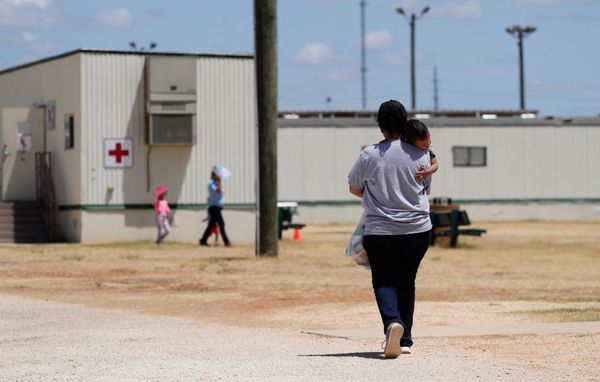
In Arizona in the US, there have been 233 more confirmed cases of Covid-19 in an immigration detention facility.
Immigration and Customs Enforcement (Ice) confirmed the infections at the La Palma correctional center in Eloy, which has so far seen a total of 356 cases, AP reports.
No other facility reported even close to as many cases as La Palma did on Friday, with most detention centres seeing single-digit increases.
There are more than 21,000 people being held in Ice custody on civil immigration violations nationwide.
The Florence Immigrant & Refugee Rights Project, an advocacy group that provides legal services, said the high number of infections underscores the need to release immigrants from detention.
Ice reported 850 new positive cases nationwide on Friday for a total of 5,300 overall cases since the pandemic began.
Updated
The governor of California outlined a new process for the state’s reopening on Friday, hoping that a staggered process will allow the economy to pick up while preventing another virus surge.
“Simple, also slow,” said Gavin Newsom about the new rules that take effect on Monday.
California was the first state in the US to impose a stay-at-home order when the pandemic spread across the United States in March. The state started to re-open by mid-June but was forced to close down many businesses again over the summer amid rising infections. With 700,000 confirmed cases, California has the most confirmed infections in the US.
More on the plan from the Associated Press:
The four-tiered, color-coded system ranks counties based on the number of virus cases and infection rates. Businesses can add more customers or open more services as their county moves into lower tiers.
For example, counties in the most restrictive tier purple can only allow restaurant dining outside. But in lower red, orange and yellow tiers, they can serve people in indoor dining rooms at reduced capacity.
When the new system takes effect, 38 of the state’s 58 counties, including Los Angeles and nearly every other large county, will begin at purple. Only three rural counties will begin in the yellow phase, the least restrictive.
There is no stage established for the return of live event audiences at professional sports and theater and concert venues.
The new system established a benchmark for all counties to allow all types of retail, including indoor shopping malls and hair salons that operate indoors. Counties also can keep stricter rules in place than the state allows and that’s what Los Angeles County officials may do.
Luke Donnellan, the Victorian minister for ageing and carers, is also asked about single households, and he says the decision on that is a matter for the chief health officer
He did say that he had people who were isolated or living alone calling his electorate office and having a chat.
Again on when restrictions can be eased, Andrews says:
“I have used a bushfire analogy many times. If we leave this thing smouldering, it will take off again. We have got to put it out, get it down to such low numbers that we can then lock into a program to ease and then a Covid-normal that will run for many, many months.
“Even within that there will be many rules, whether it is masks, the fact that if you have it you have to stay home for 14 days.”
Andrews is asked if he can comment on reports that the hotel quarantine budget has ballooned by billions of dollars.
“I am not able to comment or confirm it,” he says. “It is not something I have been briefed on.”
Queensland records 4 new cases
Some breaking Queensland news – the state has recorded 4 new cases.
#BREAKING: Queensland has recorded four new cases of COVID-19 in the past 24 hours, all related to the Wacol cluster.
— ABC News (@abcnews) August 29, 2020
Today’s numbers show that the lockdown “is working”, Andrews says.
“[Victorians] they should be positive, the numbers are coming down,” he says.
“I am very pleased to see the strategy is working and I am very grateful and very proud of every Victorian who is working so hard to make this strategy work.”
Daniel Andrews says Victorians should not expect dramatic changes to restrictions in 14 days
Andrews says Victorians should not expect drastic changes in 14 days, when the current stage-four restrictions are scheduled to end.
“I don’t want to be in any way negative about this but I think most Victorians know and understand while they would like to flick a switch on the 14 September and simply go back to absolute normal, that is not going to be possible,” he said.
“We are going to have to ease back into that Covid normal and indeed find that Covid normal, and find it such as a way that is sustainable.”
He adds that it could be “deep into 2021” before a vaccine is ready.
Updated
Cases need to drop to 'the lowest number we can get' before restrictions ease, Andrews says
Andrews is now asked about any potential “next stage” of eased restrictions.
“We will make announcements when the data, when the science of this allows us to ... It is frustrating, I completely appreciate that, that is the nature of this virus, it is very, very difficult to plan ahead.
“[But] something that is as wildly infectious as this, but certainly even at 94 cases, we are not able to open up now, and we are not able to provide a detailed roadmap with the sort of certainty that I would want.
“We still have, we still have to see further days of these numbers dipping, and we want them to come down to a very low number, the lowest number we can get them to, because that will mean we can have much greater confidence that we can stay on top of this and open up.”
He then adds: “We are not seeking three months of zero, it is not tied to that.
“But what we have seen and what we know all too well, all of us, is that what might be a handful of cases, if you are to open too early, then they don’t stay handful too long, they become many many hundreds and indeed thousands of cases.”
Updated
Andrews addresses a mooted idea of a “single household bubble”, which the chief health officer, Brett Sutton, said was under consideration last night.
Yes. We know it’s really hard. It’s being talked through and under active consideration. https://t.co/TBupsN6GOJ
— Chief Health Officer, Victoria (@VictorianCHO) August 28, 2020
That would mean people who live on their own could still visit people they don’t live with, if they nominate them or a small number of people.
Andrews says it’s still too early to finalise this.
“I know there has been a lot of feedback from people who live on their own, people without others in their household are doing it tough.
“These numbers today are clear evidence the strategy is working, to be under 100. We want to continue to drive those numbers down of course. If we want to open up even with 94 cases per day than it would not take too long before it would not be 94, it would be a much bigger number ... so we don’t want that, it is a bit early for us to finalise.
“But we are looking very closely at that because we do know, we have had a lot of feedback, that this is particularly challenging for those who live on their own”.
Updated
Andrews also says there are 13 extra suburbs that are subject to water quality alerts, after a power outage, caused by storms, at a water treatment plant.
“Boiled water notices remain in place for around 200,000 households,” he says. “That is 101 suburbs. South East Water has identified 13 extra impacted suburbs, in addition to the 88 suburbs that were identified by Yarra Valley water.
“At this stage, people in those impacted suburbs, those 101 suburbs, should bring their water to a rolling boil before drinking. So before drinking, preparing beverages and preparing food, baby formula, brushing teeth or making ice.”
Andrews also says there have been 3000 calls to the state emergency service due to storms overnight in Victoria.
There are still 13,000 homes and businesses without power.
Updated
There are 43 active cases in disability facilities, Andrew says – 29 staff members and 14 residents. There are 1,305 active cases in aged care.
Andrews says there are 411 healthcare workers who have Covid-19, which shows “stability and a steady decline” in the total active cases.
He also says active cases in regional Victoria are coming down.
There are 4,223 cases of unknown origin.
Updated
Victorian premier Daniel Andrews is speaking now.
He says 16 of the 18 deaths reported today are linked to aged care outbreaks. There are 481 Victorians in hospital, 26 of whom are in intensive care, and 17 of those in hospital are on ventilators.
NSW records 14 new cases of Covid-19
New South Wales has recorded 14 new cases in the 24 hours to 8pm last night, 13 of which were locally acquired.
Ten are linked to a known case or cluster and three are under investigation.
Eight of the new cases are linked to the growing Sydney CBD cluster. Three people attended the City Tattersalls Club, three more were close contacts of people who had attended the club and two people are household contacts.
“NSW Health is investigating whether the CBD cluster originated in the City Tattersalls Club and then spread to workplaces in the city and to households across Sydney and the Central Coast,” the department said.
“NSW Health is asking anyone who attended the Club between 4 August 2020 – 18 August 2020 to get tested for Covid-19 and isolate until a negative test result is received.”
Genomic sequencing has shown that the CBD cluster is related to other NSW outbreaks, and not related to the Marriot Hotel security guard, whose strain came from overseas.
Updated
Victoria police also have this updated statement on an anti-lockdown protest rally that was held yesterday.
One man was arrested and 19 people were fined.
“A 64-year-old Dandenong man was arrested for failing to provide his name and address for breaching the Chief Health Officer directions,” police said. “He was released after providing identification and issued with a penalty notice.
“An event organiser, a 48-year-old Dandenong man, was arrested at a residential address in Dandenong for breaching the chief health officer’s directions.
“He was charged with contravene bail conditions and breach chief health officer directions and was remanded to appear at Melbourne magistrates’ court on 29 August.
“Police are continuing to investigate Friday evening’s protest activity and will consider issuing penalty notices for anyone else found to be in breach of the directions issued by the chief health officer.”
Updated
In the past 24 hours, Victoria police have issued 195 fines, including 27 for failing to wear a mask and 66 for curfew breaches.
That includes “two men and a woman [who] were found at a home in Boroondara after the resident invited friends around for drinks to watch the football.
“The resident attempted to hide the visitors letting them try and flee over a back fence. One of the men was found hiding in bushes.”
Victoria’s press conference today will be at 11.15.
Mexico records 5,824 new cases and 552 new deaths
Mexico’s health ministry on Friday has reported 5,824 new confirmed cases of coronavirus infections and 552 additional fatalities, bringing the total in the country to 585,738 cases and 63,146 deaths.
The government has said the real number of infected people is likely significantly higher than the confirmed cases, Reuters reports.
Great exclusive here from my colleague Michael McGowan:
Federal Nationals MP Anne Webster has quietly launched defamation action against an Australian conspiracy theorist who claimed, without any factual basis, the MP was “a member of a secretive pedophile network” who had been “parachuted into parliament to protect a past generation of pedophiles”.
Within weeks of the case being filed, Justice Michael Wheelahan made urgent orders for the defendant to remove the posts, labelling them “vile” and describing the legal action as “one of those exceptional cases” where the court could order the removal of the allegedly defamatory material before a trial.
Updated
In the US, the University of Alabama has reported that an additional 481 students have tested positive for Covid-19, according to AP.
That brings the college to a total of more than 1,000 infections since its students returned to campus.
The additional 481 cases on the Tuscaloosa campus were reported between 25 August and 27 August, with no students hospitalised, according to the university’s own fata.
The UA system chancellor, Finis St. John, said in a statement: “We are closely monitoring our data daily, and we will continue to adjust operations as the situation warrants.
He said every student on university’s three campuses has the option of moving to fully online instruction at any time, remaining either on campus or returning home to continue their course work.
The quick rise in Covid-19 cases on campus prompted action from city and university officials to try to limit student gatherings and off-campus socialising.
The university last week announced a 14-day moratorium on all in-person student events outside classroom instruction. Social gatherings are prohibited on and off campus and the common areas of dormitories and fraternity and sorority houses are closed, according to the new guidelines. Visitors are not allowed in dormitories or sorority and fraternity houses.
On Monday, the mayor of Tuscaloosa ordered bars closed for the next two weeks.
Updated
Queenslanders are waking up today to the reality of extended restrictions after two new cases were diagnosed yesterday in Pimpama.
As of 8am today, restrictions in the Australian state will be extended to the Gold Coast.
Gatherings will be limited to 10 people, meaning that the popular school leavers’ holiday, known as Schoolies, will be cancelled. It was scheduled to start in less than three months.
The state’s premier, Annastacia Palaszczuk, told reporters yesterday: “This is a mass event. It poses a high risk”.
Currently, no more than 10 people can gather in Brisbane, Ipswich, Logan and now the Gold Coast without a Covid-19 safety plan, after an outbreak at a youth detention centre.
Yesterday two residents of Pimpama, who were training at a nearby corrective services centre, were diagnosed with the virus.
Liberal MP Trent Zimmerman has just been on ABC News, where he addressed the sad story from yesterday where a woman’s unborn child died after she waited 16 hours before she could be flown from NSW into Queensland for surgery.
Zimmerman said it was a “tragic human story” due to “decision-making that’s occurred” under Queensland’s Labor premier, Annastacia Palaszczuk.
“We’ve seen the family in Ballina. We saw last night on the news a mum trying to get her daughter with Down syndrome to get urgent medical care in the Gold Coast.”
Labor MP Ed Husic then accused Zimmerman of “politicking”.
“Why didn’t you criticise Gladys’s [Berejiklian] government or Steven Marshall’s government where these things have occurred?” he asked. “When Canberrans were stuck at the border in New South Wales, I don’t think our side criticised Gladys Berejiklian on that issue.”
Updated
New South Wales Health has strongly advised that people from Sydney and the Central Coast should not visit an aged care facility for the next two weeks, as cases rise.
In a statement, the department stressed this was a “precautionary step”, but was spurred by the latest outbreak in the Sydney CBD.
“The current Sydney CBD outbreak involves people who have travelled from multiple areas in the Sydney metropolitan and Central Coast areas,” NSW Health said.
“NSW Health is extending existing visitor restrictions by strongly advising people who live or work in the Greater Sydney metropolitan area and Central Coast to refrain from visiting aged care facilities until 12 September.
“Staff are also requested to wear masks when working in these facilities.
“There is currently no evidence of any cases in aged care residents or staff in aged care facilities in NSW. These are precautionary steps to prevent the entry of Covid-19 into this vulnerable setting.”
Victoria records 18 more deaths and 94 new cases
For those catching up just now, Victoria has recorded 94 new cases of coronavirus and 18 deaths on Saturday morning.
That’s the lowest daily case increase for eight weeks, as the state, and particularly the city of Melbourne live under intense restrictions.
We’re expecting a press conference from Victoria later today.
#COVID19VicData for 29 August, 2020. There were 94 new cases detected in Victoria yesterday, and we are sad to report 18 lives lost. More information will be available later today via our media release. pic.twitter.com/VqT7Ow6FJW
— VicGovDHHS (@VicGovDHHS) August 28, 2020
Hi all, it’s Naaman Zhou here, bringing you the latest coronavirus news from Australia and around the world.
The Australian state of Victoria has just announced its coronavirus case statistics today, happily the lowest total for eight weeks.
Here’s what has happened over the past few hours:
-
Victoria recorded 18 more deaths and 94 new cases of Covid-19, the lowest number of cases in eight weeks, after Queensland extended gathering restrictions to the Gold Coast.
- Canada extended a measure barring most foreign travellers from entering the country to 30 September.
- The White House has dismissed concerns about the possible spread of coronavirus among the large crowd which gathered on the South Lawn to hear president Donald Trump accept the Republican presidential nomination.
-
For the second day in a row, France recorded its worst post-lockdown increase in cases, with 7,379.
- Hungary announced it would close its borders to foreigners from 1 September.
- Italy was considering evacuating dozens of tourists under quarantine in Sardinia to the mainland.
- Turkey suffered the most deaths in a single day since 17 May. Another 36 people died on Friday, while the daily number of new cases again rose above 1,500, according to health ministry data.
- Japan’s prime minister, Shinzo Abe, announced his resignation. The move came amid growing concerns about his health as the country battles its biggest economic slump on record due to the pandemic.
- Indonesia reported its worst increase in new cases for a second successive day.
- It became compulsory to wear a mask anywhere outside in a public space in the French capital.
- Global infections from Covid-19 rose to 24.4m, with deaths totalling more than 832,000.
- India has recorded its highest one-day tally of coronavirus cases, with 77,266 new infections recorded. That’s the second-highest number of cases ever recorded by a single country in one day.
Stay with us for all the latest.
Updated