That’s it for this blog for today (it’s seen enough).
We’ve launched a brand new one at the link below, where my colleagues and I will be bringing you the most important coronavirus news from around the world for the next few hours:
Fact check: Travel restrictions
Trump has repeatedly touted his travel restrictions as evidence that he reacted early to the coronavirus threat. We’ve addressed this several times on the liveblog over the past few weeks, but here we go again...
The administration’s travel policy did not “cut off” all travel from China, as Trump calims. Although non-US citizens were prohibited from entering the country if they had traveled to China within the previous two weeks, American citizens, permanent residents and their immediate family members were exempt. Similarly, Trump’s European travel restrictions exempted citizens, residents and their families. And initially, the restrictions didn’t apply to the UK and Ireland, as well as most Eastern European countries.
Epidemiologists have told the Guardian that these policies likely had little impact, as they were enacted after the virus was already spreading within the US.
Read more:
Donald Trump: “Nobody made a mistake.”
— Olivia Nuzzi (@Olivianuzzi) April 14, 2020
We’ll be listening to Trump’s sad excuses for allowing so many Americans to die for the rest of his life.
— Evan McMullin (@EvanMcMullin) April 14, 2020
“We have an investigation under way on the WHO,” says Trump. The investigation may find that things can be “remedied,” but it might not.
Trump is asked if he would reconsider his decision to cut funding to the WHO if Tedros Adhanom Ghebreyesus was to step down as director general.
“I don’t know the gentleman,” he says. Then he talks again about the WHO’s “support” of China.
“The governors will be very respectful of the presidency. Again, this isn’t me, this is the presidency,” Trump says after being asked about reopening the economy and his claims of authority over the states.
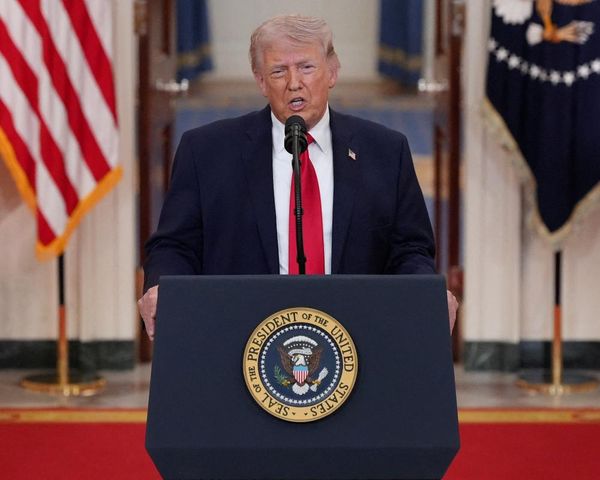
US President Donald Trump is now taking questions. Watch live below:
Updated
In my absolutely darkest moments right after the 2016 election I could not imagine this moment: thousands of Americans dying a day, an economic contraction to rival the Great Depression and Trump just listing off the names of CEOs while congratulating himself for a job well done
— Chris Hayes (@chrislhayes) April 14, 2020
Just a reminder, as Trump reads out an endless – so far – name of private companies, that one in ten working Americans have lost their jobs in this crisis.
Trump has been reading companies and their CEOS who are working with the administration for several minutes, riffing on some of the names. "Just met with Sam!"
— Josh Dawsey (@jdawsey1) April 14, 2020
Wait, why is the president just reading off the names of companies?
— Molly Jong-Fast🏡 (@MollyJongFast) April 14, 2020
If you're looking for stock tips for tomorrow morning here's nearly a minute of Trump reading off the names of random companies and CEOs pic.twitter.com/Z0N0mHxwWe
— Aaron Rupar (@atrupar) April 14, 2020
And pharmaceutical companies.
And tech companies.
“The respect for silicon valley and our tech companies. There’s nobody close to our tech companies.”
Now sports. “We have to get our sports companies. I’m tired of watching baseball games that are 14 years old. But” – he catches himself – “I haven’t had too much time to watch.”
And now he’s thanking individual sports companies.
(He is listing all of these companies by name, but I’ll spare you)
Trump is now thanking everyone from Wolfgang Puck to McDonalds.
And shipping and transportation companies.
And telecommunications companies.
And healthcare companies.
Watch the White House press conference here:
well, now i feel better about things pic.twitter.com/fNKgHr1IlF
— Aaron Rupar (@atrupar) April 14, 2020
Trump is now listing banks that have “been great”. There are too many to list here, but rest assured, Trump is a fan of US banks.
Trump is talking about a saliva-based test. “I call it innovation under pressure,” he says.
Now he is talking about the economy.
“There’s never been an economy like we had.”
“Just over a month ago we set records nobody has ever set.”
“The plans to reopen the economy are close to finalised and we will soon be sharing details.”
Now onto the states:
“I will be speaking to 50 governors shortly and I will be authorising each governor to implement a re-opening plan,” he says – according to the appropriate conditions. That’s a bit of a relief - that he doesn’t plan to use what he yesterday called “absolute power” (which he does not have) to force states to reopen.
One day after (falsely) claiming he has "total authority" to reopen states, Trump has walked that back and is now saying he'll merely consult with individual governors about when they'll get their economies up and running again pic.twitter.com/yNB7BClkfD
— Aaron Rupar (@atrupar) April 14, 2020
Ha. Trump says he will be "authorizing" each governor to reopen their state at the time of their choosing.
— Daniel Dale (@ddale8) April 14, 2020
This isn't his call; he doesn't get to authorize. The power is already theirs.
He says there are 20 states “in fairly good shape” which should be able to reopen soon.
And he’s back onto the ventilators:
Every time he says ventilator, drink. Unused ventilators, two shots. #TrumpPressConf #Ventilator
— Brian Cogan (@TheBrianCogan) April 14, 2020
Updated
Adam Boehler, a friend of Jared Kushner and administration official spoke briefly at the podium. “There are over 60,000 ventilators at hospitals that are not in use,” he said —so the government has launched a program to move ventilators where they’re needed. “There has been no American who has needed a ventilator that hasn’t recieved one,” Boehler said.
We’re working on fact-checking Boehler’s absolute claim. In the meantime, here’s what we know about ventilator shortages in the US:
It is true that some states, so far, have ended up with more ventilators than they originally projected they would need. California has loaned 500 ventilators to states like New York. California hospitals managed to increase their stock from 7,500 machines to more than 11,000, according to the state’s governor, Gavin Newsom. “That has put less strain and pressure on the state’s effort to procure additional ventilators,” Newsom said.
However, that doesn’t mean that there isn’t a national shortage. The US has roughly 173,000 ventilators, according to the Center for Health Security at Johns Hopkins University. Experts from Harvard Medical School predict that the US could end up needing 31 times that number to treat coronavirus patients.
An article in the New England Journal of Medicine published on Wednesday 25 March categorically concluded that the US does not have enough ventilators to treat patients with Covid-19 in the coming months.
Trump is calling on various members of of his “Dynamic Ventilator Reserve” to sing his praises now.
The reserve is a public-private partnership with health CEOs:
President Trump unveils the “Dynamic Ventilator Reserve”
— Chanel Rion OAN (@ChanelRion) April 14, 2020
Presents top Health CEOs from across America.
Private Public partnership creating a database to ensure areas that need ventilators will always have them. pic.twitter.com/MA1u20WgSY
You can get in touch with me directly on Twitter @helenrsullivan with tips, tweets, news and questions.
Here is the 14 January WHO tweet criticised by Trump:
Preliminary investigations conducted by the Chinese authorities have found no clear evidence of human-to-human transmission of the novel #coronavirus (2019-nCoV) identified in #Wuhan, #China🇨🇳. pic.twitter.com/Fnl5P877VG
— World Health Organization (WHO) (@WHO) January 14, 2020
Updated
Trump is announcing that his administration is partnering with hospitals across the country to create the “dynamic ventilator reserve” to ensure there is never the threat of a shortage of ventilators again.
Trump calls Andrew Cuomo's ventilator requests "ridiculous" and then attacks President Obama, who left office in 2017, for the fact the national ventilator stockpile was depleted in 2020 pic.twitter.com/RofWikafHL
— Aaron Rupar (@atrupar) April 14, 2020
Trump also criticised the WHO for praising China’s “transparency”.
But the president himself praised China’s transparency — on January 24:
China has been working very hard to contain the Coronavirus. The United States greatly appreciates their efforts and transparency. It will all work out well. In particular, on behalf of the American People, I want to thank President Xi!
— Donald J. Trump (@realDonaldTrump) January 24, 2020
Fact check:
Trump said that the WHO at some point implied that the coronavirus was “not communicable” — there is no evidence that the organization did that.
He also said “there was credible” information in December to suspect human-to-human transmission and the WHO did not respond appropriately. “So much death has been caused by their mistakes,” he said.
But Trump himself ignored and undermined the severity of the crisis well into March.
The president was warned at the end of January by one of his top White House advisers that coronavirus had the potential to kill hundreds of thousands of Americans and derail the US economy, unless tough action were taken immediately, new memos have revealed.
The memos were written by Trump’s economic adviser, Peter Navarro, and circulated via the National Security Council widely around the White House and federal agencies. They show that even within the Trump administration alarm bells were ringing by late January, at a time when the president was consistently downplaying the threat of Covid-19.
Moreover, the US intelligence community, public health experts and officials in Trump’s own administration had warned for yearsthat the country was at risk from a pandemic, including specific warnings about a coronavirus outbreak.
An October 2019 draft report by the Department of Health and Human Services, obtained by the New York Times: “drove home just how underfunded, underprepared and uncoordinated the federal government would be for a life-or-death battle with a virus for which no treatment existed,” the Times reported.
Fact check: WHO
Trump has accused the WHO of “severely mismanaging and covering up” the coronavirus crisis.
The WHO has been criticized for a 14 January tweet, which Trump has referenced, that noted that a preliminary investigation by Chinese officials found no evidence of human-to-human transmission. However, by 30 January, the organization declared coronavirus a “public health emergency”, and went on to declare a pandemic on 11 March after numerous countries - including the US and UK - failed to follow its advice. WHO director-general Tedros Adhanom Ghebreyesus spoke of “alarming levels of inaction” from many countries.
The WHO “has been drained of power and resources”, said Richard Horton, editor of the influential medical journal the Lancet. “Its coordinating authority and capacity are weak. Its ability to direct an international response to a life-threatening epidemic is non-existent.”
The Trump administration and the president himself repeatedly played down the crisis - specifically downplaying the threat to the US, inaccurately compared it to the flu and told his supporters that growing worries about the coronavirus was a “hoax”.
By the time Trump announced travel restrictions from China on 31 January, most major airlines had already suspended flights, following the lead of several major international carriers that had stopped due to the outbreak. In late February, the president said the spread of Covid-19 in the US was not inevitable and the danger to Americans “remains very low”. He predicted that the number of cases diagnosed in the country, just 15 that time, could fall to zero in “a few days”.
Updated
Trump hitting another talking point now: ventilators.
“The scariest day of my life so far,” says Trump, was when he was told the country was short “hundreds of thousands of ventilators. This is the system we inherited.”
As he has done repeatedly over the course of the pandemic, Trump is boasting about his decision ti impose travel bans.
Now, he is again being critical of China.
“The WHO pushed China’s misinformation.”
“So much death has been caused by their mistakes”
“For the time being we will redirect global health and work directly with others. All of the aid we send will be discussed at very powerful levels.”
Watch the briefing live here:
Trump is expanding on his decision to temporarily cut funding to the WHO. Just a note that we will be fact checking these claims.
We have deep concerns whether America’s funding is being used in the best way possible, he said.
“The WHO failed to obtain, vet and share information,” and they “failed to investigate credible reports in China,” he says.
“They parroted and publicly endorsed the idea that there was not human to human transmission despite evidence to the contrary”
Had the WHO done its job to get medical experts into China to objectively assess the situation of the ground and to investigate China’s claims, he says, it would have saved countless lives and economic damage.
Trump says he will today instruct administration to halt WHO funding
Hi, Helen Sullivan with you now for another White House Press Briefing.
“Today I am intructing my administration to halt funding for the World Health Organization”, Trump has just said.
We’ll bring you more shortly.
The northern Nigeria economic powerhouse state of Kano will impose a seven-day lockdown, a spokesman for the governor has said. The country has recorded 373 cases and 11 deaths.
Starmer warned the “silent pressures” on communities across the UK “cannot be underestimated” and said that, to maintain morale and hope, people “need a sense of what comes next”.
He urged Raab to commit to setting out the criteria the government will use to inform how and when it intends to ease the lockdown; to publish the exit strategy now or in the coming week; and to outline the sectors and core public services that are most likely to see restrictions eased.
A government source has told the Press Association: “Our strategy is focused on saving lives. We have been clear that all decisions will be guided by the scientific advice and data. Talk of an exit strategy before we have reached the peak risks confusing the critical message that people need to stay at home in order to protect our NHS and save lives.”
The UK government is being urged to publish its lockdown exit strategy this week.
The leader of the opposition Labour party, Sir Keir Starmer, has written to Dominic Raab, who is deputising for the prime minister, to say his party would support an extension – but that ministers need to explain their plan.
The question for Thursday, therefore, is no longer about whether the lockdown should be extended, but about what the government’s position is on how and when it can be eased in due course and on what criteria that decision will be taken.
Ministers have argued that now is not the time to talk about this. I profoundly disagree. Overcoming this crisis requires taking the British public with you.
Millions of people have played their part and exceeded government assumptions about their willingness to make sacrifices and to stay at home in the national interest.
In return, the government needs to be open and transparent with the public about how it believes the lockdown will ease and eventually end, how this decision will be informed and what measures are being put in place to plan for this eventuality.
Amazon has fired two employees after they publicly denounced the company’s treatment of warehouse workers during the pandemic.
Emily Cunningham and Maren Costa said they were fired after internally circulating a petition about health risks for Amazon warehouse workers during the Covid-19 crisis. Costa had worked at the company for more than 15 years and Cunningham had been an employee for more than five. Costa said:
I don’t regret standing up with my co-workers. This is about human lives, and the future of humanity. In this crisis, we must stand up for what we believe in, have hope, and demand from our corporations and employers a basic decency that’s been lacking in this crisis.
AFC Bournemouth have become the latest English Premier League club to reverse their decision to furlough members of their non-playing staff.
The south-coast club said they were “aware of criticisms of Premier League clubs applying for this scheme” during the suspension to the football season caused by the coronavirus pandemic.
We have listened to our supporters and have reversed our decision to furlough these employees.
Liverpool and Tottenham have also reversed their initial moves to make use of the government’s job retention scheme, which covers the cost of 80% of the salaries of furloughed staff, up to £2,500 per month for each employee.
In the UK, a mobile phone mast serving the emergency NHS Nightingale hospital in Birmingham is one of the latest targeted by arsonists who wrongly believe 5G technology is linked to the spread of coronavirus, Mark Sweney and Jim Waterson write. Nick Jeffery, the chief executive of Vodafone UK, said:
Burning down masts means damaging important national infrastructure. In practice, this means families not being able to say a final goodbye to their loved ones; hard-working doctors, nurses, and police officers not being able to phone their kids, partners or parents for a comforting chat.
In Germany, local media are reporting that zoos are making contingency plans, including killing some of the animals, should the lockdown continue without a solution to their financial troubles.
Neumünster Zoo’s director has told Die Welt they have “listed the animals we will have to slaughter first” and said some may even have to be fed to others. But even such drastic plans would not be sufficient to solve the problem.
Verena Kaspari told the paper the step would be a last resort and “unpleasant”. She referred to the plight of the piscivorous animals and added: “If it comes to it, I’ll have to euthanise animals, rather than let them starve.”
US intelligence indicates the virus likely occurred naturally, as opposed to being created in a Chinese laboratory – but there is no certainty either way, the chairman of the joint chiefs of staff has said.
The remarks by US army General Mark Milley could fan speculation about the virus’ origins; something China has dismissed as a conspiracy theory that is unhelpful to the fight against the pandemic.
Asked whether he had any evidence that the virus perhaps began in a Chinese laboratory and was perhaps released accidentally, Milley was non-committal at a Pentagon news briefing.
There’s a lot of rumour and speculation in a wide variety of media, the blog sites, etc. It should be no surprise to you that we’ve taken a keen interest in that and we’ve had a lot of intelligence take a hard look at that.
And I would just say, at this point, it’s inconclusive although the weight of evidence seems to indicate natural. But we don’t know for certain.
British charities have said thousands of homeless people are still on the streets despite the government’s aim to house all rough sleepers by the end of last month.
Local authorities in England were urged to find accommodation for all rough sleepers by 29 March, to protect them during the pandemic.
But a coalition of charities, including Streets Kitchen, StreetVet, The Outside Project, Simon Community and the Museum of Homelessness, believe as many as 20% of homeless people could still be sleeping rough.
It is also believed one in 10 rough sleepers will or have been refused accommodation because they have pets.
The organisations have called for all homeless people to be housed, allowed to keep their pets while in accommodation and to be provided with adequate protective equipment and support. John Glackin, of Streets Kitchen, said:
We understand around 20% of homeless people in England have yet to be housed - which equates to tens of thousands of people.
However, we suspect the real figure is much higher from the amount of people we’re still feeding out on the streets.
The International Monetary Fund views its $1tn (£790bn) in lending capacity as “quite substantial” to help members deal with the pandemic, but believes further resources may be needed as the full brunt of the crisis reaches developing countries.
Its chief economist, Gita Gopinath, has told Reuters that 100 of the 189 members – of whom half are low-income countries – have now contacted the global lender about receiving emergency funding to beef up their efforts to contain the outbreak vand mitigate its economic impact.
She welcomed an agreement by international creditors to suspend debt payments for the poorest countries through the end of the year as a “very, very good step”, but said debt relief measures might have to be extended into 2021 since the worst of the pandemic’s effects had not yet been felt in many of the poorest countries.
Updated
The European commission plans to narrow controls on the export of protective equipment to just a single product – masks – as well as exempt the countries of the western Balkans from the restrictions.
The EU executive, which oversees trade policy for the 27 EU member states, has set out a draft regulation to apply for 30 days from 26 April. The adjustments were designed to meet the EU’s global commitments in tackling the pandemic.
The bloc’s current restrictions apply to protective spectacles and visors, face shields, protective garments, gloves, as well as mouth and nose masks. These products can only be exported to a non-EU country with an authorisation granted by individual EU countries. The restrictions were due to run from 15 March to 25 April.
Rio de Janeiro’s governor, Wilson Witzel, has announced he has tested positive; one of the highest profile politicians to be struck down by the illness in Brazil.
In a Twitter video, the 52-year-old politician said he had been feeling ill since last Friday and had been suffering a temperature, a sore throat and loss of smell.
NOTA OFICIAL pic.twitter.com/NCl7WlPH9v
— Wilson Witzel (@wilsonwitzel) April 14, 2020
“I’m sure I will overcome this difficulty. You can all count on me ... to keep working,” Witzel said, repeating his plea for Rio state’s 17 million residents to stay at home. “As you can see this illness can target anyone and infection happens quickly.”
The US president, Donald Trump, will hold a video teleconference with G7 leaders on Thursday to coordinate national responses to the pandemic, the White House has said.
Trump, who is head of the G7 this year, had to cancel the group’s annual summit, which he had planned to hold at the presidential retreat of Camp David, Maryland, in June.
The Group of Seven nations include the United States, France, Britain, Italy, Canada, Japan and Germany, and all seven of them have been hit hard by the outbreak. The White House spokesman, Judd Deere, said:
Working together, the G7 is taking a whole-of-society approach to tackle the crisis across multiple areas, including health, finance, humanitarian assistance, and science and technology.
France summons Chinese envoy
France’s foreign minister has summoned the Chinese envoy after the embassy published a second article on its website criticising western handling of the coronavirus crisis. Jean-Yves Le Drian said:
Certain publicly voiced opinions by representatives of the Chinese embassy in France are not in line with the quality of the bilateral relation between our two countries.
The latest comments on the embassy’s website, which in part suggested western countries have left their pensioners to die in nursing homes, come after France ordered millions of masks from China to curb a shortage in the country.
The US State Department has reported the first fatality among the staff at its Washington headquarters, bringing the total death toll in its global workforce due to the outbreak to five. William Walters, the deputy chief medical officer for operations in the Bureau of Medical Services, said:
The individual passed over the weekend. He was hospitalised for some time fighting the coronavirus.
Walters said that the civil servant had been out of the office for more than two weeks. He did not provide further details including in what role the individual served at the State Department, citing privacy issues.
Summary
Here are the latest headlines from our Covid-19 coverage so far on Tuesday.
- The International Monetary Fund slashed its forecasts for global growth and warned of a slump in output this year unparalleled since the Great Depression of the 1930s. It said the “Great Lockdown” is likely to cause a drop in activity more painful than the recession that followed the banking meltdown of the 2008.
- A further 778 deaths were recorded in UK hospitals taking the total to at least 12,107. The true extent is likely to be greater because the data do not include deaths in other settings and many hospitals are still collating figures from the bank holiday.
- “We think we are at the apex,” the New York governor, Andrew Cuomo, announced after the state recorded a small decrease in its the number (1,600) of new patients coming into New York hospitals on Monday.
- Italy, Spain and Austria allowed partial returns to work as countries across Europe report further falls in new cases and begin taking the first cautious steps out of lockdown to revive their battered economies.
- Global cases passed 1.9 million, according to researchers at Johns Hopkins University, whose tally showed at least 1,945,055 people have been infected and 121,897 have died since the outbreak began.
- Britain’s economy could shrink by 35% and unemployment rise by more than 2 million people due to the crisis, the official economics forecaster, the Office for Budget Responsibility warned, as it forecast a 13% fall in GDP for 2020.
- Mary Lou McDonald, the leader of Ireland’s Sinn Féin party, tested positive for Covid-19. She says she is no longer deemed to be infected or infectious and hopes to return to work next week. She was tested on 28 March and got the result on Monday, a two-week wait reflecting delays and glitches that have plagued testing in Ireland.
- Vladimir Putin warned Russians to brace for an “extraordinary” crisis. As Moscow tightened its lockdown measures, Russia reported its highest daily infection figures yet.
That’s it from me, Damien Gayle, I’ll be with you again tomorrow.
Updated
The Czech Republic is the latest to announce plans to ease its lockdown, with a five-stage plan to remove restrictions beginning on 20 April and ending on 8 June, AFP reports.
An EU member of 10.7 million people, the Czech Republic registered 6,101 confirmed cases of the virus on Tuesday evening, including 161 deaths. “The epidemic is showing a downward trend,” the deputy health minister, Roman Prymula, said.
Outlining the plan to reopen the country, the deputy prime minister, Karel Havlíček, told reporters:
The scenario reckons with the coronavirus being under control as is currently the case. There might be changes.

Havlíček said that first in line to reopen on 20 April would be open-air markets and crafts and trades with workshops, like shoe repairs or dressmakers. Weddings with up to 10 people will also be allowed and professional athletes will be able to train in smaller groups.
Smaller shops that are not located in shopping malls will be able to do business again as of 27 April. Larger shops outside shopping malls and fitness centres without dressing rooms will open on 11 May, while restaurants and pubs will be allowed to serve their products in outdoor beer gardens from 25 May.
On the same day, the government will open hairdressers’ and cosmetics salons, museums, galleries and the outdoor parts of zoos.
Shopping malls, restaurants, pubs, hotels, theatres, castles, zoos, and cultural and sports events up to 50 people as well as larger weddings will be back as of 8 June.
The education minister Robert Plaga said the government would start re-opening schools and universities gradually from 20 April, but added that they probably would not open fully before the summer holidays starting on 1 July.
Updated
António Guterres, the UN secretary general, has announced an initiative to “flood the internet with facts and science”, in an effort to counter the growing spread of misinformation about the coronavirus outbreak.
As the world fights #COVID19, we are also fighting an epidemic of harmful falsehoods & lies.
— António Guterres (@antonioguterres) April 14, 2020
I'm announcing a new @UN Communications Response initiative to spread facts & science, countering the scourge of misinformation - a poison putting more lives at risk. pic.twitter.com/3S8KZDjbcb
762 more Covid-19 deaths in France
Health authorities in France have reported 762 new deaths from coronavirus, including 559 in hospitals and 221 in care homes.
In total the number of confirmed cases reported by France is 103,573, up 5,497 in the past 24 hours. The total death toll stands at 15,729, while 28,805 have so far recovered.
The number of people in intensive care has fallen for the sixth day, down to 6,730, from 6,821 on Monday.
Health authorities in Poland on Tuesday reported 270 new confirmed cases of coronavirus and 18 more deaths in the past 24 hours, as the country’s health minister said the government would begin to “slowly defrost” the economy from the end of this week.
The total number of confirmed cases in Poland now stands at 7,202, with 263 deaths. With the numbers of new infections slowing in recent days, the health minister, Łukasz Szumowski, said the isolation had proved effective, but “if the economy does not move, if we have a tragedy and economic collapse, people will die of other oncological diseases, rare diseases.” (Thank you Google Translate...)
Current restrictions on shopping malls, cinemas, theatres, hairdressers and beauty parlours are due to end on Sunday, while schools and kindergartens are due to reopen the following week, local media report.
However, even as plans are being made to end Poland’s lockdown, the Polish health ministry announced that from Thursday face masks would become mandatory in public.
❗️❗️Od 16 kwietnia każda osoba przebywająca w miejscu publicznym będzie miała obowiązek zasłaniania ust i nosa ❗️❗️ 😷 #koronawirus pic.twitter.com/Iq03D7NE9s
— Ministerstwo Zdrowia (@MZ_GOV_PL) April 14, 2020
Updated
Canada shutdown 'going to be weeks still'
Justin Trudeau has warned that Canada’s economic shutdown is likely to remain in place for weeks, as coronavirus infections continue to climb across the country, writes Leyland Cecco in Toronto.
The prime minister said on Tuesday:
I know people are interested in when things will go back to normal. The reality is, it’s going to be weeks still. It is going to be important to get our economy going – but we’re going to have to remain vigilant until such a time as a vaccine is found.
Trudeau’s measured comments come in stark contrast to Donald Trump, who has grown increasingly frustrated with the protracted slowdown of the American economy and has clashed with state governors over deciding when measures will ease.
As of Tuesday, Canada had recorded more than 26,100 cases of the coronavirus and 823 deaths, many of which happened at long-term care facilities.
Updated
Here’s more detail on the Covid-19 situation in Ireland today, courtesy of the Irish department of health’s Twitter feed.
#COVID19 #coronavirus
— Department of Health (@roinnslainte) April 14, 2020
Statement from the National Public Health Emergency Team
The Health Protection Surveillance Centre has today been informed that 41 people diagnosed with #COVID19 in Ireland have died.
#COVID19 #coronavirus
— Department of Health (@roinnslainte) April 14, 2020
·36 deaths located in the east, 4 in the west, 1 in the south of the country
·the people included 16 females and 25 males
·the median age of today’s reported deaths is 85
·31 people were reported as having underlying health conditions
There have now been 406 #COVID19 #coronavirus related deaths in Ireland.
— Department of Health (@roinnslainte) April 14, 2020
As of 1pm Tuesday 14th April, the HPSC has been notified of the following cases:
— Department of Health (@roinnslainte) April 14, 2020
·An additional 548 new confirmed cases of #COVID19 reported by Irish laboratories
·An additional 284 confirmed cases of #COVID19 reported by a laboratory in Germany
With the latest figures from Germany included, there are now a total of 11,479 confirmed cases of #COVID19 #coronavirus in Ireland.
— Department of Health (@roinnslainte) April 14, 2020
For more detailed case information data, please visit https://t.co/8Ak2jFalT1
Global airline revenues 'to fall by half'
Global airline revenues are now forecast to drop by more than half - $314bn (£249bn) – in 2020, as the industry warned that its “outlook grows darker by the day”, writes Gwyn Topham, the Guardian’s transport correspondent.
The International Air Transport Association’s (Iata) latest estimate adds a further $62bn of lost revenue from its previous assessment in late March and is almost three times worse than its “worst-case scenario” from five weeks ago, with around 95% of international passenger traffic now lost due to travel restrictions.
The figures would mean a 55% drop in revenue from 2019, as Iata factored in the extension of travel restrictions, a deepening recession and the further spread of Covid-19 to Africa and Latin America. Iata’s director general, Alexandre de Juniac, said:
The industry’s outlook grows darker by the day. The scale of the crisis makes a sharp V-shaped recovery unlikely. Realistically, it will be a U-shaped recovery with domestic travel coming back faster than the international market.
Ireland’s department of health has reported 41 new deaths from coronavirus, and 832 new cases.
#COVID19 #coronavirus
— Department of Health (@roinnslainte) April 14, 2020
Statement from the National Public Health Emergency Team
The Health Protection Surveillance Centre has today been informed that 41 people diagnosed with #COVID19 in Ireland have died.
Department of Health Covid19 press briefing https://t.co/IzseafFL6g
— Department of Health (@roinnslainte) April 14, 2020
Commercial creditors owed money by poor countries should only be eligible for government Covid-19 bailout cash if they agree to sign up to a comprehensive global debt deal, the head of one of the world’s leading charities has said, writes Larry Elliott, the Guardian’s economics editor.
Despite signs that the G20 group of developed and developing nations are edging towards an agreement on help for the most vulnerable nations, Inger Ashing, chief executive of Save the Children International, said the plan would only be fully effective if it included the private sector.
Ashing said in an open letter to the G20 that commercial creditors, such as banks, commodity traders and asset management firms, accounted for almost half the $62bn (£42.2bn) debt payments due to be made by the world’s 75 lowest-income countries in 2020. The letter said:
Commercial creditors account for almost half of scheduled 2020 payments. Allowing them an exemption would weaken any debt-relief initiative. Providing aid through the World Bank and other donors while allowing commercial debt payments to absorb a large share of the transfer would be the financial equivalent of pouring water into a bucket with large holes. To put the figures in context, commercial debt repayments would be equivalent to over half of the emergency Covid-19 financing being prepared by the World Bank for delivery through IDA.
... Official creditors should make it clear that they expect commercial creditors to apply comparable treatment. There are precedents which, if not directly applicable, could serve as a guide. These include the ‘Vienna Initiative’ through which European governments coordinated the response to the 2009 financial crisis. If necessary, governments should encourage participation by making access to special Covid-19 financing programmes conditional on commercial creditors participating in the debt standstill. Faced with a global public health emergency that demands a global financial response, governments must deploy their regulatory powers and financial resources in the interest. The G20 should work with the IMF and World Bank to convene a commercial creditors summit to agree terms for creditor participation in debt repayment suspension.
Updated
The coronavirus lockdown in Uganda has been extended for another three weeks, with the president, Yoweri Museveni, calling on people to be disciplined to avoid spreading infection.
In a lengthy address to the nation on Tuesday, Museveni reaffirmed Uganda’s 35 restrictions to curb the spread of the coronavirus, adding that judging by the comparatively low number of infections in the country - 54 confirmed cases as of Monday - they seemed to have worked. On the extension, he added:
The extra 21 days cannot be a mistake. After those 21 days, the virus will either be totally defeated or we shall be better prepared.
Therefore, I would like to appeal to the Ugandans to observe the prohibitions already announced and summarised above. Stay at home except those carrying cargo, including food; the youth stop going into the trading centres to loiter. Be in the gardens with your parents. This is the season for planting. What are you doing in the trading centres?
... I thank the majority of Ugandans for cooperating and supporting the tough measures we have been announcing eve rsince the 18th of March, 2020. You have seen how much damage this virus has caused in other countries. We should not allow that to happen here.
Museveni said that he made arrangements with the Indian prime minister, Narendra Modi, for India to supply Uganda with hydroxychloroquine, the malaria drug believed by some to help treat Covid-19.
To our doctors and health workers, once again, I salute you for the professionalism. You have been able to heal these initial corona-virus cases and stay free of the virus at the same time. Thank you. pic.twitter.com/F4Y77q2X5H
— Yoweri K Museveni (@KagutaMuseveni) April 14, 2020
A Guardian reader, Julie Green, sent in this description of life in Uganda at the moment:
Everything is pretty much locked down here - no flights in and out, borders all closed, all shops apart from food shops and essentials like pharmacies are closed, those selling food on markets are not allowed to go home and have to sleep by their stall, all public and private transport is banned with only vehicles carrying cargo allowed on the roads.
The boda bodas (motorcycles) can only operate up until 2pm every day (apparently they were being used for criminal activities). In addition, no-one can gather in groups of more than five, and no weddings or funerals etc are allowed. Schools and all educational institutions remain closed as well.
Updated
The number of deaths from coronavirus in Italy rose by 602 on Tuesday, 36 more than on Monday, taking the death toll to 21,067, Angela Giuffrida reports.
Angelo Borrelli, the chief of the civil protection authority, said the number of people who are currently infected rose by 675 (0.6%) to 104,291, the lowest daily increase since 10 March. He said the pressure on hospitals continues to ease, with another daily fall in the number of intensive care beds in use.
To date, there have been 162,488 confirmed cases of coronavirus in Italy, including the victims and 37,130 survivors.

Updated
Health authorities in Serbia have reported 411 new confirmed cases of coronavirus, taking the total in the country to 4,465, Serbian news site Telegraf reports.
The death toll in Serbia from Covid-19 is now 94, after nine more people - seven men and two women - died in the Balkan country in the past 24 hours.
On Tuesday, 3,006 patients were in hospital, with 131 on ventilators.
While taking your dog for a walk may be allowed under Italy’s strict lockdown, a woman in Rome discovered not all animals are equal in the eyes of the law when she was arrested while exercising her turtle, writes David Batty.
The Roman police said the 60-year-old woman was “caught outside her home without a justifiable reason” and fined €400, according to AFP.
Roman police spokesman Nunzio Carbone told the news agency that the turtle was “as big as a pizza” but not wearing a lead.
Sweden's coronavirus death toll passes 1,000
Doctors, virologists and epidemiologists in Sweden have denounced their government’s approach to tackling the coronavirus outbreak, as its death toll from Covid-19 increased by 114 in 24 hours, taking its total past 1,000.
Unlike other parts of Europe, including its close neighbours Finland and Norway, Sweden has not imposed extraordinary lockdown orders to stem the spread of the virus, instead calling for citizens to take responsibility to follow social distancing guidelines. The strictest measures implemented so far have been gatherings of more than 50 people and a ban on visits to nursing homes.
But its soft approach has drawn criticism. On Tuesday Sweden’s public health agency said it had recorded a total of 11,445 confirmed cases of Covid-19 and 1,033 deaths. Neighbouring Finland, which has about half the population of Sweden, had as of Tuesday reported 64 deaths, and has closed down restaurants and schools.
In an open letter, a group of 22 doctors, virologists and researchers from Sweden’s top hospitals, universities and research institutes pointed write:
One would like to imagine that Sweden has also had a forward-looking strategy, especially as our country has always had a different way of dealing with the spread of infection than the rest of the world. One would like to imagine that our authorities have prepared well since the epidemic broke out in China, and especially since it was clear that the problem was likely to be global.
… If there was a well-thought-out, well-functioning strategy for Swedish infection prevention work with Covid-19, Sweden would hardly have the same death toll as Italy today, and 10 times higher than Finland’s. If there had been a well-developed, well-functioning strategy, half of Stockholm’s elderly residents would not have been affected by the epidemic - and in some cases over 20% of the healthcare staff would be antibody positive.
… The approach must be changed radically and quickly. As the disease-free virus spreads, it is necessary to increase social distance. Close schools and restaurants in the same way you do in Finland. Everyone who works with the elderly must wear adequate protective equipment. Prior to mass testing of infectiousness on all caring staff and testing for antibodies to sars-covid-2 so that established immune personnel can return to work. Require quarantine by the whole family if a member is ill or tests positive for viruses. Impress in society that anyone can be contagious.
Updated
New York 'at the apex' of outbreak says governor
New York saw a small decrease in its coronavirus hospitalisations yesterday, the state’s governor, Andrew Cuomo, announced at his daily briefing.
America’s worst-affected state recorded a “small tick down” in hospitalisations, Cuomo said, but the number was basically flat.
He said the change was “statistically irrelevant, but better than being up.”
“We think we are at the apex,” Cuomo said, while noting that 1,600 new people came in to New York hospitals yesterday. The decrease is attributed to people recovering from coronavirus and being discharged.
Follow live updates of Cuomo’s daily press conference on our US-focused coronavirus live blog.
Updated
Positive news from Taiwan, where health authorities have reported no new cases of coronavirus for the first time in 36 days, according to Channel News Asia.
The island, which has strong cultural links with China, was hit early by the coronavirus but managed to keep initial infections low and stop the disease spreading locally. Checks on passengers from China began there on 31 December - the same day the new virus was first reported by Chinese authorities to the World Health Organization.
Taiwan then suffered a second wave of cases as nationals returned home from overseas, but the latest figures offer hope that authorities have managed to bring it under control.
Pictures from Taipei showed that – unlike most of the rest of the world – life continues pretty much as usual, save for the now ubiquitous face masks.
Taiwan has so far reported 393 confirmed cases and six deaths.

Updated
Health officials in Kenya say the coronavirus outbreak in the country is beginning to move out of urban centres and into more rural areas.
On Tuesday, Dr Mercy Mwangangi, chief administrative secretary for health, said eight new confirmed cases of coronavirus had been detected, bringing the country’s total to 216.
The health ministry has published more details on its Twitter feed.
Kenya is beginning a crucial phase in our battle against COVID-19 pandemic. We are witnessing a phenomenon where the virus is increasingly moving to the counties; Dr. Mercy Mwangangi, CAS Health.#KomeshaCorona update pic.twitter.com/KNSDZVAIO9
— Ministry of Health (@MOH_Kenya) April 14, 2020
In the last 24 hours, we have tested 694 samples. Out of these samples, 8 have tested positive for Coronavirus disease, bringing to 216 the total number of confirmed cases in the country; CAS Dr. Mwangangi.#KomeshaCorona update pic.twitter.com/8dUGQT6L8s
— Ministry of Health (@MOH_Kenya) April 14, 2020
The new cases counties of residence;
— Ministry of Health (@MOH_Kenya) April 14, 2020
✅Nairobi 6, Siaya 1 & Nakuru 1.
✅5 are Kenyans, 1 Briton, 1 Pakistani & 1 Ugandan.
✅6 have a history of travel from UAE, UK, Pakistan, Zambia & Comoros.
The disease is affecting the most productive group of our society. #KomeshaCorona pic.twitter.com/zHTTleQo03
#COVID19 cases per county;
— Ministry of Health (@MOH_Kenya) April 14, 2020
Nairobi 101, Mombasa 34
Kilifi 10, Kiambu 7
Mandera 6, Machakos 6, Nakuru 5, Kisii 1, Kitui 2, Laikipia 2, Kajiado 2, Muranga
2, Homa Bay 1, Kakamega
2, Nyamira 1, Nyandarua
2, Nyeri 1, Siaya 2 Uasin Gishu
2, Vihiga 1, Kwale 1#KomeshaCorona update pic.twitter.com/sYI1WzctMW
Updated
This is Damien Gayle back at the controls. Do send any tips or news that we might have missed to me at damien.gayle@theguardian.com, or via Twitter DM to @damiengayle.

Updated
Singapore’s health ministry has confirmed 334 more coronavirus infections, taking its tally to 3,252.
Most of the new cases were linked to outbreaks in migrant workers’ dormitories, the ministry said. None have come into the city state from overseas.
According to the Straits Times, at least 15 dormitories have emerged as infection clusters, with eight placed in isolation so far. About 7,000 healthy foreign workers have been relocated to temporary housing.
As of 14 Apr 2020, 12 pm, 25 more cases of COVID-19 infection have been discharged from hospitals or community isolation facilities. In all, 611 have fully recovered from the infection and have been discharged. https://t.co/QJeGY4qYiU
— Ministry of Health (@sporeMOH) April 14, 2020
As of 14 Apr 2020, 12pm, we have confirmed and verified an additional 334 cases of COVID-19 infection in Singapore. Of these,128 are linked to known clusters, 22 are linked to other cases, 114 are pending contact tracing. https://t.co/QJeGY4qYiU
— Ministry of Health (@sporeMOH) April 14, 2020
Contact tracing and investigation are underway for currently unlinked cases to establish any links to known clusters or previous cases. In the past week (7 April to 13 April), MOH has uncovered links for 342 previously unlinked cases. https://t.co/QJeGY4qYiU
— Ministry of Health (@sporeMOH) April 14, 2020
Of the 1,315 confirmed cases who are still in hospital, most are stable or improving. 28 are in critical condition in the intensive care unit. https://t.co/QJeGY4qYiU
— Ministry of Health (@sporeMOH) April 14, 2020
Deportation flights from the United States to Guatemala began again on Monday after a one-week pause prompted by three deportees testing positive for coronavirus.
The Guatemalan government had asked the US not to send more than 25 deportees per flight, to give them health exams before departure and to certify that they were not infected.
Despite these guidelines, there were 76 migrants on the first flight and 106 on the second, PA reports.
At least three of the migrants who arrived on Monday were taken directly to a hospital for Covid-19 testing. One of the flights also included 16 unaccompanied minors, according to the Guatemalan Immigration Institute. Citing the epidemic, the US has started swiftly deporting unaccompanied minors rather than holding them in protective settings as specified by law.
The flights were the same day that the US state department announced that aid would continue to Guatemala and the other Northern Triangle countries.
Updated
As the number of fatalities in long-term care homes continues to rise, the outspoken premier of Canada’s most populous province says the tragedy hits close to home.
“It breaks my heart watching [my wife] Karla stand outside the window in tears,” Ontario’s premier, Doug Ford, told reporters on Monday. The conservative leader’s mother-in-law lives at the West Park long-term care home in a suburb of Toronto. The facility has had at least five coronavirus-related deaths. “And there’s thousands of families in the same position, wishing they could jump in there and help their loved one in there.”

Canada’s chief public health officer has warned that the tragedy will probably continue to worsen. “Almost all jurisdictions are essentially trying to deal with the outbreaks in long-term care facilities,” Dr Theresa Tam said on Monday. “Even as the numbers of cases slows down, the number of deaths, unfortunately, are expected to increase.”
In recent days, the devastating scope of the virus in care homes across the country has become clear. In Montreal, 31 people died at a retirement facility, whose owners are accused of withholding medical files from provincial authorities and whose staff are alleged to walked off the job. In the Ontario town of Bobcaygeon, 29 people died at Pinecrest Nursing Home, which houses 65 residents.
To date, more than 350 Canadians in retirement homes have died from the virus, making up nearly half of the 780 deaths across the country.
Updated
A US federal appeals court panel has ruled that medication abortions, in which pills are taken to terminate a pregnancy, can be provided in Texas during the coronavirus pandemic.
The Texas Republican governor, Greg Abbott, issued an executive order last month that bars non-essential medical procedures to ensure that health resources can go to treating coronavirus patients.
The Texas attorney general, Ken Paxton, has said that providing abortions other than for an immediate medical emergency would violate the order.
In a ruling on Monday, a three-judge panel of the 5th US circuit court of appeals said that medication abortions can go forward.
Over the weekend abortion clinics in Texas asked the supreme court to step in to allow medication abortions.
Medication abortions involves taking one pill at a clinic, then taking a second pill 24 to 48 hours later, usually at home. Clinics have argued that medication abortions do not require personal protective equipment like masks, gloves and gowns that might be needed for coronavirus patients.
Texas permits medication abortions during the first 10 weeks of pregnancy.
Updated
EU countries take first cautious steps out of coronavirus lockdown
Italy, Spain and Austria have allowed partial returns to work as countries across Europe reported further falls in new Covid-19 cases and began taking the first cautious steps out of lockdown to revive their battered economies.
Spain said on Tuesday that while its death toll had surpassed 18,000, the highest in the world after Italy, its daily increase in new cases was the lowest since 17 March. Workers there returned to some factory and construction jobs, but most shops and services remained closed and office staff must still work from home if they can.
In Italy, where the death toll is nearing 20,500, bookshops, laundries, stationers and children’s clothes stores reopened on a trial basis in some regions, after the number of critically ill patients dropped for the 10th day in a row.
More here:
Hong Kong’s postal service will stop airmail to dozens of countries including the UK, US, Australia and parts of Europe because of mass flight cancellations, from tomorrow.
Today marks the last day for people in Hong Kong to send anything via Speedpost to numerous countries, meaning any letters or packages would have to travel via surface mail - which takes up to a month.
Other European destinations, including France, the Netherlands and Italy, are also suffering from the “insufficient air traffic capacity”, but can currently still receive air mail, albeit with delays of over a week.
For a number of African nations there is no mail at all via the Hong Kong postal service.
Flight cancellations have knocked out air mail to the UK, most of the rest of Europe, North America, Australia and NZ but there’s still a queue at the post office to catch it before it closes early. Just three people away from getting my temperature checked now. Woo pic.twitter.com/F98H8McH3x
— Alice Woodhouse (@alicemuwu) April 14, 2020
Once one of the world’s busiest airports, Hong Kong saw a 91% reduction in passenger travel in March.
Good afternoon everyone, this is Gregory Robinson taking over the live blog.
If you want to follow me or contact me on Twitter to share insight or send tips, I’m on @Gregoryjourno or send me an email at gregory.robinson@guardian.co.uk
Total UK hospital deaths up 778 to 12,107
Here is an update from our UK-focused coronavirus live blog.
The Department of Health and Social Care has announced that 778 people have died across the UK after contracting coronavirus in the past 24 hours.
As of 5pm on 13 April, of those treated in hospital in the UK who tested positive for coronavirus, 12,107 have died.
There may be a delay in reporting figures as many NHS trusts are still collating figures from over the bank holiday period
More here:
Updated
Poland’s government has been forced to defend officials’ apparently breaking their own coronavirus lockdown rules at commemorations for a plane crash that killed its former president, the Associated Press reports.
More than a dozen government members, without protective masks, joined the ruling party leader, Jarosław Kaczyński, in open-air ceremonies in Warsaw on Friday for the 10th anniversary of the crash that killed Kaczyński’s twin, the then-president Lech Kaczyński, and 95 other prominent Poles.

An opposition party leader, Adam Szłapka, has notified prosecutors that attendance greatly exceeded the maximum permissible five people. Media and ordinary Poles have also been critical, saying the government showed contempt for its own restrictions.
Several cyclists, walkers and at least one church have been fined the equivalent of almost €3,000 ($3,300) for infringing social distancing rules.
The government spokesman Piotr Müller argued on Tuesday that the ceremonies were part of government members’ duties and were not banned under regulations permitting people to go to work. He added that members of prime minister Mateusz Morawiecki’s cabinet met face-to-face quite often.
However, weekly government sessions and news conferences are held remotely by video.
Kaczyński also came under strong public criticism for taking a limousine on Friday to his mother’s grave in Warsaw’s Powązki cemetery, which is closed to the public.
Poland has so far reported 7,049 confirmed cases of the coronavirus, and 251 deaths.
Updated
Romania has extended its nationwide coronavirus lockdown for another month, with the crisis in the country not expected to peak until after next week’s Orthodox Easter, AFP reports.
One of the EU’s poorest nations, with a population of almost 20 million people, Romania has so far reported more than 6,800 confirmed cases of the virus, with 346 deaths. About 800 healthcare workers have tested positive.
The government will maintain previously enforced restrictions, including allowing citizens to go outside only for work and essential shopping during the day, closing schools and barring most foreigners from entering the country.
The president, Klaus Iohannis, said during a televised address:
The danger hasn’t passed. Relaxing restrictions ... would lead to a drastic increase in new cases and pressure on the healthcare system ... It’s clear we are facing an epidemic, which is very hard to control.
Updated
IMF predicts steepest downturn since the 1930s
The International Monetary Fund has slashed its forecasts for global growth in response to the Covid-19 pandemic and warned of a slump in output this year unparalleled since the Great Depression of the 30s, writes Larry Elliott, the Guardian’s economics editor.
In its half-yearly forecasts, the IMF said the “Great Lockdown” would cause a dramatic drop in activity that would be far more painful than the recession that followed the banking meltdown of the late 00s.
The IMF said the sudden shock caused by the spread of the coronavirus meant it had been forced to tear up an estimate it made just three months ago of 3.3% global growth this year and replace it with an expected contraction of 3%.
Until now, the downturn that followed the near-meltdown of the global financial system in late 2008 has been the most serious of the postwar ear, with global activity shrinking by 0.1% in 2009.
Bigger output losses have now been pencilled in for 2020, concentrated in the rich economies of the west, which are forecast to shrink by 6.1% on average. Italy and Spain – the two worst-affected European economies from Covid-19 so far – will experience GDP falls of 9.1% and 8% respectively, the IMF said in its world economic outlook. Britain’s drop in output is put at 6.5%.
Updated
Moscow may run out of hospital beds to treat a rising influx of coronavirus patients in the next two to three weeks despite frantic efforts to get more in place, city authorities have warned.
According to the latest figures, published on Tuesday, Russia has 21,102 confirmed cases of coronavirus, 13,002 of which have been detected in the capital, where new cases increased 1,489 overnight. Authorities say 170 people have died so far across Russia.
Moscow has rushed to reconfigure hospitals to treat patients with the virus and made thousands of new beds available, but officials said those efforts looked insufficient and that they had to ramp up capacity further.
In a statement, seen by Reuters, the Moscow health department said it would reconfigure 24 more hospitals and planned to have a total of 21,000 beds available within the next 10 days. But, the statement added:
The operational headquarters predicts that despite the inclusion of an increasing number of state, federal and commercial clinics, a shortage of beds in redeveloped hospitals is possible in the next two to three weeks.

Updated
Austria relaxes lockdown measures
Austria has taken the first steps back towards normality, with the government allowing a relaxation of the measures taken to slow down the spread of coronavirus, Kate Connolly reports.
Austria’s leader, Sebastian Kurz, told the nation it was the equivalent of a “resurrection” referring to the Easter celebrations at the weekend.
Small shops, public parks, DIY and gardening centres were given permission to open this morning after almost a month of being closed, as the country looks to gradually increase opening up the rest of the economy. But Austrians have to abide by strict distancing measures as well as wearing masks.
Fines of €25 can be given to those who break the rules.
Kurz said on Tuesday that the country was “on the right track”.

Updated
UK economy could shrink 35% in Q2
Britain’s economy could shrink by 35% and unemployment rise by more than 2 million people due to the coronavirus crisis, an official economics forecaster warns, writes Richard Partington, the Guardian’s economics correspondent.
In a stark assessment of the economic fallout from Covid-19 as lockdown measures bring the country to a standstill, the Office for Budget Responsibility said that gross domestic product (GDP) could plunge by more than a third in the second quarter of the year and 13% for 2020 as a whole.
Sounding the alarm that the immediate hit to living standards could be worse than the initial shock of the 2008 financial crisis, it said joblessness could hit 10% by the end of June and government borrowing this year would increase at the fastest pace since the second world war.
Here is an extract from the OBR’s report:
We do not attempt to predict how long the economic lockdown will last – that is a matter for the government, informed by medical advice. But, to illustrate some of the potential fiscal effects, we assume a three-month lockdown due to public health restrictions followed by another three-month period when they are partially lifted. For now, we assume no lasting economic hit.
Real GDP falls 35% in the second quarter, but bounces back quickly. Unemployment rises by more than 2 million to 10% in the second quarter, but then declines more slowly than GDP recovers. Policy measures support households and companies’ finances through the shock.
Public sector net borrowing increases by £218bn in 2020-21 relative to our March budget forecast (to reach £273bn or 14% of GDP), before falling back close to forecast in the medium term. That would be the largest single-year deficit since the second world war.
For more from the UK, follow our UK-focused coronavirus live blog.
Updated
Dozens of unaccompanied migrant children will be relocated from Greece to other countries this week, the country’s migration minister has said.
Notis Mitarachi made the announcement after Human Rights Watch today launched a campaign demanding that the Greek government free unaccompanied migrant children “from police cells and detention centres” because of the heightened risk of exposure to coronavirus.
1 \ The campaign to #FreeTheKids, which starts today, urges people to press #Greece’s Prime Minister Mitsotakis to immediately release unaccompanied migrant children who are in detention, and to transfer them to safe, child-friendly facilities. https://t.co/D0xSRDS82I pic.twitter.com/c5nmqbhCc0
— Wenzel Michalski (@WenzelMichalski) April 14, 2020
Mitarachi told Athens city radio that 12 children would be relocated to Luxembourg on Wednesday and 50 to Germany on Saturday, AFP reported.
Greece is host to about 100,000 asylum seekers, who stay mostly in camps, hotels and flats. There have been two coronavirus outbreaks in camps on the Greek mainland, forcing authorities to lock down both facilities.
The worst congestion occurs in camps on five Aegean islands near Turkey where there are over 36,000 people for fewer than 6,100 places.
Updated
Can you get coronavirus twice?
A serious concern since the emergence of Covid-19 has been whether those who have had it can get it a second time – and what that means for exiting this crisis.
In this video report, Hannah Devlin, the Guardian’s science correspondent, looks at how our bodies fight coronavirus when infected, how we develop immunity and if we can get reinfected with Covid-19
Updated
Sinn Féin leader tests positive for Covid-19
Mary Lou McDonald, the leader of Ireland’s Sinn Féin party, has tested positive for Covid-19. In a statement on Tuesday the 50-year-old said she was no longer deemed to be infectious, and hoped to return to work next week, writes Rory Carroll in Dublin.
She was tested on 28 March and received the result on Monday, a two-week wait reflecting delays and glitches that have plagued testing in Ireland.
“The Public Health Doctor informs me that I am no longer infected or infectious, and this is a great relief after weeks of being very unwell. I had a setback in my recovery at the weekend and developed post-viral pleurisy in my right lung. I am on medication and responding very well, and I fully expect to be back at work next Monday.”
McDonald’s party won more votes than any other party in Ireland’s general election in February but has not managed to form a coalition government. The ruling Fine Gael party of Leo Varadkar and its historic rival, Fianna Fáil, are in talks to form a government.

Updated
The health ministry in Japan has said that strong alcoholic drinks can be used “when absolutely necessary” instead of hand sanitiser in hospitals, with supplies running out as a result of the coronavirus outbreak.
Spirits with an alcohol proof of between 70 and 83% can be substituted to sterilise hands under new rules set out in a health ministry document, obtained by AFP on Tuesday.
Traditional Japanese drinks such as sake and shochu do not make the grade - at a maximum alcohol proof of roughly 22 and 45% respectively; but some sake makers have begun producing stronger alcohol products to meet the demand for sanitiser.
Japan has reported 7,645 confirmed cases of coronavirus, and 109 deaths.
Updated
Confirmed coronavirus cases in Africa pass 15,000
The World Health Organization has reported that the number of confirmed cases of the coronavirus in Africa has now passed 15,000.
An emergency shipment of medical supplies for African nations’ health systems departed Addis Ababa this morning. Although Covid-19 has yet to take hold across the continent, it is perhaps the most ill-equipped region of the world to tackle it.
Last week the WHO’s Africa office estimated there were about five intensive care beds per million people in Africa, compared with about 4,000 per million people in Europe.
(NB: A reader points out that this statistic seems unrealistic. A rough calculation suggested that Germany, for example, with 40,000 intensive care beds for a population of about 83million, has about 480 ICU spaces per million people. Given that Germany is one of the better-equipped countries in Europe, it is likely that others have far less.)
Over 15,000 reported #COVID19 cases on the African continent. View country figures & more with the WHO African Region COVID-19 Dashboard: https://t.co/V0fkK8dYTg pic.twitter.com/0HjrhcOr5C
— WHO African Region (@WHOAFRO) April 14, 2020
The first @UN Solidarity Flight will leave Addis Ababa today with #COVID19 medical supplies for frontline health workers in all African countries. This will help countries to scale up testing, treat more patients, and ensure health workers are protected. pic.twitter.com/3GaqgFsFNQ
— WHO African Region (@WHOAFRO) April 14, 2020
The @WHO cargo transported by @WFP includes critical personal protective equipment for African health workers, as well as ventilators. Thank you to our partners for their support, including @foundation_maa, @uaegov, @mfaethiopia, @AU & @AfricaCDC. pic.twitter.com/s0WemG4hLR
— WHO African Region (@WHOAFRO) April 14, 2020
Updated
Hi, this is Damien Gayle taking over the coronavirus world news live blog now.
Please send me news from your part of the world that you think we’re missing, either via email to damien.gayle@theguardian.com, or in a direct message to my Twitter account, @damiengayle.
The Slovak government will release a plan next Monday on when and how shops will reopen after forced closures due to the spread of the new coronavirus, the prime minister, Igor Matovič, said on Tuesday.
Reuters reports him as saying Slovakia aims to protect the 70% of the economy that is running from being affected by the spread of the virus and that the reopening of retail will be cautious.
The country has reported 835 cases of Covid-19, the disease caused by the coronavirus, and two deaths.
Updated
The European commission is urging EU states to coordinate as they begin to ease lockdown measures, warning that failure to do so could result in new spikes of the coronavirus epidemic.
Several EU states have announced plans or have already begun to relax restrictions imposed to contain the outbreak, as pressure grows to revive their battered economies.
The EU executive arm, which has no power to dictate health measures to the 27 EU states, has repeatedly called for a common approach as the bloc’s members acted independently of each other in tackling the virus and are now proceeding in the same way in their exit strategies from lockdowns.
In a draft set of recommendations, which it is expected to adopt this week, the commission said:
It is time to develop a well-coordinated EU exit strategy. The exit strategy should be coordinated between the Member States, to avoid negative spillover effects.
Updated
Maureen Zeman was a registered nurse for 29 years at a hospital in San Jose, California, before she was laid off with dozens of other nurses despite the coronavirus pandemic, reports Michael Sainato.
Dozens of states across the US have issued orders to halt elective medical procedures as part of emergency shutdowns to curb the spread of Covid-19. As a result, hospitals and medical treatment clinics across the US are implementing layoffs, furloughs, and cuts to salaries and work schedules in response to declines in revenue.
The for-profit company which owns the hospital where Zeman worked decided to shut down the maternal delivery department at the end of March, putting her and many others out of a job, and leaving patients with far fewer options.
“They say it’s not related to Covid-19, but it’s a huge disservice to the women of the east side of San Jose. Doing this during a pandemic is terrible,” said Zeman.
“They said it wasn’t financially stable to keep the unit open and so they’re closing. Our big concern is we’re a trauma center and there are no hospitals in this area that can take care of women and children’s services.”
Summary
- The global death toll neared 120,000 as cases passed 1.92 million. According to Johns Hopkins University figures, 1,920,985 people worldwide are known to have been infected with coronavirus, though the total number of infections is likely higher. So far, 119,687 people have died in the pandemic.
- France restrictions to ease in May. In a televised address, the French president said France would start returning to normal life on 11 May, if citizens were “civic, responsible and respected the rules” – and if the number of cases of coronavirus continued to drop. He said that only by respecting the confinement rules would the battle against Covid-19 be won. The country’s budget minister said its budget deficit was set to hit a post-war record of 9% of economic output this year.
- Brace for ‘extraordinary’ crisis, says Vladimir Putin. As Moscow tightened its lockdown measures, Russia reported its highest daily infection figures yet. In a video conference with officials on Monday, the country’s president said the next weeks would be “decisive” for Russia’s fight against the virus as the situation “is changing practically every day, and unfortunately not for the better.”
- China cases emerge on Russia border. China reported 89 new coronavirus cases on 13 April, down from 108 the previous day. China’s state broadcaster had reported earlier that 79 of the day’s imported cases were in the northeast province of Heilongjiang, which shares a border with Russia. Hubei province reported 0 new deaths and cases.
- Trump threatens to withdraw funding from WHO again. In a bizarre and antagonistic press briefing that included the airing of a campaign-style video attacking the press and Trump announcing his authority over lockdown rules is “total”, the US president said he will also decide this week whether he plans to reopen the US by 1 May. Payments to individuals as part of the US economic stimulus package will be made by Wednesday, US treasury secretary, Steven Mnuchin, said.
- Hospitalisations in New York start to plateau. A glimmer of hope. Deaths and hospitalisations are falling in New York. “Yes, I think you can say the worst is over,” said the state’s governor, Andrew Cuomo, announcing an alliance with six other governors in the region to explore how to lift restrictions. “If you do it wrong, it can backfire, and we’ve seen that with other places in the globe,” Cuomo said.
- England’s death toll at record levels. Coronavirus has pushed the death toll in England to its highest level since official weekly statistics began in 2005, with fatalities running at almost 40% above the average. The Office for National Statistics said that in the week to 3 April, 16,387 people died in England and Wales, an increase of 5,246 deaths compared with the previous week and 6,082 more than the five-year average.
- IMF to provide immediate debt relief to 25 countries. The debt relief will be made available under the IMF’s Catastrophe Containment and Relief Trust. About $215m of the total will be used for grants to the first 25 countries over the next six months, with extensions possible up to two years.
- Heathrow passenger demand down 90% in April. Usually the busiest in Europe, the airport has forecast a huge fall in demand this month. The company said on Tuesday that passenger numbers were down 52% in March compared with the same period last year, with many of those journeys being made by Britons returning home from abroad.
Updated
French Ministers have added some details to fill out the broad brush strokes of Emmanuel Macron’s televised address yesterday evening, which was watched by an estimated 36.7 million people – more than half the French population.
In the 30-minute broadcast, the president announced France would remain in strict lockdown until Monday 11 May when he said crêches, schools, colleges and lycées would “progressively” reopen. He called on people to be “civic, responsible and to respect the lockdown rules”.

On Tuesday, interior minister, Christophe Castaner, stressed that the 11 May was not “a certainty but an objective”, while in a separate interview the education minister, Jean-Michel Blanquer, said not all education establishments would open their doors at 9am on 11 May as it would be “out of the question to have packed classrooms”.
Following up on Macron’s promise to shake up the country’s health system, especially the wages and conditions for staff, the health minister, Olivier Véran, reiterated that there will be a complete overhaul of medical personnel salaries and working conditions when the coronavirus crisis is over.
A fourth cabinet member, the economy minister, Bruno Le Maire, went on television to warn that the French economy will shrink by around 8% in 2020 as a result of the crisis.
The French government is spending the next two weeks drawing up a “After Covid-19 Plan” to be announced in a fortnight.
Updated
Belgian authorities have announced 4,157 people have now died from coronavirus, making the country among the worst affected in Europe.
Deaths from coronavirus in Belgium exceeded the 4,000 mark with 262 new deaths confirmed in the last 24 hours, the National Crisis Centre reported in its daily briefing on Tuesday. Cases rose to 31,119, as testing was stepped up. The number of new patients admitted to hospital each day is continuing on a slow downward trend that has been evident since the end of March.
According to the European Centre for Disease Prevention and Control, the number of deaths in Belgium is behind only Italy, Spain, France and the UK, all significantly more populous countries. Belgium, which has a population of 11.5m, has recorded more deaths than its neighbour the Netherlands, which has a population of 17.1 million and 2,727 deaths at the latest ECDC count.
Comparisons are difficult as all countries are at different phases of the outbreak and calculate the death rate in varying ways. Belgium includes deaths in care homes, which so far account for 46% of all fatalities. Belgian authorities also include people suspected, but not confirmed, of having died from Covid 19.
The country’s national security council is due to meet on Wednesday to discuss when to end the lockdown, following a report from an expert group. The francophone state broadcaster RTBF reported that the lockdown was likely to be extended until 3 May.
The mayor of Brussels, Philippe Close, has called on the government to announce a date for ending the lockdown. “It is not enough to ask people to deprive themselves of their individual freedoms without telling them ‘we will come back to you and explain the next step,’” he said.
He also said people could forget about any mass events before the end of June.

Updated
Coronavirus has pushed the death toll in England to its highest level since official weekly statistics began in 2005, with fatalities running at almost 40% above the average.
The Office for National Statistics said that in the week to 3 April, 16,387 people died in England and Wales, an increase of 5,246 deaths compared with the previous week and 6,082 more than the five-year average, reports Robert Booth.
The figures also showed the increasing impact of Covid-19 on mortality in England and Wales with 22% of all deaths relating to the disease in the week ending 3 April compared to 5% in the week ending 27 March.
In London, nearly half of deaths registered involved Covid-19 and the West Midlands also suffered one of the high proportions of Covid-19 deaths, accounting for 22.1% of all deaths registered in the region.
Updated
Coronavirus deaths in Spain rose slightly over the past 24 hours to 567, compared to 510 yesterday, according the ministry of health. This brings the total number of deaths to 18,056, and the total number of recorded cases to 172,451.
Businesses in the construction and manufacturing sectors tentatively reopened yesterday – a public holiday – after the Spanish government relaxed some lockdown measures put in place two weeks ago that confined most people to their homes.
There have been no reports of crowded buses and trains. The Barcelona transport authority said there had been increased passenger traffic but still fewer than on 24 March, the last normal Tuesday before the full lockdown was enforced.
Meanwhile, the health ministry has taken control of all private laboratories and clinics to accelerate the process of testing and has introduced measures to avoid abusive pricing of tests.
Many furloughed employees have been unable to collect their benefits as unemployment offices struggle to cope with the huge number of claimants.
Carmen Calvo, the vice-president, and Fernando Simón, the chief medical officer, both returned to work today after recovering from Covid-19.
Spain recorded 48,712 deaths in March, the highest March number since 1975, the last year of the dictatorship.

Positive news from leading public health body in Germany, the Robert Koch Institute, whose head, Lothar Wieler has said the country’s attempts to control the virus’ spread are showing “positive tendencies”.
“We cannot yet talk of a containment, but of a slowing down,” Wieler said in his first briefing since the Easter break.
According to figures from health ministries across Germany, there are just over 130,000 confirmed infections in Germany, and there have been 3,246 deaths. The reproduction rate is currently 1.2 and the aim is to get this under one.
Germany’s coronavirus mortality rate is 2.4% and will increase as more elderly people become infected, Wieler said.
But he said if the development of the virus in Germany continues in a similar way, hospitals are not in danger of being overburdened.
“It is good to see that the efforts being made are showing positive results,” Wieler said. He appealed to Germans to continue following the hygiene regulations as well as keeping their distance, saying these remained the two most crucial ways to dampen the virus’ spread.
He added that in Germany the average age of those infected was 49, and a cough, temperature, blocked nose and loss of taste and smell remained the most commonly reported symptoms. In 2% of cases people developed pneumonia he said, while 16% of cases ended up in hospital.
On Monday, the Academy of Sciences, Leopoldina released a long-awaited study in which it recommended a staggered return to normal life starting with schools reopening. Angela Merkel has said the study’s results would be an “influential resource” in her government’s decision as to when and how the current lockdown might be relaxed. Merkel is due to meet with the leaders of Germany’s 16 states tomorrow after which a decision is expected to be made as to Germany’s way forward.
The Philippines has introduced a more aggressive testing programme for the coronavirus to locate what it said could be as many as 15,000 unknown infections.
The country has implemented some of Asia’s strictest and earliest lockdown measures, reports Reuters. Covid-19 has so far infected 5,223 people locally and killed 335.
Authorities are to start the new programme of ramped-up testing on Tuesday with 8,000 people working at or admitted to Manila hospitals that were treating patients with the virus.
Although the Philippines has Southeast Asia’s highest number of coronavirus infections and nearly 40% of its known fatalities, the government believes its swift move to close borders and put half its population under home quarantine may have averted a far greater toll and a healthcare disaster.
The former military chief in charge of the national coronavirus task force said on Tuesday that modelling suggested 75% of infections - or 15,000 people - had yet to be detected.
Carlito Galvez said:
Our strategy is Metro Manila first because this is the epicentre. When we test Manila, we can win this battle against Covid.
The Tour de France will not begin as originally planned because French President Emmanuel Macron has cancelled all public events with large crowds until mid-July in response to the coronavirus pandemic.
Tour organisers say it is now impossible for the three-week race to start on 27 June in the Riviera city of Nice as scheduled. It is unclear if cycling’s biggest event will be scrapped from the race calendar.
Israeli prime minister Benjamin Netanyahu and his chief rival have met in a final effort to finalise an agreement on an emergency government that would tackle the coronavirus threat and prevent yet another costly and divisive election amid the crisis.
Reuters reports that the meeting between Netanyahu and former military chief Benny Gantz followed an overnight session in which the two asked for, and received, a deadline extension from President Reuven Rivlin to try to complete the talks.
Should the pair fail to reach agreement, the clock will start ticking toward the dissolution of parliament and a possible, yet still seemingly improbable, fourth election in just over a year.
Last month’s election, just like the previous two, ended with no clear winner. Gantz repeatedly vowed not to sit in government with Netanyahu because of the criminal corruption charges against the prime minister.
But with the virus crisis worsening, and his own shaky alliance fraying, Gantz made an about-face late last month and accepted an offer from Netanyahu to pursue a joint government to deal with the pandemic.
Israel has reported over 11,800 cases and at least 117 deaths from the outbreak, which has paralysed the economy, shuttered Israelis in their homes and driven unemployment to record highs.

Germany’s health authorities are appealing to medically qualified migrants to help them tackle the coronavirus, reports Kate Connolly in Berlin.
As increasing numbers of doctors and nurses fall ill or are quarantined, the shortage of medical staff is putting pressure on a usually well-resourced health service.
Government initiatives have already increased the number of intensive care beds from around 24,000 to 40,000, most of them with ventilators. Staff are being retrained and non-essential operations across the country have been cancelled.
But the health system still needs more medical personnel to care for patients, increase the levels of testing, and track down people who have been in contact with those who are sick.
Match4Healthcare, a website backed by medical authorities which was created by a volunteer team of students and hackers, seeks to match healthcare workers and volunteers – both citizens and foreigners living in Germany – to clinics and care homes needing support.
The eastern state of Saxony is at the forefront of a campaign calling on foreign doctors, including the thousands of refugees who arrived in 2015, to help. According to the Facebook group Syrian Doctors in Germany there are 14,000 Syrian doctors waiting for their qualifications to be approved.
In the UK, the Office for National Statistics has published its figures for deaths from coronavirus up until 3 April. They include all deaths where the virus is mentioned on the death certificate and not just deaths that occur in hospital, as the daily figures from the Department of Health do.
Our data shows that of all deaths in England and Wales that occurred up to 3 April (registered up to 11 April), 6,235 involved COVID-19 compared with the 4,093 deaths reported on 4 April 2020 by @DHSCgovuk https://t.co/DjWb5AxR5o
— Office for National Statistics (ONS) (@ONS) April 14, 2020
#COVID19 #coronavirus pic.twitter.com/KE45NiBwWp
There is a difference in the numbers as we include all deaths where COVID-19 was mentioned on the death certificate even if only suspected, and we include deaths that happened in hospital and in the community.
— Office for National Statistics (ONS) (@ONS) April 14, 2020
Our blog post explains this is in more detail https://t.co/oI6fFbMkXN
For deaths that occurred up to 3 April (registered by 11 April), there were 5,979 deaths in England involving COVID-19 compared with 5,186 deaths reported by @NHSEngland for the same period in their reconciled figures https://t.co/VmPQDlpI0m #COVID19 #coronavirus pic.twitter.com/DtaevwRV2t
— Office for National Statistics (ONS) (@ONS) April 14, 2020
Reuters is reporting that Amazon.com Inc has fired two employees for “repeatedly violating internal policies” after they criticised the working conditions at the e-commerce giant’s warehouses in the wake of the coronavirus pandemic.
The termination of Emily Cunningham and Maren Costa, who worked as user-experience designers in Seattle, came a couple of weeks after the company fired another employee, Christian Smalls, for raising health and safety concerns for people labouring through the outbreak.
The Seattle-based firm has been facing public scrutiny over safety and working conditions of warehouse, delivery and retail gig workers in the United States after cases of Covid-19 were reported in some of its facilities. Amazon workers have also protested in other countries.
Amazon said it supported “every employee’s right to criticize their employer’s working conditions, but that does not come with blanket immunity against any and all internal policies”.
More than 100 academics, parliamentarians and public figures from across Europe and Australia have signed an open letter criticising the role of China’s government in the global pandemic, saying the current crisis affecting the world “has been caused by the regime so many of you have been tolerating and supporting for decades”.
China has faced continued hostility and skepticism over its virus response, in particular because of its suppression of information at the beginning of the outbreak, and the punishment of health workers who sought to warn colleagues of the new virus in December.
The already tense relationship between the US and China has worsened, as each government sought to blame the other for the outbreak – including unfounded allegations about deliberate production of the virus. The pandemic has also fuelled hostilities with Taiwan, which has been left out of the World Health Organisation’s response, and with African nations whose citizens have been subject to discrimination in Guangzhou.
“We should never forget that China’s Chernobyl moment was a self-inflicted wound,” reads the letter, published on Tuesday in the Hong Kong Free Press.
The global pandemic forces us all to confront an inconvenient truth: by politicising all aspects of life including people’s health, continued autocratic one-party rule in the People’s Republic of China has endangered everyone.
Rather than trusting the CCP’s intentions and accepting establishment academics’ uncritical approval of the party-state’s policies, we should pay greater attention to the voices of what can be termed ‘unofficial’ China.
These independent-minded academics, doctors, entrepreneurs, citizen journalists, public interest lawyers and young students no longer accept the CCP’s rule by fear. Neither should you.
Afghanistan prepared for 'worst case scenario'
Afghan’s health minister has said the country is prepared for the worst case scenario, as the number of confirmed cases reached 714 amid a surge of infection in Kabul and Kandahar.
49 new Coronavirus cases were recorded in last 24 hours in the war-torn country, 18 of which were confirmed in the capital Kabul, taking the total number of infections to 178.
Two Covid-19 patients died in the same period, bringing the total number of deaths to 23. There have been 40 recoveries.
Kabul was put into full lockdown last week and all roads to the city of six million people were blocked. 1,600 police officers were appointed to monitor adherence to the new rules.
The western province of Herat is the country’s worst affected area with 291 positive cases, including 41 health workers.
13 new cases have been confirmed in the southern province of Kandahar, pushing the total number of infections to 86. Thousands of Afghan migrants have poured back into Kandahar from Pakistan in recent days.

Speaking at the opening of a mask and isolation kits factory in Kabul on Tuesday morning, the health minister said the country was prepared for the worst case scenario and asked people to respect the advice of health workers to avoid a “storm”.
Ferozuddin Feroz, said it would not be possible to test everyone, but that if people heeded hygiene advice “Coronavirus will be ended [in the] next two months”.
He said the historic Darlaman palace would become a field hospital in coming days. Feroz asked all health workers to join the government’s fight against the virus and promised to increase salaries of current employees as well as reduce their working hours.
Updated
France heading for deficit of 9% says minister
The French government’s budget deficit is set to hit a post-war record of 9% of economic output this year, the budget minister has said in the second revision in less than a week.
Budget minister Gerald Darmanin said that financial shortfall would exceed the 7.6% prediction announced last week after President Emmanuel Macron extended a nationwide lockdown until 11 May.
Darmanin told France Info:
We are going from a deficit -7.6% (of GDP) to a deficit of -9%. Our country has never seen such a deficit since World War Two.

Updated
German Chancellor Angela Merkel’s conservative Christian Democrats (CDU) will likely delay the election of a new leader until December due to the coronavirus, current leader Annegret Kramp-Karrenbauer has said.
The new leader will be in pole position to run as chancellor in the next federal election as Merkel has said she will not seek a fifth term at the head of Europe’s biggest economy.
The party had already cancelled a special congress in April to pick a leader and Kramp-Karrenbauer was quoted by dpa news agency as saying it looked increasingly likely that the decision would not take place until a regular conference in December.

Heathrow passenger demand down 90% in April
Heathrow Airport, traditionally the busiest in Europe, has forecast that passenger demand will be down 90% in April, as coronavirus restrictions stop most people from travelling.
Heathrow said on Tuesday that its passenger numbers were down 52% in March compared with the same period last year, with many of those journeys being made by Britons returning home from abroad, reports Reuters.
The airport, which is owned by a group of investors including Spain’s Ferrovial, the Qatar Investment Authority and China Investment Corp, said it was now only using one of its two runways, as flights continue for cargo.

Updated
Southeast Asian leaders have held a meeting via video link to plot a strategy to overcome a crisis that has threatened their economies and kept millions of people in their homes under lockdowns, the Associated Press reports.
The heads of state of the 10 members of the Association of Southeast Asian Nations were to hold further talks later Tuesday, also through video conferencing, with their counterparts from China, Japan and South Korea who are expected to express their support in helping ASEAN fight the coronavirus.

Vietnam, ASEAN’s leader this year, has postponed an in-person gathering tentatively to June.
In an opening speech, the country’s prime minister, Nguyen Xuan Phuc, said it is in these grim hours that the solidarity of the ASEAN community “shines like a beacon in the dark”.
He said containment efforts have placed the pandemic under control, but warned against complacency, with a number of member countries, including Indonesia and the Philippines, fearing spikes in infections after large-scale testing is conducted.
Founded in 1967 in the Cold War era, ASEAN – a diverse bloc representing more than 640m – people has held annual summits of its leaders and top diplomats with ceremonies steeped in tradition, protocol and photo-ops. Derided as a talk shop by critics, the bloc is known largely for photographs of its leaders locking arms at annual meetings in a show of unity despite often-thorny differences.
All of ASEAN’s member states have been hit by the coronavirus outbreak, with the total number of confirmed cases reaching more than 20,400, including over 840 deaths, despite massive lockdowns, travel restrictions and home quarantines.
Hello and welcome to the Guardian’s live coverage of the coronavirus pandemic with me, Frances Perraudin, in London.
I’ll be bringing you the latest updates on the crisis for the next few hours. You can contact me directly on Twitter (@fperraudin) with tips, questions and comments, and I’ll do my best to respond.
That’s it from me, Helen Sullivan. With you for the next few hours is my colleague Frances Perraudin.
If you’re just waking up or checking in, it’s worth (at the very least in case you were under the impression it things couldn’t get weirder) watching this video of US president Donald Trump’s White House press briefing meltdown on Monday evening in Washington:
Summary
- The global death toll neared 120,000 as cases passed 1.92 million. According to Johns Hopkins University figures, 1,920,985 people worldwide are known to have been infected with coronavirus, though the total number of infections is likely higher. So far, 119,687 people have died in the pandemic.
- France restrictions to ease in May. In a televised address, the French president said France would start returning to normal life on 11 May, if citizens were “civic, responsible and respected the rules” – and if the number of cases of coronavirus continued to drop. He said that only by respecting the confinement rules would the battle against Covid-19 be won.
- Brace for ‘extraordinary’ crisis, says Putin. As Moscow tightened its lockdown measures, Russia reported its highest daily infection figures yet. In a video conference with officials on Monday, Putin said the next weeks would be “decisive” for Russia’s fight against the virus as the situation “is changing practically every day, and unfortunately not for the better.”
- China cases emerge on Russia border. China reported 89 new coronavirus cases on 13 April, down from 108 the previous day. China’s state broadcaster had reported earlier that 79 of the day’s imported cases were in the northeast province of Heilongjiang, which shares a border with Russia. Hubei province reported 0 new deaths and cases.
- Trump threatens to withdraw funding from WHO again. In a bizarre and antagonistic press briefing that included the airing of a campaign-style video attacking the press and Trump announcing his authority over lockdown rules is “total”, the US president said he will also decide this week whether he plans to reopen the US by 1 May. Payments to individuals as part of the US economic stimulus package will be made by Wednesday, US Treasury Secretary Steven Mnuchin said.
- Hospitalisations in New York start to plateau. A glimmer of hope. Deaths and hospitalisations are falling in New York. “Yes, I think you can say the worst is over,” governor Andrew Cuomo said, announcing an alliance with six other governors in the region to explore how to lift restrictions. “If you do it wrong, it can backfire, and we’ve seen that with other places in the globe,” Cuomo said.
- Japan reports 390 new cases. Monday’s new cases were lower than the 530 new cases reported by the health ministry on Sunday. The country’s total is 7,645. Japan was put under a state of emergency last week, but many people were still seen queuing up at grocery stores and crowding shopping arcades in parts of downtown Tokyo.
- IMF to provide immediate debt relief to 25 countries. The debt relief will be made available under the IMF’s Catastrophe Containment and Relief Trust (CCRT). About $215 million of the total will be used for grants to the first 25 countries over the next six months, with extensions possible up to two years.
Never thought I’d say this but:
i love sports https://t.co/4vOk1UN7cV
— Helen Sullivan (@helenrsullivan) April 14, 2020
A spokesperson for the Polish government says decisions on easing restrictions will be taken on Wednesday or Thursday, with limits around shopping being the first to be lifted, Reuters reports.
Poland has 6,934 confirmed cases and 245 deaths according to the Johns Hopkins University tracker.
India extends nationwide lockdown to 3 May
In a televised address on Tuesday morning, prime minister Narendra Modi announced that India’s nationwide lockdown is to be extended till 3 May.
The lockdown in India, imposed on its population of 1.3bn people, is the largest of its kind anywhere in the world and has been the cause of enormous amounts of human suffering since it was first introduced at midnight on 24 March.
India’s millions of migrant workers, and the 300 million people who fall below the poverty line and live a hand-to-mouth existence, have struggled without being able to work and travel and it has led to many finding themselves without food.

In his speech, Modi thanked people for being “disciplined soldiers” and said that it was “now clear that the road we have taken is the right one”. Over the past 24 hours, the number of coronavirus cases in India reached 10,000, with the death toll currently at 339.
Modi’s speech also emphasised his belief that India had tackled the spread of coronavirus more proactively and successfully than many countries in the west.
“Compared to developed countries across the world, India is in a much better position,” he said.
Modi also announced that from 20 April the lockdown would be eased in a few select areas which had no risk of becoming hotspots for the virus, but that they would be determined on a case by case basis.
Human Rights Watch is today launching a campaign demanding that the Greek government free unaccompanied migrant children “from police cells and detention centres” because of the heightened risk of exposure to coronavirus.
The campaign, running under the hashtag #FreetheKids, urges people to call on Greek prime minister Kyriakos Mitsotakis to release the minors and transfer them to safe, child-friendly facilities.
1 \ The campaign to #FreeTheKids, which starts today, urges people to press #Greece’s Prime Minister Mitsotakis to immediately release unaccompanied migrant children who are in detention, and to transfer them to safe, child-friendly facilities. https://t.co/D0xSRDS82I pic.twitter.com/c5nmqbhCc0
— Wenzel Michalski (@WenzelMichalski) April 14, 2020
“Keeping children locked up in filthy police cells was always wrong, but now it also exposes them to the risk of COVID-19 infection,” said Eva Cosse, Greece researcher at the US-based group. “The Greek government has a duty to end this abusive practice and make sure these vulnerable kids get the care and protection they need.”
The organisation launched the initiative after what it described as “years of research and advocacy” on the country’s practice of detaining and locking up children, with no immediate access to a parent or relative, in police cells and detention centres.
Greece: Free Unaccompanied Migrant Children https://t.co/chnePLsN0V
— Human Rights Watch (@hrw) April 14, 2020
Citing figures released from the state-run National Centre for Social solidarity, it says that as of March 31, some 331 minors were in police custody awaiting transfer to a shelter, almost twice the number who were in detention in January.
According to the group, Greek authorities argue they place unaccompanied children - many who have made perilous journeys to get to Greece - in detention under a form of “protective custody regime” that is in the child’s best interest.
HRW claims the facilities are not only inappropriate but overcrowded and highly unhygienic and, as such, provide fertile ground for a Covid-19 outbreak.
Updated
UK papers
Here are the UK’s newspaper front pages for Tuesday, 14 April 2020:
GUARDIAN: Revealed: how Britain missed three chances to bulk buy protective kit #TomorrowsPapersToday pic.twitter.com/XEZFOlaPbO
— Neil Henderson (@hendopolis) April 13, 2020
TIMES: Lockdown for 3 more weeks #TomorrowsPapersToday pic.twitter.com/FNSvnz3s5D
— Neil Henderson (@hendopolis) April 13, 2020
INDEPENDENT: How the coronavirus does discriminate #TomorrowsPapersToday pic.twitter.com/PtBLXoFIJw
— Neil Henderson (@hendopolis) April 13, 2020
TELEGRAPH: Ministers plan gentle path back to normal life #TomorrowsPapersToday pic.twitter.com/2T5UAVeVXO
— Neil Henderson (@hendopolis) April 13, 2020
SUN: Thanks for doing your Brit #TomorrowsPapersToday pic.twitter.com/OZqARuBQum
— Neil Henderson (@hendopolis) April 13, 2020
Tomorrow's front page: NO MORE: Mirror campaign demands more protective equipment for NHS to prevent further lost lives. #tomorrowspaperstoday https://t.co/BJHLLYhMZJ pic.twitter.com/RcBTRB3etf
— Daily Mirror (@DailyMirror) April 13, 2020
SCOTSMAN: Scotland could go own way on lockdown rules #TomorrowsPapersToday pic.twitter.com/hWEztcUodW
— Neil Henderson (@hendopolis) April 13, 2020
Updated
Thailand on Tuesday reported 34 new coronavirus cases and a death of a 52-year old Thai female bus driver in Bangkok.

Of the new cases, 27 patients are linked to previous cases, four with no links to old cases, while two people who tested positive are awaiting investigation into how they were infected, said Taweesin Wisanuyothin, a spokesman for the government’s Center for COVID-19 Situation Administration.
A Thai national who tested positive on Tuesday was already under quarantine after traveling to South Sulawesi province, Indonesia for a religious gathering last month.
Since the outbreak escalated in January, Thailand has reported a total of 2,613 cases and 41 fatalities, while 1,405 patients have recovered and gone home.
Vietnam’s civil aviation authority (CAAV) said on Wednesday that domestic flights would remain suspended, after airlines announced they were set to resume after the expiry of a government order for 15 days of social distancing, Reuters reports.
“In order to strictly implement social distancing and curb the spread of the coronavirus, airlines are not allowed to sell tickets for flights from April 16,” the CAAV said in a statement.

How coronavirus almost brought down the global financial system
In the third week of March, while most of our minds were fixed on surging coronavirus death rates and the apocalyptic scenes in hospital wards, global financial markets came as close to a collapse as they have since September 2008. The price of shares in the world’s major corporations plunged. The value of the dollar surged against every currency in the world, squeezing debtors everywhere from Indonesia to Mexico. Trillion-dollar markets for government debt, the basic foundation of the financial system, lurched up and down in terror-stricken cycles.
On the terminal screens, interest rates danced. Traders hunched over improvised home workstations – known in the new slang of March 2020 as “Rona rigs” – screaming with frustration as sluggish home wifi systems dragged behind the movement of the markets. At the low point on 23 March, $26tn had been wiped off the value of global equity markets, inflicting huge losses both on the fortunate few who own shares, and on the collective pools of savings held by pension and insurance funds.
What the markets were reacting to was an unthinkable turn of events. After a fatal period of hesitation, governments around the world were ordering comprehensive lockdowns to contain a lethal pandemic. Built for growth, the global economic machine was being brought to a screeching halt. In 2020, for the first time since the second world war, production around the world will contract.
It is now clear that we can, if circumstances demand, turn the economy off. But the consequences are catastrophic.
Global Covid-19 cases near 2 million as Putin warns Russia faces ‘extraordinary’ crisis
The number of Covid-19 cases recorded worldwide is nearing 2 million, as Vladimir Putin warned warned officials to brace for “complex and extraordinary” scenarios in Russia as a result of the outbreak.
The country reported 2,558 new cases on Monday, its highest daily figure yet, as officials tightened lockdown restrictions in Moscow. The overall nationwide tally is 18,328 and the death toll is 148. Putin told officials in a video conference the situation was “changing practically every day, and unfortunately not for the better” and Russia’s next few weeks would be “decisive”.
China has also voiced concern about spread of the virus in Russia. While China’s daily reported infection rate remains far below its peak during the pandemic, the majority of new cases have been in regions bordering its northern neighbour. The area has become the new focus of containment measures, with some lockdown measures brought in for the cities of Hubin and Suifenhe.
“Russia is the latest example of a failure to control imported cases and can serve as a warning to others,” said the state-owned English-language Global Times in an editorial.
“The Chinese people have watched Russia become a severely affected country … This should sound the alarm: China must strictly prevent the inflow of cases and avoid a second outbreak.”
In New Zealand, new modelling from the Treasury has painted a dire picture of the country’s economic prospects for the next year, with a surge in unemployment to as much as 13% even if Covid-19 infections are contained and lockdown rules eased after the initial four weeks.
A jobless rate of up to 26% – and a fall in GDP of 23% – is predicted if the country is forced to remain in its strictest level of shutdown for a total of six months before moving to marginally lighter measures.
However, with a larger fiscal stimulus package than the NZ$20bn (£9.7bn) already pledged by the government, the 13% jobless rate modelled could hit a much lower peak of 8.5% before falling to 5.5% in the year to June 2021. On Tuesday, Robertson pledged to release further support.
All seven of the scenarios modelled – the first released since the pandemic reached New Zealand – predicted that unemployment would be higher in the June quarter of this year than the 6.7% reached during the 2008 global financial crisis. The current jobless rate is just over 4%.
Summary
-
The confirmed global death toll passed 119,687, and at least 1.92 million people have been infected, according to researchers at Johns Hopkins University. The tallies are likely to be underestimates.
-
The majority of new cases in China are in a province bordering Russia. China reported 89 new coronavirus cases on April 13, down from 108 the previous day. China’s state broadcaster had reported earlier that 79 of the day’s imported cases were in the northeast province of Heilongjiang, which shares a border with Russia. Hubei province reported 0 new deaths and cases.
- Russian President Vladimir Putin on Monday warned officials to brace for an “extraordinary” virus crisis as Moscow tightened its lockdown measures and Russia reported its highest daily infection figures yet, AFP reports.
- US president Donald Trump said we’ll know in the next few days whether he wants to reopen by 1 May, and also whether he plans to continue funding the World Health Organization. Payments to individuals as part of the US economic stimulus package will be made by Wednesday this week.
- New York Governor Andrew Cuomo said “I think you can say the worst is over,” as the number of coronavirus hospitalisations in the state starts to plateau.
- The US is nearing the peak of its outbreak, according to the director of the Centres for Disease Control and Prevention (CDC), Robert Redfield, who told NBC: “You’ll know when you’re at the peak when the next day is actually less than the day before. We are stabilising right now.”
- The International Monetary Fund said on Monday it would provide immediate debt relief to 25 member countries under its Catastrophe Containment and Relief Trust (CCRT) to allow them to focus more financial resources on fighting the coronavirus pandemic
- Japan’s health ministry has reported 390 new coronavirus cases, for a domestic total of 7,645. The country was put under a state of emergency last week, but many people were still seen queuing up at grocery stores and crowding shopping arcades in parts of downtown Tokyo. Japan’s health ministry reported 530 new cases and four deaths on Sunday.
- The French president, Emmanuel Macron, says crèches and schools will begin to reopen on 11 May. That date will mark the start of a new phase, he said, but the lockdown will continue until then.
- German experts recommended a gradual relaxing of restrictions, as long as new infections stabilise and hygiene measures to control the spread of the virus are maintained.
- The head of the World Health Organization urged caution over moves to lift lockdown conditions. He said much was still unknown about the virus and that finding, testing and isolating cases was still crucial.
- The UK will not ease lockdown this week, said to the foreign secretary, Dominic Raab, who added that it was “still far too early”, and that the UK would be getting ahead of itself if ministers relaxed restrictions before medical experts advised them to.
Updated
Podcast: How vulnerable are people with asthma?
Nicola Davis speaks to Dr Andy Whittamore about the effects of Covid-19 on people with asthma and what they can do to protect themselves.
The coronavirus pandemic has led to an unprecedented global surge in digital surveillance, researchers and privacy advocates around the world have said, with billions of people facing enhanced monitoring that may prove difficult to roll back.
Governments in at least 25 countries are employing vast programmes for mobile data tracking, apps to record personal contact with others, CCTV networks equipped with facial recognition, permission schemes to go outside and drones to enforce social isolation regimes.
The methods have been adopted by authoritarian states and democracies alike and have opened lucrative new markets for companies that extract, sell, and analyse private data. One of the world’s foremost experts on mobile phone surveillance said the pandemic had created a “9/11 on steroids” that could lead to grave abuses of power.
How Greece is beating coronavirus despite a decade of debt
Every day at 6pm Greeks turn on their TV sets and tune into a broadcast that at other times they might have missed. Like most rituals, there are no surprises: two men, seated several meters apart, behind a long table in a brightly lit room.

The health ministry’s daily coronavirus briefing then begins with Sotiris Tsiodras, a soft-spoken Harvard-trained professor of infectious diseases, delivering the latest facts and figures with the occasional emotional plea. Nikos Hardalias, the civil defence minister, invariably follows, invoking the gravity of the situation with warnings that Greeks “must stay at home”.
The bookish professor and no-nonsense former mayor are the faces who have come to be associated with the government’s drive to contain the spread of Covid-19. Their efforts at keeping the country virus-safe appear to be paying off: in a population of just over 11 million, there were, as of Monday, 2,145 confirmed cases of coronavirus and 99 deaths, far lower than elsewhere in Europe. Italy to date has registered 20,465 deaths.
Greece, it is generally agreed, is having a better crisis than may have been expected:
Brazilian President Jair Bolsonaro and his health minister Luiz Henrique Mandetta are in open conflict over the countrys coronavirus response, leading many to worry that the far-right leader could soon fire the official who has played a major role in containing the outbreak, AP reports.

The public battle between a president notorious for his polarising remarks and the more measured doctor has reminded many of a similar tug of war taking place in the United States, between President Donald Trump and his chief virus expert, Dr. Anthony Fauci.
It has also raised concerns that efforts to prevent the spread of the virus in Latin America’s largest country could veer off track.
In a televised interview earlier this month, Bolsonaro said Mandetta had failed to show humility and that anyone can be fired. A few days later, Bolsonaro told a group of supporters that he would use his pen against officials in his government who are full of themselves.
Those comments were widely understood as signaling an end to Mandetta’s tenure, so much so that the minister said his subordinates cleaned out his desk.
But asked about the possibility of resigning recently, Mandetta said he learned from his teachers that a doctor never abandons his patient.
According to Washington Post journalist Robert Klemko, March this year was the first month in the US since 2002 without a school shooting.
Presumptive Democratic presidential nominee Joe Biden has retweeted the statistic:
It shouldn't take a global pandemic shutting down schools to end school shootings. https://t.co/H9Xwn6Mhkd
— Joe Biden (@JoeBiden) April 13, 2020
The novel coronavirus is 10 times more deadly than swine flu, which caused a global pandemic in 2009, the World Health Organization said Monday, stressing a vaccine would be necessary to fully halt transmission.
AFP reports that WHO chief Tedros Adhanom Ghebreyesus told a virtual briefing from Geneva that the organisation was constantly learning about the new virus sweeping the globe, which has now killed nearly 115,000 people and infected over 1.9 million.

“We know that Covid-19 spreads fast, and we know that it is deadly, 10 times deadlier than the 2009 flu pandemic,” he said.
More than half of the planet’s population is currently staying home as part of efforts to stem the spread of the virus, but Tedros warned that while COVID-19 had accelerated quickly, “it decelerates much more slowly.”
“In other words, the way down is much slower than the way up,” he said.
WHO said that “ultimately, the development and delivery of a safe and effective vaccine will be needed to fully interrupt transmission”.
A vaccine is thought to be at least 12 to 18 months away.
In Mexico, health workers briefly blocked a street in Mexico City on Monday to demand more protective gear as their hospital receives more patients suffering from Covid-19, AP reports.

Dozens of nurses, doctors and other personnel from the October 1 Hospital carried handwritten signs and shouted for assistance. The hospital is part of Mexico’s public health system for government workers.
One nurse, who had worked at the hospital for more than 20 years, but requested anonymity to avoid repercussions, said she received only one flimsy mask per day even though she works on a floor with dozens of patients with the new coronavirus.
At least one nurse has already died at the hospital and a doctor is in intensive care, she said. Calls to the hospital and the agency that runs it were not immediately answered.
Mexico’s Institute of Social Security acknowledged Monday there had been outbreaks among medical personnel in at least five hospitals across the country, with 535 medical workers infected and nine dead so far.
Mexico has seen a growing number of such protests in recent weeks as the epidemic spreads.
Mexico has reported just over 5,000 confirmed cases of COVID-19 and 332 deaths.
Japan reports 390 new cases, South Korea 27
Japan’s health ministry has reported 390 new cases of infection for a domestic total of 7,645. The country was put under a state of emergency last week, but many people were still seen queuing up at grocery stores and crowding shopping arcades in parts of downtown Tokyo to stock up on necessities.

South Korea meanwhile has reported 27 fresh cases of the new coronavirus, the 13th day in a row of below 100, as infections continued to wane in the worst-hit city of Daegu and nearby towns.
Figures released by South Korea’s Centers for Disease Control and Prevention on Tuesday brought national totals to 10,564 infections and 222 virus-related deaths.
The KCDC says at least 940 of the cases were linked to passengers arriving from overseas, with most of the cases detected in the past three weeks.
A sweet story from our correspondent in New Zealand, where endangered plovers have been relocated from Christchurch to near Wellington, despite the lockdown:
The US Census Bureau wants to delay deadlines for the 2020 head count of all US residents because of the coronavirus outbreak, the Associated Press reports.
If approved by lawmakers, it would push back timetables for releasing data used to draw congressional and legislative districts, officials said on Monday.
Census Bureau officials said they were postponing all field operations until 1 June and the deadline for wrapping up the nation’s head count was being pushed back to 31 October.
Field operations for the 2020 census have been suspended since mid-March and were set to resume this week. The deadline for finishing the head count also had been pushed back from the end of July to mid-August because of the pandemic.
Here’s some more from China, where Russia is being blamed for new infections inside the country.
Russia has become China’s largest source of imported cases, with a total of 409 infections originating in the country, and Chinese citizens should stay put and not return home, the state-owned Global Times said in an editorial.
“Russia is the latest example of a failure to control imported cases and can serve as a warning to others,” said the paper, which is run by the Communist Party’s People’s Daily.
“The Chinese people have watched Russia become a severely affected country ... This should sound the alarm: China must strictly prevent the inflow of cases and avoid a second outbreak.”
China’s northeastern border province of Heilongjiang saw 79 new cases of imported coronavirus cases on Monday. All the new cases were Chinese citizens travelling back into the country from Russia, state media said on Tuesday. They formed the bulk of new cases on the Chinese mainland, which stood at 89.
Here is US President Donald Trump at the White House press briefing earlier playing a campaign-style video attacking the media.
The video comprises clips from Trump’s preferred network, Fox News, praising his record on the pandemic. CNN and MSCNB cut away from the briefing, calling the video “propaganda”.
At the rest of the briefing an agitated Trump angrily lashed out at reporters for questioning his response and insisted ‘everything we did was right’ while the media was ‘guilty’
IMF to provide immediate debt relief to 25 member countries
The International Monetary Fund said on Monday it would provide immediate debt relief to 25 member countries under its Catastrophe Containment and Relief Trust (CCRT) to allow them to focus more financial resources on fighting the coronavirus pandemic, Reuters reports.
IMF Managing Director Kristalina Georgieva said the fund’s executive board approved on Monday the first batch of countries to receive grants to cover their debt service obligations to the fund for an initial six months.
I am very pleased that the IMF’s Executive Board just agreed to provide immediate debt service relief to 25 of the poorest countries for the next 6 months. This will provide them space to reorient funding towards critical areas to address #COVID19. https://t.co/Qvn996Bzbc pic.twitter.com/8eKNoRscKt
— Kristalina Georgieva (@KGeorgieva) April 13, 2020
About $215 million of the total would be used for grants to the first 25 countries over the next six months, with extensions possible up to two years, an IMF spokeswoman said.
The first countries that will receive debt service relief from the CCRT are Afghanistan, Benin, Burkina Faso, Central African Republic, Chad, Comoros, the Democratic Republic of Congo, Gambia, Guinea, Guinea-Bissau, Haiti, Liberia, Madagascar, Malawi, Mali, Mozambique, Nepal, Niger, Rwanda, São Tomé and Príncipe, Sierra Leone, Solomon Islands, Tajikistan, Togo and Yemen, the IMF said.
Here is everything we know about the deadly Covid-19 cluster in north-west Tasmania that may have been sparked by an “illegal dinner party” of healthcare workers.
Ben Doherty and Charlotte Graham-McLay report:
Australia’s chief medical officer Brendan Murphy has told a NZ parliamentary committee that the dinner party attended by healthcare workers was the origin of a cluster of new cases in the state.
But the state’s premier, Peter Gutwein, said the chief medical officer “was commenting on a rumour”, and no dinner party had been identified as a possible source of infection.
The cluster of more than 60 cases has caused a spike in Tasmania’s previously low number of infections, and forced about 5,000 people into the country’s strictest lockdown, as well as the emergency closure of two hospitals.
So far more than 60 cases of Covid-19 have been linked to the outbreak, including at least 45 medical workers and nine patients.
Podcast: Why have the UK and Germany taken different approaches to Covid-19 testing?
In February, the UK and Germany were taking a similar approach to testing for coronavirus. But over the subsequent weeks, the two countries began to go in very different directions. Guardian health editor Sarah Bosley and Berlin bureau chief Philip Oltermann look at what happened next.
Speaking of readers – thanks to the 11.6 million of you who read this blog, the Australia live blog, and other news coverage on Guardian Australia this month:
Guardian Australia’s audience increased by 104% in March making it the fourth most popular news site in the nation with 11.6 million readers.
The global Covid-19 pandemic has seen a spike in traffic to news websites, with Guardian Australia experiencing the biggest surge in the Australian market.
Guardian Australia doubled its unique audience in March and moved up from seventh to fourth place, according to the Nielsen digital content ratings.
The coronavirus reporting, which includes two of the most popular pages on the site – a daily liveblog and data tracker, has boosted Guardian Australia up the rankings ahead of the Daily Mail (5th), nine.com.au (6th) and the Sydney Morning Herald (7th).
Updated
Thanks to the readers who have sent news and tips today – you have been really helpful. A reminder that the easiest way to get in touch with me directly is on Twitter @helenrsullivan.
Trump claims ‘total authority’ and attacks media in chaotic coronavirus briefing
More analysis of that White House presser now.
Donald Trump declared in a White House briefing on Monday that his “authority is total” when it comes to lockdown rules during the coronavirus pandemic, and he denied that he was weighing firing Dr Anthony Fauci, the country’s foremost infectious diseases expert who sits on the coronavirus task force.
After a weekend reprieve from presidential briefings that have been likened to Trump rallies for their uninterrupted flow of Trumpian id, the president returned to the lectern on Monday to deliver one of his most bizarre performances yet.
US governors announce multi-state pacts to begin easing coronavirus ordersRead more
He played a campaign video produced by White House staff, in a possible violation of elections laws, that he said highlighted the media’s downplaying of the coronavirus crisis in the early stages of the pandemic.
Wounded by media scrutiny, Trump turned a briefing into a presidential tantrum
A toddler threw a self-pitying tantrum on live television on Monday night. Unfortunately he was 73 years old, wearing a long red tie and running the world’s most powerful country.
Donald Trump, starved of campaign rallies, Mar-a-Lago weekends and golf, and goaded by a bombshell newspaper report, couldn’t take it any more. Years of accreted grievance and resentment towards the media came gushing out in a torrent. He ranted, he raved, he melted down and he blew up the internet with one of the most jaw-dropping performances of his presidency.
This was, as he likes to put it, “a 10”.
Trump’s Easter had evidently been ruined by a damning 5,500-word New York Times investigation showing that Trump squandered precious time in January and February as numerous government figures were sounding the alarm about the coronavirus.
With more than 23,000 American lives lost in such circumstances, some presidents might now be considering resignation. Not Trump. He arrived in the west wing briefing room determined to tell the world, or at least his base, that he was not to blame. Instead it was a new and bloody phase of his war against “enemy of the people” – the media. Families grieving loved ones lost to the virus were in for cold comfort here.
On that Johns Hopkins error earlier:
For those who may have seen the Johns Hopkins coronavirus tracker suddenly spike to over 2 million cases worldwide, it was an error in figures for Florida, with 100k cases added to Okaloosa county. This was corrected, and current cases stand at 1,918,855. https://t.co/zf7EBG7GYt pic.twitter.com/EZ9awq81A7
— Helen Sullivan (@helenrsullivan) April 14, 2020
The Okaloosa bit – the county actually has 103 cases, up 1 from earlier (ie 102), which looks like what caused the error "102,103": pic.twitter.com/UdAXbGFyMp
— Helen Sullivan (@helenrsullivan) April 14, 2020
Updated
In Australia, an update on the confusing situation in Tasmania.
The CMO Brendan Murphy told a New Zealand health committee this morning they needed to keep a lid on the virus infections, telling them
We thought we were doing really well then in the last week we had a cluster of 49 cases in a hospital in Tasmania just over the weekend. Most of them went to an illegal dinner party of medical workers.”
Then not half an hour later, the Tasmanian premier, Peter Gutwein, said the CMO had been commenting “on a rumour”.
I spoke to Brendan Murphy, a short while ago. To be frank, Brendan was commenting on a rumour.
At this stage, there has... our contact tracing has not identified a dinner party of health workers.
However, I accept that this is a serious allegation, and it’s something that needs to be followed up, and so we will retrace our steps, but, importantly, I’ve asked the Tasmania Police to investigate this matter, and that will be started today. We need to get on top of this.
So Tasmania will investigate whether or not there was a dinner party, as it tries to work out the origins of the north-west outbreak, which has caused two hospitals to close and put just under 5000 people into a strict lockdown.
First sailor dies from Covid-19 and 600 test positive after outbreak on USS Theodore Roosevelt
The death of the first US active duty military member comes 11 days after captain was fired for voicing concerns over safety of his crew on ship off Guam.
A member of the crew of the coronavirus-infected USS Theodore Roosevelt has died of complications related to the disease, 11 days after the aircraft carrier’s captain was fired for pressing his concern that the US navy had done too little to safeguard his crew. The sailor was the first active-duty military member to die of Covid-19.
Biden projected to win Wisconsin primary after Sanders drops out
The Guardian’s Tom McCarthy and Sam Levine report.
As former vice-president Joe Biden scored a widely expected win in the Wisconsin Democratic presidential primary, a liberal challenger for a state supreme court seat declared victory in an upset hailed by Democrats as boding well for the presidential election in November.
The state supreme court is expected to rule in numerous voting rights cases in the lead-up to the presidential election, including a case in which 200,000 voters could be purged from voter rolls. Wisconsin is a swing state that narrowly voted for Donald Trump in 2016.
Biden, the presumptive Democratic presidential nominee, had held a large lead in polls before the vote was held. His main opponent, Bernie Sanders, dropped out of the presidential nominating race the day after the vote. Sanders endorsed Biden’s candidacy in a video chat on Monday.
The results from Wisconsin on Monday were drawn from election day the previous Tuesday, which was marred by long lines of voters forced to go to the polls in person as coronavirus ravaged the country.
Coronavirus fears led to an unprecedented number of requests for absentee ballots in the state, numbering more than 1m, but many voters reported that they had not received ballots by election day.
Majority of new cases in China in province bordering Russia
China reported 89 new coronavirus cases on April 13, down from 108 the previous day, the health authority said on Tuesday.
Of the total, 86 were imported, down from 98 a day earlier, the National Health Commission said.
Hubei province reported 0 new deaths and cases.
The number is down from Sunday’s 108 new infections, the highest number in more than five weeks, surpassing Saturday’s 99, which was nearly double the 46 reported on Friday.
China’s state broadcaster had reported earlier that 79 of the day’s imported cases were in the northeast province of Heilongjiang, which shares a border with Russia.

China’s northeastern border with Russia has become its new frontline in the fight against a resurgence in the epidemic,
The number of total confirmed cases in China now stands at 82,249. Its death toll from the pandemic stands at 3,341, with no new deaths on April 13.
Updated
Just a note to those of you who may be watching the Johns Hopkins University tracker closely, as we are.
The figure listed on their website briefly showed that there were more than two million confirmed cases worldwide. This has now been revised down to 1,918,855.
We’ll keep a close eye on it throughout the day – no word yet from Johns Hopkins on what the reason behind this was.
In Australia, mind-melting news from the Chief Medical Officer Brendan Murphy now.
According to Sky News New Zealand correspondent Jackson Williams, Professor Murphy has said Australia needed to be prepared for “further outbreaks”.
Why? Because of an illegal dinner party. Who attended? Medical workers.
We thought we were doing really well then in the last week we had a cluster of 49 cases in a hospital in Tasmania just over the weekend. Most of them went to an illegal dinner party of medical workers.”
Geez...As reported by @jacksonw____ - Aust CMO Brendan Murphy has dropped a bit of a bombshell to a NZ Committee: "A cluster of 49 cases in a hospital in Tasmania just over the weekend...but most of them went to an illegal dinner party of medical workers!"
— Thomas O'Brien (@TJ__OBrien) April 13, 2020
The Tasmanian premier Peter Gutwein has previously dismissed questions of a dinner party as ‘social media rumours’
“To be frank, I’ve never taken much notice of social media,” he said, when this was last raised on Monday.
“The key thing here is we work through this.
“The contact tracking and tracing will determine how this has occurred and, importantly, what the epicentre of it is.”
Help the Guardian document the US healthcare workers who die fighting coronavirus
Lost on the frontline is a project by the Guardian and Kaiser Health Newsthat aims to document the life of every healthcare worker in the US who dies from Covid-19 during the pandemic. This project will capture the diverse range of frontline health workers risking their lives to help others in this fight. You can read more about the project here .
If you know a healthcare worker who has died from Covid-19, we’d like you to share their story.
We are specifically documenting workers who were exposed while treating or caring for patients with Covid-19 during the pandemic, or were exposed because they worked at a medical facility serving Covid-19 patients.
More details on what we’re looking for and how to reach us below:
In case you missed it, here is some of the bizarre and unsettling footage played by Trump before Monday evening’s White House press briefing:
.@realDonaldTrump scowls at reporters in briefing room while video clips are played, that he says show what a great job he’s done in tackling #coronavirus - and not being recognized by the media pic.twitter.com/bFc5RLH6N3
— Jon Sopel (@BBCJonSopel) April 13, 2020
Straight up North Korea-style propaganda going on right now in the White House briefing room. Get a load of the dramatic music. pic.twitter.com/p3KO6Ap2Sp
— Aaron Rupar (@atrupar) April 13, 2020
Trump is now playing back clips of various governors praising him pic.twitter.com/LiwAM8OgyB
— Aaron Rupar (@atrupar) April 13, 2020
Belarus President Alexander Lukashenko said on Monday nobody would die from the coronavirus in his country and again rejected any need for the strict lockdown measures adopted by most countries to contain the spread of the pandemic.

It was the latest show of defiance by the strongman leader, who has dismissed worries about the disease as a “psychosis” and variously suggested drinking vodka, going to saunas and driving tractors to fight the virus, Reuters reports.
Belarus has kept its borders open and even allowed soccer matches in the national league to be played in front of spectators. Its churches have also remained open in the run-up to Orthodox Easter on 19 April.
“No one will die of coronavirus in our country. I publicly declare this,” Lukashenko said. “We have already found combinations of drugs to save people.”
The health ministry has reported 2,919 confirmed coronavirus cases and 29 deaths in Belarus. But Lukashenko said the fatalities were the result of underlying health conditions in the patients, such as heart disease and diabetes.
“Therefore, I say that not a single person died purely from the coronavirus.”
Putin warns Russia to prepare for ‘extraordinary’ virus crisis

Russian President Vladimir Putin on Monday warned officials to brace for “extraordinary” scenarios in the coronavirus pandemic as Moscow tightened its lockdown measures and Russia reported its highest daily infection figures yet, AFP reports.
Russia reported 2,558 new cases on Monday, bringing the overall nationwide tally to 18,328. Eighteen people diagnosed with the virus died overnight, pushing the death toll to 148. Though rising, the number of deaths remains much lower for now than in countries such as the United States and Italy.
In a video conference with officials on Monday, Putin said the next weeks would be “decisive” for Russia’s fight against the virus as the situation “is changing practically every day, and unfortunately not for the better.”
He told officials that they need to “consider all scenarios for how the situation will develop, even the most complex and extraordinary.”
In the video conference, Putin called for measures to end shortages of protective equipment for medics.
“I know there’s not always enough of that and of course here we need additional measures to get rid of all these shortages,” the president said.
He added that Russia would also bring in the defence ministry to help if necessary.
Updated
And before we move onto news from the rest of the world, a reminder that about half an hour into that White House briefing, Trump had yet to provide any updates on the crisis in the US. Instead, he spent that time defending his record.
CNN’s response to this included these news banners:
CNN banner right now pic.twitter.com/oA6IK9zuY2
— Shimon Prokupecz (@ShimonPro) April 13, 2020
Another banner pic.twitter.com/KTeB72Rizs
— Shimon Prokupecz (@ShimonPro) April 13, 2020
— Shimon Prokupecz (@ShimonPro) April 13, 2020
That White House press briefing has now ended.
Here are the main points:
- US president Donald Trump will decide whether to continue funding the WHO and whether to reopen the economy on 1 May in the next few days, he said.
- “I have the ultimate authority” to re-open the country and scale back distancing measures, Trump claimed. This is not true.
- Payments to individuals as part of the US economic stimulus package will be made by Wednesday this week, said US Treasury Secretary Steven Mnuchin.
- The US has significantly ramped up testing in recent days. “In three weeks, we went from 300,000 tests to 3m tests,” said Dr. Deborah Birx.
In other US news: Bernie Sanders endorsed Joe Biden’s bid for president. The announcement comes five days after Sanders withdrew from the Democratic primary, and the former candidate told his supporters today, “We’ve got to make Trump a one-term president.”
Dr Deborah Birx noted earlier that the US has significantly ramped up testing in recent days. “In three weeks, we went from 300,000 tests to 3m tests,” she said. “We know that we have to further increase that.” A team is mapping the testing capacity is across the country, she added.
The White House Press Briefing is ongoing, with Dr Anthony Fauci – the country’s leading infectious diseases expert and a key member of the US coronavirus task force – speaking now.
“I can tell you one thing he’s going to listen. But I think what’s going to happen is he’s going to get input from a number of experts. One of them is health.”
Dr. Fauci is speaking following a retweet by US president Trump that included the hashtag #FireFauci, and is being asked bout Trump’s plans to possibly reopen the country by 1 May – Trump said earlier in the presser that he will know later this week whether that will happen.
Trump also said earlier in the press briefing that he did not plan to fire the doctor.
“When you have conversations with the president, sometimes they really have to be confidential,” Dr Fauci said when asked if he’s willing to publicly contradict Trump if he advocates for unsafe policies.
“I’ll have to think about that,” Fauci said, adding that he’s confident the president will defer to public health experts’ guidance.
Updated
Summary
Hello and welcome to today’s live coverage of the coronavirus pandemic with me, Helen Sullivan.
As confirmed cases worldwide approach two million and deaths at more than 119,400, according to the Johns Hopkins University tracker, New York Governor Andrew Cuomo is seeing “glimmers of hope” and has told the state that the “worst is over”.
Later, in a freewheeling and aggressive press conference, even by his standards, US president Donald Trump repeatedly confronted journalists, calling one disgraceful, and saying another would be “the last to know” the answer to her question.
Meanwhile Russian President Vladimir Putin has warned the country to prepare for an “extraordinary” virus crisis, saying the situation “is changing practically every day, and unfortunately not for the better.”
I’ll be bringing you the latest for the next few hours. You can get in touch with me directly with news, tips, questions or comments on Twitter @helenrsullivan.
- The confirmed global death toll passed 119,483, and at least 1.9 million people have been infected, according to researchers at Johns Hopkins University. The tallies are likely to be underestimates.
- US president Donald Trump said we’ll know in the next few days whether he wants to reopen by 1 May, and also whether he plans to continue funding the World Health Organization. Payments to individuals as part of the US economic stimulus package will be made by Wednesday this week.
- New York Governor Andrew Cuomo said that with the number of coronavirus hospitalisations starting to plateau, that there were glimmers of hope. “Yes, I think you can say the worst is over,” he said.
- The US is nearing the peak of its outbreak, according to the director of the Centres for Disease Control and Prevention (CDC), Robert Redfield, who told NBC: “You’ll know when you’re at the peak when the next day is actually less than the day before. We are stabilising right now.”
- The US governors of New York, New Jersey, Pennsylvania, Rhode Island, Delaware and Connecticut announced they had formed a regional advisory council. Each state will name a public health official and an economic development official to serve on a working group alongside each governor’s chief of staff to design a “reopening plan” for their states.
-
The French president, Emmanuel Macron, says crèches and schools will begin to reopen on 11 May. That date will mark the start of a new phase. B, he said, but the lockdown will continue until then.
- The number of deaths from coronavirus in Italy passed 20,000 after they rose by 566 on Monday, 135 more than on Sunday. Almost half of the deaths (280) were registered in Lombardy, the northern region worst affected by the virus.
- A total of 11,329 patients have died in UK hospitals after testing positive for coronavirus, the UK’s Department of Health said, up by 717 in 24 hours.
- German experts recommended a gradual relaxing of restrictions, as long as new infections stabilise and hygiene measures to control the spread of the virus are maintained.
- The head of the World Health Organization urged caution over moves to lift lockdown conditions. He said much was still unknown about the virus and that finding, testing and isolating cases was still crucial.
- The UK will not ease lockdown this week, said to the foreign secretary, Dominic Raab, who added that it was “still far too early”, and that the UK would be getting ahead of itself if ministers relaxed restrictions before medical experts advised them to.
- Spain saw another fall in its overnight death toll, down by 102 to 517 in 24 hours, bringing the total to 17,489, the country’s health ministry said, adding that it was the smallest proportional daily increase since tracking began.