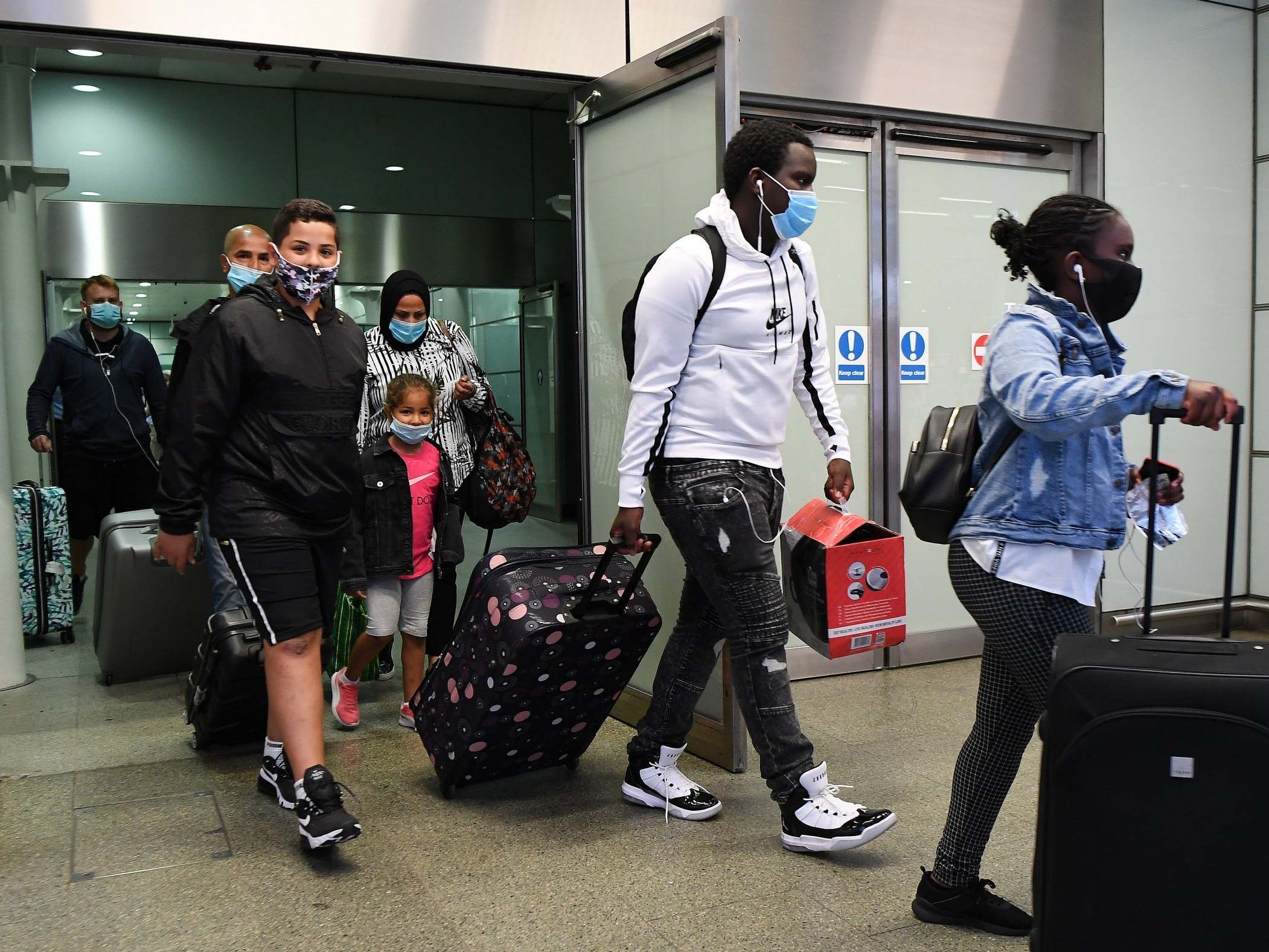
Quarantine for travellers returning to the UK could be cut by testing for the coronavirus twice, the government’s scientific advisers have said.
The Scientific Advisory Group for Emergencies (Sage) reviewed research on the effectiveness of double-testing, including an investigation by Public Health England (PHE), and agreed that screening on arrival and a week later could shorten the self-isolation period to 10 days from the current fortnight.
The PHE paper concluded that testing travellers at the border and again after five days of isolation, with release from quarantine two days later if the result was negative, resulted in an 85 per cent success rate.
But screening at the border and again after eight days of isolation, plus waiting another two days before ending quarantine in the case of a negative result, would be 96 per cent successful, making it as effective as the current policy.
Minutes of a Sage meeting in June, first published on Friday, said: “Double testing of travellers significantly reduces the risk of false negatives, and could enable quarantine duration of less than 14 days.
“The optimal days of testing are between days five and eight post-exposure.”
The group also raised the possibility of testing travellers before entering the UK and said this could shorten quarantine further if they agreed to self-isolate between testing and travelling.
This model would, however, require international agreements and common standards.
Sage highlighted test turnaround times, ongoing uncertainty around test positivity over time in asymptomatic cases, and public adherence as “complicating factors” in changing the policy.
Grant Shapps, the transport secretary, said testing travellers on return is something that the government has been keeping “a very close eye on”, but that such a policy is not without its obstacles.
“Testing on return isn’t quite as straightforward as it sounds because if you test someone who is asymptomatic – in other words, they don’t think they’ve got anything, but they may, in fact, have it on day one on their return – we’d probably only capture a very small percentage, scientists suggest perhaps only 7 per cent, of actual cases,” he told Sky News on Friday.
“Now, clearly you need a system that is more accurate than that before you can say to people, ‘You’ve now been tested and you don’t need to quarantine.’”
Any adjustments to the travel restrictions and quarantine regime would need to be approved by the home secretary, health secretary and transport secretary.
The Department of Health and Social Care has been approached for comment.