Now that the government has decided to extend the state of emergency amid the spread of the new coronavirus, issues surrounding COVID-19, the disease caused by the virus, are also changing the government's economic policymaking process.
In the process of dealing with the crisis, there have been moves to sow seeds that will lead to economic growth after the virus has been brought under control and other moves to look for potential risks in the future.
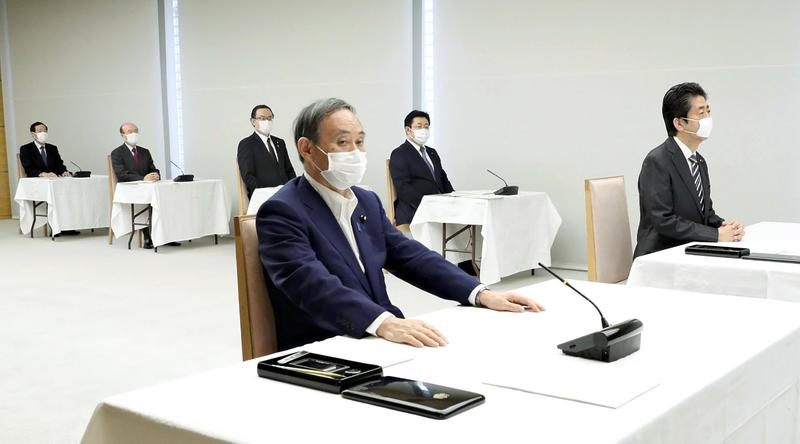
Just before 9 a.m. on May 1, Prime Minister Shinzo Abe and Chief Cabinet Secretary Yoshihide Suga were sitting in a room in the Prime Minister's Office. On the large monitor before them, Finance Minister Taro Aso and the other Cabinet ministers appeared.
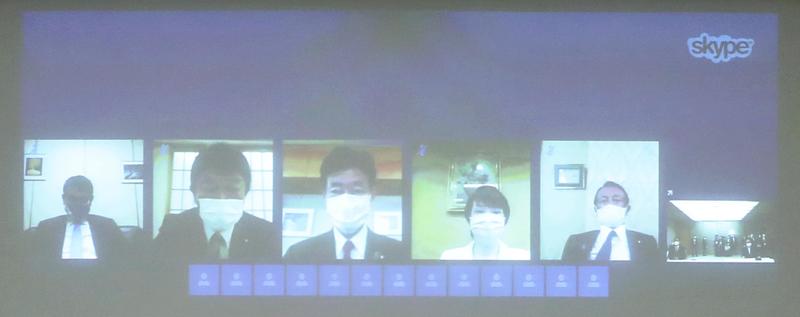
It was the first time in the history of modern politics that a Cabinet meeting was held in the form of a videoconference. A sense of urgency over preventing the further spread of the coronavirus is breaking down precedents.
A ban has been lifted to expand the system for online medical examinations (see below) to allow patients to receive an initial consultation while at home -- a practice considered a rock-solid regulation that the medical community has protected for years.
If people can receive clinical exams online from their first consultation onward for mild illnesses such as colds and stomachaches, this can reduce the risk of getting infected by visiting medical institutions. The advantages of this approach are obvious, and it is only natural to lift the ban.
However, it was not easy to remove the regulation even during an actual crisis. The Economy, Trade and Industry Ministry and the Finance Ministry -- which were trying to promote online medical examinations by taking advantage of the government's Council for Promotion of Regulatory Reform -- faced off against the Japan Medical Association and the Health, Labor and Welfare Ministry, which sides with the association.
If the physical distance between doctor and patient is no longer an issue thanks to online medical exams, it may become difficult for small, privately run hospitals to operate since many people would seek services from larger, more reputable institutions.
Having such concerns, the association would not tolerate a subsidy policy that would promote clinical examinations online using the cutting-edge 5G telecommunications technology. "Those who resisted were practitioners who fear that they would lose patients [to bigger medical institutions]," a senior economy ministry official said.
While the two sides engaged in a series of behind-the-scenes battles, the way was paved for deregulation on March 31. At a meeting of the Council on Economic and Fiscal Policy, Abe emphasized the significance of online clinical examinations. "[This approach] is important to protect not only patients, but also doctors and nurses from the risk of nosocomial infections," he said.
This remark encouraged the health ministry to accept lifting the regulation for medical examinations online starting from a patient's first consultation. That saved face for the Abe administration in its latest push for deregulation.
LDP panel turns to telecommuting
Support for companies to introduce telecommuting has also accelerated. "The debate over the tax system to support telecommuting has changed drastically," said a senior member of the Liberal Democratic Party's Research Commission on the Tax System.
In annual tax reforms, the government normally submits related bills to the Diet to revise the tax system. But this is not the time to stick to precedents. This time, the LDP tax panel decided to change the existing tax breaks for capital investment by small and midsize companies to strengthen their management so that they can cover telecommuting-related equipment.
It also decided not to set conditions on productivity and profitability, which the commission has sought to impose on companies to receive tax breaks. The LDP commission usually requires strict conditions to be met for any tax cut, but in this emergency, it put aside this basic stance.
Will cracks in established regulations made to deal with the coronavirus crisis go deeper?
Even after the spread of infections is brought under control, it is likely that the momentum for telecommuting will see no end and work styles at Japanese companies will drastically change.
On the other hand, when it comes to expanding the scope of patients eligible for medical examinations online, many believe that advocates and opponents have just reached a temporary compromise.
The expansion has been made "as an exception of exceptions under the state of emergency," said Kichiro Matsumoto, executive board member of the Japan Medical Association. Clinical exams online definitely involve some challenges as doctors cannot physically touch patients or listen to sounds from their bodies.
What effects has the deregulation on online medical exams produced? What challenges has it exposed? Both advocates and opponents will have to review it once the spread of infections is contained.
-- Online medical examinations
Allows patients to not have to go to a hospital and see a doctor using the video-chat function on a smartphone or computer. In April, the government decided to expand the scheme to include a patient's first consultation as a measure to be implemented "until infections are brought under control."
Until now, to receive clinical exams online, patients were required to have seen their doctor every month over the previous three months, in addition to their first visit, and the service was limited to patients with chronic and lifestyle-related diseases such as diabetes.
When providing an online medical examination for a patient's first consultation, institutions receive about three-quarters of the medical treatment fees they normally get face-to-face.
Read more from The Japan News at https://japannews.yomiuri.co.jp/