The spread of the new coronavirus has also cast a shadow over the acceptance of foreign nationals into the workforce in Japan.
As the entry into Japan of foreign nationals traveling from a total of 73 countries and regions has been restricted, foreigners who were scheduled to work in this nation continue to be unable to get in.
Industries that greatly depend on foreign workers will inevitably find themselves with a serious labor shortage. Also coming to the fore, however, is a contradiction in the existing labor policies, as shown by the central government's new measures to help foreigners work.
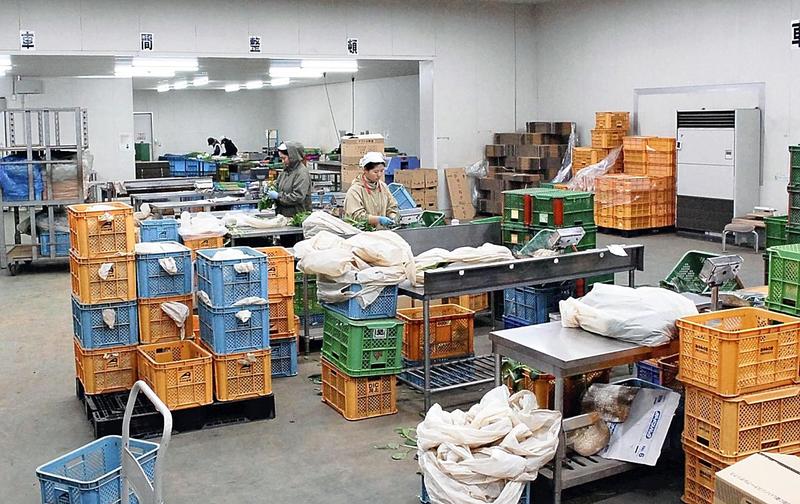
At ACT Farm, an agricultural production corporation in Ibaraki-machi, Ibaraki Prefecture, green vegetables including komatsuna (Japanese mustard spinach) and herbs are grown in greenhouses in a 40-hectare field.
Normally 18 Chinese people, working as foreign technical trainees, handle such tasks as harvesting and shipping. Six Chinese trainees-to-be were scheduled to enter this country in March to replace employees who returned home to China after completing their technical training, but visas have not been issued for the six, forcing them to remain in China.
The only thing to do with vegetables that cannot be harvested due to insufficient manpower is to smash them with a tractor and then throw them away. ACT Farm expects to see its sales decline by about 10 million yen a month.
"All we can do is endure [this hardship] until the coronavirus is brought under control," said company representative.
The situation in the fisheries industry is also critical. The Fisheries Cooperative Associations of Ishikawa Prefecture was scheduled to accept about 25 Indonesian technical trainees starting this month, but that has been postponed.
"As things stand now, it will become difficult for us to operate," said chairman of the operating committee at the Ogi branch of the associations. The Ogi branch had been scheduled to accept about 10 trainees for such positions as the crew of a squid fishing vessel.
Among the countries whose people are subject to an entry ban or the suspension of visas -- measures implemented in response to the spread of the coronavirus -- are the Southeast Asian nations, which are major contributors of technical trainees in Japan.
According to the Agriculture, Forestry and Fisheries Ministry, it remained difficult as of April 9 for about 2,200 foreigners, including technical trainees-to-be, to enter this country to be involved in the agriculture and fisheries industries.
Foreign nationals are also losing their jobs due to the spread of the coronavirus. Particularly notable are job losses in industries related to foreign tourism, which employ more than 200,000 foreign nationals. Technical trainees working in these industries are also likely to be fired.
The adverse impact has spread as well to the manufacturing industry, which employs about 30 percent of all foreign workers in Japan. According to the center for the rescue and assistance of foreign workers, a non-profit organization based in Gifu, a Chinese technical trainee in her 40s who was sewing women's clothing at a company in Chiba Prefecture was fired in late March.
The company told the woman, "There is no more work." She was dismissed apparently because of a decline in orders amid a slowdown in consumption.
In the wake of the collapse of Lehman Brothers in 2008, foreigners working in such sectors as manufacturing were fired one after another. The central government shouldered the expenses for about 21,600 foreigners, including Brazilians of Japanese descent, to return to their home countries.
A Chinese director at the center, said, "Things like calling in foreigners only when they're needed and then axing them first when things become difficult must not happen."
In response to these developments, the Immigration Services Agency of Japan on April 17 launched new measures to provide reemployment assistance to technical trainees and the like who are fired by the companies they had worked for as interns.
By giving people who wish to find reemployment the residence status of "designated activities," technical trainees will be allowed to work for a new employer and granted a permit to stay for up to one year. Former technical trainees who have completed their training period are also eligible for the new status, and there is expected to be a shift of foreign workers who were involved in the tourist and manufacturing industries into the agriculture and nursing care sectors.
But under the technical intern training programs, the techniques that foreign trainees acquire in Japan are supposed to be taken back by them to their home countries, under the principle of "international contribution." And under normal conditions, trainees cannot change the places where they are to work as interns.
However, many of these foreign trainees work for minimum wage, and there is a deep-rooted view that in reality, the purpose of these programs is to "secure cheap labor."
The Immigration Services Agency emphasized that the new support measures are "stopgap measures to enable foreign trainees to resume their technical training at their former workplace once the situation [the spread of the coronavirus] gets under control."
But the measures can also be interpreted as the central government's effective recognition of the foreign trainees as a workforce, as they are to be transferred to sectors hit hard by a labor shortage amid the spread of the coronavirus.
According to the Health, Labor and Welfare Ministry, about 1.65 million foreign nationals worked in Japan as of the end of October last year, accounting for only 2.4 percent of the total number of employees in Japan. However, this is about 2.6 times the 0.9 percent seen in 2009, and the degree of dependence on foreign workers has grown year after year.
The increase in the number of technical trainees is particularly remarkable, with the number of new entrants as foreign trainees totaling 188,872 in 2019, up 38,711 from a year earlier.
Eriko Suzuki, a professor at Kokushikan University who is well versed in policies related to foreign nationals, said: "With the recent spread of the coronavirus, the contradiction in the system has been made clear once again: Even though it's called "intern training,", actual work cannot be done without these foreign trainees.
"Such circumstances as people's movements coming to a standstill or businesses being hit by a recession are likely to occur in the future, too. The relevant system should be changed into one that is based on realities."
Read more from The Japan News at https://japannews.yomiuri.co.jp/


.png?w=600)