A chief constable has said the “phenomenal” response to the death of a beloved beat bobby was a vivid reminder that despite budget constraints forces had to commit to grassroots community policing.
The death of PC Andy Hocking prompted extraordinary scenes in Falmouth, Cornwall, with 6,000 people lining the streets to pay their respects at his funeral.
Falmouth mourns much-loved community PC Andy Hocking. This relationship CAN work. Humbled by this. pic.twitter.com/vXdsegnipN
— Charlie Banks (@TheCharlieBanks) March 20, 2015
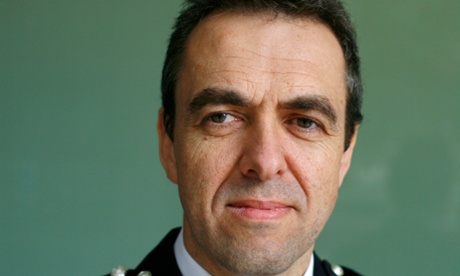
Shaun Sawyer, the chief constable of Devon and Cornwall police, said Hocking’s death, which happened suddenly while he was off duty, had reinforced his view that old-fashioned community policing had to lie at the heart of what forces do.
In an interview with the Guardian, he suggested that too many of his colleagues focused on what policing could no longer achieve because of money and time pressures. “No one is saying what are the things we definitely will do,” he said.
He said forces needed to focus on traditional “beat” policing – as well as turning their attention to the “digital beat” to combat online crime. But they also needed to make hard choices about allocating resources, perhaps including employing civilians to carry out detective roles to make sure there were enough officers out and about.
Sawyer said Hocking, who had worked in Falmouth for 23 years, had a “very firm grip” on what was going on in the town and local area.
He said: “It’s not Heartbeat, it’s not Dixon of Dock Green. What Andy had and what I believe we have to hold on to is that connection and time with communities. He was a local lad, he grew up in the community type he policed. That connection and consistency is one of the things the police service has to stand up and say no matter what the funding issues, we are going to try to sustain that.”
Sawyer said he read “a lot of articles” from chief constables – including the most senior officer in the UK, Sir Bernard Hogan-Howe – who “rightly” say forces are “coming to the point where policing won’t do certain things.”.
He accepted that “traditional community policing” probably did not greatly reduce crime. “But it makes people feel safe. That’s one of the stakes in the ground that policing has to put in no matter what the pressures are on the budget. The public voted with their feet in Falmouth. The reality is you move away from that legitimacy at your peril.”
Meanwhile, on BBC Radio 4’s Today programme, Hocking’s widow, Sally, agreed that people wanted to see officers on the beat.
She said her husband was engaged with and interested in people. She said: “The general public wants to see officers on the beat. They don’t see a policeman or they may see a policeman in their car whizzing by. It’s not really what people want, evidently.”
Sawyer said Hocking made everyone he came across feel the “most important person in the world. He was one of those rare people. For those 30 seconds you were the most important person to him.”
The Devon and Cornwall force is about to launch a major consultation to find out how people want the two counties policed. Sawyer said resources would have to be moved on to the “digital beat” because of the increased challenges of online crime – but he said ways of providing “community policing” would have to be found in this sphere too.
Sawyer, who spent 24 years in the Met and worked as a detective in organised crime and counter-terrorism, said a sea-change might have to be made in how police work was carried out – perhaps including turning many investigative jobs into civilian ones to make sure there were enough uniformed beat officers.
He said: “I hear senior colleagues rightly say we have this digital explosion – we will need to pull resources away from communities to deal with it. I say do so at your peril. I think the people of Cornwall gave a very clear steer to police of what we should not step away from. If you say what’s important then the money follows.”