
Amid the bout of newfound love for Japan from President Donald Trump's administration, the U.S. government is mulling introducing tariffs on polysilicon and derivative products used in chips and solar panels, according to a report from Reuters. The report further states that the government may set a price floor for these imports while allowing investors in wafer and solar-cell production to obtain concessions to offset costs.
So, why did Corning (GLW) shares rally on this news? Well, Hemlock Semiconductor (HSC) — a joint venture (JV) between the company and Japan's Shin-Etsu Handotai — operates a polysilicon factory in Michigan. Notably, Corning holds a roughly 80% stake in the JV while the rest lies with Shin-Etsu Handotai.
About Corning Stock
Founded in 1851, Corning is a global leader in specialty glass, ceramics, optical communications, and advanced materials. While many consumers may know it for the Gorilla Glass used in smartphones, Corning today is increasingly becoming an artificial intelligence (AI) infrastructure company. Its optical fiber, connectivity solutions, and advanced glass products are critical components inside hyperscale data centers, making it an indirect beneficiary of the AI boom.
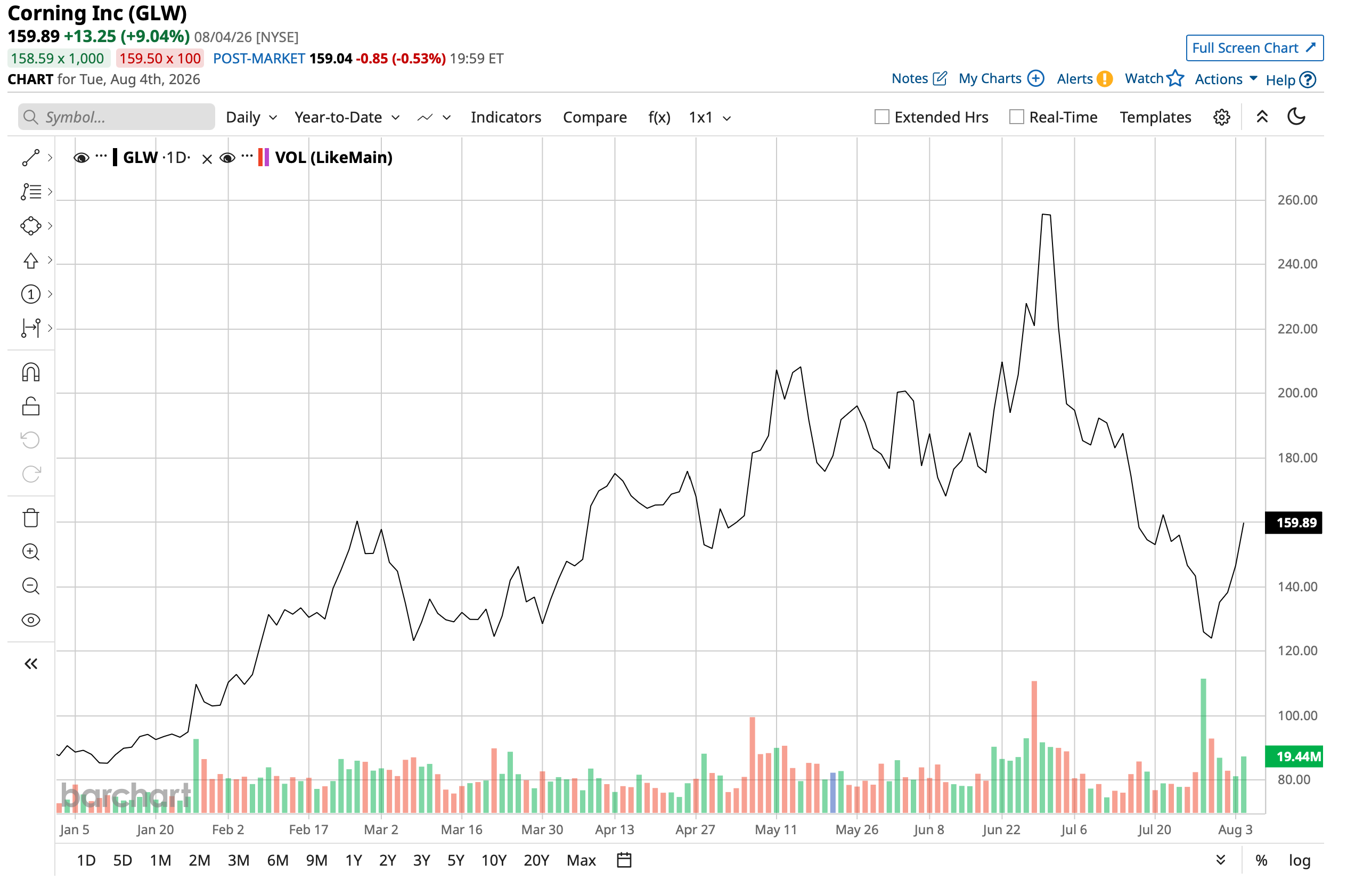
Valued at a market capitalization of about $135 billion, GLW stock has shot up by 81% so far this year. The stock also offers a dividend yield of 0.70%.
But why is Corning's polysilicon joint venture so critical for the United States? Let's take a closer look.
The Hemlock JV Is a China Counter
In the world of solar energy, China is the undisputed top player, holding more than 80% of the manufacturing capacity across key segments of solar production like polysilicon, wafers, cells, and more. For foundational components like wafers and ingots, China's share of global production approaches 95%, making it a hegemony.
Crucially, broader solar manufacturing costs in China are “10% lower than in India, 20% lower than in the United States, and 35% lower than in Europe” due to variations in energy, labor, and overhead expenses. Thus, Corning's JV is material for U.S. solar energy security. It may not be as strong a bulwark to combat the whole of China's might in solar, yet it has certain inherent advantages that give the U.S. some strategic edge.
Shin-Etsu Handotai, Corning's partner, is one of the world's largest manufacturers of silicon wafers, making it one of the most important companies in the global semiconductor supply chain. Further, the firm reportedly controls roughly 27% of the global silicon wafer market, making it the largest supplier worldwide.
Coming to HSC, the joint venture is one of the leading producers of hyper-pure polysilicon, the raw material used to manufacture semiconductors, solar wafers, and solar cells. HSC's significance also stems from the fact that it's one of a handful of companies capable of producing the purity levels required for leading-edge semiconductors.
Expansion plans are afoot, with one of the latest highlights being the $375 million “next-generation finishing facility” completion in Michigan to modernize semiconductor-grade polysilicon production, improve purity, and increase output. Additionally, in 2024, the U.S. Department of Commerce announced plans to award up to $325 million under the CHIPS Act to further expand HSC's production of semiconductor-grade polysilicon.
Corning Reports a Super Q2
Corning reported beats on both the top and bottom lines in its latest quarter. Second-quarter 2026 revenue rose 17% year-over-year (YOY) to $4.74 billion, with the Optical Communications segment growing 32% YOY to $2.07 billion. This segment contains the company's AI sales.
Corning signed deals with Amazon (AMZN) and Nvidia (NVDA) during the quarter, both for enhancing optical connectivity. Gross margins came in at about 36%, while operating margins hovered around the 15% range.
Earnings went up 30% YOY to $0.78 per share, coming in ahead of the consensus estimate of $0.76 per share. Notably, this was the eighth consecutive quarter of an earnings beat from the company.
For Q3, Corning expects core revenue between $4.9 billion and $5 billion and EPS of $0.85 to $0.89. Analyst estimates for revenue are at $4.99 billion while earnings are expected at $0.88 per share.
Net cash flow from operating activities in Q2 more than doubled to $1.72 billion from $708 million in the year-ago period. Overall, Corning ended Q2 with a cash balance of $2.5 billion, exceeding its short-term debt levels of $668 million by a wide margin.
However, GLW stock is overvalued. Its forward price-to-earnings (P/E) ratio of 48.9 times, price-to-sales (P/S) multiple of 8.8 times, and price-to-cash flow (P/CF) ratio of 38.6 times are all above the respective sector medians.
What Do Analysts Think of Corning Stock?
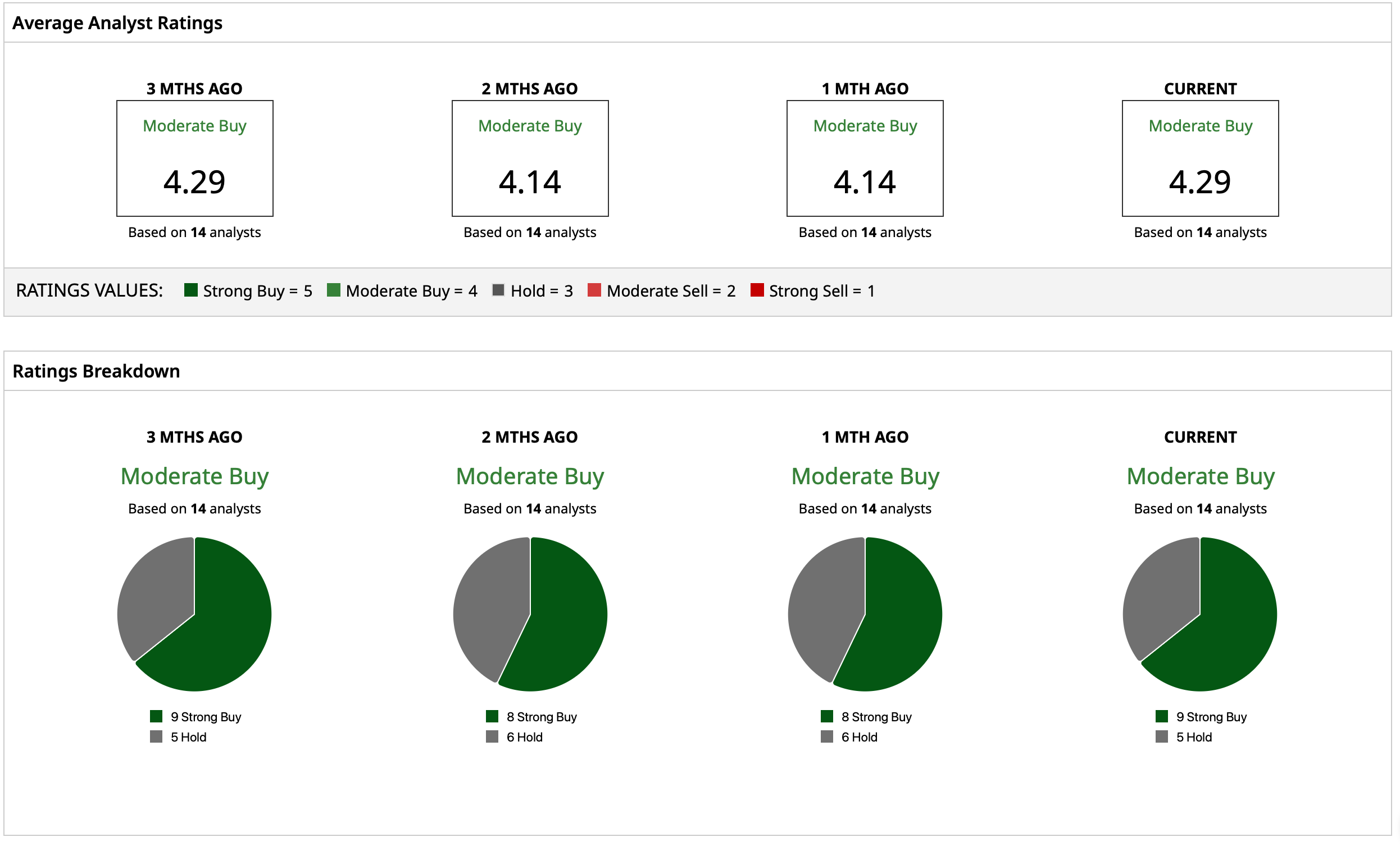
Taking all of this into account, analysts have a consensus “Moderate Buy" rating on GLW stock. The mean target price of $185.14 denotes potential upside of 18% from current levels. Out of 14 analysts covering the stock, nine have a “Strong Buy” rating while five have a “Hold” rating.